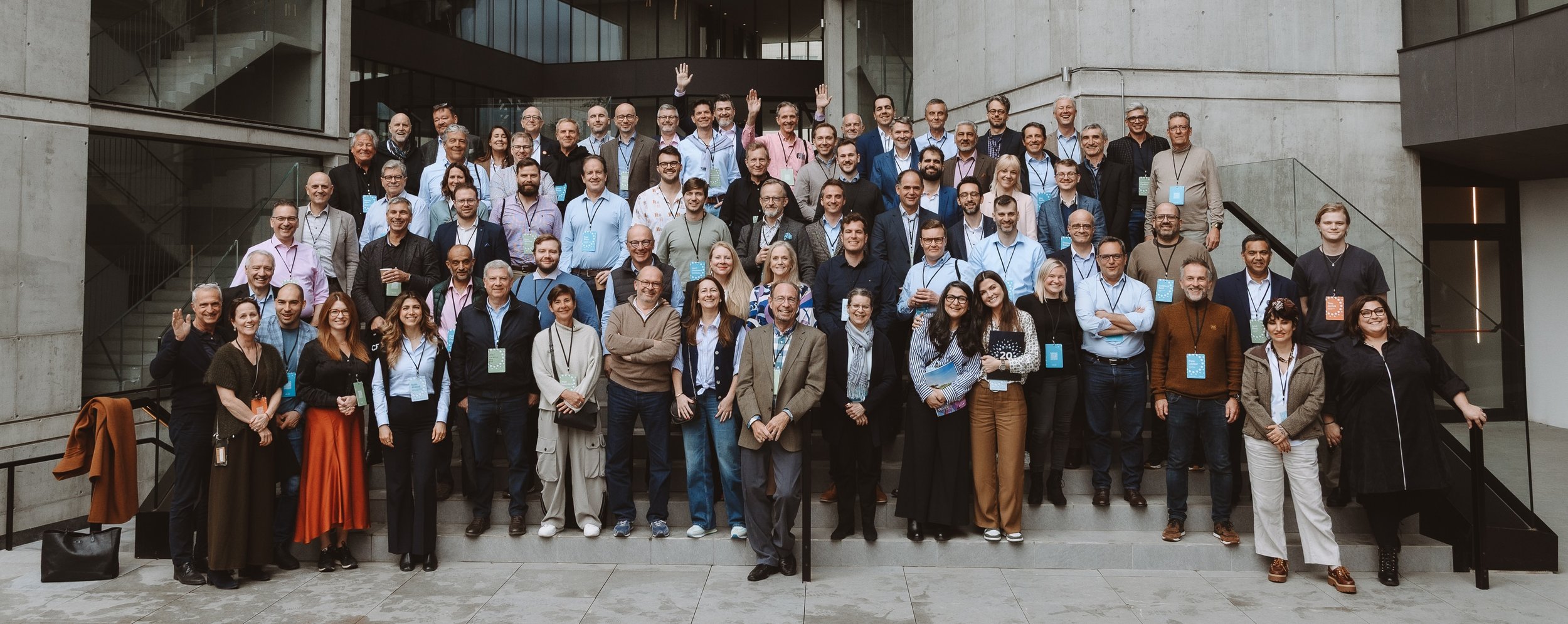
CEO CF has been bringing business leaders together across Europe since 2005. More than twenty years is a fair amount of shared history. What interests me most is how that history keeps being made: people come back.
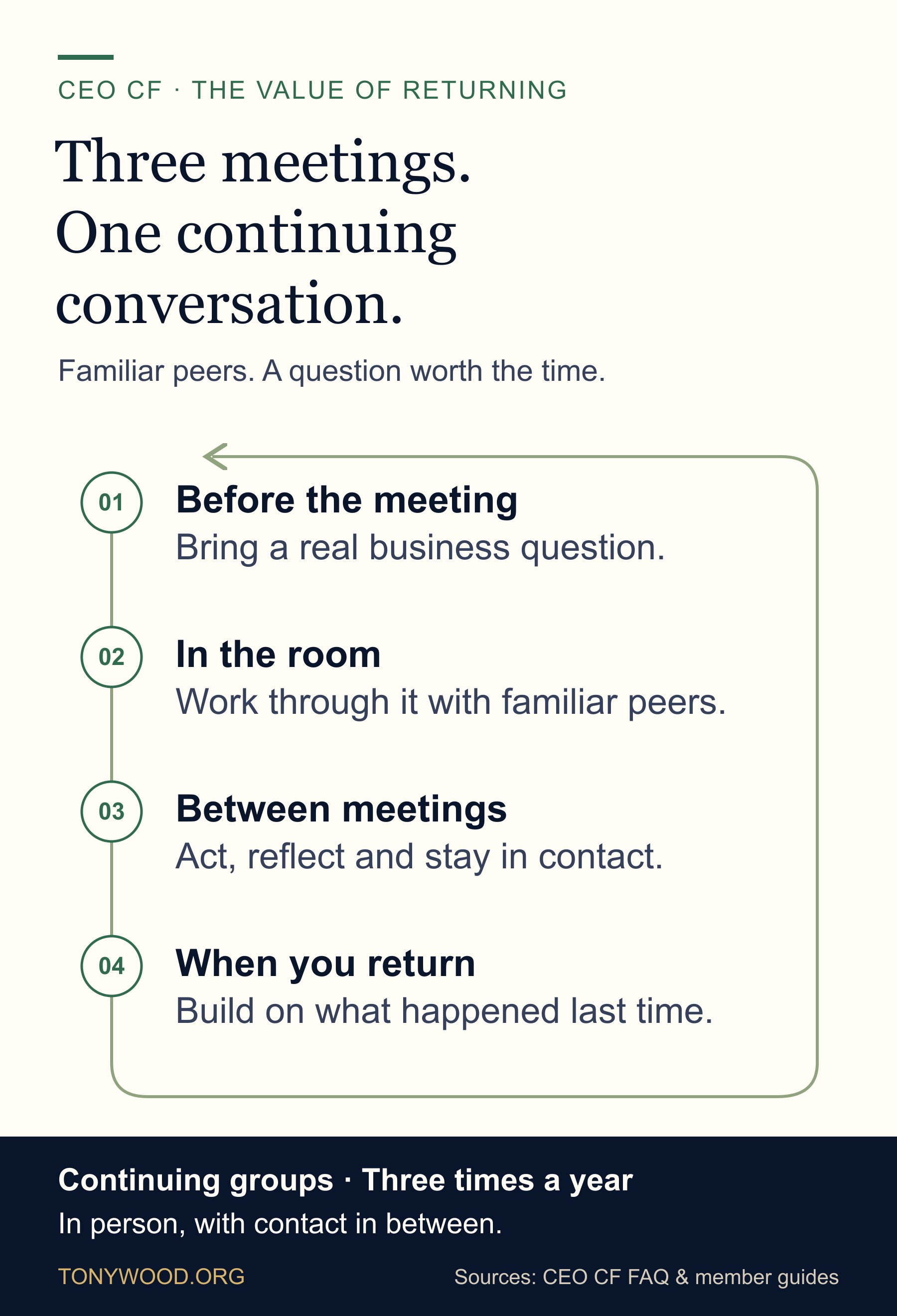
Three times a year, its members meet in person in their continuing peer groups. CEOs and business leaders from different European countries and different industries, building on the conversations they have already had.
That continuity is the bit I would pay attention to. People have a chance to understand your business, hear how you think and remember the decision you were wrestling with last time. The next conversation can start a little further on.
I help lead CEO CF, so I have a particular interest in this. But if you are going to give a community your time, money and several days out of the office, you deserve a clearer explanation of its value than a photograph of smiling people wearing lanyards.
The same group changes the conversation
CEO CF calls these continuing peer groups Trust Groups. Members are carefully matched, and the current membership model brings their groups together in person three times each year, within the wider community's summits.
Of course, membership can change. The point is to build a continuing relationship, with enough shared history for people to understand the context behind a new question.
Consider a leader deciding whether to expand into another country. An initial conversation might explore the opportunity. The next could examine what happened when they tested it. A later conversation might reveal that the real obstacle was management capacity rather than demand.
Those are different conversations. Having people who remember the earlier ones can make the later ones more useful.
It also gives accountability a human face. A reasonable question from somebody who knows what you committed to can be surprisingly effective. Especially when you have been very busy finding reasons to do something else.
Europe is part of the experience
The membership pack describes leaders sharing experience across disciplines, industries and geographies. The summit programme gives that European community a regular place to meet.
That mix matters to me. If everybody around you works in the same market, it is easy for familiar assumptions to pass without examination.
A manufacturer and a software founder may know very different things about their products. They can still have something useful to say to each other about delegation, succession, an overstretched management team or the difficulty of letting go.
Someone operating in another country may also help you see which parts of your thinking are specific to your home market. Their experience gives you another starting point to investigate. You still have to do the work of understanding the market you want to enter.
There is a human discipline here too. People bring different ways of disagreeing and explaining themselves. As I wrote in my piece about politeness across cultures, understanding one another sometimes requires a little effort. That effort is part of becoming a more capable international leader.
You bring a decision that matters
One of the strongest features in the member materials is the CEO Challenge: a prepared, real business or leadership question worked through with peers.
There is a structure. Preparation helps sharpen the question. The group first seeks to understand it, then offers observations and recommendations. The person presenting identifies what they have discovered and decides what to do next.
I like the separation between understanding and advising. It creates space to notice that the question being answered may not yet be the right question.
There is practical support around the discussion too: Chairs and coaches, live written capture of the feedback, and a record of discoveries and commitments to take away. CEO CF also has a Facilitator Assistant Academy for the people supporting and documenting those sessions.
That means the presenter can spend more of the session listening. There is something to return to afterwards, when ordinary work starts demanding attention again.
The decision remains yours. Peers bring experience and questions; you bring responsibility for your company. I think that is a useful relationship.

A small group, with a wider community around it
The group is deliberately small: CEO CF describes a typical size of eight to fourteen, with direct competitors kept apart. Confidentiality is a core requirement.
Your Trust Group provides the continuity. The wider summit adds other people, experience and possible connections. The guest materials describe an Ask the Community or CEO Issue session, alongside opportunities to work on a business challenge. Those particular guest sessions are optional.
I can see the value in that combination. You have somewhere to work through a question in depth, and a wider circle to turn to when it needs a particular connection or a different kind of experience.
The welcome has some thought behind it as well. The guest pack describes personalised onboarding, a buddy, an opening orientation and introductions to the community.
Those details can look small on a brochure. Walking into an established group of people who already know one another can feel rather less small when you are the person doing it.
Leave enough room to think
One phrase in the guest pack particularly appeals to me: Balcony Time. Some distance from the immediate demands of the business, so you can look at it more clearly.
The membership pack combines structured challenges and business content with informal conversations and shared activities. I would protect that breathing space. A discussion over dinner may help you understand a person in ways that a tightly scheduled session cannot.
There is also a rhythm between summits. The current membership description includes monthly group calls, ongoing messages and access to peers and coaches. The member pack puts follow-up, accountability and lasting relationships at the centre of the offer.
That is where the three annual meetings become more than dates in a diary. They give the relationship a recurring physical meeting point, with contact continuing in between.
A community with more than twenty years behind it
CEO CF began in 2005 and today operates as a not-for-profit, member-owned and member-led community.
More than twenty years of history matters. It gives the community roots. Its present value still depends on what members contribute and how well the groups work today.
The values in the membership pack include trust, excellence, diversity and respect, generosity and humility. The last two are particularly relevant when a room contains people accustomed to being in charge.
You need enough confidence to contribute and enough humility to learn. You also need to give other people's questions the attention you would like them to give yours.
There are routes for different stages of a leadership career: alumni remain part of the wider story, and the separate nextGen programme supports emerging leaders. nextGen has its own virtual and hybrid formats; the three-meeting core membership model should not be assumed to apply to every programme.
What the research adds
There is a useful body of research behind the wider idea that business relationships matter. It looks at different businesses and different kinds of relationship, so it needs a little care in the reading.
A 2014 research review covering 61 independent samples found a positive association between the resources available through entrepreneurs' networks and small-firm performance. Network diversity had the strongest association among the network characteristics examined. Having access to people who know different things seems particularly relevant to a European, cross-industry community.
Trust has a substantial research base too. A 2016 review drawing on 112 studies and 7,763 teams linked trust within teams with better team performance. These were teams, rather than independent CEOs meeting as peers, but the finding gives some substance to a word that can otherwise become rather decorative in a brochure.
Closer to home, England's Peer Networks evaluation, written in 2022, found that, six months after the programme, 63% of surveyed participants were still in touch with businesses they had met through it. Participants also reported more favourable turnover changes than comparison firms. It was an online programme during the pandemic, and differences in motivation and other business support make it difficult to isolate its contribution.
The continuing relationship is especially interesting in a Kenyan mentoring trial published in 2018. Mentoring improved profits among inexperienced women running microenterprises, but the gains faded as relationships ended. The researchers' interpretation was that access to help with new, changing problems mattered. That is a different business setting, but a familiar reason to keep a conversation going.
There is experimental evidence for organised peer meetings too. In Cai and Szeidl's 2018 study, 2,820 young firms in one Chinese city were randomly assigned to monthly owner-manager meetings over a year or a control group. The meetings improved business performance and generated learning and partnerships.
Taken together, this gives me a reason to take peer relationships seriously. It does not establish CEO CF's financial return or an ideal number of meetings. The practical value I would look for is access to different experience, enough trust to use it, and people to return to as the questions change.
Why make the commitment?
For me, the practical test is closer to home. Would it help to have a group outside your business that understands enough of your context to challenge your thinking? Are you willing to bring a real question, listen properly and return to what you said you would do?
And will you make the same effort for the other people in the room?
If you are considering CEO CF, I would ask three questions before joining:
- How will you match me to a group, and what will I be able to contribute?
- What real decision could I bring, and how will you help me prepare it?
- Can I commit to the meetings and the relationships between them?
You can speak to the membership team about fit and whether an approved guest visit would help you decide.
I think a good reason to leave the office is to find people who can help you see your business more clearly. A good reason to come back is that those people now know you well enough to ask a better question.
Sources and notes
This is my personal assessment as someone involved in leading CEO CF. Organisational descriptions were checked on 2 September 2026 against its public pages, the membership, guest, alumni and nextGen information, and the CEO Challenge: How the Method Works member and guest guide supplied for this article. These describe the organisation's offer; they are not independent measurements of member outcomes. The examples above are hypothetical, not accounts of private member discussions.
CEO CF's founding date and its current meeting format are separate facts; this article does not establish an uninterrupted physical-meeting schedule since 2005.
Related reading: Not Everybody In Your Community Is Going To Be Your Cup Of Tea and People Aren't Always Being Rude. They're Being Polite In Their Own Way.