If I were backing a CEO, I would want them to have somewhere to test their thinking before an uncertain idea became an expensive commitment. Somewhere they could explain the problem, hear from people who had faced something similar, and be asked a question they had been avoiding.
I would also want them to have time to step back, see the business as a whole and return with more energy for the job. That is why I think venture capital investors should take CEO CF seriously as support for the leaders they back.
I am involved in CEO CF, so this is a personal view. What interests me is the practical value of helping a CEO become clearer about a decision and more deliberate about what happens next. The company still has to do the work. A membership card will not do it for them.
If you back the team, help the team keep developing
There is a sensible starting point in the research. In a 2015–16 survey of 885 institutional venture capitalists at 681 firms, Paul Gompers and colleagues found that respondents placed particular importance on the management team when choosing investments. Overall, they rated it above business characteristics such as the product or technology, although the balance varied by stage and industry.
That is evidence about investors’ stated priorities across a US and international sample. It does not show that a particular leadership programme improves investment returns. But it does leave me with a straightforward question: if you attach that much importance to the people, what are you doing to help them keep developing?
Some investors make that support explicit. In October 2024, Balderton described a six-month leadership programme for growth-stage CEOs, including an in-person start and smaller CEO cohorts meeting virtually. It placed this alongside executive coaching and CEO forums.
That is Balderton describing its own programme, rather than endorsing CEO CF. It is a useful example of an investor putting resources behind the development of the people running its portfolio companies.
There is a historical investor connection to CEO CF itself. In a September 2008 interview with VentureCapital Magazin, founder Dave Darsch said that Dirk Brinkmann, then CEO of Software4You, had been introduced to the forum by his venture capitalist. That is one reported referral from the organisation’s early years. It helps explain the investor angle without pretending to be a survey of what VCs think today.
A place to work through the question
A board conversation needs clear information, considered proposals and decisions. Getting to a considered proposal can require a different kind of conversation.
A CEO may need to say: “I am not sure I understand why this is happening.” Or: “I keep describing this as a people problem, but perhaps the way I have organised the business is causing it.”
I want a leader to have somewhere to examine those possibilities properly. A trusted investor can be part of that support. So can a group of peers whose relationship with the CEO is built around helping them think.
CEO CF describes confidential, facilitated discussions in carefully matched groups of leaders from non-competing businesses. Its members come from industries across Europe. For me, the attraction is being able to bring a difficult question to people with experience to offer and enough space to listen.
The useful result would be a better conversation back at the company: a clearer diagnosis, a more considered proposal, or a specific piece of evidence the CEO now knows they need. Peer support should strengthen the CEO’s work with their team and board. It should not become an excuse to avoid either.
Better questions before expensive answers
The part of the CEO CF Challenge I particularly value is the preparation. A coach helps the presenter narrow the issue and build an explanation. The group then has a question period before moving into Observations and Recommendations.
Consider an invented example. A CEO arrives wanting advice on hiring a country manager. The conversation reveals that nobody has established whether customers in that market will buy through the proposed channel. The useful next step may be to test the route to market before making the hire.
There could still be a good case for the appointment. But the CEO now has a more useful question to answer.
Research by Leonid Rozenblit and Frank Keil found that people could overestimate how well they understood a mechanism until they tried to explain it. Their experiments concerned explanatory knowledge, including everyday devices, rather than company strategy. My application is simple: asking a leader to explain how a plan is meant to work can expose assumptions worth examining.
From an investor’s perspective, that is an attractive opportunity. I would want the CEO to test the reasoning behind a decision while there is still time to change it.
Experience beyond the portfolio
A fund’s own founder network can be useful. I would also want a CEO to hear from people with different businesses, customers and ways of working.
CEO CF’s European and cross-industry mix gives that possibility some substance. A leader from another market may ask about a distribution relationship that everyone in your usual circle takes for granted. Someone in another industry may recognise the organisational problem underneath your sector’s vocabulary.
Those are possibilities to explore, rather than a promise that diversity will automatically produce better advice. The CEO still needs to ask: what is similar here, what is different, and which assumptions would have to hold for this experience to help me?
The contribution need not be an answer. “When we tried that, this was the part we misunderstood” can give a leader something very useful to investigate.
That is how I would want a portfolio CEO to use the community: add relevant experience to their judgement, then take responsibility for the decision.
The conversation has to survive the journey home
An interesting discussion is only the beginning. What will the CEO do with it?
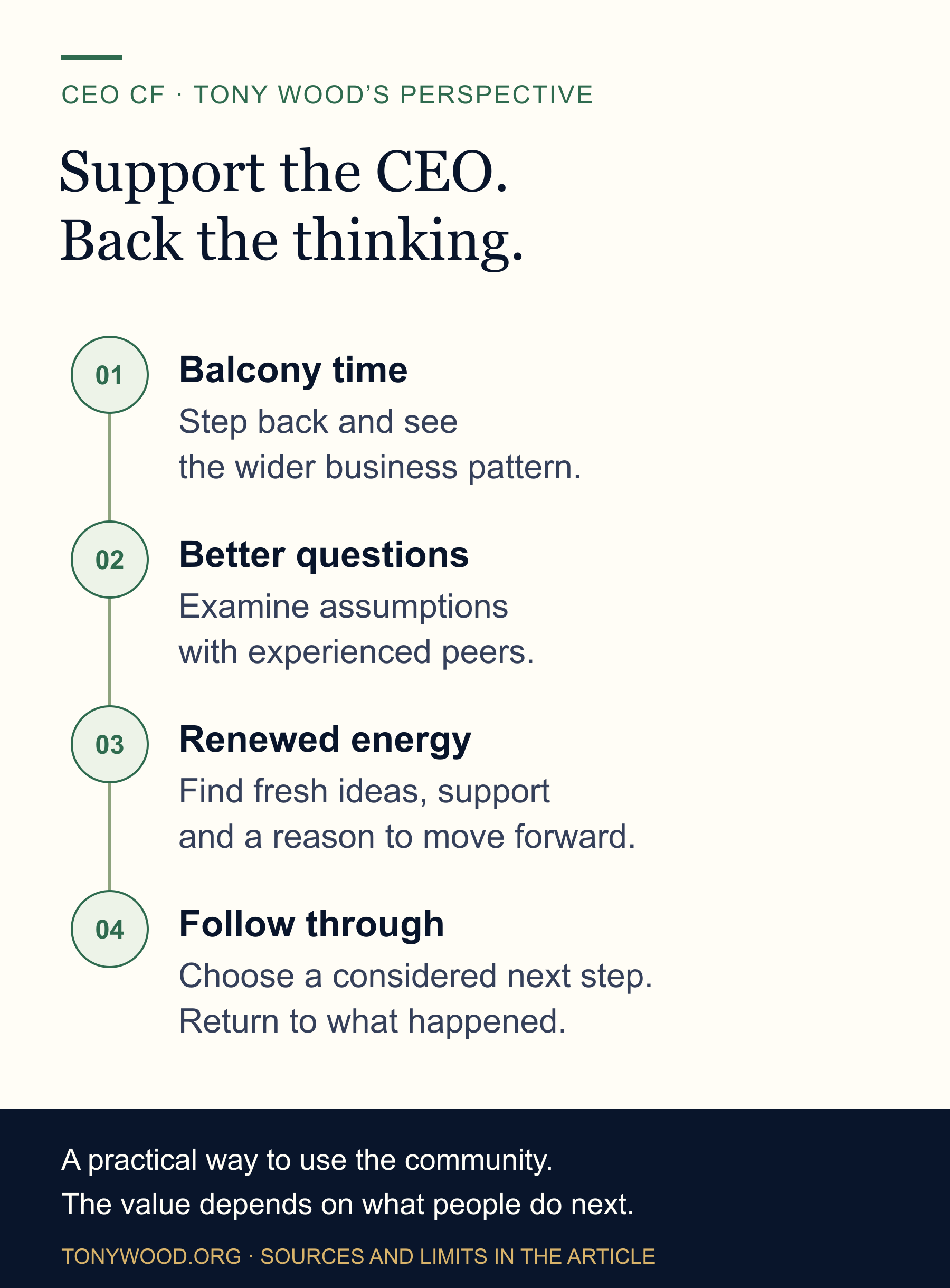
The Challenge separates what peers notice from what they recommend. The presenter listens to that feedback, identifies discoveries and rediscoveries, and chooses their own commitments. The Facilitator Assistant helps capture a record they can return to.
That ownership matters. Ten people offering suggestions does not create ten instructions. The CEO needs to decide what they have learned, which action to take and by when.
There is relevant evidence for the follow-through. Harkin and colleagues’ meta-analysis of experimental studies found that interventions encouraging people to monitor their progress improved goal attainment on average. The studies covered varied goals and settings; they did not test CEO CF. They support taking the later check seriously, rather than assuming that making a commitment completes the job.
In the country-manager example, I would want the CEO to return to the actual action: did the customer conversations happen? What did they reveal? Has the hiring decision changed? If the original idea was right, what evidence now makes us more confident?
The record gives that review a starting point. It is also why I value participants putting thought into their contributions and checking that the captured words preserve their meaning. A polished summary is useful only if it helps people return to the right question.
Balcony time to see the business more clearly
Time away deserves scrutiny. The CEO has a company to run, and two days together need to earn their place in the diary.
One reason I think they can is balcony time. When your day is full of decisions, messages and people needing something, it is easy to keep responding without looking at the pattern. Why do the same problems keep coming back? Where has the business outgrown the way you run it? What are you doing that keeps the problem in place?
Ronald Heifetz’s balcony metaphor captures the value of gaining enough distance from the action to observe what is happening, including your own part in it. For me, CEO CF offers a practical opportunity to do that with people who can help you look.
Think back to the country-manager example. In the office, the next task might be to approve the job description. From the balcony, the question becomes whether the business has understood how to enter that market. That wider view can change what deserves the CEO’s attention when they return.
Two days allow a conversation some room to develop. A question raised in the session can continue over dinner. Someone can add a relevant experience. The next morning, the CEO may see the problem differently. I would want an investor to recognise that reflection as part of the CEO’s work and help them protect the time for it.
The energy to go back and lead
There is another benefit I would want investors to value: the boost in energy a CEO can take back with them.
Imagine arriving with a difficult decision that has been going round in your head for weeks. You explain it, someone recognises the situation, and the group helps you work out what to do next. The problem may still be hard. But now you have a way forward and people you can return to as you work through it.
That is the kind of lift I mean. Feeling understood. Finding a fresh idea. Remembering that other capable people have difficult days too. Helping another CEO can be part of it as well: your experience is useful to somebody else, and contributing can be energising in its own right.
A demanding two days can leave you tired and still more enthusiastic about the work ahead. I would look for renewed purpose and the willingness to tackle the next difficult conversation. In the country-manager example, that might mean returning ready to speak to customers and test the plan.
CEO CF’s current programme describes three in-person group meetings each year and contact between meetings. The continuing relationship is part of the appeal. People can return to what happened after the last conversation, rather than encounter each other once and start again with a new room.
For an investor, I think the combination is worth taking seriously: space to see the business more clearly, people who help the CEO think, and renewed energy to act. The follow-through is where that benefit has to become useful to the company.
Support the CEO without taking over the room
If I were considering membership for a portfolio CEO, I would ask three practical questions:
- Is there a group with relevant experience and enough difference to challenge their thinking?
- Is the CEO willing to bring a real issue, listen carefully and make the same effort for other members?
- How will they make time to act on and review what they learn?
I would also respect the confidentiality of the group. The CEO can discuss their own decisions and what they intend to do without passing on other members’ private contributions. I would want the investment in their development to show up in how they lead, rather than expect access to the room’s notes.
CEO CF should sit alongside an effective board, the right specialist advice and any support the CEO already values. Fit matters. A peer community cannot provide every kind of expertise a growing business needs.
My case for it is straightforward. If you believe in the CEO enough to back the business, support their development and make room for them to step back. Give them opportunities to learn from other leaders, regain some energy and return to decisions after real life has tested them.
That is why I think VCs should want their CEOs in a community like CEO CF. The value I would look for is a leader who returns with a clearer view of the business, renewed energy and a considered next step they are ready to take.
Sources and notes
This is Tony Wood’s personal case for investor-supported peer learning. Sources were checked on 3 September 2026. It does not establish that VCs generally endorse CEO CF, that Balderton recommends it, or that membership improves investment returns.
The Gompers paper reports a 2015–16 survey; the linked university-hosted file begins with the accepted journal article and also contains older material. The 2008 interview is a historical account from CEO CF’s founder. Balderton’s 2024 announcement is an operator description. The explanatory-depth experiments and progress-monitoring meta-analysis concern other tasks and populations. None evaluates this complete CEO CF process.
The balcony metaphor is attributed to Heifetz in the linked Harvard Business Publishing brief, on printed page 3. It is a leadership framework, rather than an experimental finding about CEO CF. The discussion of renewed energy expresses the benefit I value and the Challenge’s intended outcome; it is not a measured wellbeing, productivity or investment-return claim.
Challenge details draw on local CEO CF method and role guides. The two-day framing follows the event duration specified for this article series; it is separate from the three annual meetings and does not describe every programme or Summit. The country-manager example is invented. No private member case or investor endorsement has been supplied as a testimonial.
For the method, see The CEO CF Challenge: A Better Way to Think Through a Difficult Decision. For the wider community, see CEO CF: Bringing European Leaders Together Since 2005.