Two days away from the business is a serious commitment. Add the journey, the diary rearranging and the messages waiting when you return, and it is reasonable to ask: could we do this online?
For me, the strongest reason to travel to CEO CF is the chance to stay with a conversation long enough for it to change. To ask another question. To hear from someone you would never have thought to call. To return the next morning having reconsidered what you said the day before.
I am part of CEO CF, so I have a personal interest in this. I wanted to understand what the research says about being physically together: how we connect, think, learn and remember, and whether those relationships can make a difference to a business.
There is a good case for making the journey. It rests on what we do with the time together.
The conversation can continue
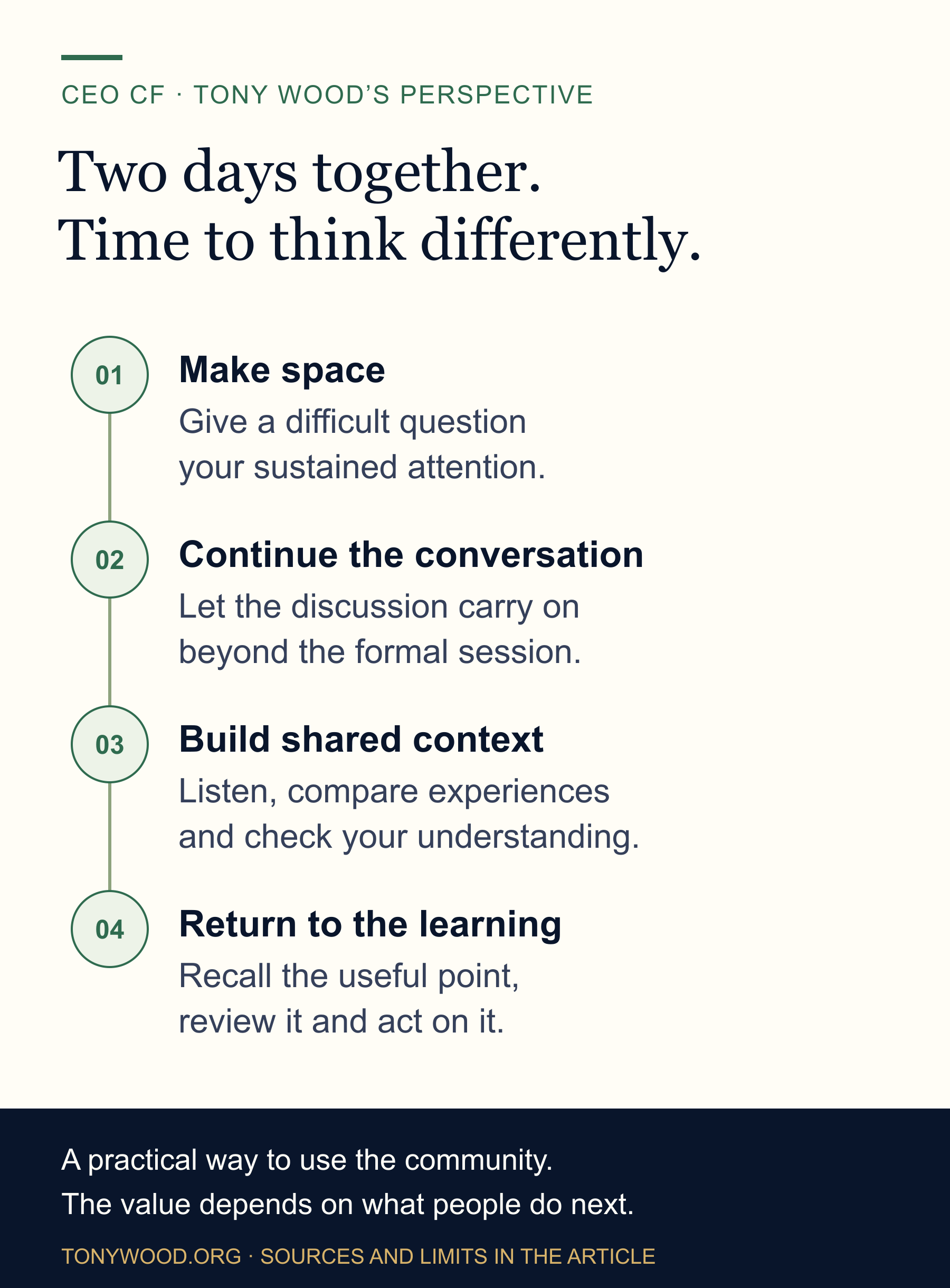
Imagine bringing a difficult decision to a group. During the session, someone asks a question that makes you pause. At dinner, you explain the part you had left out. Another member shares a relevant experience. The following morning, you realise that you have been trying to solve the wrong problem.
That is an illustration, rather than a particular member's story. It captures what interests me about a gathering over two days: there are opportunities to return to a subject without arranging another meeting.
One particularly relevant study examined nine small scientific conferences, five virtual and four in person, alongside data from three larger conferences. It found that organised small-group interaction helped new collaborations form in both formats. Informal interaction played a larger role at the physical conferences. The research appeared in PNAS Nexus.
The researchers' representative programmes allowed about 23 hours of potential informal interaction in person, compared with seven and a half online. Those were opportunities in the schedules, not measured hours of actual conversation. Conference format was also affected by the pandemic, rather than randomly assigned. These are useful findings about scientific meetings, not a forecast of CEO CF results.
My practical reading is that the gaps deserve as much thought as the sessions. A break, a meal or a walk creates room for a conversation that nobody knew to put on the agenda.
If every minute is filled with presentations, we have booked the venue and then designed away part of the reason for being there.
A room can help us think more broadly
A leadership group needs room to explore. Sometimes the useful contribution is an alternative way of describing the problem, or a possibility that nobody had considered.
In a laboratory study and a field experiment across five countries, Melanie Brucks and Jonathan Levav found that pairs communicating by video produced fewer creative ideas than pairs meeting in person. Their evidence linked this to the narrower focus associated with looking at a screen. Crucially, they found no evidence that video groups were worse at selecting which idea to pursue. The distinction is in the original Nature paper.
That gives me a reason to value physical meetings when we are opening up a question. It is a more specific claim than saying every decision is better around a table.
At CEO CF, I would want to use that time to examine the uncomfortable possibility, hear a different interpretation and ask what we might be missing. The Challenge format gives that discussion a structure. Being together provides opportunities to carry it beyond the timed session.
We respond differently to a person in the room
There is also research on the human response to physical presence. In a controlled face-gazing experiment, participants looked longer at a partner's face in person than through a live video setup. The researchers also recorded differences in pupil responses and brain activity. Zhao and colleagues' study shows that these two situations can produce different responses, even when the face and task are held constant.
It does not tell us that one brain pattern produces better leadership, deeper trust or more accurate memory. Looking at a face in a laboratory is a considerable distance from discussing a difficult acquisition.
There is a more everyday consideration too. A four-week workplace experiment involving 103 employees found that requiring cameras to be on increased fatigue. Greater fatigue was associated with less voice and engagement. The experiment compared camera conditions within virtual work, rather than online meetings against physical ones.
For an organiser, I would take that as a reason to vary the demands on people. Long stretches of watching and being watched deserve breaks. So do long days in a conference room. Nobody becomes more insightful simply because we have kept them sitting down until six.
What actually changes about learning and memory?
This was one of my original questions. If I travel somewhere, meet people, hear their stories and discuss them, will I remember more?
It helps to separate learning the material from remembering the occasion.
For knowledge and skills, physical presence does not have a universal advantage. A 2022 rapid review of three systematic reviews found generally similar learning outcomes for live online and classroom instruction. The underlying research was limited and largely concerned higher education and preparation for work, rather than CEO peer groups. It nevertheless gives us good reason to take online learning seriously.
Context is another matter. A review and meta-analysis by Steven Smith and Edward Vela found that environmental context can affect remembering. Its influence depends on the task and the other cues available; mentally reinstating a context can also help reduce the effects of a changed setting.
My inference for a gathering is modest. Remembering where a conversation happened may help bring the conversation back to mind. A room, a walk or a particular moment could provide a useful cue. That does not establish that travelling creates stronger memories than meeting online, which has its own surroundings and cues.
Nor is remembering together exclusive to a physical room. In experiments using online text chat, participants developed shared patterns of recall. These were word-list experiments with comparisons to earlier in-person research, not a direct test of CEO events against video calls.
I would put the effort into what happens around the learning. Write down the point that changed your thinking. Explain it in your own words. Later, try to recall it before checking your notes. Return to the decision and ask what happened. I explore the research behind those practices in the companion article on memorable Challenges.
A vivid memory of an excellent dinner is a perfectly respectable outcome. For the business, I would also like to remember what I said I would do on Monday.
Getting better at meeting people takes practice
Two days together give us room to practise being useful to other people: introducing ourselves properly, asking a question that goes beyond the job title, listening without immediately offering a solution, and following up on something we promised.
That is how I would approach developing networking skills. Attendance creates an opportunity to practise; it is not evidence that the skill has improved.
There is a useful warning in Paul Ingram and Michael Morris's study of a business mixer. Participants encountered existing friends more often than expected, despite wanting to make new contacts. Putting people in a room did not make them use it as intended.
I would therefore arrive with a little purpose. Who do I want to understand better? Who is new? Whose experience is different from mine? Where might I be able to help?
The useful follow-up is specific: “You mentioned that your team was struggling with this. Did the change you were considering help?” That gives a relationship somewhere to go.
Trust also needs something to rest on. For me, that means discretion, honest contributions and doing what you said you would do. Two days together offer opportunities to observe those behaviours. Proximity alone tells us very little.
Why returning to the same community matters
This is where the CEO CF model makes particular sense to me. Its current programme description sets out three in-person group meetings a year, with groups typically comprising eight to fourteen non-competing leaders from industries across Europe. Its membership page also describes monthly calls and messaging between gatherings.
The continuing group gives the next meeting a starting point. You can ask what happened after the difficult decision. Someone can notice that the problem has changed. A conversation has a chance to develop across the year.
The European mix interests me for a similar reason. A peer working in another country or industry may have a different starting assumption. I want to hear enough of their experience to work out whether it applies to mine. That takes curiosity and explanation; a diverse guest list will not do the work for us.
There is evidence that organised business relationships can have commercial value. In Cai and Szeidl's randomised study of 2,820 young firms in Nanchang, China, an intervention offering monthly owner-manager meetings over a year increased revenue by 8.1% relative to the control group at the midline assessment. There was no online comparison, and this was not a study of European executive communities.
It supports taking organised peer exchange seriously. It gives us no percentage to put against a CEO CF membership or a plane ticket.
Make the journey earn its place
Good relationships can develop online too. Two studies collecting more than 10,000 everyday interaction reports from 385 young adults in Spain found no statistically significant average difference in reported interaction quality between video calls and face-to-face contact. That observational finding is not proof of equivalence, but it challenges the assumption that a video conversation is necessarily a poorer human experience. The circumstances mattered.
My preference for CEO CF would be to use each part deliberately. Prepare online where that helps. Protect the physical gathering for exploration, difficult questions and time with peers. Keep the follow-through going by phone, video and messages afterwards.
During the gathering, leave space between sessions. Help newcomers into conversations. Make small-group discussion possible. Allow people some quiet time. Two days together offer an opportunity, not a scientifically established optimum, and nobody should have to be sociable every waking minute.
The journey also has to be workable. Cost, time away, caring responsibilities, health, accessibility and environmental impact belong in the decision. A well-designed online route can make participation possible for someone who could not attend physically.
I would judge the value afterwards by a few practical questions. Who do I now understand well enough to call? What assumption did I change? What did I learn from someone outside my usual circle? What have I actually done with it?
For me, that is why two days together can be worth the journey: enough time to ask, listen, reconsider and return to a conversation with people whose experience matters. Then to keep that conversation going when everyone is back at work.
Sources and notes
Research checked on 2 September 2026. This is a researched personal essay, not a systematic review or an evaluation of CEO CF outcomes. The studies concern different settings and tasks. Their relevance to the community is explained above, with the limits alongside the findings.
- Zajdela and colleagues (2025 issue; first published 2024), Face-to-face or face-to-screen: A quantitative comparison of conferences modalities, PNAS Nexus. Three authors worked for the organisation supplying conference data.
- Brucks and Levav (2022), Virtual communication curbs creative idea generation, Nature. Read alongside its publisher correction.
- Zhao and colleagues (2023), Separable processes for live “in-person” and live “zoom-like” faces, Imaging Neuroscience.
- Shockley and colleagues (2021), The fatiguing effects of camera use in virtual meetings: A within-person field experiment, Journal of Applied Psychology.
- Robson and colleagues (2022), A rapid review of systematic reviews on the effectiveness of synchronous online learning in an occupational context, American Journal of Industrial Medicine.
- Smith and Vela (2001), Environmental context-dependent memory: A review and meta-analysis, Psychonomic Bulletin & Review.
- Greeley, Peña and Rajaram (2022), Social remembering in the digital age: Implications for virtual study, work, and social engagement, Memory, Mind & Media.
- Ingram and Morris (2007), Do People Mix at Mixers? Structure, Homophily, and the “Life of the Party”, Administrative Science Quarterly.
- Cai and Szeidl (2018), Interfirm Relationships and Business Performance, Quarterly Journal of Economics.
- Fernández and colleagues (2025), The quality of face-to-face and digitally mediated social interactions, Journal of Computer-Mediated Communication.