When Do We Need Judgement?
A practical note on why judgement engines should be called deliberately, not sprayed across every conversation, and how agents might use them when a decision actually matters.
Writing archive
Older essays on agentic systems, governance, operations, incentives, and the work of making AI useful in real organisations.
A practical note on why judgement engines should be called deliberately, not sprayed across every conversation, and how agents might use them when a decision actually matters.
A practical note on why SaaS systems still matter for collaboration, how they create a shared language around data, and what a common-understanding MCP could give agentic teams.
A practical note on why the next AI lock-in may be your context, not the model, and how to start building a useful context store for agents.
A reflective note on the dead time that appears while capable AI agents run: how humans switch focus, supervise output, rest, talk, walk, and redesign workflows around waiting.
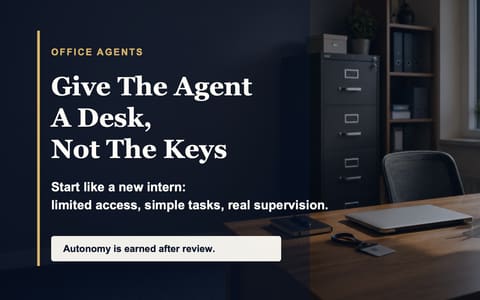
A practical operating note for introducing office agents: give them a contained workspace, limited access, clear supervision, simple tasks, and enough time for people to become supervisors of their own AI.

A practical starting point for individual AI productivity: use a small sandbox, a second account, and one repeatable expense workflow before trying to transform the whole company.
A practical note on using RACI to separate AI execution from human accountability when documents and decisions are produced with AI.
If agents start doing more of the choosing, the winning advert looks less like persuasion and more like inspectable evidence.
A reflection on what happens to the open knowledge commons when agents, not people, are doing more of the asking and learning.
A practical argument for treating vibe coding as an early system maturity layer, not the enemy of production engineering.
A personal reflection on running out of tokens, choosing the right level of intelligence for the task, and why the future workday may be bounded by model budget as much as hours.
A personal reflection on what happens when the old blockers disappear and the real work becomes choosing, pacing, and staying human.

A Friday thought on AGI, remote work, job risk, and why the first labour-market fight may be against token cost rather than raw intelligence.
A voice-led note on the choice now facing organisations: keep forcing work through controlled screens, or let people work naturally while agentic systems carry the rules and integrations around them.
A short, plain-English explanation of Agent Canon: why Tonywood.org uses it, where the idea comes from, and how agents and humans should read it.
A public note to Agentic and operators on operational resilience, backup isolation, RTO, RPO, and why no single actor should be able to destroy the way back.

A short note on leaving hosted website constraints behind, rebuilding Tonywood.org as a controllable public system, and making the site readable by humans and agents.

Most AI proof-of-concepts fail after the demo. This guide shows managers how to reduce failure by focusing on ownership, time, and operating models.
They recruit smart people, invest in analytics, and talk about evidence-based decision making. Yet when I walk into a large company, I often see the same pattern.
Most companies rely on platforms like LinkedIn or PitchBook to share public profiles and key information.
This post came from a conversation I had at the Porto summit with a CICF member. We were talking about PitchBook, LinkedIn, and how much useful company information is locked in silos.
If no one is accountable for acting on the output the system will be ignored no matter how good it is.”
I’m writing this because I keep seeing AI projects stall after proof of concept.
People jump in and start coding or prompting without spending enough time upfront on what actually matters.
Privacy choice
Cookieless Matomo analytics help me understand which public pages are useful. They are on by default unless you turn them off, and your choice never affects access to the site.