
Why I Am Writing About More Than Agentics
I am widening the subjects I research so my agentic work has a traceable evidence base, not just more AI commentary.
Writing archive
Older essays on agentic systems, governance, operations, incentives, and the work of making AI useful in real organisations.
I am widening the subjects I research so my agentic work has a traceable evidence base, not just more AI commentary.

A useful plain-English way to think about an agentic graph: nodes stand for the things involved, while edges show possible relationships and transitions through the work.

Deloitte, KPMG and PwC have faced public scrutiny over AI-assisted research errors. The lesson is not to laugh at them, but to build verification strong enough that the same thing does not happen to us.

Wind and sunlight are renewable flows. Turbines and solar panels are finite manufactured infrastructure. This is what they consume, repay and leave behind.
A UK evidence update on data-centre water and electricity use: what is measured, what is modelled, why peak demand matters, and what good planning should disclose.

Data centres already underpin ordinary British life. AI increases the need, but Britain needs a portfolio of sites matched to workloads, power, fibre, water and local opportunity.
A dental AI booked the wrong specialist. The important question was not only what failed, but whether anyone captured the event, owned the system, and turned the mistake into learning.

What agentic organisations can learn from NHS England's patient-safety systems, learning infrastructure, and continuing struggle to turn reports into safer practice.
Part four of Agentic Operating System For Your Business: moving from agentic tasks and messaging into a visible business operating system with runners, waypoints, state, evidence, and human control.
Why estimates for agentic work need uncertainty classes, several definitions of done, evidence ranges, and deliberate human review pauses rather than one confident completion date.

This morning, Voice in Codex stopped feeling like a chatbot feature and started feeling like an operating interface across projects, agents and real work.
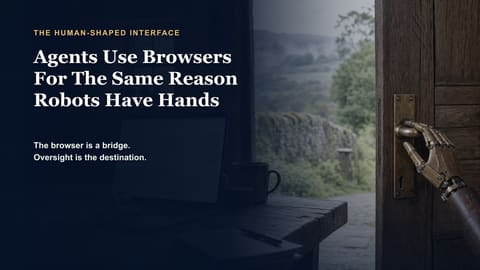
We built the physical world around human hands and the digital world around human clicks. Browser agents are an ingenious bridge, but the future belongs to structured tools and interfaces designed for human oversight.

Part three of Agentic Operating System For Your Business: choosing between the deep integration of an agent harness and the flexibility of portable API workers.

Use the agent harness for leverage today, but keep a tested API or local-model route so convenience does not become operational dependency.
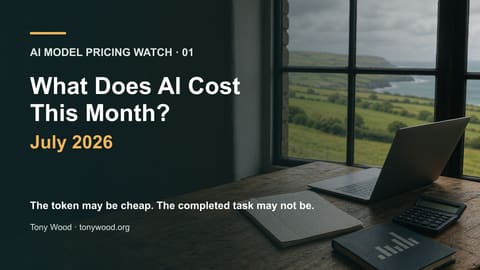
The July 2026 UK baseline for direct AI API prices, showing quick, general, and frontier models alongside reference workload costs and the qualifications that affect a completed task.

A personal note to Alex about moving from ChatGPT on a phone to a simple Restaurant Control Room in Codex on a laptop.
A thought from OpenAI Build Week in London about uncertainty, pricing, and building where no reliable pattern exists yet.

A practical experiment with Focus Reader, dyslexia, attention, and comprehension.
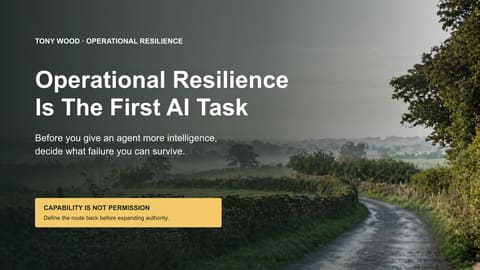
Before you give an agent more intelligence, decide what failure you can survive. Operational resilience is the first task, not the final check.

AI can advise, challenge, and inform. It cannot take responsibility for the judgement you choose to make.
AI can help us build at extraordinary speed. It cannot reliably warn us about rules, risks, and details we do not yet know exist.
Calling an AI tool an employee does not make it ready for work. A practical safety guide to onboarding agents through bounded tasks, context, supervision, tests, least privilege, and earned authority.

Why Tony is replacing message streams and human issue lists with bounded work packets that agents can triage, discuss, approve, execute, and receipt.
A plain-English guide to OpenAI's GPT-5.6 model family, ChatGPT, ChatGPT Work, Codex, the API, reasoning settings, tools, skills, MCP connectors, and multi-agent work.
Privacy choice
Cookieless Matomo analytics help me understand which public pages are useful. They are on by default unless you turn them off, and your choice never affects access to the site.