
Here is a free AI business idea: build a commercial lettings service that my agent can actually use.
Not another website with a chat box bolted to the corner. A useful local service with clear information, someone responsible for it, and a reliable answer to the most important question: is this place still available?
I would start small. Build it around Enfield, or your own local area. Offices, shops and small workspaces. One area, one job, and enough local knowledge to tell whether the thing is working.
The idea is free. The business would still need to earn its keep. And to be clear, this is a proposal, not a service I have already launched.
Edited from my spoken notes
Start with business rentals as a niche. Build it around Enfield, or your own local area. Get the information together, let the agents put their properties on it, and when something comes off the market, their agent updates it. Put the idea out there and find an entrepreneur to drive it.
That is the useful thread from my spoken notes. There are two kinds of agent in this story: the property professional who knows the premises, and the AI agent helping somebody find them. I think the opportunity is to make it easier for them to work together.
The problem is not just finding a listing
Imagine I need a small office. I can describe what I want: an area, a budget, enough space, decent access and a date when I need to move.
An agent might help me search and compare. But if the underlying information is incomplete or old, it can simply help me get to the wrong answer more quickly.
There is the rent. Then there are the questions: is VAT applicable? What is the service charge? What lease is being offered? Is there a break clause? What repair obligations might I take on? Is my intended use acceptable? And is somebody already negotiating for the place?
Those are things I would want confirmed, not filled in by a model because it has seen a similar property before.
A nice photograph is useful. It is not a substitute for knowing what I would actually be taking on.
Start with commercial rentals, not every home in Britain
I would resist the temptation to launch a national property platform on day one. It sounds impressive. It also gives you a national collection of things you have not checked.
Start with a manageable patch around Enfield, or wherever you know the local market and can build relationships. Talk to commercial letting agents and landlords who want to participate. Ask small businesses what they struggle to find out before arranging a viewing.
Enfield is a suggested starting point, not the only place this could work. Choose your own local area if that is where your knowledge and connections are. I am not claiming to have measured the market or discovered a guaranteed gap. Demand, available stock and willingness to pay would all need testing.
That is the work an entrepreneur would have to do. The website is only part of it.
Give each property a useful record
The first version does not need to be clever. It needs to be clear.
- The space: address, type, floor area, photographs and who supplied them.
- The costs: asking rent with its period and basis, VAT position, service charge and other stated costs. Separate confirmed figures from estimates and unknowns.
- The terms: proposed lease length, break options, deposit, repair obligations and permitted use, where supplied and checked.
- The practicalities: access, parking, delivery arrangements, available date and relevant documents.
- The status: available, under offer, let, withdrawn or not recently confirmed.
- The evidence: who may update the record, its source, when it was checked and what still needs an answer.
For the applicable commercial premises, EPC information matters too. Government guidance for non-dwellings in England and Wales describes requirements to show the energy rating in commercial advertisements, subject to the relevant scope and exceptions. That is distinct from the physical-display duty for certain buildings. The service should check the actual requirement, not have an AI invent a certificate. The linked government EPC guide is dated December 2017. Check current business-premises EPC requirements and non-domestic minimum-energy-efficiency rules and exemptions separately before marketing or letting.
The business record should say unknown when something is unknown. That is more useful than a beautifully written guess.
The important feature is keeping it current
This is the part I would build the service around.
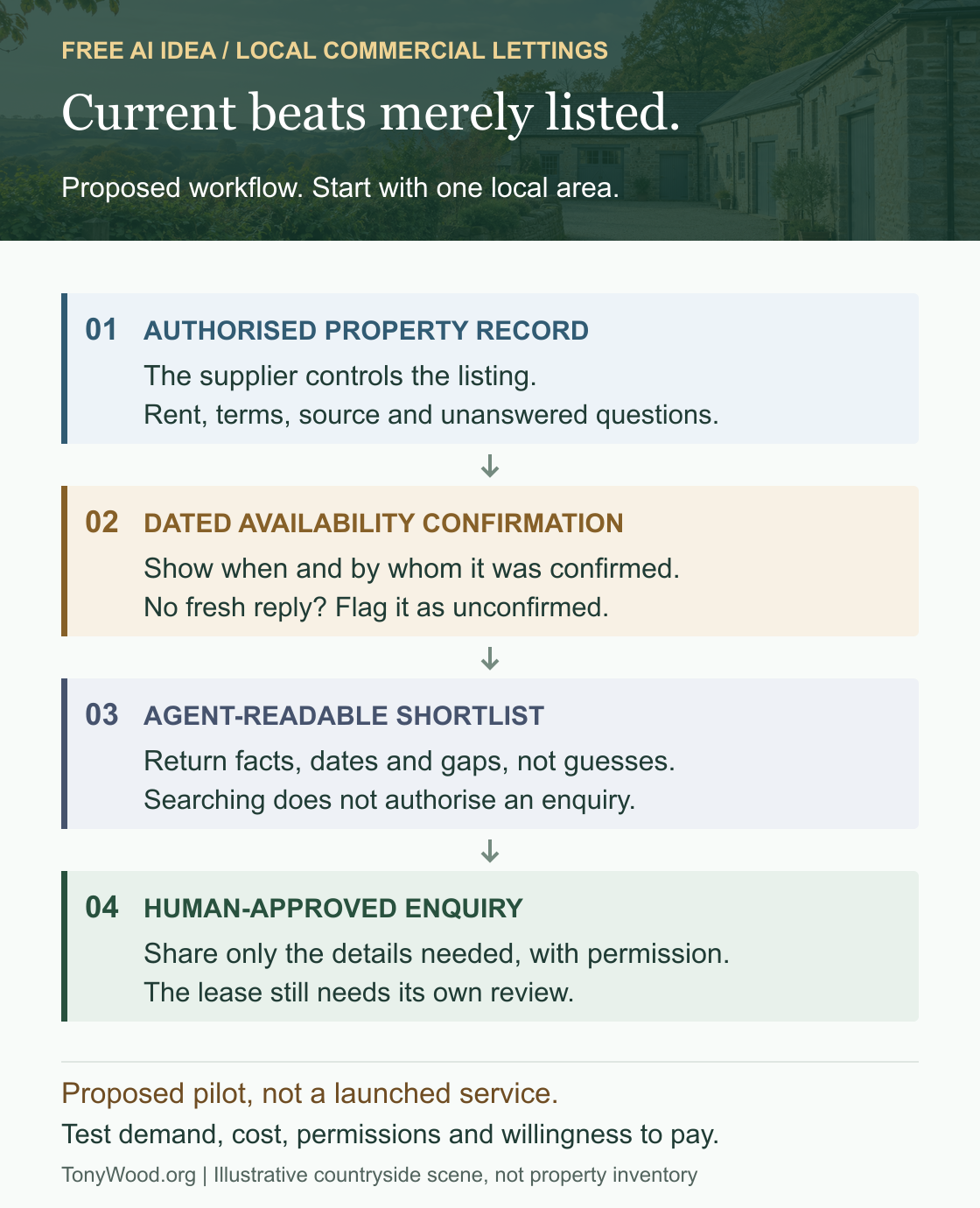
A property professional uploads an authorised listing. Their system, or an AI agent with permission, can submit changes when the asking terms or availability change. The platform records who changed what.
But I would not treat an unattended update as proof of reality. A feed can be late. A message can be misunderstood. Somebody may have forgotten to mark the property as let.
So give the record a confirmation date and a named source. Ask for reconfirmation on an agreed schedule. If the answer does not arrive, show that clearly or remove the listing from the confirmed shortlist.
No fresh confirmation should mean less confidence, not another confident recommendation.
That does not guarantee the premises remain available between checks. It gives the next person an honest basis for asking.
Make it easy for my agent to ask sensible questions
Imagine telling your agent: "Find me suitable workspaces around Enfield. Show me the known costs, the gaps and when availability was last confirmed. Do not contact anybody yet." Use your own local area instead, of course.
The service could return structured records as well as ordinary pages. An API, or an MCP connection if that suits the tools people use, could make the information easier to inspect and compare.
I do not need the agent to admire the website. I need it to understand the rent, distinguish annual from monthly figures, spot unanswered questions and tell me why a place does or does not fit.
Then I approve an enquiry or viewing request. The system sends only the details needed for that request, with my permission.
Searching is not agreeing a lease. Shortlisting is not permission to send my information everywhere. That distinction needs to exist in the product, not just the small print.
Build it agentic-first, including the operations
And I would not stop at making the listings readable by agents. I would create an agentic operations worker to help run the service.
That could mean exploring Grok Bot, an OpenAI-based bot, or an OpenClaw setup. They are different tools, not interchangeable installations. Grok Bot describes persistent AI teammates; OpenAI provides agent-building tools; OpenClaw is a self-hosted gateway for connecting messaging channels to agents. Pick a setup that fits the access, hosting and supervision you need, then test the actual job. Grok Bot overview, OpenAI Agents SDK, OpenClaw documentation.
Give that worker a clear role: organise authorised property information, flag missing costs, prepare reconfirmation requests, match enquiries to current records and bring exceptions back to you. Once a routine is tested and authorised, it could handle agreed follow-ups too. It should not invent a rent, decide a property is available because nobody replied, or negotiate a lease on your behalf.
That is the agentic-first position. Do not build a human-only process and bolt a chatbot onto the front. Build the records, permissions and workflows so agents can use them from the beginning, while keeping a straightforward website for people.
If the customer's agent asks a sensible question, your agent should be able to give a useful answer.
For example: "Is this still available? What does the quoted rent exclude? Can my client view it on Tuesday?" Return the known facts, their sources and dates. If Tuesday has not been confirmed, say so. A viewing request is not a booked viewing, and neither is permission to agree commercial terms.
Use AI to help build your own MCP
MCP, the Model Context Protocol, is a standard way to expose tools and information to AI applications. Think of your MCP server as the service desk other agents can connect to, not the brain that runs the business. OpenAI's documentation describes both connecting agents to MCP and building a server. Connecting agents through MCP, Building an MCP server.
You could ask Codex to help craft that server around your property database, using an existing maintained SDK rather than inventing a new protocol. Start with a few small tools:
- Search properties: location, use, budget and size, with clear units.
- Fetch a property: costs, lease information, sources, confirmation dates and unanswered questions.
- Submit an enquiry: an authorised request with a receipt and status, not an automatic commitment.
- Update a listing: available only to the supplier authorised to maintain that record.
The first pilot could be read-only. Prove that another agent can find and interpret the right information before adding actions. A factual search need not wake an expensive reasoning agent for every query; the server can return the stored records directly, with the operations bot helping where judgement or follow-up is needed.
Here is a brief I would give it:
Help me build a small commercial lettings service for Enfield, or my local area. Use authorised sample listings. Define the property records and build a read-only MCP server to search and fetch them. Include source links, confirmation dates, unknowns and clear cost units. Test it with a separate client. Propose how approved enquiries and supplier-only updates would work, but do not enable them or deploy anything yet. Give me a simple setup guide and explain the running costs.
Then choose where it runs. That might be your own machine for a private pilot, or a suitable hosting provider for a shared service. Ask AI to help with packaging, configuration and instructions, but check the result. Hosting a server is not the same as having a managed, secure service.
For private data and write actions, access rules must be enforced by the server, not left to the bot's judgement. Keep contact details out of public search results, require approval for consequential actions, record what changed and set usage limits. Those principles also appear in OpenAI's MCP server guidance.
So you have two connected pieces: an agentic worker helping with the operations, and your own MCP making the service easy for other agentics to use. Let the agents handle the routine exchange. Keep people responsible for trust, exceptions and decisions that matter.
Where could you host it?
You do not need to invent the hosting either. There are existing routes worth comparing. These are starting points for research, not a claim that one provider is always cheapest or that every template is production-ready.
Cloudflare Workers: a documented route for hosting a remote MCP server, with authentication options. Check whether your database and background work fit the runtime. Use the current supported example, not an older template blindly.
Render: a guide to building and hosting a custom MCP server as a web service. Check service and database costs, persistence, authentication and how scheduled work will run.
Hostinger VPS: a VPS hosting route aimed at MCP deployments. Decide who maintains the operating system, updates, backups, monitoring and secure access. A VPS is not someone taking responsibility for your whole application.
For a first build, I would ask Codex to compare one managed deployment route with one VPS route using the actual design. Show me the monthly costs, renewal terms, data location, backup and restore plan, and who owns maintenance. Do not buy hosting or open anything to the internet until I approve it.
Let people bring their own intelligence and tokens
Here is another part of the business model I like: why should you pay for every visitor's AI reasoning?
Give the site a Connect your agent option. The visitor uses their own compatible AI client and model account to query your MCP. Their agent does the thinking; your service supplies the authorised property information.
That is what I mean by bringing your own tokens. You are not moving a bag of tokens from one provider to another. The customer's client uses its own subscription allowance or API billing, where its plan supports that connection. Your server does not need to call your paid model just to return a property record.
It could be a useful way to make the service accessible without subsidising everybody's conversations. Keep an ordinary search page as well, so people do not have to understand MCP to look for premises.
Bring your own agent, not your secret API key.
I would not start by asking strangers to paste provider keys into the website. OpenAI's key-safety guidance warns against exposing keys in browsers and sharing them. Let the customer's own client hold its credentials. If you later offer AI chat inside the site using customer-funded access, treat that as a separate integration: check the provider's permitted authorisation method, billing and security before building it. OpenAI's API key safety guidance.
And this does not make the business free to run. You still pay for the server, database, support and your own operations agent. Any model calls made by that agent remain your bill. Put limits around requests and make any service fee clear; customer-funded reasoning is not permission for unlimited use of your infrastructure.
Craft the first version, then automate what works
I would give the build five small stages, rather than asking for an autonomous property business in one prompt.
- Define the records. Use fictional sample properties first. Agree costs, units, sources, supplier ownership and confirmation dates. Keep personal contact information separate.
- Build search. A basic website and read-only MCP should use the same records. Test with a compatible external AI client, without giving it the owner's model key.
- Draft the operations. Have the worker flag stale records, prepare requests for missing information and produce a short exception report. Start in dry-run mode: no external messages or record changes.
- Automate a bounded routine. Once tested, approve a defined schedule and participating suppliers. Reconfirmation reminders go only to those authorised contacts; repeat requests must not create duplicate messages. Missing replies flag uncertainty, not availability.
- Add approved actions. Test supplier-only updates and human-approved enquiries, with receipts, access checks and a way to pause or undo mistakes. Prove backup restoration before launch.
Ask the AI to deliver the starter files, setup instructions, tests and a clear list of what is not enabled yet. Ask it to show which calls cost model tokens and which are ordinary database requests. That gives an entrepreneur something inspectable to work with, rather than a reassuring "all done".
That is the opportunity: a small local service, designed for agentics to work with agentics, with enough automation to remove repetitive work and enough clarity for a person to stay in charge.
Do not build it on information you have no right to reuse
My first thought was that you could gather existing listings to get started. Then comes the important question: what are you allowed to gather and republish?
Publicly visible does not automatically mean available for your new commercial database. For example, Zoopla's terms restrict commercial reuse without a licence and expressly address scraping, subject to applicable law. Zoopla's terms of use.
I would start with direct uploads, authorised feeds, licensed data and partnerships. Get permission for the photographs and descriptions as well as the facts. Do not build the business on bypassing somebody else's access controls.
AI might help organise information you can legitimately use. It does not give you somebody else's rights.
The phone calls and the legal role need thought
Could agents help with enquiries and follow-ups? Possibly. I would start with people who have agreed to participate, rather than sending a voice bot off to ring every business in the area.
The ICO distinguishes live business marketing calls from automated calls playing recorded messages. Its guidance requires screening live calls against TPS, CTPS and previous objections, with consent needed in the specified circumstances; automated marketing calls need consent specifically covering them. Do not assume a conversational AI call qualifies as a human live call. Check that design before using it. ICO business-to-business marketing guidance.
Also decide what business you are actually running. Publishing adverts and enabling direct contact is different from acting on a client's instructions, negotiating or taking money.
HMRC's guidance describes specific advertising and direct-contact exclusions from its letting-agency definition, as well as circumstances in which commercial letting work falls within money-laundering supervision. Those are particular rules, not a blanket exemption for an "AI platform". HMRC's letting-agency guidance.
Get the actual model checked before launch, including fees, data handling and any activity that might make you an intermediary. This is a business idea, not legal advice or a claim that all UK letting regimes are the same.
How would it make money?
I would test a fee for an agreed introduction or completed letting, with clear terms about when it is earned. Another option is a subscription for agents who value the listing and update service.
Those are alternatives to test, not a price list. A transaction-linked fee may also affect the service's legal role. Get advice on the actual activities rather than assuming the billing label settles it.
And I would not promise it will be cheap just because agents do some of the work. There are still data rights, hosting, model usage, support, insurance, compliance and the time spent checking things. A disputed referral fee is not made free by having a bot argue about it.
The useful calculation is what it costs to produce a qualified, current enquiry, and whether somebody will pay enough for that to leave a viable business.
The entrepreneur matters more than another demo
I could see a useful partnership here: someone who can help build the platform, and an entrepreneur who knows the area, earns the agents' trust and drives the business.
Not "I built it, so surely everybody will use it". Someone still has to get the right listings, agree the terms, handle exceptions and make the service worth coming back to.
For a first pilot, I would want a small group of willing suppliers, a manageable set of authorised listings and a few businesses genuinely looking for premises.
Measure the stale listings caught, unanswered questions resolved, suitable viewings arranged, effort per enquiry and willingness to pay. If nobody finds it useful, learn that before expanding the map.
So there is the free AI idea: commercial lettings, built for agents, starting locally.
Make it easy to find a place. Make it even easier to know whether the information can be trusted.
Sources and notes
This is Tony Wood's proposed business model, developed from a spoken note. The pilot area, product features, pricing options and workflow are suggestions, not claims of a launched service, validated demand or guaranteed savings.
The linked operator, regulator and government sources were checked on 2 October 2026. Zoopla's terms apply to its service; the ICO guidance describes marketing rules; HMRC addresses its money-laundering scope, not every legal requirement. The December 2017 EPC guide concerns non-dwellings in England and Wales; current EPC and minimum-energy-efficiency guidance is linked separately. This is not a complete compliance checklist.
The agent and MCP documentation was also checked on 2 October 2026. The operations worker, tools and setup brief above are a proposed design, not a claim that an off-the-shelf bot already supplies this lettings workflow or that it has been built and tested.
The hosting links describe existing deployment routes, not a price comparison or residency audit. Bringing your own agent is a proposed cost-sharing design; actual compatibility and charging depend on the client, provider and service setup.