If AI allows Britain to get more done, what do we actually want to do with that capacity?
We talk a lot about cheaper services, more competitive businesses and fewer hours spent doing paperwork. Good. I want those things. But there is another possibility that deserves rather more attention.
We could look after each other better.
That is why I think keeping health and social care high on the government's agenda makes sense. Not simply as a bill we have to pay, but as part of the infrastructure of a successful country. And potentially as part of how we prepare for an economy in which AI changes the work people do.
I am not suggesting that ministers have secretly designed a grand AI employment plan. This is my argument for joining the policies together. Nor am I suggesting we invent unnecessary jobs. The point is to meet genuine human need while helping people navigate a changing labour market.
What is actually being promised?
The 2025 Spending Review committed to increasing annual NHS day-to-day spending by £29 billion in real terms between 2023–24 and 2028–29. That is the increase in the annual budget at the end of the period, not a £29 billion pot spread across five years. These figures concern the NHS in England. Source: Spending Review 2025.
The government has also announced a National Care Service in the next Parliament, including a phased introduction of free personal care for older people based on need. The October 2026 Budget confirms the commitment concerns England. It is a future programme, not a service already delivered, and the announcement does not promise that accommodation and all other care costs will become free. Source: National Care Service announcement; Budget 2026.
I welcome the priority. That does not mean every detail of the funding or delivery plan gets a free pass. Supporting the destination and scrutinising the route are perfectly compatible.
The argument here is about Britain's economic future; the specific health funding and care-workforce figures used here are for England. They should not be casually presented as a UK-wide settlement. A Britain-wide approach would need to respect the different national systems and local needs.
Prepare for change, not a prediction of mass unemployment
The Bank of England's October 2026 business intelligence is useful here. Its contacts report productivity gains from AI, but limited evidence of widespread AI-driven job losses. The changes they describe include slower recruitment, less replacement hiring and reduced trainee intake. This is qualitative intelligence from businesses the Bank speaks to, not a causal census of the whole economy. Source: Bank of England, October 2026.
Think about that. You do not have to fire everyone for a career ladder to become harder to climb. If fewer people get their first opportunity, or the next vacancy never opens, the transition can still be painful.
The ILO's 2026 review of empirical research similarly finds more evidence so far of tasks and work being reorganised than of large-scale employment displacement. Its findings do not settle what happens as the technology improves. They do tell us to distinguish observed change from an alarming forecast. Source: ILO research review.
The OBR estimates that, over the next decade, around 10% of the UK labour force could be exposed to substitution by AI, with a further 30% potentially having their work complemented. Those are uncertain exposure estimates, not a prediction that one in ten people will lose their job. Source: OBR, July 2026, Box 4.1.
My position does not require mass unemployment to be inevitable. It requires us to recognise that transitions take time. Waiting for a large unemployment figure before building training routes would be a peculiar way to prepare.
There is already useful work to do
We are not looking for a make-work scheme. We are looking at a country where care capacity matters in its own right.
| England: adult social care | What the figure means |
|---|---|
| 1.59 million filled posts | Estimated for 2025–26. Posts are not the same as individual people or full-time equivalents. |
| 96,000 vacant posts | Estimated vacancies on an average day in 2025–26, not 96,000 newly created jobs. |
| 410,000 additional posts by 2040 | Additional to 2025–26's 1.69 million total posts, if the workforce grows with the population aged 65 and over. This includes filled and vacant posts; it is not a funded hiring commitment. |
Source: Skills for Care, October 2026 executive summary. Do not add the current vacancies to the future projection and call the result guaranteed new jobs. They are different measures with different time horizons, and the projection's baseline already includes vacancies.
These workforce totals exclude adult-social-care-related roles employed by the NHS. Source: full report's scope note.
That gives us a sensible planning question: how do we build a better care workforce while helping people whose existing careers are changing?
It does not establish that care can absorb everyone affected by AI. Different places will have different shortages, and people will have different ambitions. Britain should also be developing routes into engineering, education, construction, technical services and new businesses.
It is not just about employing care workers
Think about a family member who would like to return to paid work but cannot find reliable support for someone they care for. If better services give them that option, the benefit goes beyond the person employed to provide care.
The same logic applies to treatment and rehabilitation that help someone stay in work or return when they are ready. These are possible routes to a stronger economy, not a calculation of how many extra workers a particular spending increase will produce. The purpose of healthcare is still to help people, whether or not they have a job.
Care is not the labour market's waiting room
There is a trap in this argument. We must not slide from “we need more care” into “send anyone who loses a job into care”.
The person receiving care is not there to provide somebody else with employment. Their dignity, safety, independence and preferences come first.
A good transition route would need to answer practical questions. Does the person want this work? Are they suited to the particular role? Can they afford to train? What qualifications, safeguarding checks and supervision does it require? Is there a real employer and a sustainable job at the other end?
Someone leaving an administrative job does not become a nurse or occupational therapist because we have drawn an arrow on a policy diagram.
I would want paid training, clear progression and proper support. Not a compulsory move into a low-paid role described as an exciting opportunity by someone who would never take it themselves.
Neurodivergence is not a job description
When thinking about this, I initially focused on people who already find the labour market difficult, including neurodivergent people. That concern matters. But we need to be precise about it.
The government's 2026 Expert Academic Panel on Neurodiversity emphasises support based on individual needs rather than assuming that a diagnosis tells us what someone can do. Neurodivergence covers very different people, strengths and barriers. The report does not establish a single group of “neurodivergent jobs” destined to disappear because of AI. Source: expert panel's final report.
The response should be individual choice and better job design: accessible recruitment, clear instructions, suitable working environments and adjustments agreed with the person. For some, that might open a route into care. For others, the right route will be somewhere entirely different.
AI tools should be assessed for whether they help a particular person participate, not used as an excuse to write them off. And some people will not be able to work. They still deserve support. This is not a proposal to make care or income security conditional on being economically useful.
Use AI to give people more time for people
England's 10 Year Health Plan describes a shift towards community services, prevention and digital systems. It envisages AI supporting clinical work and reducing administrative burdens. That is the intended direction, not proof that every system is safe or that the promised savings have arrived. Source: 10 Year Health Plan for England.
My preference is straightforward. If technology safely removes time spent duplicating notes or organising appointments, ask whether we can put that time into better care before automatically treating it as a payroll saving.
An OECD study of long-term care in 2020 described technology's potential to support workers while identifying the importance of communication and interpersonal skills. It is useful background, not a verdict on the limits of today's models or a promise that care will never be automated. Source: OECD, Who Cares?.
The test should be the result. Are people getting safer, more responsive support? Is the worker actually saving time after checking the output? Are consent, privacy and accountability clear? An impressive demonstration is not the same thing as a better service.
There is a bill. We should be honest about it
Employing people to meet genuine care needs can create value. It does not follow that the programme pays for itself.
Staff need wages. Training needs funding. Buildings, equipment, supervision and technology cost money. Taxes paid by new workers and any reduction in benefit spending could offset some of the gross cost. Claims that they cover the whole bill would need evidence, not an optimistic assumption.
Nor does moving a worker from one employer to another automatically create an additional job for the economy. We need to distinguish gross recruitment from net additional employment, and better services from a bigger headcount.
The OBR also identifies a deeper issue: the existing tax system collects different amounts from labour income and profits. If AI shifts income away from wages towards profits, revenues could weaken even without a fall in total GDP. The direction and scale are uncertain; the OBR's long-term illustrations are scenarios, not forecasts. Source: OBR, Box 4.1.
So “AI will fund it” is not a funding plan. Productivity gains have to materialise, and government has to decide transparently how much can be directed towards care alongside everything else.
I would also be careful with the word collapse. An unprepared economy could face difficult transitions and pressure on public finances. That is not the same as proving it will fall apart. And welfare spending is not starting from zero: the question is how needs, incomes and revenues change.
What I would like Britain to do
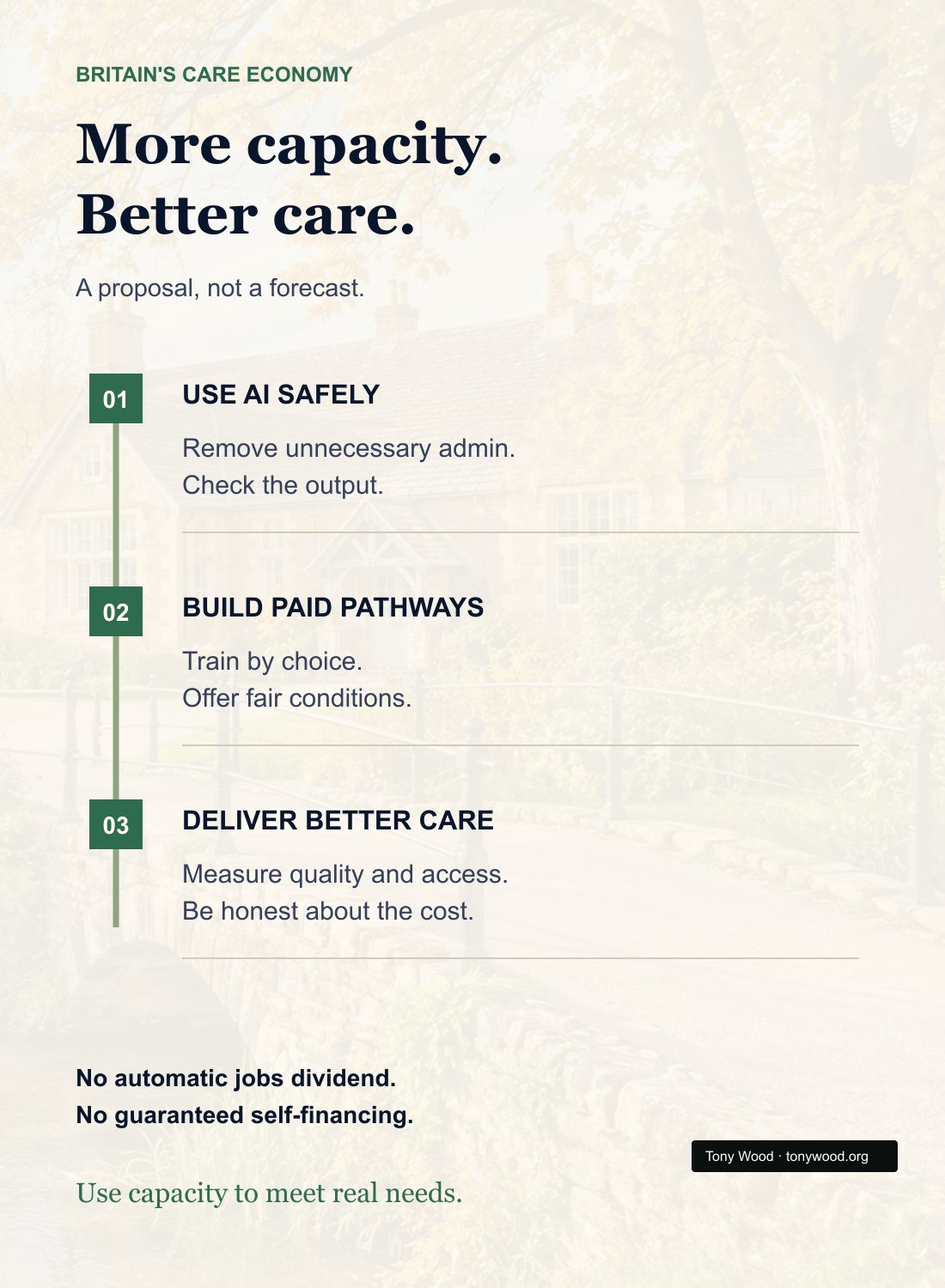
I would connect the AI strategy and the care strategy through a practical programme, with six priorities.
- Start with unmet care needs. Plan capacity around the support people need, not around an arbitrary target for moving people off benefits.
- Build paid routes before a crisis. Give people in changing occupations a way to explore suitable roles, train and move without first falling into long-term unemployment.
- Make the jobs worth staying in. Pay, predictable hours, training, supervision and progression belong in the plan from the beginning.
- Design for different people. Offer individual adjustments and genuine choice. Do not assign careers by age, diagnosis or the job someone used to do.
- Use AI where it improves the service. Test administrative and clinical tools properly, with clear human responsibility. Measure whether they free time for care rather than merely shifting checking work elsewhere.
- Publish the costs and the results. Track care quality, access, retention, sustained employment and net public cost. Review what works and stop what does not.
There are policy foundations to build on. The government is developing an adult social care Fair Pay Agreement process in England, with negotiations expected to begin in 2027. That is a process towards better conditions, not evidence that a new agreement is already in workers' pay packets. Source: government's consultation response.
I would want councils, health services, colleges, employers and people receiving care involved in designing the local routes. And I would want to hear from unpaid carers too: better services might give some more choice about paid work, but the aim is not to make every hour of family life economically productive.
A more useful measure of progress
I am positive about AI. I want Britain to use it, build with it and become more productive.
But the measure of success cannot simply be how many people we manage to remove from a payroll. It should also be what that productive capacity allows us to do.
If the transition is mostly about changing tasks rather than eliminating jobs, a better care system would still be valuable. If displacement becomes more serious, having useful services, training routes and a functioning safety net already in place would be better than improvising them afterwards.
That is the thing. We do not have to choose between being ambitious about technology and being ambitious about looking after people.
Some of the gain from machines doing more could be humans having more time to care. To me, that is a future worth preparing for.
Sources and notes
Evidence checked 31 October 2026. Government announcements describe intentions, not delivered outcomes. The executive summary and full Skills for Care report describe the same study.
- Spending Review 2025: full document (2025-06-11).
- Plans for a new National Care Service (2026-09-29).
- Budget 2026: full document (2026-10-28).
- Bank of England Agents' summary: October 2026 (2026-10-30).
- The impact of GenAI on jobs, productivity and work organization: A review of empirical evidence (2026-06-01).
- OBR Fiscal risks and sustainability: July 2026 (2026-07-07).
- The state of the adult social care sector and workforce in England 2026: executive summary (2026-10-14).
- Expert Academic Panel on Neurodiversity: final report and recommendations (2026-10-02).
- Fit for the future: 10 Year Health Plan for England (2025-07-03).
- Who Cares? Attracting and Retaining Care Workers for the Elderly (2020).
- Fair Pay Agreement process in adult social care: government response (2026-07).
- The state of the adult social care sector and workforce in England 2026: full report (2026-10-14).