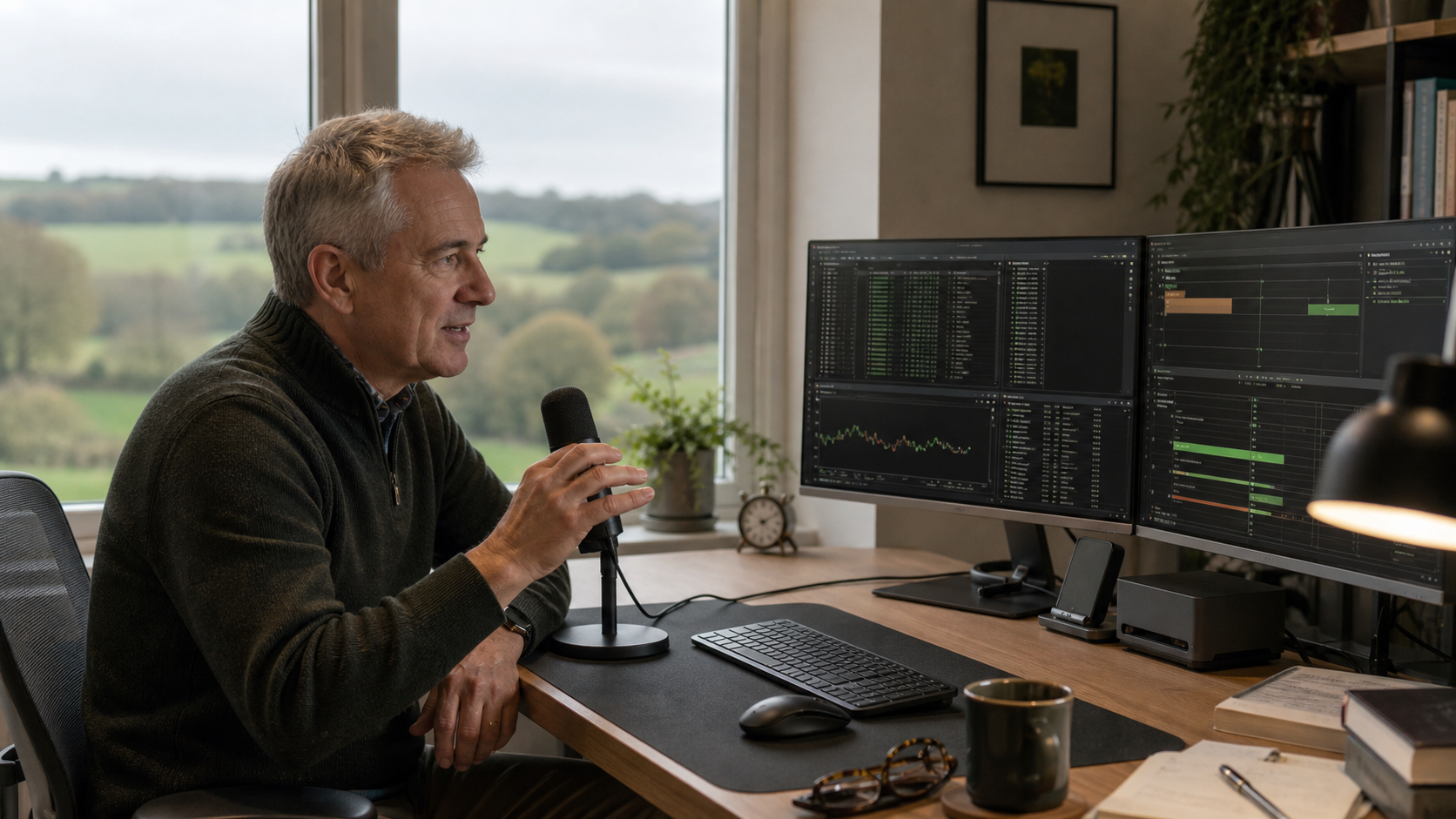
Working with Codex Voice has started to feel less like using software and more like having a coworker beside me.
I can ask, "What is happening in that thread?"
I can ask it to explain the problem to me simply. Really simply. Imagine I am a child. What has failed? Why does it matter? What is the team trying next?
Those are some of the most useful conversations in my day.
When you are rolling out a lot of code and connecting a lot of systems, you inevitably move into areas where you are not the expert. If I hired human specialists across every part of one large release, I could easily need decades of combined experience around the table.
Now I can have an agent doing the work and another part of the system helping me understand the work.
That feels like a coworker.
But I think the next change is bigger.
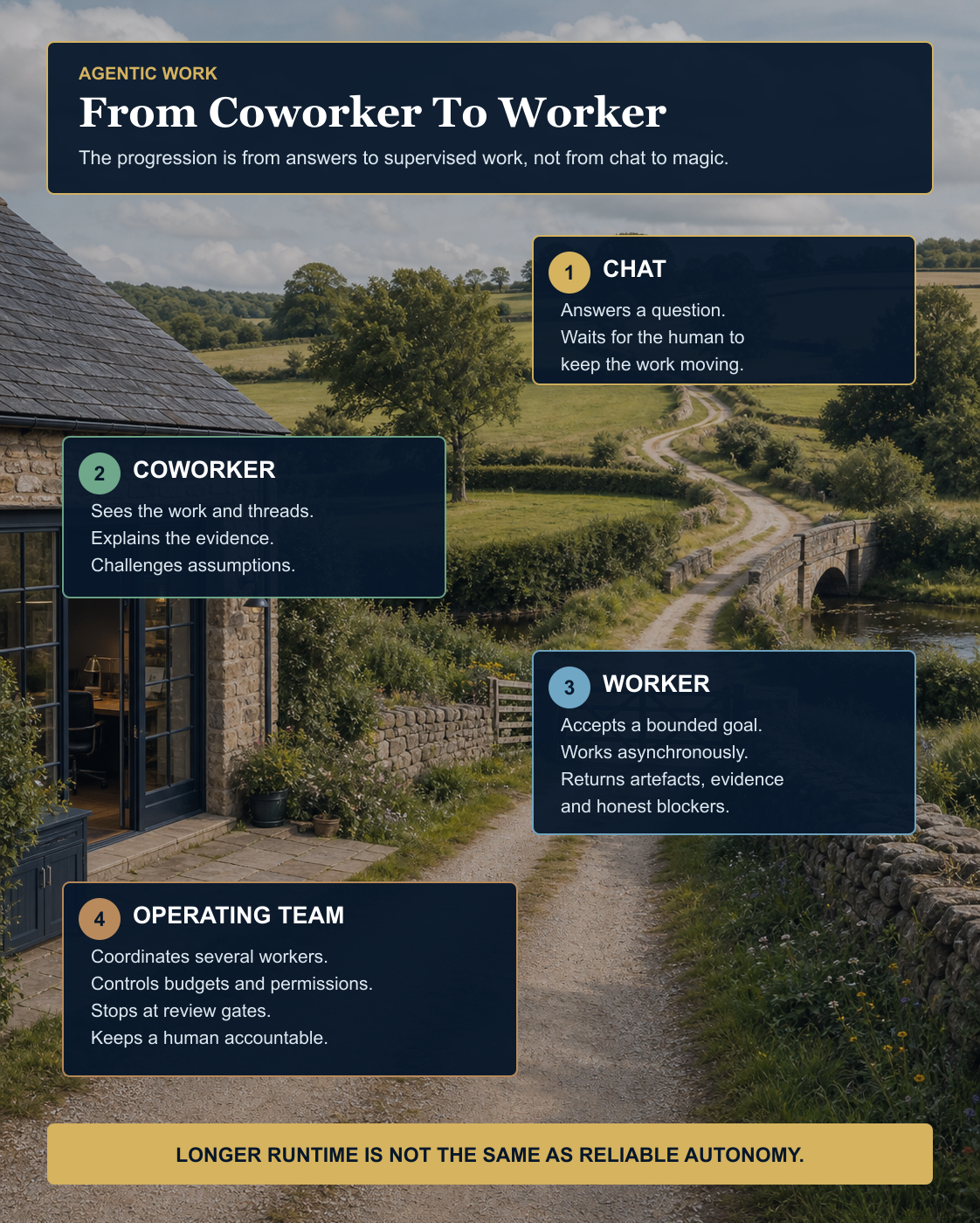
The coworker is here. The employee is next.
Talking to the work changes the work
I have written before about wanting every Codex thread to have its own voice. The useful thing is not simply dictating a prompt instead of typing it.
The useful thing is the conversation around the work.
- What did the agent actually do?
- What evidence says it worked?
- What assumption has just proved wrong?
- Which decision needs me?
- Can the team continue safely without me?
It is part technical lead, part business analyst and part very capable rubber duck.
The voice does not have to write every line itself. It has to be able to see the threads, inspect the evidence and translate what is happening into a conversation I can use.
That matters because the next generation of agents will not sit politely waiting for each individual instruction. We will give them a bounded goal, a budget, an environment and a definition of done. Then they will work.
A major release is not one clever prompt
I see this while building Orchistra.
A major upgrade can take a couple of days to move from my local development environment through rehearsal and into a governed live release. The code may be the easy part.
There are contracts, requirements, migrations, tests, security boundaries, operational resilience, rollback routes and release evidence. The first time through a route, something unexpected nearly always appears.
"I did not realise that was a thing."
Then the team has to diagnose it, fix it, rehearse it, sometimes roll it back and prove it again. You cannot responsibly push a consequential release merely because an agent says it looks fine.
Today, I supervise much of that movement through threads. I check in. I ask what is blocked. I ask the voice to explain the logs. I decide whether the evidence is good enough to move forward.
The next useful agent is not one that can produce a bigger code dump.
It is one that can take the release goal on Monday, keep moving through the bounded work, stop at the gates that require authority and return with an honest status rather than a cheerful invention.
A quick correction about Astra
While thinking this through, I had heard the name Astra and mentally put it beside OpenAI.
That was wrong.
Project Astra is Google DeepMind's exploration of a universal AI assistant. It focuses on natural conversation, vision, screen understanding, memory and being present across devices. Some of those capabilities have been moving into Gemini Live.
Astra is relevant to the coworker part of my argument: an assistant that can see what I see, hear what I say and maintain the thread of the conversation.
It is not the same category as a long-running software worker such as Codex, Devin or Jules.
OpenAI's relevant product is Codex. OpenAI describes the Codex app as a command centre for multiple agents, parallel work and tasks that can span hours, days or weeks. The important word there is can. A product surface may support long-running work without every task becoming reliable, independent employment.
That distinction is worth keeping. The assistant helps me think and steer. The worker accepts a task and changes an environment. A serious harness needs both.
The practical long-running agent shortlist
This market is changing too quickly for any list to be complete for long. The table below is a practical shortlist of products that can take meaningful work and continue outside a single chat response.
Prices and limits were checked on 27 August 2026. They are not directly comparable. Some products sell seats, some sell credits, some meter model usage and some bundle several products into one subscription. Taxes, enterprise agreements and overage charges can also change the bill.
| Product | What it is good at | Working environment | Cost shape | Main catch |
|---|---|---|---|---|
| OpenAI Codex | Parallel coding and knowledge-work agents; local, remote and cloud work; long-running project threads. | Codex app, CLI, IDE, cloud and connected development environments. | Plus is $20 a month; Pro is $100 or $200 a month. Business Standard is $25 per user monthly or $20 per user per month billed annually; Premium is $125 monthly or $100 annually. Enterprise is custom. Codex is included subject to plan limits, with credits available for extra usage. | Capability depends heavily on environment setup, permissions, tests, context and review. A long runtime is not proof of a correct result. |
| Claude Code and Cowork | Deep interactive coding, agent teams, refactors, debugging and broader document or analysis work through Cowork. | Terminal, IDE, desktop workspaces and API-built agent systems. | Claude Pro is $20 a month; Max tiers are $100 and $200 in the US. API usage is separate and metered. | Even the longest real Claude Code turns measured by Anthropic were usually far shorter than a working day. Background processes are not the same as an unattended employee. |
| Devin | Asynchronous software tickets, bug fixes, codebase work, pull requests and shared team workflows. | Hosted Devin sessions, terminal and Devin Desktop, with integrations for common engineering tools. | Free, $20 Pro and $200 Max individual plans. Teams starts at $80 a month, with $40 full seats and shared on-demand credits. | Quotas and credits still matter. A well-scoped ticket and a reproducible environment remain much easier than an ambiguous transformation programme. |
| Google Jules | GitHub-scoped fixes, upgrades, migrations, tests and pull requests in an isolated environment. | A fresh Google-hosted virtual machine connected to selected GitHub repositories. | Free tier: 15 daily tasks and three concurrent tasks. Pro: 100 and 15. Ultra: 300 and 60, bundled through Google AI plans. | Paid access is currently tied to individual Google accounts, and the product is primarily a repository worker rather than a general company operator. |
| GitHub Copilot coding agent | Turning GitHub issues into pull requests inside familiar repository and review controls. | GitHub repositories and GitHub Actions runners. | Available through Copilot plans. Pro is $10 and Pro+ $39 a month in the US; agent sessions also consume premium requests and Actions minutes. | A task can consume several billable resources, and the useful operating boundary is strongly GitHub-shaped. |
| Cursor cloud agents | Parallel bug fixes, planned features, merge-ready pull requests and ambitious long-running code changes. | Isolated cloud virtual machines, reachable from Cursor, web, mobile, Slack, Linear and GitHub. | Pro is $20, Pro Plus $60 and Ultra $200 a month; all include Cloud Agents. Teams Standard is $40 per user monthly, Premium $120 and Enterprise custom. Extra usage follows model rates; Teams and Enterprise add $0.25 per million tokens for third-party models. | Cloud agents have internet access and auto-run terminal commands. That power needs explicit repository, secret and exfiltration controls. |
| Replit Agent | Taking an idea through design, code, hosted services and deployment, especially for new applications. | The integrated Replit development and hosting environment. | Core is $25 monthly or $20 monthly billed annually, with $25 credits. Pro is $100 monthly or $95 billed annually, with $100 credits and up to ten background tasks. | It is strongest when the application lives inside Replit's integrated stack. Usage credits and production resource charges still need managing. |
| Google Project Astra | Natural, multimodal assistance across speech, screens, cameras and devices. | Research capabilities feeding Google products such as Gemini Live and emerging form factors. | No standalone worker price. Access arrives through Google products and plans. | It belongs in the coworker conversation, not the autonomous coding-worker comparison. |
The list reveals three different jobs
Once you put the products beside one another, the category becomes clearer.
- The assistant sees, hears, remembers and explains.
- The worker takes a bounded task, changes an environment and returns an artefact.
- The operating layer coordinates several workers, protects the boundaries and shows the human what requires a decision.
Most products are strongest in one or two of those jobs. The thing I want is the combination.
I want to speak to the technical lead for the project. I want that lead to see the workers. I want the workers to continue while I am elsewhere. And I want the system to stop pretending that activity is evidence of completion.
Capital starts to replace attention
There is an economic change hidden inside this.
Until now, much of agentic work has been constrained by my attention. How many threads can I watch? How often can I intervene? How long can I keep the context in my head?
Long-running workers begin to move the constraint towards capital and operating design.
How many agents can I afford to run? How much model effort should each task receive? How many independent attempts are worth funding? How much verification do I want before a human sees the result?
More money can buy more runtime, parallelism, retries and stronger models. But money does not automatically buy a correct release. Poor requirements can now be misunderstood five times in parallel.
The companies that benefit will not simply be the ones with the largest token budgets. They will be the ones that turn money into useful work through good environments, clear contracts, competent review, tests, stop-lines and evidence.
That is why I prefer to measure the cost of a successful outcome rather than the price of a token.
We are still learning what long-running means
The research is encouraging, but the language can run ahead of the evidence.
Anthropic's study of real Claude Code use found that the longest interactive turns were becoming longer, rising from under 25 minutes to over 45 minutes at the 99.9th percentile over the period it studied. That is meaningful progress. It is not an eight-hour autonomous shift.
METR's task-horizon work measures the length of a task in human-expert time at which an agent reaches a given success rate. That is useful, but it is not the same as measuring how long an agent physically runs or whether it can safely own a live business outcome.
OpenAI reports that, by May 2026, more than 70% of sampled individual Codex users had asked for at least one task estimated to take a human more than an hour. The company also reports growth in requests estimated above eight human hours. Those durations are model estimates, not stopwatch measurements, and they do not mean every request succeeded.
So the direction is clear. The finish line is not.
My request for the harness developers
Please join the coworker and the worker.
- Give every serious project a persistent voice that knows the threads.
- Let me conduct a short stand-up and assign bounded goals.
- Let the workers continue through safe, pre-agreed steps.
- Bring decisions, blockers and uncertainty back to the voice.
- Show budget, model effort, elapsed time and evidence in one place.
- Require explicit approval at authority boundaries.
- Keep project context and permissions separate.
- Return a proper receipt: what changed, what was tested, what failed and what still needs a human.
Do not merely give me an agent that works for longer.
Give me an agentic team I can brief, question, understand and hold to account.
OpenAI, see you in London
I was going to finish this article by asking OpenAI to bring DevDay back to London.
The research produced a pleasant surprise.
I loved the previous London event. Meeting the people building the tools, comparing notes with other users and feeling the energy of the community was enormously valuable.
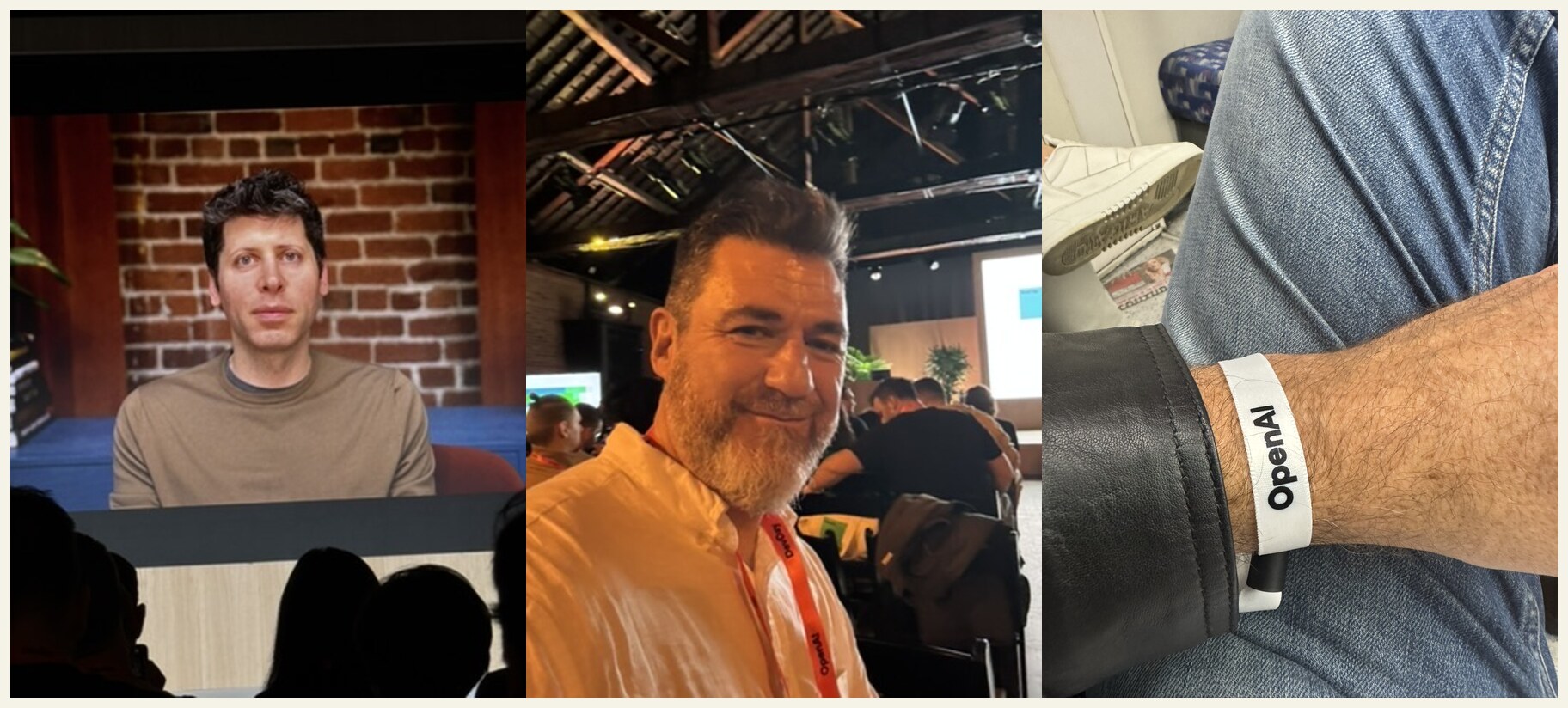
So my request has changed slightly.
Thank you for putting London on the route. Now give us as much of the real thing as you can: technical depth, product teams, difficult questions, working examples and enough time for the community to meet one another properly.
I suspect the most interesting conversation will not be about a model benchmark.
It will be about how we supervise a workforce that never existed before.
Is this AGI?
Not from this evidence alone.
Definitions vary. OpenAI's Charter defines AGI as highly autonomous systems that outperform humans at most economically valuable work. A coding agent that can complete some long tasks is not proof that it can outperform humans across most valuable work.
Today's agents remain dependent on models, harnesses, tools, permissions, environments, human-written goals and human judgement. They can be brilliant in one thread and oddly lost in the next. They can work for longer without becoming wiser about whether the goal was sensible.
But I understand why the question keeps appearing.
When intelligence can listen, explain, inspect several projects, accept a goal, work while I sleep and return with something useful, the abstract AGI debate starts to feel less abstract.
Perhaps this is not AGI.
It may be something more immediately important to most companies: the moment AI stopped being a box we asked questions and started becoming a team we had to learn how to manage.
Related reading
- Give Every Codex Thread Its Own Voice
- Your AI Harness Should Teach While It Works
- The AI Harness Is Becoming The Operating System
- How Long Will Agentic Work Take?
- Stop Using Your Smartest AI For Everything
Sources and notes
- OpenAI: Introducing the Codex app. Checked 27 August 2026. Describes parallel agents, long-running tasks, plan availability and the direction towards background automations.
- OpenAI: ChatGPT Plus, Pro tiers and Business billing and seats. Checked 27 August 2026. These are US list prices before tax; included limits, credits, region and billing cycle affect actual cost.
- OpenAI: How agents are transforming work. Checked 27 August 2026. Its task-duration figures are model-estimated human-equivalent time and should be treated as directional.
- Google DeepMind: Project Astra. Checked 27 August 2026. Astra is a Google universal-assistant project, not an OpenAI autonomous coding product.
- OpenAI DevDay 2026. Checked 27 August 2026. The main event is listed for 29 September in San Francisco; a London DevDay Exchange is listed for 3 November.
- Anthropic: Measuring AI agent autonomy in practice. Checked 27 August 2026. The reported 99.9th-percentile Claude Code turn duration is not the same as human task time or end-to-end project ownership.
- METR: Task-Completion Time Horizons of Frontier AI Models. Checked 27 August 2026. Human-expert task duration is used as a difficulty measure, not agent wall-clock runtime.
- Product capabilities and billing: Devin, Jules, GitHub Copilot, Cursor models and pricing, Cursor Cloud Agents, Replit and Claude. Checked 27 August 2026. Prices are provider-published US figures where stated, before tax, and may vary by region or billing cycle.
- OpenAI Charter. Checked 27 August 2026. Used only for OpenAI's own definition of AGI; there is no universally agreed operational definition.
This article combines my own experience with current product documentation. The word employee is a metaphor for delegated work, not a claim that an AI has legal personhood, judgement, accountability or employment status. Product features, limits and prices can change quickly.