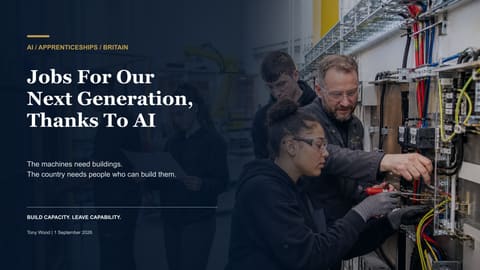
Jobs For Our Next Generation, Thanks To AI
AI infrastructure will not only need models and code. It could help Britain train a new generation of electricians, engineers and technicians for the physical economy.
Writing archive
Older essays on agentic systems, governance, operations, incentives, and the work of making AI useful in real organisations.
AI infrastructure will not only need models and code. It could help Britain train a new generation of electricians, engineers and technicians for the physical economy.

The permanent workforce is smaller than the headline, but a sustained data-centre build programme could help rebuild Britain's electrical and engineering skills base.

A real community is not a room full of people who always agree with you. It is learning how to disagree, set boundaries, repair relationships and know when behaviour has crossed the line.
Demanding leaders are paid to decide, challenge and move quickly. The difficult part is learning when directness is cultural, when silence means exit, and when behaviour has genuinely crossed the line.

Codex Voice already feels like a coworker. Long-running agents are beginning to feel like employees. What changes when we can brief them, leave them working and return to evidence?

There is no agreed AGI finish line. Here are the competing definitions, the public evidence and the five-part test that matters for organisations.
Preventing an unearned production release was a safety success. Failing to reach the smallest useful outcome was still a delivery failure. This is what the first Orchistra rollout taught me, and why the rebuild starts with Orchistra Zero.

The new portable skills and plugin moment makes professional know-how easier to package, share and copy. What can a licence, a hash and a common format actually protect?
Pricing Watch 2: an August 2026 UK view of direct AI API prices, separating Anthropic Haiku's provider-price change from small GBP exchange-rate movement.

A citation is the start of a conversation, not the end of one. Here is the evidence trail that should sit behind the phrase: research says.

The working agent and the agent I talk to are not always the same job. Give every Codex thread its own persistent voice, project context and bounded technical lead.
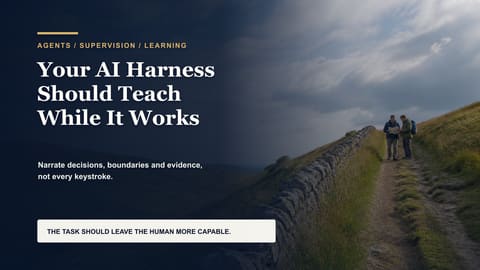
Long-running agents need supervision. The same narration that keeps them on course could turn every task into a lesson.

Do not postpone AI until every system is clean. Use bounded, valuable data now, verify the work, and improve the wider data estate in parallel.

We have never had to choose an employee by intelligence setting. AI changes that. The practical rule is to use the smallest model and reasoning level that can reliably finish the work, then escalate on evidence.

Zero Data Retention removes a major practical objection to frontier AI. It does not make GDPR, permissions or company governance somebody else's problem.

Companies need one coherent view of the work. They can get it by consolidating into ERP or by letting an authorised agentic layer orchestrate their existing systems.

Onshore wind and large solar really are cheap sources of bulk electricity. France shows existing nuclear can be competitive too. The hard part is comparing different services and whole-system costs honestly.

The gas shock explains the surge in UK household energy bills. Britain now has unusually expensive household electricity but comparatively cheap gas, and the difference sits across fuel exposure, infrastructure, market design and how costs are recovered.

We may not remain the smartest things on the planet. We can still have an incredible life.

The Linux desktop preview gives Codex users a cheaper route to dedicated agent machines, but price is only the first line of the specification.

AI adoption starts with one safe tool, protected time, bounded access and domain experts learning alongside technical people.
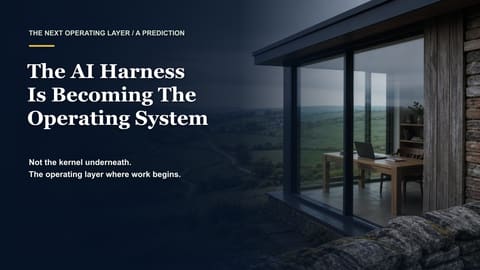
Codex and Claude are moving beyond chat and becoming operating layers for work. The kernel remains underneath, but the surface people actually use may be about to change.

AI does not make software secure by magic. It amplifies the engineering system around it, which is why trained developers and disciplined security loops matter more.
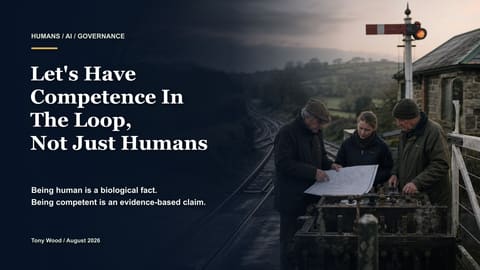
A human in the loop is not automatically a safety control. Meaningful oversight requires task-specific competence, information, capacity, authority and accountability.
Privacy choice
Cookieless Matomo analytics help me understand which public pages are useful. They are on by default unless you turn them off, and your choice never affects access to the site.