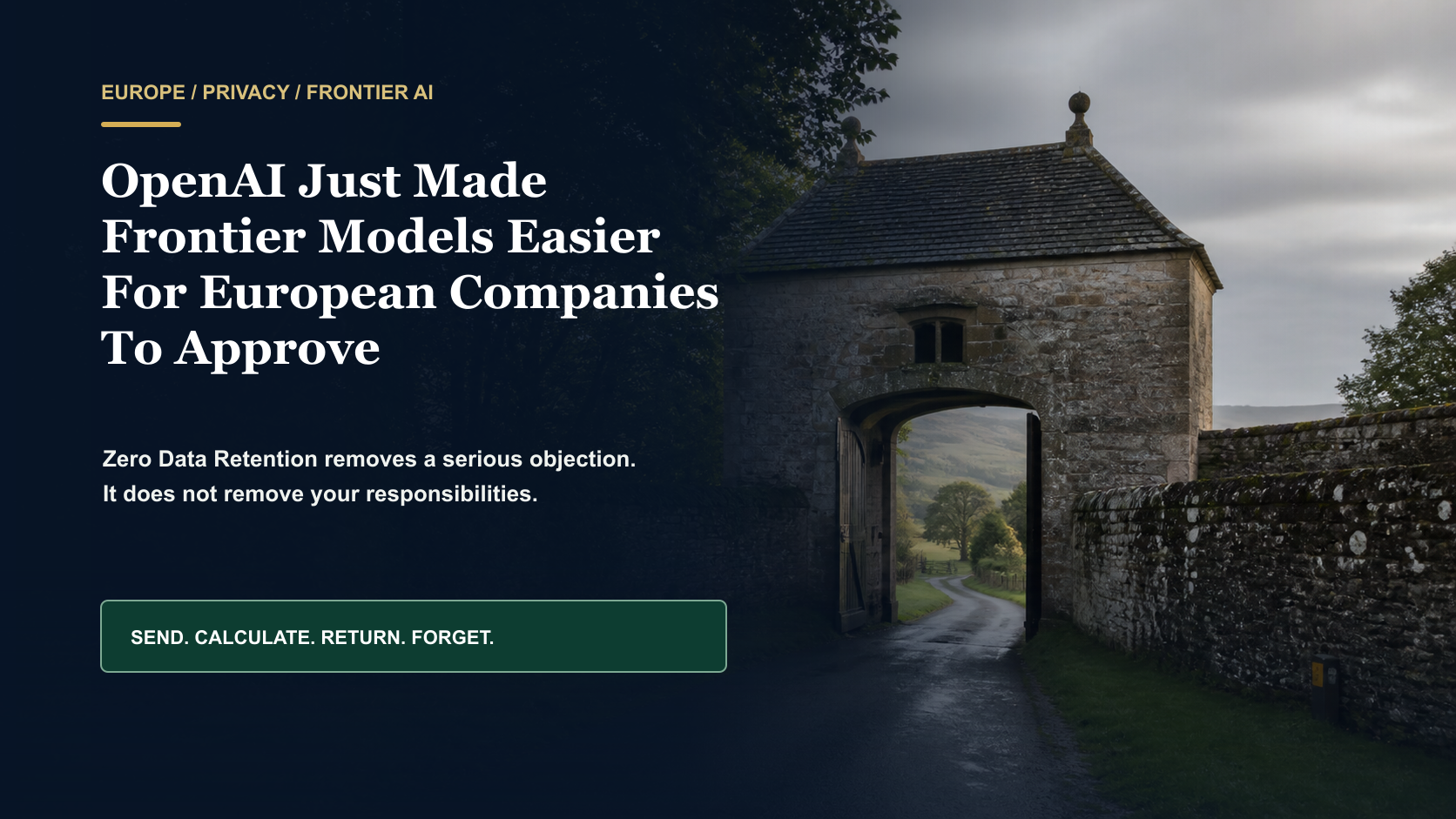
OpenAI has just removed one of the most persistent practical objections to using its frontier models inside a European company.
Not all the objections. Come on.
But one of the big ones.
On 19 August 2026, OpenAI announced that eligible API customers can use its frontier models with Zero Data Retention, or ZDR, while it develops a new safety system designed to identify risky patterns across related interactions without giving OpenAI personnel access to the underlying customer content.
That sentence needs a little unpacking.
It does not mean OpenAI was previously unlawful to use in Europe. Many companies were already using OpenAI under contracts, a data processing agreement, defined controls and their own lawful basis.
It does mean that the retention question has become much easier to answer for an eligible deployment:
Send the minimum information needed. Calculate the answer. Return it. Do not retain the prompt or response after the request is processed.
For a data protection officer, a chief information security officer or an enterprise buyer, that is not a small change.
Europe did not ban AI
There is a slightly lazy version of this story which says, at last, European companies can use OpenAI.
That is not quite right.
European data protection law does not say that a company cannot use an external processor. It says the company must know what personal data it is processing, why it is processing it, what its lawful basis is, where the data goes, how it is protected, how long it is kept and how people can exercise their rights.
OpenAI already publishes a Data Processing Addendum covering processor obligations, subprocessors and international transfer mechanisms. It also says that API and enterprise customer data is not used to train its models by default.
Those things matter. They are part of a serious supplier review.
But they did not make the retention concern disappear.
The old enterprise objection
Imagine an agent has to review a customer complaint, an employment case, a medical note, a financial record or a confidential engineering document.
The company may have a legitimate reason to process that information. It may have strong access controls. It may have a contract with the model provider.
Then somebody around the table asks a perfectly reasonable question:
After the model has produced the answer, why does the provider need to retain the prompt and response?
If the answer is abuse monitoring, service operation or debugging, the next questions arrive quickly. Who can access it? For how long? In which region? Under which exception? What happens if there is a breach? Can we honour deletion or access requests? Are we sending more than we need?
This is where many otherwise promising AI projects become stuck between a good demo and a production approval.
The technology works. The retention story does not fit the risk appetite.
What OpenAI actually changed
Zero Data Retention itself is not new. OpenAI has offered data-retention controls to eligible API customers for some time.
The important part of the new announcement is that OpenAI is committing to keep ZDR available for frontier-model deployments while improving the safety systems needed for longer, more agentic work.
OpenAI says eligible ZDR customers receive three important protections:
- Prompts and model responses are not retained after the request is processed.
- Customer content is not available to OpenAI personnel for review, subject to a narrow legal exception for images flagged as possible child sexual abuse material.
- Enterprise customer data is not used for model training unless the customer explicitly opts in.
The proposed Private Safety Processing system is intended to look for patterns across related interactions without exposing the underlying content to OpenAI personnel. For ZDR deployments, OpenAI says the content remains on infrastructure controlled by the customer. Automated systems can return a limited safety signal if they identify potential misuse.
That system is still a preview. OpenAI says it is being tested with early customers and plans to begin rollout, with a technical white paper, in September 2026.
So this is a meaningful product direction and a current commitment. It is not yet a completed independent assurance report.
Zero means something precise, not everything
The phrase zero data retention is wonderfully clear. The implementation details are less magical.
OpenAI's API data-controls documentation says ZDR is available to eligible customers after approval. It also explains that compatibility depends on the endpoint, feature and tool being used.
For example, standard Responses and Chat Completions requests can be ZDR eligible, with storage disabled. But persistent conversations, assistants, vector stores, files, batches and some other stateful features have different retention behaviour or are not ZDR eligible. Background mode can write response data to disk temporarily. Code Interpreter and hosted shell containers can hold temporary application state while a container is active. Prompt caching also has its own temporary-state rules. Data sent to a third-party MCP server is governed by that service's own retention policy.
OpenAI's documentation also describes limited circumstances in which a model can be made ineligible for ZDR or placed under Safety Retention, with affected customers notified in advance. That is another reason to verify the live agreement and configuration rather than relying on a label.
That gives us a very practical rule:
Do not buy the acronym. Verify the exact model, endpoint, tool, project configuration and external service used by the real workflow.
A ZDR badge on an architecture diagram is not evidence that every route through the system forgets.
Why data protection officers should care
ZDR reduces several risks at once.
- Retention risk: fewer copies of sensitive prompts and outputs remain with the model provider.
- Secondary-use risk: the content is not quietly repurposed for model training.
- Internal-access risk: OpenAI personnel do not have the underlying customer content available for review in the stated ZDR design.
- Breach exposure: content that is not retained cannot later be exposed from that retained store.
- Minimisation: the architecture now better supports a send, calculate, return and forget model.
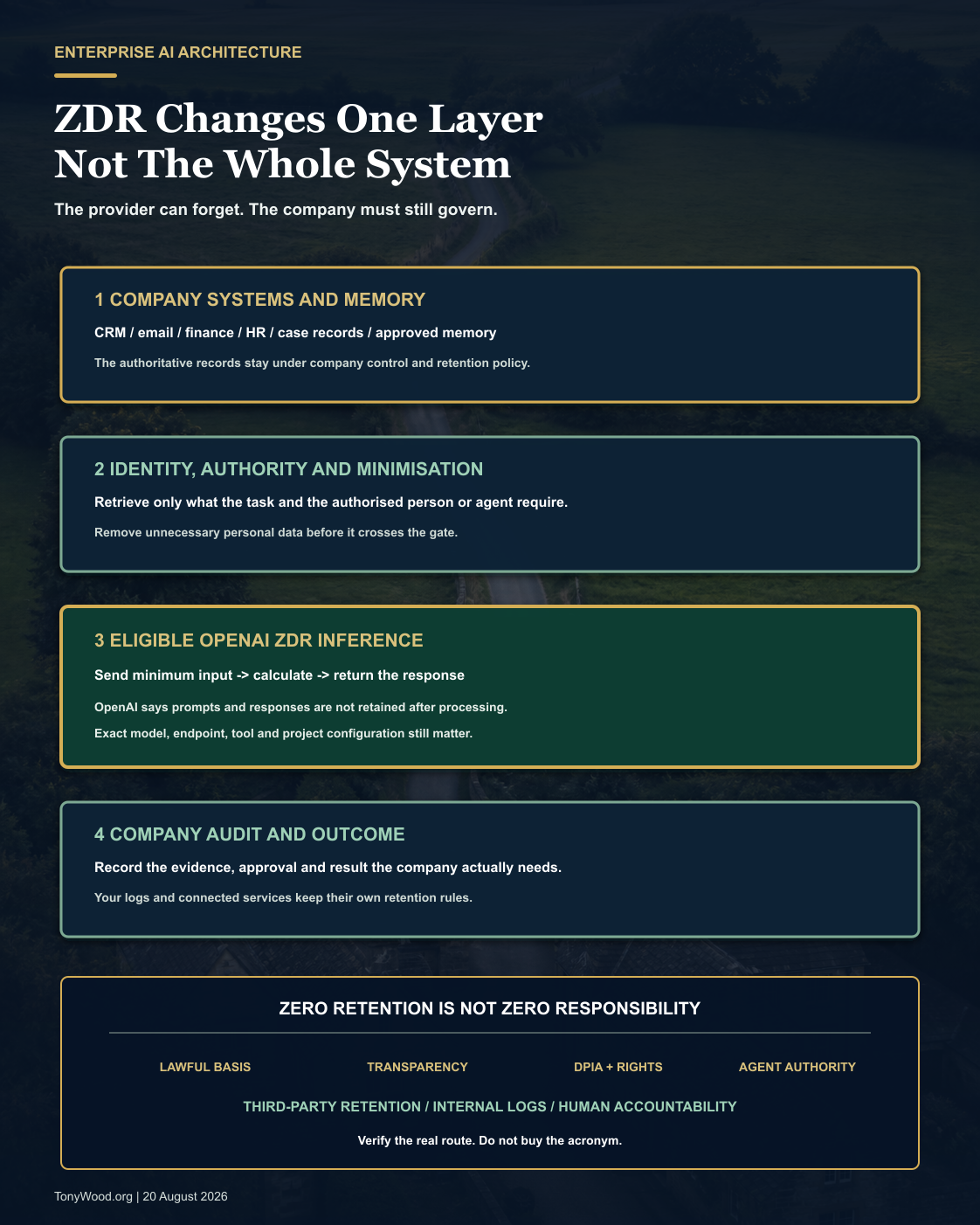
It does not reduce those risks to zero across the whole company. Your own systems may keep the prompt. Your orchestration layer may log it. Your observability tool may capture it. Your MCP server may store it. The employee may paste the answer into a case record that has a ten-year retention policy.
ZDR changes the provider-side inference layer. It does not rewrite the rest of your architecture.
ZDR does not mean GDPR compliant
This is the part I would put in large letters on the board paper.
Zero Data Retention is a useful supplier control. It is not a lawful basis.
The organisation still has to decide:
- Why it is processing the personal data and which lawful basis applies.
- Whether it is sending only the data genuinely needed for the task.
- What it tells employees, customers, patients or other affected people.
- Whether the use requires a Data Protection Impact Assessment.
- How it handles special-category data and higher-risk decisions.
- How people can exercise access, correction, objection and other rights.
- Whether any automated decision has a legal or similarly significant effect.
- Who can review, challenge and override the agent's work.
- What the company itself records, retains and deletes.
The ICO's AI guidance makes the same basic point: data protection obligations follow the processing, not the excitement around the tool. Its guidance on automated decision-making and profiling also requires organisations to think about lawful basis, transparency, rights, accuracy, risk and meaningful oversight.
For EU organisations, the same practical questions need to be tested against EU GDPR and the applicable national rules. For UK organisations, use the current UK GDPR and ICO guidance. They are closely related systems, but they are not one interchangeable sentence in a procurement form.
This article is operational commentary, not legal advice. A real deployment needs the company's own legal, privacy and security review.
Agentic AI makes this more important
A person might make one request to a model.
An agent can make thousands.
It may retrieve a CRM record, inspect an email, compare an invoice, read a personnel policy, draft a response, call another tool, reconsider the answer and try again.
That is why I am much more interested in this announcement as an agentic architecture change than as a chatbot privacy feature.
At scale, small retention choices become large data estates. One extra copy per request becomes a great many extra copies when the system is working all day.
The stronger architecture is:
- The company keeps authoritative data and persistent memory in systems it controls.
- Identity and permissions decide what the agent may retrieve.
- A policy layer removes unnecessary personal or confidential information.
- An eligible ZDR inference route performs the bounded calculation.
- The answer returns to the company.
- The company records the evidence, approval and outcome it actually needs under its own retention policy.
OpenAI can provide the intelligence without automatically becoming the company's memory.
That is a much better separation of duties.
The real shift is inference as infrastructure
We are used to thinking about software as a place where data lives.
Frontier AI may increasingly work more like a calculation service.
Send. Calculate. Return. Forget.
The company still owns the difficult bits: identity, permissions, purpose, source data, memory, audit, retention, human accountability and recovery.
Good. It should.
But the model provider no longer needs to retain the full conversation merely to provide the intelligence, at least for an eligible and correctly configured ZDR route.
That does not make the governance work disappear.
It makes the architecture cleaner, the supplier conversation easier and the route to a defensible production deployment considerably more realistic.
For European companies that have been waiting for a better answer to the retention question, this is a serious step forward.
Not permission to stop asking questions.
A much better answer to one of them.