I am beginning to wonder whether my next operating system will be an agent.
I find myself working inside the agent's framework more and more. Windows or macOS is still there, doing its job, but increasingly it is the thing I use to launch the place where I actually work.
That is quite a shift. The computer starts up. I open the agent. Then I get on with working through the things I want to do.
And it leaves me wondering: if that is where the work is going to happen, why are we still organising so much of the experience around opening applications?
Perhaps the next big change is not a better desktop. Perhaps it is a different way of getting things done.
I remember when the desktop was the exciting bit
I remember Internet World in 1995, and the excitement around that period. I had worked through earlier versions of Windows, including Windows 3.1. The interface mattered enormously.
Windows 95 launched on 24 August 1995, bringing the Start menu and taskbar. We are now more than thirty years on from that launch. Microsoft's own retrospective is a useful reminder of where those familiar ideas came from.
Those interfaces gave us a way into the machine. Open this program. Find this file. Move between these windows. Learn where the software designer has put the thing you need.
They were useful. They still are. And interfaces have changed since then: I am not pretending the industry has stood still.
But I still spend time adapting myself to somebody else's arrangement of the work. Their menus. Their categories. Their idea of the sequence I should follow.
What interests me now is the possibility of turning that relationship around.
The operating system underneath still matters
Before somebody quite reasonably points it out: an agent is not a replacement for everything an operating system does.
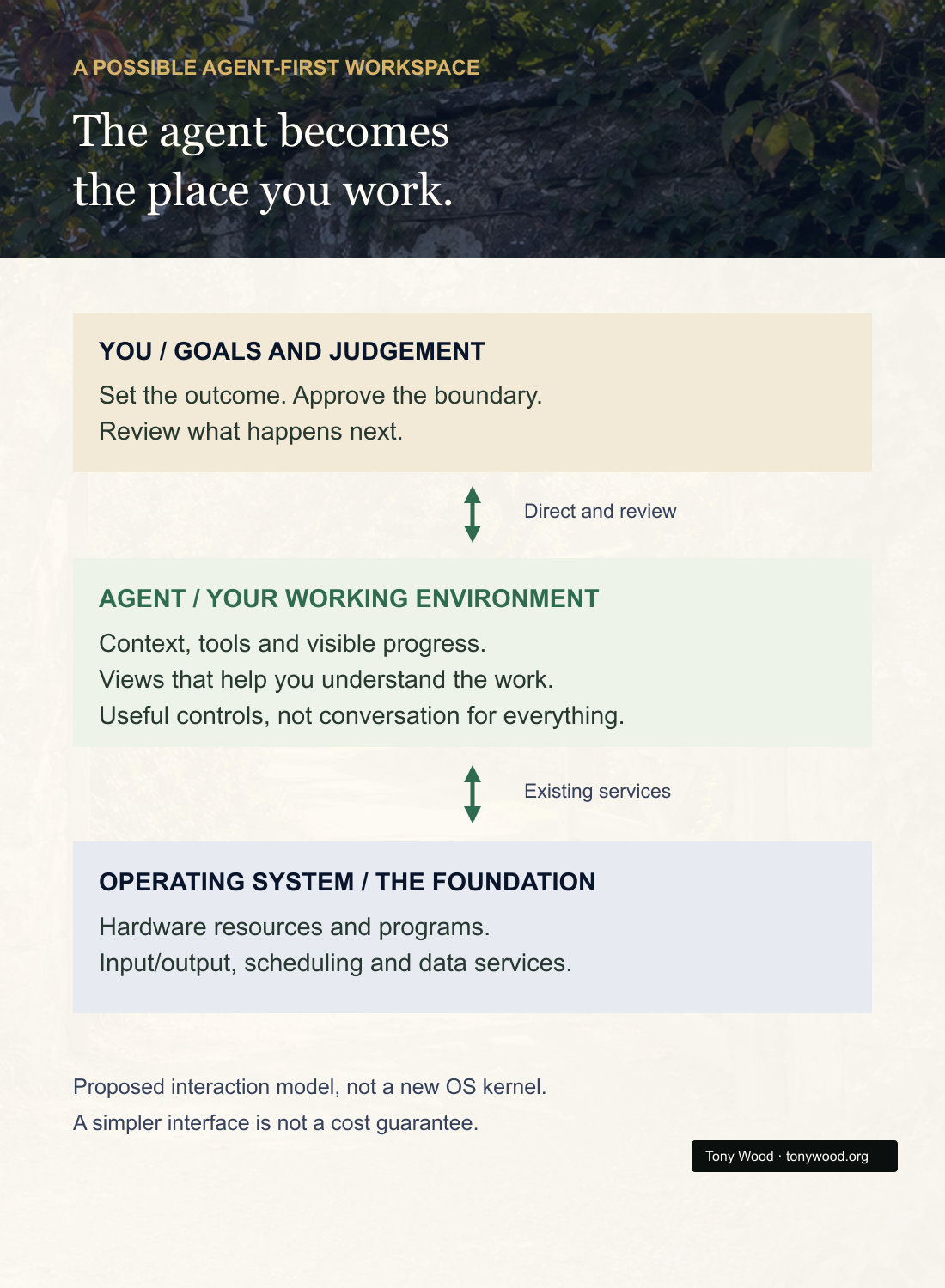
Operating systems manage hardware resources and provide services for programs, including input and output, scheduling and data management. That is the underlying technical role described in NIST's definitions. A conversational workspace does not make those jobs disappear.
I mean something different: the place where I direct my work, find its context and see what is happening.
The traditional operating system looks after the computer. The agent could increasingly organise my interaction with the work running across it.
One sits on top of the other. There is no need to pretend they are technically the same thing to recognise that the change could be significant.
From opening a program to asking for an outcome
Think about it. If I want to prepare for a meeting, the outcome is not that I have opened my calendar, email, document store and notes application.
The outcome is that I understand the meeting, have the relevant information and know what I need to decide.
I would like to start there. Let the agent gather what it is authorised to access, show me what it found and make the gaps obvious. Give me the source documents when I need them. Do not make me conduct a tour of four applications just to assemble the question.
This becomes more interesting when the agent can do agreed work without waiting for me to type the same request again.
There are already limited, concrete examples. Anthropic documents recurring tasks in Claude Cowork, including research, reports and briefings using configured connectors. That is a vendor-described scheduling capability, checked on 13 November 2026. It is not evidence that a system can independently understand and run my whole life.
That distinction matters. A scheduled instruction is one thing. Reliably noticing that my priorities have changed and knowing what to do about it is quite another.
But I can see the direction: less time remembering which application to visit, more time deciding what I want done and reviewing what happened.
Why should my mind fit your menu?
This is the part that interests me most.
I might want to talk an idea through. Another person might want a diagram, a comparison table or a sequence they can tick off. I might want different things depending on the problem.
That does not require an AI to discover a fixed category for my brain. It can start with a much simpler question: how would this be easier for me to understand and work with?
Show me the relationships. Break the decision into stages. Put the evidence beside the claim. Let me change the view without reorganising all the underlying information.
The idea of adapting an interface to a person is not new. In a 2008 study by Krzysztof Gajos, Jacob Wobbrock and Daniel Weld, ability-based interfaces generated by SUPPLE++ improved speed and reduced errors for participants with motor impairments compared with the baseline interfaces. It was a small laboratory study about motor accessibility, not a test of generative AI or evidence that every person has a fixed learning style.
What I take from that is a useful design principle: difficulty using an interface need not mean the person is the problem. Sometimes the interface is a poor fit.
I would like agents to extend that principle into everyday work. Adapt to what I am trying to do, what I can comfortably use and what helps me see the situation clearly.
I do not want software to diagnose how my mind works. I want it to stop insisting that there is only one sensible way to do the job.
Please do not replace every button with a conversation
There is a slightly comic version of this future where I have to negotiate with my computer to change a number in a spreadsheet.
No, thank you.
If a button does the job, keep the button. If I am comparing figures, give me a table. If the work is spatial, show me a picture. Conversation is useful for explaining intent and working through uncertainty; it need not become the only way to interact.
And adaptation should not mean the controls move every morning because the agent has had another idea.
Microsoft Research's 2019 human-AI interaction guidelines recommend making capabilities clear, supporting correction and dismissal, and adapting cautiously over time. Those are design recommendations, not proof that today's products follow them.
That sounds like a reasonable bargain to me. Let the agent help me arrange the work. Keep the important controls predictable, and let me tell it when its arrangement is making things worse.
Would I buy a machine built around this?
Quite possibly.
If somebody offered me a dependable machine built around the agent workspace I actually use, with the browser, connections and tools I need, I would be interested. I do not necessarily need the most elaborate desktop experience to launch it.
I have already written about choosing Linux for some of my agentic workers. This is the next question: what if the environment were designed around the agent from the beginning, rather than the agent being another application I install afterwards?
A simpler device could be cheaper for some workloads, particularly if the demanding computation happened elsewhere. That is a possibility, not a price comparison or a claim that the computing has become free.
I would still have to count the subscription, usage, connectivity, support and replacement costs. If the work needed powerful local models, I would need suitable hardware for that too.
I would also want to know what happened when the connection failed, the provider changed its prices or the account stopped working. Could I still get my files, export my working context and carry on another way?
A cheap box that makes it difficult to leave the service is not automatically a cheap way to work.
A helpful agent needs a visible brake
The more the agent becomes my working environment, the more important it becomes that I can see what it is doing.
I want to know which information it used, what it changed, what is still running and what needs my decision. Reading something, drafting something and sending something are different permissions.
There is also a real security issue. The UK's National Cyber Security Centre warns about prompt injection: untrusted content can influence a model as though it were an instruction. Its advice is to reduce risk and impact, not assume a complete fix.
For me, that means limited access, clear approval boundaries and a way to stop work. A request inside a document should not become permission to spend money or email somebody. Those boundaries need to be enforced by the tools and services too, not left entirely to the model's judgement.
This connects with working beside an agent. I am interested in an environment that helps me understand and steer the work, not one that makes the work disappear from view.
The next desktop might be organised around me
I do not know which company will get this right. It could be an existing operating-system provider. It could be an agent company. It could be somebody building on an existing system underneath.
Nor do I think everyone will stop using familiar applications. There are plenty of jobs where directly manipulating a document, image or set of figures is exactly what you want.
But the change I am noticing is real for me: I am becoming less interested in which application holds a task and more interested in having an environment that helps me move the task forward.
That is the thing. We have spent years learning how software wants us to behave.
Perhaps the next stage is software learning enough about our work to meet us halfway.
Keep the operating system underneath. I would just quite like the working environment on top to fit the person using it.
Sources and notes
Evidence checked on 13 November 2026. This is personal experience and an argument about a possible interface shift, not a product announcement or a market forecast. Vendor documentation is not independent reliability evidence. The 2008 motor-accessibility study is not evidence of fixed learning styles or generative-AI performance. Hardware savings remain conditional.
- Looking back: The 25th Anniversary of Windows 95.
- NIST CSRC glossary: operating system.
- Schedule recurring tasks in Claude Cowork.
- Gajos, Wobbrock and Weld: Improving the Performance of Motor-Impaired Users with Automatically-Generated, Ability-Based Interfaces.
- Guidelines for Human-AI Interaction: Eighteen best practices for human-centered AI design.
- Mistaking AI vulnerability could lead to large-scale breaches, NCSC warns.