
Give an agent one useful job, a named owner and only the access it needs. Prove that the work is good, that the boundaries hold and that you can stop it. Then expand.
That is how I would start rolling out smart agents across an enterprise.
The ambition can be global. The first piece of work should be small enough for someone to understand and take responsibility for. Buying access is the easy part. Someone still has to decide what these new colleagues are allowed to do.
Grok Bot is a useful example because it combines ongoing agents with a hosted computer and access to business applications. It brings the rollout question into focus: who can use it, where does the information go, and what can it actually change?
Start with the product, plan and country
A global business needs to know whether its chosen tool can serve the people and markets involved. Check the actual plan and workspace, the supported countries and the enabled features before building a company-wide process around it.
There is an important correction to make here. As checked on 21 October 2026, OpenAI lists Dots as rolling out worldwide for Business Premium and Enterprise. Its EEA, UK and Switzerland exclusion is listed for Pro plans. Enterprise Dots are off by default and require an administrator to enable them; the rollout is gradual.
However, OpenAI's enterprise eligibility guidance says Dots do not support data residency or inference residency during the Enterprise beta. Some workspace configurations are excluded. That can rule Dots out for an enterprise with those requirements, despite the worldwide rollout.
So I would not describe Grok as the only global enterprise option on a blanket regional-exclusion basis. Nor would I assume that a worldwide rollout means a particular workspace already has access. Check the actual eligibility, data requirements and contract before choosing.
I am using Grok Bot as the worked example. The enterprise discipline applies whichever supplier you choose.
Understand what you are deploying
A Grok model in an application, a Grok business subscription and Grok Bot are different things. This article concerns the Bot product: an agent that can keep working across websites, applications and files.
Cursor's deployment guide describes installing the client on staff devices through the organisation's normal software-management tools. The hosted computer where the Bots work sits in Cursor's cloud. Managing the employee's laptop does not automatically bring that cloud computer into the company's device-management estate.
The security FAQ describes a separate hosted computer for each user. Every Bot belonging to that user shares it. Treat a file or login on that computer as accessible to all the Bots that user runs.
That matters. Calling one Bot Finance and another Marketing does not create a secure departmental boundary. Where a workload needs its own computer and credentials, the documentation directs customers to use a separate Cursor user. Work through the appropriate accounts and permissions with IT.
Follow the data before connecting the tools
I would ask for a simple map of the whole journey:
Company information → the Bot's computer → the model service → connected applications → the company's records and audit trail.
Mark what is stored at each stage, who can access it and how it is removed.
Cursor currently says Grok Bot's hosted computers run in the United States. A member of staff sitting in London or Frankfurt is therefore not evidence that the Bot's work stays in Europe.
If the requirement is UK-only or EU-only processing, the documented US-hosted Bot computer does not meet that requirement. Stop that proposed route and resolve the location requirement before putting the information into it.
International processing can be possible under data-protection rules, but the arrangement needs assessment. The ICO and European Data Protection Board explain the relevant transfer requirements. I would have the privacy and legal teams assess the actual data, contracts and destinations.
Ask separately about the model layer. Cursor says Grok Bot chooses its models, may use third-party providers and is not governed by the team's model allowlist. Do not approve a Bot workflow on the assumption that it uses only one named model supplier.
Also separate model-provider retention from files, memory, browser sessions and logs. A retention promise about one layer is not a statement that the entire workflow leaves nothing behind. Get the terms for the product you are actually buying, rather than borrowing a promise from its API or another service.
Give the first group one job
Here is the pilot I would consider: a supplier-renewal brief.
A small group prepares a regular note showing which approved software contracts are approaching renewal, what the available usage figures say and which questions the budget owner should ask.
Start with invented records or properly sanitised examples. Once the data review and access controls are approved, use the minimum real information needed. A contract can contain confidential or personal information; a familiar spreadsheet is not automatically harmless.
The Bot's job is to prepare a brief with links to the underlying evidence. It should flag missing information and uncertainty. The budget owner reviews the recommendations.
For this pilot I would keep supplier messages, cancellations, purchases and changes to the official contract register outside the Bot's permissions. There is plenty to learn from preparing a reliable recommendation before giving it authority to change the business.
Record how people do the task today: time spent gathering information, checking it, correcting mistakes and reaching a decision. Compare the agent-assisted process against that whole job. A quick draft which takes longer to check has not saved the company time.
Set the controls before background work
Grok Bot has enterprise controls, but their availability and their configuration are different questions.
Network Controls, enforced Auto-review and team Auto-review rules require the Enterprise plan. Self-serve Teams do not provide those administration settings.
The current enterprise administration guide says that teams without a network policy default to allowing all network access. Enforced Auto-review is off by default. Applying a network allowlist to remote MCP connections is a separate switch, also off by default. MCP is one way agents connect to other tools.
I would configure the first group deliberately:
- Company access. Use the corporate sign-in process, a defined pilot group and a tested leaver process. Cursor documents SSO and Enterprise SCIM provisioning; check the permissions in connected applications as well.
- Limited destinations. Allow the systems needed for the approved job. Include remote tool connections in that review.
- Explicit approval. Enforce review and require a person to approve consequential actions. Inspect group exceptions and shared-channel behaviour before relying on the policy.
- Restricted devices and credentials. Begin with local execution and routes into private systems disabled unless the pilot needs them. Use approved credential storage and narrowly scoped accounts.
- Evidence. Configure the records needed to investigate a run before the pilot starts.
Keep the final permission in the underlying system wherever possible. A Bot that can draft a purchasing recommendation need not have permission to place the order. An instruction in a prompt is useful guidance. Application permissions provide another control when that guidance fails.
Make the agent family useful
Once one Bot produces a dependable brief, I would consider separating the work into a small family.
A coordinator owns the brief. A research Bot gathers the approved records. A checking Bot compares dates, quantities and claims with the sources. The human budget owner makes the decision.
Each handoff should say what was found, where it came from, what remains uncertain and what happens next. Keep the working record somewhere the company controls, rather than relying on a conversation being remembered.
These are proposed roles, not a claim that I have deployed this procurement team. The shared-computer boundary still applies: a checking Bot on the same user's computer is not an independent security barrier. Adding a job title does not remove access.
Separate workloads that need separate permissions. Bring in a human or a genuinely separate review process for consequential decisions. Add another Bot when it improves the job, rather than because the organisation chart has an empty box.
Test the failure and the stop
During the pilot, I would give the agent a document containing a misleading instruction, a conflicting renewal date and an unavailable source. Does it treat an instruction inside a supplier document as company authority? Does it invent the missing date? Does it tell the owner it is stuck?
Use controlled test data and harmless destinations for these exercises. Inspect what happened and whether the controls blocked the attempted action.
For Grok Bot, administrative audit logs and Action Recording are separate. Action Recording is an Enterprise setting which starts off disabled. It records action metadata, not a full replay of everything the Bot saw or typed. Configure export if those events need to reach the company's monitoring system.
I would ask someone outside the pilot team to reconstruct a run from the available records. What did the agent access? What did it propose? Who approved the resulting business action? Where are the limits of the record?
Then test stopping and recovery. Terminating a Grok Bot computer stops its current work but retains its durable disk. The member can start a fresh computer on that disk. Termination does not remove access.
The runbook therefore needs separate steps for stopping current work, disabling future work, removing access and revoking connected credentials where required. Test the manual fallback too. Someone should still be able to prepare the renewal brief when the service is unavailable.
Expand in stages
I would use stages with evidence to advance, rather than promising a company-wide launch on an arbitrary date. This is a proposed rollout sequence, not a vendor deployment guarantee.
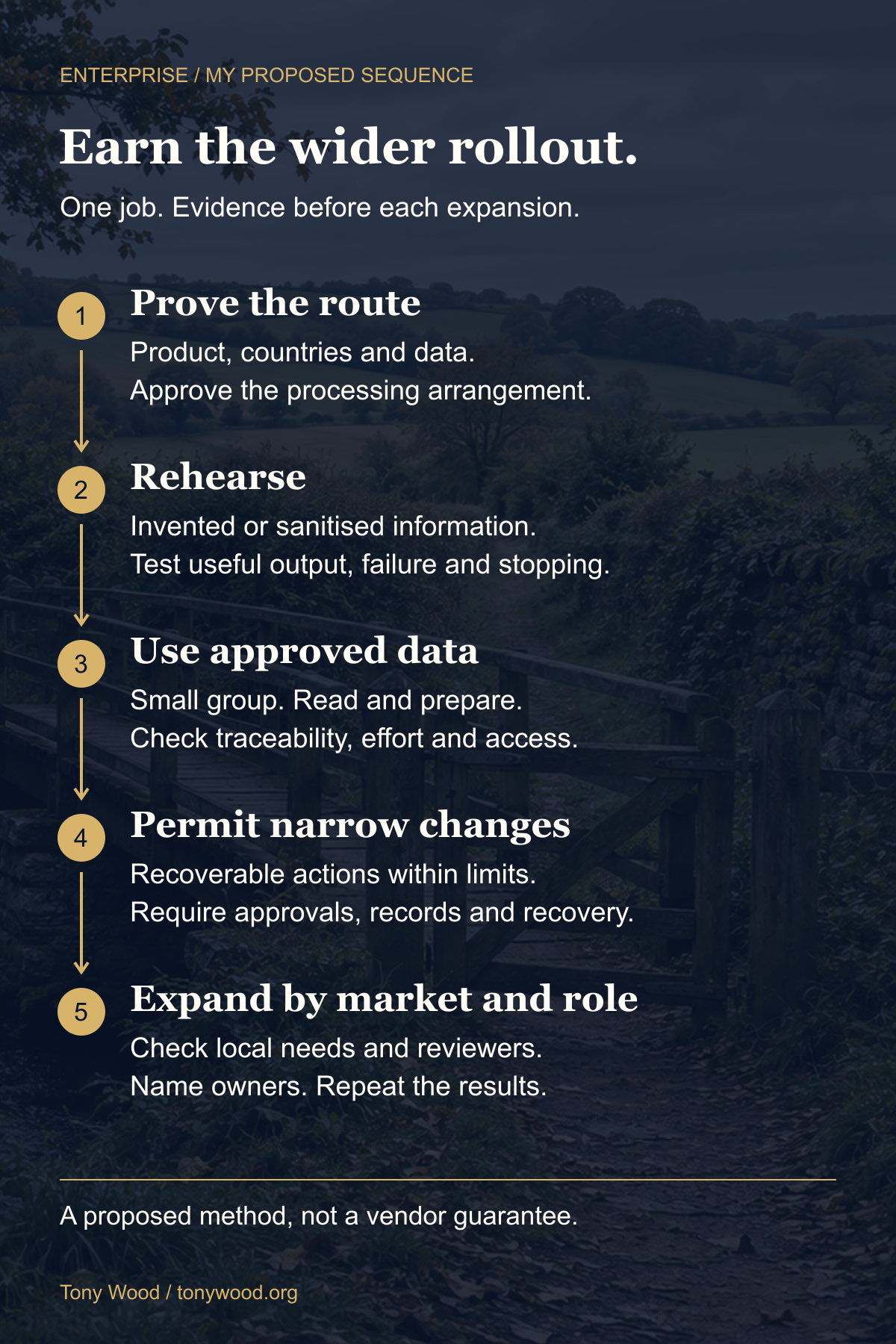
| Stage | Scope | Evidence before expansion |
|---|---|---|
| Prove the route | Product, plan, countries, contracts and data journey. | Documented access and an approved processing arrangement for the proposed work. |
| Rehearse | One workflow with invented or sanitised information. | Useful output, visible failures and a tested stop process. |
| Use approved data | Small group; limited sources; read and prepare. | Traceable recommendations, measured checking effort and functioning access controls. |
| Permit narrow changes | Specific, recoverable actions within agreed limits. | Required approvals, records and demonstrated recovery. |
| Expand by market and role | Additional groups with local requirements checked. | Named owners, trained reviewers and repeatable results in each new setting. |
For a global rollout, repeat the relevant checks in each market: language, time zone, currency, information access and who is available to approve work. A process that succeeds with the London team watching it is not yet evidence that it works unattended for another region.
Give people a clear route to suggest useful jobs and get them assessed. Otherwise the sanctioned pilot and the work people actually want to do can drift apart.
What I would ask at the board table
I would want a short account of the work, its limits and its results:
- Which business job is improving, and who owns the result?
- Who has access, in which markets, and where does the information go?
- What can agents change, and which decisions still require a person?
- What failed in testing, and did stopping, revocation and recovery work?
- What is the cost per accepted piece of work, including usage, checking and correction?
I would also want to know who watches supplier and platform changes. A changed model route, connector or permission can change the approved arrangement. Put rechecking it into someone's job.
Grok Bot makes the enterprise question concrete. There is a hosted working environment, company information, connected accounts and software capable of taking action. Someone has to own how those things fit together.
The global ambition is useful work across the business, with a common standard and clearly approved local differences. Start with one job you can inspect. Earn the wider rollout.
Sources and related reading
Product documentation checked on 21 October 2026. Vendor descriptions establish documented behaviour and controls; they are not an independent assurance of a customer's configuration. The procurement example, agent roles and rollout stages are my proposed approach, not a reported enterprise deployment or a legal approval.
- Grok Bot: deployment, security FAQ, security architecture, enterprise controls and computer management.
- OpenAI Dots: plan-specific rollout, Enterprise beta residency limits and enterprise requirements.
- Earlier articles: Grok Bot: A Practical Guide to Getting Work Done and OpenAI Dots: Keeping the Work Moving Between Conversations.
- Shepherd of Agentic Sheep: the wider field notes and thinking behind how I work with agents.