Here is an interesting thought experiment. If AI becomes very good at connecting people who need things with people who can provide them, could we get rid of money?
Not just coins. Not just paying with a card instead of cash. Money itself.
I do something useful for you. You do something useful for somebody else. Somewhere in that network, somebody provides what I need. Our agents organise the connections, agree the commitments and keep track of what has happened.
Why does every step need to pass through a bank balance?
I think there is something to this. AI could make some exchanges practical without conventional money. But removing the hassle of arranging a trade is not the same as removing every reason we use money.
The interesting question is how far we could take it, and what we would need to put in its place.
Why do we use money in the first place?
Imagine I can repair your cupboards and you can do my accounts. If we both want those jobs done, we might agree a swap.
But suppose you do not need any carpentry. You need your website fixed. The web developer needs a plumber, and the plumber needs somebody to repair a cupboard.
There could be a useful trade in there. Finding it, agreeing it and making sure everyone follows through is the difficult bit.
Money lets me avoid finding that whole chain. I can sell my work to one person and buy from another. The buyer does not have to supply what I want.
The Bank of England describes three familiar functions: money is a medium of exchange, a unit of account and a store of value. It helps us trade, compare prices and carry spending power into the future. That last function is imperfect: keeping a pound does not guarantee what it will buy later.
That is a functional explanation, not a claim that every society followed one simple journey from barter to coins to banks.
There is a real connection between Welsh livestock trading and banking. The Tywi Valley's archaeological history records drovers' banks, including Llandovery's Black Ox Bank, founded in 1799. The Bank of England's own founding in 1694 was a different story: it was established primarily to finance the government's war against France.
Those are chapters in banking history, not the beginning of money. As the Bank's explanation of earlier forms of money shows, the arrangements have changed considerably over time.
What if an agent could find the whole exchange?
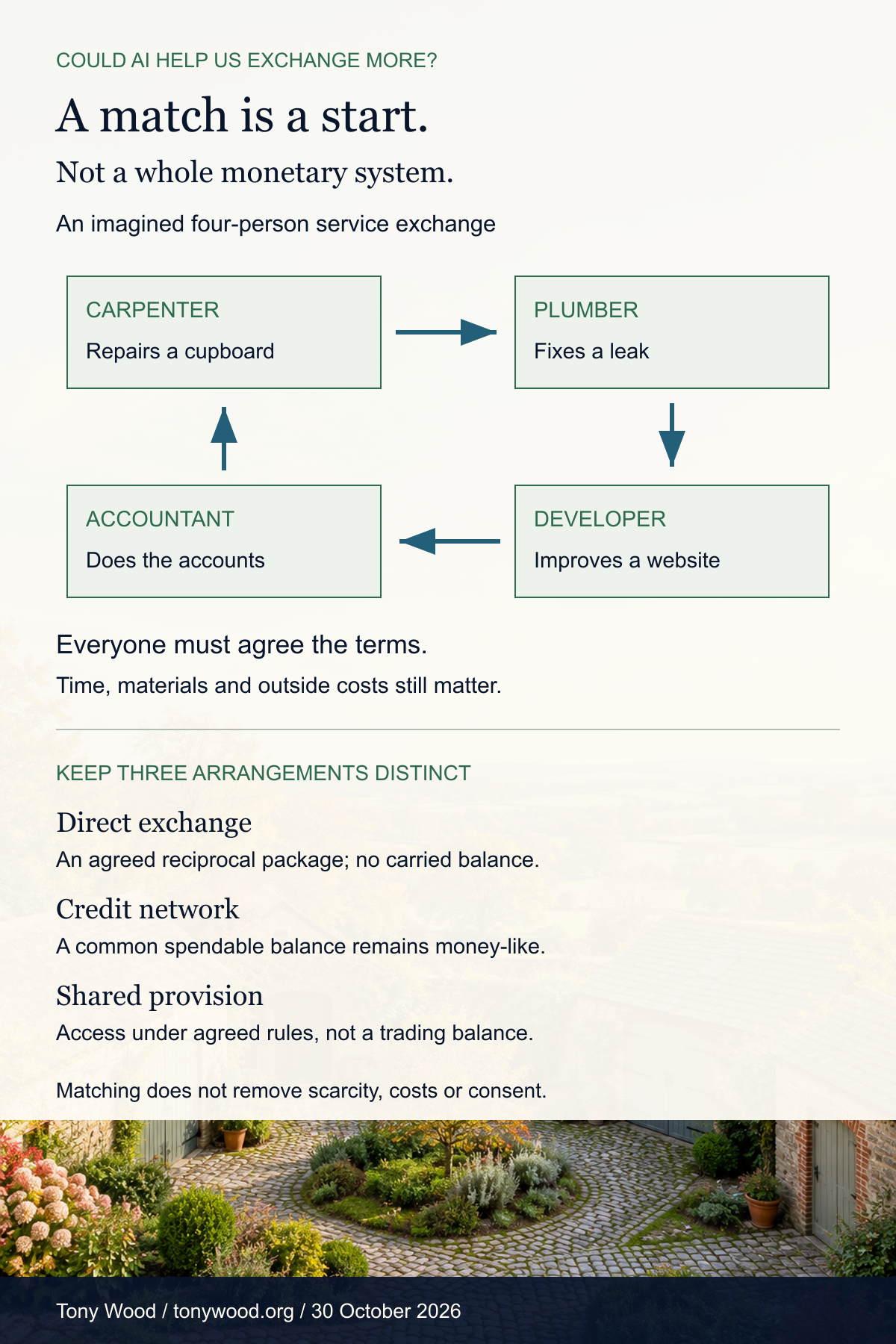
Let's return to our four people. This is an imagined example, not an existing scheme.
- The carpenter repairs the plumber's cupboard.
- The plumber fixes a leak for the web developer.
- The developer improves the accountant's website.
- The accountant does the carpenter's accounts.
Each person supplies one service and receives another. If all four accept the terms, they could complete that exchange without paying each other in pounds.
That does not mean the jobs take equal time, have identical market prices or use no materials. Those differences would need agreement. If the plumber needs to buy a part outside the network, somebody still needs to cover it.
Now imagine agents helping to find these opportunities across a local business community. They could collect offers and requests, check availability, suggest combinations and bring back a proposed deal.
Think about it. The people do not need to know that the chain exists before they join. That is part of the coordination work the system could do.
AI would not need to invent every matching algorithm. Established optimisation software could search for feasible exchanges; agents could help people describe their needs and understand the proposals. There would still need to be verification, consent and a way to handle failure.
The research chapter The Coasean Singularity?, by Peyman Shahidi and colleagues, explores how agents could reduce search, negotiation and contracting costs. It also discusses new frictions and uncertain overall welfare effects. It is an economic analysis of possibilities, not proof that agents have made those costs disappear.
My extension of that idea is to ask whether cheaper coordination could make direct, multi-person exchange more useful, rather than only making it easier to spend money.
We already have parts of this
Timebanking UK describes an arrangement in which an hour of help earns an hour's credit, which can be used to receive help from somebody else. It values everyone's time equally, whatever the task. Participants may still agree to cover expenses.
That is a deliberate social rule, not a discovery that every service has the same market price. It shows that the person you help does not have to be the person who helps you back.
Businesses have related arrangements. SardexPay describes a network in which members buy and sell using internal credits. Its own rules use a nominal value of one sardex to one euro for accounting, while saying the credit cannot be converted into ordinary currency. This is a complementary-currency system, not the disappearance of money. These are the operator's descriptions, not an independent assessment of every claimed benefit.
There is also a very different example: the UK Living Kidney Sharing Scheme. It connects donor-recipient pairs using computer matching, with transplant centres then carrying out further tests.
I am not comparing a kidney with a cupboard or proposing that organs should be traded commercially. This is a tightly governed donation scheme, not an ordinary market or an AI-led barter experiment. It illustrates the narrower point that computer-assisted matching can coordinate valuable exchanges without using a purchase price to connect the participants.
So the basic possibility is not science fiction. The open question is which of these arrangements AI could improve, at what cost, and how far they could extend.
The particularly interesting idea: money as memory
Economist Narayana Kocherlakota published a paper called Money Is Memory in 1998.
Within the particular economic environments he studies, allocations which money can support can also be supported by a specific form of transaction memory. People in the model have free, immediate access to full histories of actions within a defined network of direct and indirect trading contacts, not an unrestricted record of everyone.
That information pattern matters, not just the amount of data. It is one of the model's strong assumptions, not something an ordinary database or AI automatically provides.
It gives my thought experiment a serious foundation, though. Information about past contributions and exchanges can sometimes do work otherwise done by monetary tokens.
Importantly, that does not mean every record is money. A history of who helped whom is not necessarily a transferable balance which can be spent anywhere. The paper is a theoretical result about specified environments, not a blueprint for replacing Britain's monetary system.
My question is whether better tools could let us move some distance in that direction without requiring perfect information or a record of everybody's private life.
Value is not simply the hours somebody worked
This is the other part of the idea that interests me.
What something is worth to the recipient is not necessarily the number of hours the provider spent on it. A repair which takes ten minutes could matter enormously if it gets your business running again.
But I would separate need, willingness to pay and the price which actually gets agreed. They are not the same thing.
Imagine two people competing for the last available taxi. One has plenty of money and would prefer not to walk. The other has an urgent reason to travel but very little money.
A higher bid would not prove a greater human need. Nor would urgency, by itself, tell us the driver's costs or what alternatives are available.
An agent might negotiate around people's preferences, available capacity and constraints. It cannot discover one objectively correct value for every person's work just by being clever.
There are different systems we could choose. A time bank deliberately treats an hour as an hour. A commercial exchange might negotiate different terms. A community service could prioritise urgent need rather than contribution.
Those are choices about how we want to live, not three versions of the same calculation.
At what point have we invented money again?
Suppose I help today, but there is nothing I want until next month.
The system could give me a balance to spend later. If that balance is durable, widely accepted and usable to obtain many different things, it starts performing monetary functions, even if we call it a contribution score.
We should not announce that money has disappeared just because the pounds have been replaced with points.
| Arrangement | Details |
|---|---|
| Direct exchange | How it works: People agree a particular package of reciprocal contributions, with no spendable balance carried forward. What has changed? That exchange may need no currency between participants. |
| Credit network | How it works: Members earn and spend a common balance across the network. What has changed? Ordinary-currency payments may fall, but a money-like system remains. |
| Shared provision | How it works: A community grants access under agreed rules, perhaps based on need rather than a trading balance. What has changed? Some access is non-monetary, but production, funding and allocation still need organising. |
These could coexist. I could use a time bank for some help, a commercial credit network for some business purchases, and pounds for everything else.
That is less dramatic than declaring money obsolete. It could still change people's practical options.
Finding a match does not remove scarcity
A good agent might discover an unused workshop or an available appointment. It cannot conjure one when every suitable space or time is already taken.
Some rule must decide who gets what: bidding, a queue, assessed need, a lottery or something else. Each has consequences. Replacing the price with an algorithm does not remove the decision; it changes how it is made.
There are also gaps between doing work now and receiving something much later. What happens to retirement provision? Who contributes to a factory which will take years to produce anything? Who absorbs a failed project?
A non-monetary arrangement could answer those questions through resource commitments, shared provision or other institutions. It would need to show how. Conventional money and credit are not the only imaginable arrangements, but removing them does not remove those obligations.
And lower production costs would not, by themselves, settle who has access to the output. Even if AI helped us make much more, distribution would still matter wherever resources remained scarce.
Who controls the network?
This is where I would want us to slow down.
To arrange useful exchanges, an agent might need to know my skills, availability and preferences. It should not automatically receive my health records or complete financial history because somebody has designed a clever matching model.
If the platform knows how urgently I need something, whose interests does it serve? Does it help me find a fair exchange, or help somebody extract everything I can offer?
The Competition and Markets Authority's research on algorithms examines risks including harmful personalisation and platforms favouring their own interests. That is not evidence that an imagined barter network will fail. It is a reason to inspect incentives before assuming automation makes an arrangement fair.
I would want understandable rules, limited data collection, human appeal, credible records and an exit route. If I leave, can I recover what I am owed? What happens if somebody does poor work, withdraws halfway through a chain, or simply disagrees with the agent?
I would also insist that a person's right to essentials is not confused with how easily the system can find a buyer for their work. Children, people who are ill, unpaid carers and people with disabilities cannot be reduced to a trading score.
Getting rid of a bank balance would be a poor bargain if we replaced it with an unchallengeable ranking of people's worth.
We could test a small part without pretending we have solved everything
I would start with a voluntary, low-stakes local experiment, not somebody's rent, healthcare or life savings.
A group could list useful things they can offer and jobs they want done. Agents could clarify the requests and propose exchange chains. People would approve the terms, limits and completion conditions. Nothing would be committed merely because a model suggested it.
Start with trades which participants understand. Leave regulated or safety-critical work out unless the necessary professional and legal arrangements are in place. Keep ordinary payment available when a satisfactory exchange cannot be found.
Then measure completed exchanges, participant satisfaction, coordination time, failed commitments and the full cost of operating the system. Compare agent-assisted matching with the group's existing method, rather than counting every trade as something AI created.
We could track how much conventional-currency settlement is avoided, using a consistent, declared valuation method. But gross activity and net payments must stay separate: offsetting obligations is not evidence that the underlying goods were free. A lower sterling bill would not, on its own, show a better or fairer outcome.
Nor would success inside a selected group demonstrate that the entire economy could do the same. Members might still need pounds for supplies, wages, energy, fees and other commitments outside the network. The agents themselves would also have operating costs.
There is a practical UK boundary too. HMRC's guidance on barter and set-offs says VAT-registered businesses must account for VAT on taxable supplies even when they receive goods or services instead of money. Calling something an exchange does not create a tax exemption. A real pilot would need appropriate tax and legal advice.
None of that makes the experiment pointless. It gives us an honest way to find out whether it helps.
Perhaps money becomes less necessary, rather than suddenly disappearing
Existing agent-commerce projects often aim at making payments easier. Google's Agent Payments Protocol announcement, for example, describes authorised agent-led transactions using payment methods including cards and bank transfers. That is agent-assisted commerce, not a moneyless economy.
I wonder whether there is another design worth exploring alongside it: agents which first ask whether people could satisfy each other's needs without a separate payment at every step.
Sometimes the answer would be a direct exchange. Sometimes it would be a network credit, which we should describe honestly. Sometimes ordinary money would remain the simplest and fairest option.
That is the thing. We do not need to prove that every pound can disappear before asking whether some useful activity is being blocked by the way we organise exchange.
Could AI make money obsolete? In some exchanges, perhaps. Across an entire economy, that remains a much larger, unproved proposition.
But could it help people turn otherwise unused skills, time and capacity into things they need, without first finding somebody willing to pay them cash?
I think that is a serious idea. And it is a much more interesting question than whether an agent can find me a slightly cheaper purchase.
Sources and notes
Checked on 30 October 2026. This is a thought experiment, not a forecast, an operating exchange, or tax, legal or investment advice. The four-person trade, proposed pilot and preferred safeguards are illustrative. Existing schemes show particular mechanisms, not an AI-run moneyless national economy.
- Bank of England, Money in the modern economy: an introduction, 14 March 2014, and its full paper. Functions, IOUs, timing and bank deposits; historical proportions in the paper are not used as current statistics.
- Bank of England, What is money?, updated 27 February 2025, and the Bank's history. Varied forms of money and the specific 1694 founding, not a single origin story for money.
- Dyfed archaeological history, Tywi Time Line, post-medieval section, PDF page 6. Welsh droving and Black Ox Bank at Llandovery, distinct from the bank opening recorded in Llandeilo in 1842.
- Narayana Kocherlakota, Money Is Memory, journal publication 1998; university-hosted journal copy read. A formal result under specified assumptions, including restricted history access through trading contacts rather than unrestricted access to everyone's history, not a claim about deployed AI.
- Shahidi and colleagues, The Coasean Singularity? Demand, Supply, and Market Design with AI Agents. Author-hosted chapter; the author's publication page dates it September 2026. Economic analysis with uncertain net welfare effects, not measured proof of zero transaction costs. The NBER-hosted versions were inaccessible in this research run.
- Timebanking UK, How timebanking works. Scheme operator's explanation of equal-hour credits and possible expenses, not a universal market valuation or a national outcome study.
- SardexPay's description and credit rules. Operator evidence, read in Italian. A complementary currency with euro-referenced nominal accounting and no conversion into ordinary currency under the stated rule, not cash-free operation of every business expense.
- NHS Blood and Transplant, UK Living Kidney Sharing Scheme. Computer matching plus clinical checks in a governed donation system, not an AI or commercial barter example. No medical advice is offered here.
- CMA, Algorithms: How they can reduce competition and harm consumers, 19 January 2021. Analysis of potential algorithmic harms, not a current finding against a named exchange or a complete account of today's law.
- HMRC, VAT: part-exchanges, barters and set-offs. UK guidance for VAT-registered businesses and taxable supplies; not every informal favour is a taxable business transaction.
- Google, Agent Payments Protocol announcement, 16 September 2025. Vendor description of payment infrastructure and authorisation, not proof of money disappearing or of every transaction being safe.
Related thought experiments: What If AI Takes All the Jobs? We Still Need to Eat. and What If the Government Provided the Basics? Is That Socialism?