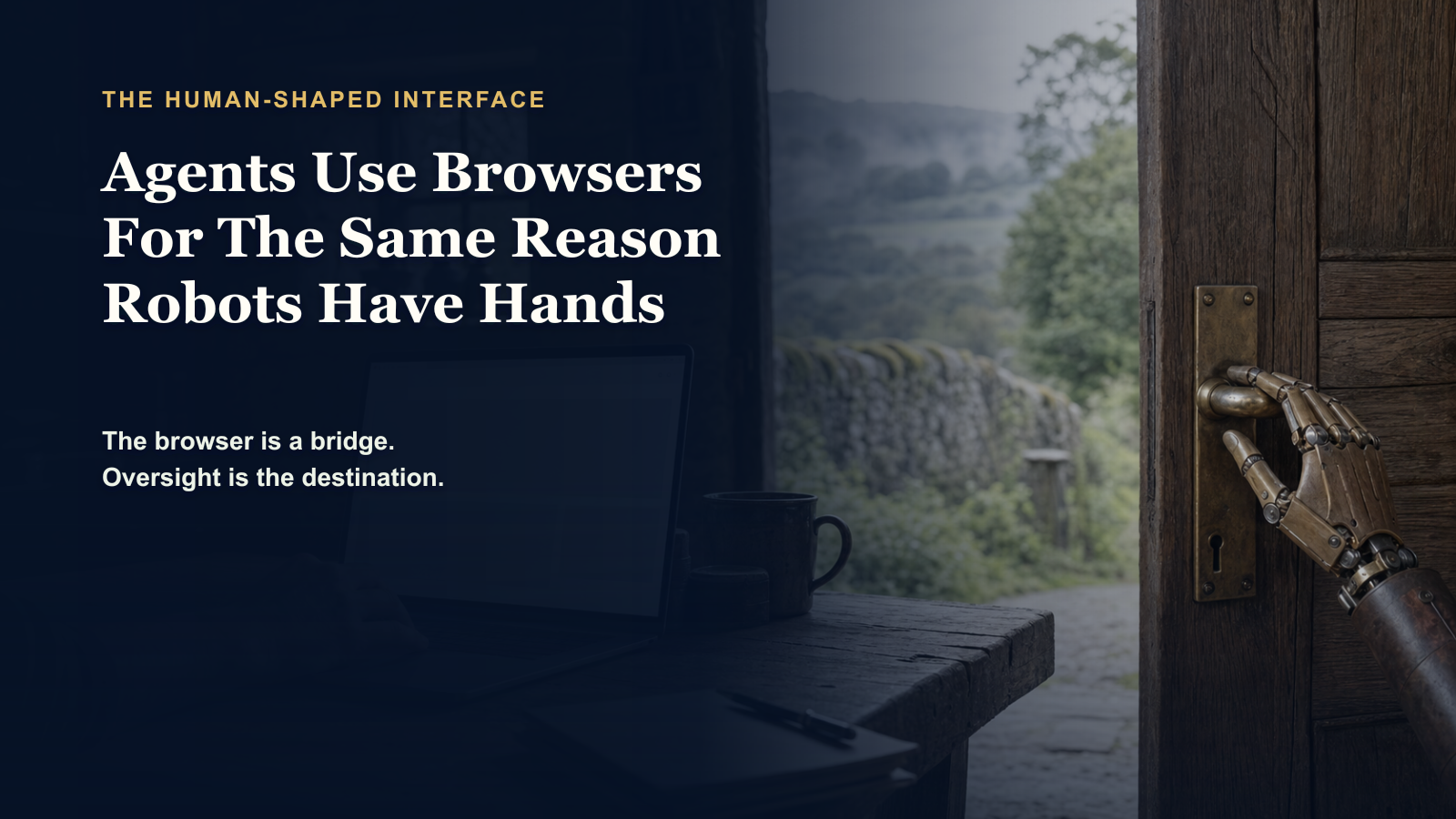
People often explain the case for humanoid robots in a very practical way.
We have built the physical world around ourselves.
Doors are the height of a human. Handles are made for human hands. Stairs fit human legs. Chairs, kitchens, switches, tools, locks, vehicles and warehouses all assume a roughly human body.
If a robot is going to work in that world without rebuilding the whole world first, it helps if the robot can reach, grip, turn, carry and move roughly as we do. Research into humanoid robots opening human-sized doors makes the point directly: our buildings are already full of interfaces designed for our bodies.
That argument is fairly obvious when you can see the robot.
Then I realised we are doing exactly the same thing with agents.
Their temporary humanoid body is the browser.
We built the digital world around human clicks
The online world was built around our eyes and hands.
We look at a screen. We recognise a button. We point. We click. We type into a box. We scroll until we find the information. We move between tabs and remember which screen contains which part of the task.
So when an agentic system needs to use software that has no proper machine interface, what does it do?
It learns to look like us.
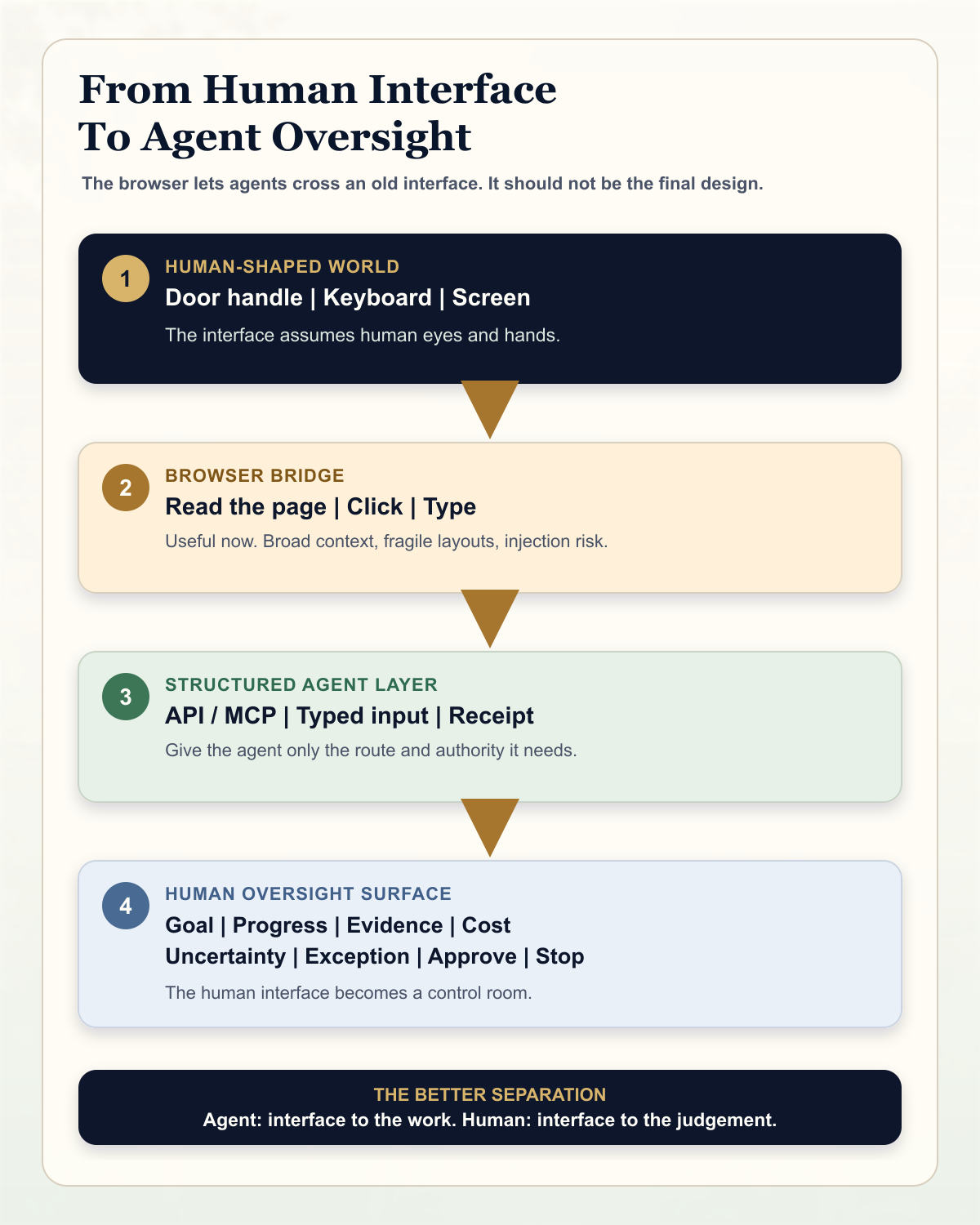
It reads the page, moves the pointer, clicks the button and types into the same box. It uses the browser because the browser is the door handle of the digital world.
This is ingenious.
It is also a sign that the underlying system has not yet caught up.
The browser is an adaptation layer
Browser agents are becoming better because they have to.
A lot of useful software still has a weak API, no Model Context Protocol interface, a restricted integration layer, or no machine-readable route at all. Sometimes that is because the product is old. Sometimes it is because integrations are difficult to build and govern. Sometimes it is because the business wants a human looking at the screen.
Whatever the reason, the agent meets a system made for people and adapts itself to the human interface.
Research environments such as BrowserGym exist because reliable web interaction is a serious technical challenge. A web agent has to understand pages, find controls, recover from changes, maintain state and work out whether the thing that happened is the thing it intended.
That is a lot of effort to reproduce a person clicking through software.
It gets the job done. I use it. I expect to use it for some time.
But I do not think it is the destination.
Screens send everything, even when the agent needs one thing
Human interfaces are designed to place a lot of possible information in front of us.
When I open a sales system, I may only want to know whether a customer has replied. The screen may also show me the pipeline, activity history, notifications, adverts, suggestions, navigation, settings, upgrade prompts and a dozen other fields that might be useful later.
That makes sense for a human. We scan. We notice. We decide where to look next.
It is a rather expensive way to ask a machine one narrow question.
A well-designed API or MCP tool can be much more precise. The agent asks for the authorised information it needs, using defined inputs, and receives structured output. It does not need the entire visual world around the answer.
The official MCP material describes tools as specific capabilities with declared inputs and outputs. That is important. It means the interface can express what the agent is allowed to ask for, what shape the answer will take and where consent may be required.
That is much closer to the future I want.
Not a machine pretending to be Tony clicking every menu.
A machine using a narrow, authorised route to achieve Tony's intended outcome.
Why nobody really wants an agent taking over the browser
Browser control is useful, but it is not the cleanest or safest design.
The agent is operating inside a space full of untrusted material. Web pages, emails, documents, comments and advertisements can all contain text. To a person, some of that text is content. To a language model, it can look like an instruction.
That creates the prompt-injection problem.
OpenAI describes prompt injection as a long-term security challenge for browser agents: malicious instructions hidden in web content may try to redirect the agent away from the user's goal. Anthropic similarly says browser use creates one of the most significant challenges for safe agent deployment and warns that no browser agent should be treated as immune.
The important point is not that browser agents are unusable.
It is that a browser session can combine three things that deserve careful separation:
- untrusted information from the open web;
- the user's authenticated sessions and data;
- the ability to take consequential actions.
Security research such as WASP and Prismata is now testing these systems under more realistic conditions, including indirect prompt injection and attempts to impersonate trusted instructions. Prismata's direction is especially sensible: permissions should be bound to the user's task and enforced mechanically, rather than relying on the model to remember every boundary by itself.
In plain English, do not give a browsing agent the keys to everything simply because it needs to open one door.
Use the browser, but put boundaries around it
I do not think the answer is to wait until every product has a perfect API.
We did not wait for the internet to become risk-free before connecting computers to it. We connected them, found the problems, and built layers of protection: authentication, encryption, firewalls, malware detection, isolation, permissions, monitoring and better operating practices.
We will do something similar for agents.
While browser control remains necessary, I would look for:
- a separate browser profile or isolated environment;
- the least access needed for the task;
- read-only access where possible;
- an allow-list of sites or actions;
- human confirmation before publishing, spending, deleting, disclosing or committing;
- clear stop-lines for privacy, money, reputation and safety;
- an audit trail or receipt showing what happened;
- a way to revoke access quickly;
- a manual route when the automation is uncertain or the interface changes.
This is not glamorous work. It is the work that makes the useful part possible.
The future browser is probably an oversight surface
I do not think screens disappear.
I think their purpose changes.
Most current business software uses the screen as the place where the human enters, moves and retrieves the data. In a more agentic system, the screen becomes the place where the human understands and governs the work.
I will not need to watch every click.
I will need to know:
- What goal is the agent working towards?
- Is it running?
- Is it making progress?
- What evidence has it used?
- What has it changed?
- What has it cost?
- Where is it uncertain?
- What needs my judgement?
- Has it crossed a risk threshold?
- Can I inspect, pause, correct or stop it?
That is not a data-entry screen.
It is a control room.
The MCP Apps extension already points towards part of this pattern by allowing tools to return structured information alongside interactive interfaces rendered by the host. The agent can use the tool, while the human gets a visual surface for the parts that need understanding or interaction.
The machine interface and the human interface no longer have to be the same thing.
We move from operators to managers
This changes our job.
We become managers of the work rather than the hands performing every step. We set the outcome, the boundaries and the evidence standard. We look at exceptions. We decide when something needs to stop. We make the judgement calls that remain ours.
I have described this elsewhere as making the goal the interface. It also connects to my argument that we should be released from the tyranny of the wizard. We should not spend our lives stepping through somebody else's sequence of screens when we can express the outcome and supervise the result.
That does not mean nobody needs to understand what is underneath.
Most people do not understand an operating-system kernel, a graphics driver, Wi-Fi or Bluetooth. Society still depends on people who do. We have always built layers of abstraction, then relied on specialists, standards, diagnostics and recovery routes beneath them.
Agentic work will be the same.
Most people will operate at the goal and oversight layer. Specialists will still need to understand the protocols, models, permissions, data, infrastructure and failure modes below. Good systems will let us move down a layer when there is a problem, or escalate to somebody who can.
A simple test for software companies
If you build software, I think the question is becoming urgent.
Are you building a better disguise for an agent using a human screen?
Or are you creating a proper authorised route for agentic work?
A useful first test is:
- Can an agent request only the information needed?
- Can its permissions be narrow, visible and revocable?
- Can consequential actions require approval?
- Can the system return structured evidence and a receipt?
- Can the human see goals, progress, uncertainty and exceptions?
- Can the work recover safely when the agent or interface is wrong?
If the answer is no, the browser may keep the system usable for now.
But it is also showing you what needs to be rebuilt.
The browser is the clue
Humanoid robots tell us something about the physical world: it was built for our bodies.
Browser agents tell us something about the digital world: it was built for our attention and our hands.
For a short period, agents will keep imitating us because that is the only way through many systems. Then the better systems will separate the two jobs.
The agent will get a precise, governed interface to the work.
The human will get a clear interface to the judgement.
That is the change I am looking forward to.
Not agents that click like us forever.
Agents that do the bounded work, while we can finally see enough to manage it properly.
Sources and notes
This is a forward-looking thought piece informed by current work on humanoid interaction, web-agent evaluation, prompt-injection security and structured agent interfaces. Browser agents and MCP are evolving quickly, so the sources below should be read as current direction rather than a settled final architecture.
- OpenAI: Continuously hardening ChatGPT Atlas against prompt injection attacks
- Anthropic: Mitigating the risk of prompt injections in browser use
- Model Context Protocol: Understanding MCP servers
- Model Context Protocol Apps extension
- BrowserGym: a Gym ecosystem for web agent research
- WASP: Benchmarking Web Agent Security Against Prompt Injection Attacks
- Prismata: Benchmarking Web Agents Under Realistic Impersonation and Injection Risks
- Learning Humanoid Locomotion over Challenging Terrain with Door Interaction