I think we have forgotten how much software taught us to think in menus.
Not just menus in the obvious sense. File. Edit. View. Tools. Help.
I mean the deeper habit.
Choose from the list. Follow the path. Fill in the field. Press next. Press next again. Accept that the software knows the route and your job is to fit your intention into it.
For a long time, that was the bargain.
The computer was powerful, but it was literal. So we built little corridors inside it. Wizards, forms, dropdowns, workflows, tabs, configuration screens, and carefully labelled buttons.
That helped.
It also trained us.
The old bargain
I am old enough to remember the excitement of desktop software in the 1990s. Windows, Office, setup wizards, printer dialogs, import tools, export tools, mail merge tools, database forms, and all the little guided routes that made difficult things feel possible.
They were useful because the machine needed precision.
If you were installing a driver, printing labels, configuring a network, formatting a document, or setting up something fragile, you did not want pure freedom. You wanted a safe path. You wanted the software to say: do this, then this, then this.
That was not stupid.
It was a humane answer to a machine that did not understand what you meant.
The wizard was a translation layer between human intention and deterministic software.
Then the wizard became the world
The problem is that the pattern spread everywhere.
The browser era made the menu tree feel normal. SaaS made the form feel like the shape of work. Workflow software made the path feel like the process. Dashboards made the box feel like the decision.
Before long, a lot of work became a hunt for the right place to put the thought.
What menu is this under?
Which field does this belong in?
Which screen lets me do the thing?
Which permission do I need?
Which status do I choose when the reality does not quite fit any of the statuses?
That is where the paralysis starts.
Not because people are lazy. Not because people are stupid. Because the interface has made them responsible for translating a messy human intention into the narrow language of the software.
Agentic work changes the starting point
When an agentic tool works well, the starting point changes.
I do not begin by hunting for the right menu.
I begin by saying what I am trying to do.
Here is the goal.
Here is the context.
Here is what good looks like.
Here are the boundaries.
Here is what I am worried about.
Now help me move.
That feels small, but it is a large change. It means the intelligence is no longer only in the person navigating the tool. Some of the intelligence is in the tool understanding the work.
When the context has been organised well, the agent does not need me to click through every little corridor. It can carry more of the translation burden.
That gives me room to work on the content, the judgement, the taste, the purpose, and the review.
Precision still matters
This is not an argument against precision.
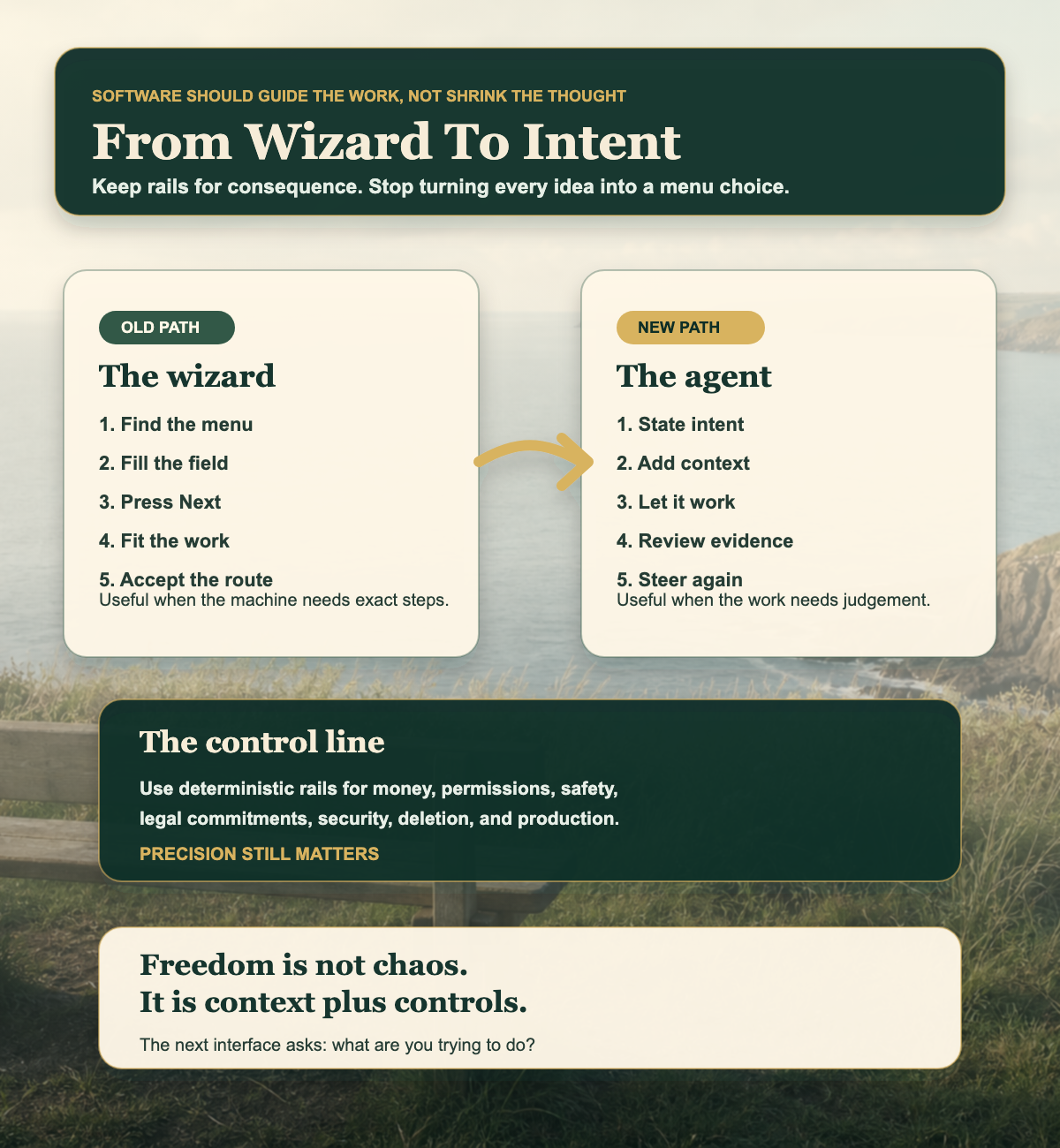
There are moments where I absolutely want the rails.
If I am dealing with money, permissions, production systems, legal commitments, medicine, security, safety, deleting data, or anything irreversible, I do not want a vague cloud of helpfulness. I want steps. Checks. Confirmations. Logs. Approval. Stop lines.
If I am doing mechanics, I want torque settings.
If I am printing something exact, I want measurements.
If I am deploying software, I want a managed release path and a receipt that says pass.
Precision is not the enemy.
The enemy is using precision-shaped interfaces for work that is really about thought, context, exploration, or judgement.
The tyranny of the wizard
The tyranny of the wizard is not that the wizard exists.
It is that every task is forced to become one.
It is the assumption that the user must always be guided through a pre-built path, even when the useful work is to describe the destination and let the system help find the route.
It is the belief that a person needs another dropdown when what they actually need is a partner that can ask a useful question.
It is the idea that work should begin with "which screen?" rather than "what are you trying to do?"
Agentic systems give us a chance to undo some of that.
Not by making everything loose.
Not by pretending controls do not matter.
But by moving the control to the right level.
Release the human
I think the next generation of software should feel less like a corridor and more like a field with good boundaries.
There should be space to move.
There should be a view of the destination.
There should be fences where the cliff edge is real.
There should be signs where the path matters.
But the person should not have to crawl through a tunnel of prompts just to express an ordinary intention.
That is the bit I keep coming back to.
Agentic tools are not interesting because they add another menu.
They are interesting because they may let us stop pretending that every human thought needs to start as a menu choice.
So yes, keep the rails where the rails protect us.
Keep the deterministic paths where precision matters.
But for the work that is really about intent, context, judgement, and movement, release us from the tyranny of the wizard.