There is a history of serious people warning that we might destroy ourselves. There is not a neat history of everyone giving every new threat the same 10% chance.
I keep hearing versions of this: AI has a one-in-ten chance of killing us all.
And I find myself asking: haven't we heard something like that before? Nuclear war. A pandemic. Environmental collapse. Something to do with algae and running out of oxygen. What did people actually say, and how well did their reasoning hold up?
So I wanted to look backwards before deciding what to think about the latest warning. Not to collect a list of people to laugh at. If somebody identifies a real danger and helps us avoid it, being alive afterwards is rather the point.
But I do want to know what is behind the number. Ten per cent of what, by when, and according to whom?
The short answer
The closest historical matches are a mixture: subjective forecasts about catastrophic deaths, a discounting assumption, and a calculation about extreme warming. Some really do concern extinction. Others very much do not.
The 2008 Oxford survey below makes the distinction particularly clear. It is worth reading across the table, not stopping at the most alarming number.
This review concentrates on non-AI hazards. Broader, all-cause estimates are identified separately, because quietly counting them as non-AI would defeat the exercise. The research is a selected historical review, not a census of every archive in every country.
First, agree what the end of the world means
| Claim | What it actually says |
|---|---|
| A dangerous event | A war, eruption, outbreak or temperature threshold occurs. Its consequences still need estimating. |
| Mass mortality | Millions or billions die. Horrific, but survivors remain. |
| Civilisational collapse | Institutions and living conditions break down. Whether recovery is possible is a separate question. |
| Human extinction | No humans survive. Check whether a study instead uses a very small surviving population as its operational definition. |
| Existential catastrophe | A broader category that can include extinction or permanent loss of humanity's future potential. |
That last distinction matters in Toby Ord's account of existential risk. It is not simply a more dramatic way of saying that everybody dies.
A forecast also needs a clock. A 10% chance during a particular crisis is not a 10% chance each year, or over a century. And a 10% chance if a catastrophe has already happened is not a 10% chance from where we stand today.
The clearest near-10% examples
Start with the primary document rather than the headline. These figures describe what their authors or respondents believed at the time, not the probabilities I am assigning today.
| Hazard | At least a billion deaths | Human extinction |
|---|---|---|
| Molecular nanotechnology weapons | 10% | 5% |
| Engineered pandemic, single biggest event | 10% | 2% |
| Nuclear wars, cumulative deaths | 10% | 1% |
| All wars, including civil wars, cumulative deaths | 30% | 4% |
| Nanotechnology accident, single biggest event | 1% | 0.5% |
| Natural pandemic, single biggest event | 5% | 0.05% |
| Nuclear terrorism, cumulative deaths | 1% | 0.03% |
Sandberg and Bostrom's original report describes an informal conference survey and warns about bias and omitted non-responses. These are medians, not measured event frequencies or an official Oxford forecast. Its all-cause extinction median was 19%, including AI. The overlapping rows must not be added together.
I find that table more useful than a dozen arguments about whether somebody is being alarmist. It shows exactly where a remembered warning can change meaning.
| Who and when | Number and horizon | What it was about | Evidence limit |
|---|---|---|---|
| C. M. Hempsell, 2004 | 5-10% over the next century | A natural catastrophe killing over a billion people, as reported in a later literature review. | The exact percentage is review-traced here, not checked against the full original article. The original abstract describes a sparse historical comparison, not a human-extinction forecast. |
| Stern Review, 2006 | About 9.5% over 100 years, from a 0.1% annual hazard | An extinction-related assumption for discounting future welfare. | Not a calculated probability that climate change would kill everyone. |
| Gernot Wagner and Martin Weitzman, 2015 | About 10%, eventual warming above 6 degrees C | A severe warming tail under their assumptions, in an argument for stronger climate action. | Not a 10% human-extinction estimate, and not a probability confined to 2100. |
Sources: Hempsell's Bristol publication record and the Beard, Rowe and Fox review appendix, entry 1; Stern Review, Annex 2A, printed pages 46-47; the authors' published Climate Shock excerpt.
The nuclear warning was real. A standard 10% figure was not.
In 1955, the Russell-Einstein Manifesto warned that hydrogen-bomb warfare could end humanity. This was an appeal from prominent intellectuals and scientists, including people close to the science that made the weapons possible. It did not give a numerical extinction probability.
There is an obvious parallel with today's researchers warning about technologies they helped develop. That makes their concerns worth hearing. It does not automatically calibrate their forecasts.
In 1983, Paul Ehrlich, Carl Sagan and colleagues examined the biological consequences of nuclear war: darkness, cold, damage to food production and consequences for survivors. Their abstract said human extinction could not be excluded. It did not assign it 10%.
The paper was addressing consequences under a large-war scenario. Estimating whether that war would happen, whether a particular aftermath would follow, and whether every human population would die requires further steps. Those steps should not disappear between the paper and the conversation.
Nor can we mark this warning wrong simply because humanity is still here. The world has not run the specified global experiment and found it harmless. Thankfully.
The Stern number: an assumption can sound like a forecast
This is an especially useful example because it appears inside a major climate report.
The Stern Review considers how to value future generations when there is some chance they will not exist. A constant hazard of 0.1% a year implies approximately 9.5% over a century. The report explicitly treats the relevant shock as external to the climate-policy choices being examined.
Its continuous-time calculation is 1 - exp(-0.001 x 100), or approximately 9.52%. That is arithmetic applied to an assumed rate, not 100 years of extinction observations. The report itself questions how plausible different rates would be.
Being printed in a climate report does not make a number a climate-extinction forecast. We have to read the role the number plays.
And the algae story?
I remembered an algae-related warning without enough detail to identify it confidently. There is a plausible match, but I am not claiming it is definitely the story I had in mind.
In December 2015, the University of Leicester publicised research about warming and oxygen production under a headline about suffocating life on Earth. The work was by mathematical researchers Yadigar Sekerci and Sergei Petrovskii.
Their paper modelled interactions between plankton and oxygen as oxygen-production rates changed. It identified conditions under which the model lost its sustainable state, and raised possible global consequences. Neither the abstract nor the university account supplies a 10% probability of human extinction.
There is another distinction worth retaining. NOAA explains that roughly half of Earth's oxygen production comes from the ocean, but marine life consumes roughly the same amount. The atmosphere also contains an enormous accumulated oxygen stock. A share of annual production is not a measure of how quickly the air we breathe would disappear.
None of that makes damage to marine ecosystems unimportant. It means that moving from a plankton model to a dated prediction about everyone suffocating needs a much fuller account of stocks, flows and timescales.
Verdict: a real research warning; a possible match to my recollection; not a verified one-in-ten extinction forecast.
What about the really big percentages?
I asked for the maximum. The more I checked, the less useful one unqualified maximum became. Here are the largest relevant examples in this selected catalogue, with their actual meanings.
| Example | Figure | What prevents a simple comparison? |
|---|---|---|
| Bologna and Aquino, 2020, deforestation model | Over 90% collapse risk implied by less than 10% avoiding collapse in its most optimistic estimate. | A conditional model of population, forests and technological development, not a measured chance of literal extinction. See the authors' later sensitivity analysis below. |
| Martin Rees, 2003 book and subsequent clarification | 50% chance of a civilisational setback comparable to catastrophic nuclear war during the century. | Rees explicitly distinguished this from everybody being wiped out. Broad threats, not one clean non-AI hazard. |
| John Leslie, 1996 book | Tentative survival estimate as high as 70% over five centuries, not a precise extinction-risk point estimate. | An all-cause philosophical judgement. Intelligent machines are explicitly included in the surrounding discussion. Not a clean non-AI estimate. |
| 2008 Oxford survey, named non-AI extinction categories | 5% for nanotechnology weapons. | The maximum within those survey categories only. Not the highest non-AI estimate ever made. |
Sources: Bologna and Aquino's paper; Rees's own interview clarification; Leslie's book, printed page 146; the Oxford survey linked above.
My answer, then, is over 90% for collapse in the selected deforestation model, not over 90% for human extinction. I cannot establish a worldwide historical maximum for non-AI extinction probabilities from this search. That would require a defined, much more complete corpus, not a collection of arresting quotations.
And I will not improve the headline by quietly dropping that qualification.
The follow-up is often more informative than the warning
The 2020 deforestation paper combines a simplified human-forest model with a model of technological progress. Success means reaching its Dyson-limit technological threshold before the modelled population maximum, treated as a no-return point. That is not simply ordinary adaptation or conservation, and the actual rescue mechanism is unspecified. Its bleak result depends on that construction and the rates fed into it. This is not an observation of hundreds of comparable civilisations, nine out of ten of which failed.
In a 2021 follow-up, also published in Communicative & Integrative Biology, the same authors explored declining population growth. Some parameter choices remained bleak; more optimistic choices could raise the modelled probability of avoiding collapse to as much as 95%. That is a sensitivity result, not a new guarantee of survival.
The important question becomes: which assumptions best fit the world, and how do we test them? That is much more productive than choosing whichever version makes us feel better.
Rees offers a different lesson. Asked about his 50% warning, he explained the outcome he meant: a devastating setback, not necessarily extinction. Going back to the speaker changes the claim.
Ord's 2024 reassessment offers another useful habit: distinguish risks changed by events and policy from risks reassessed because knowledge improved. He described his original century-scale numbers as best guesses: 1 in 1,000 for climate and nuclear risks, 1 in 30 for pandemics, and 1 in 10 for unaligned AI, all within his broader existential-risk framing.
That is a comparison within one person's framework. It is not an agreed scientific conversion table between technologies.
Are these the same sorts of people warning us today?
Sometimes, yes. Not literally the same people, and not one uniform category of expert.
| Perspective | Examples in this review | What to examine |
|---|---|---|
| Scientists close to a mechanism | Nuclear-war ecology researchers; plankton and oxygen modellers. | Does the model establish a mechanism, its likelihood in the real world, or both? |
| Distinguished scientific generalists | Rees discussing civilisation's future. | Which parts come from their own specialism and which are broader judgement? |
| Economists | Stern; Wagner and Weitzman. | Is the number a physical forecast, an input to a policy model, or an assumption about uncertainty? |
| Philosophers and existential-risk researchers | Leslie, Ord, Sandberg and Bostrom. | How do they combine uncertain pathways, define the endpoint and avoid double counting? |
| Forecasting specialists and domain experts | The Existential Risk Persuasion Tournament. | Do their estimates agree? Does short-term forecasting skill transfer to unprecedented long-term outcomes? |
I would ask about funding and incentives too. A campaigning institution, a technology developer and a government department can each have reasons to emphasise particular risks. None is automatically wrong, and none gets a free pass.
For example, the forecasting tournament names the Musk Foundation and Long-Term Future Fund among its supporters. That is useful disclosure, not a substitute for examining the questions and results. This literature is not a representative sample of every scientist, country or political outlook.
There are serious estimates much lower than 10%
We should not construct a history by collecting only the frightening tail.
A 2019 paper by Andrew Snyder-Beattie, Toby Ord and Michael Bonsall used humanity's survival record to bound background natural extinction risk. Under its assumptions, the annual rate is very likely below one in 14,000, and more tightly constrained under further assumptions. It does not apply that reassurance to newly created human technologies.
In the 2022 tournament reported in 2023, the all-cause median by 2100 was 6% among experts and 1% among superforecasters. For nuclear causes, domain experts gave 0.55%, versus 0.074% among superforecasters; engineered pathogens were 1% versus 0.01%.
Crucially, its operational definition includes reducing the population below 5,000 people. These are not strictly zero-survivor forecasts. Causes can overlap, including with AI. The disagreement is real, but neither group's century-scale answer has been validated by waiting until 2100.
What looking backwards can and cannot tell us
It can catch a misquotation. We can check whether someone actually gave the number, whether a journalist changed the endpoint, and whether an assumption was presented as a result.
It can test some assumptions. A forecast can be weakened by new evidence about its mechanism, or by revisions to demographic, physical or institutional assumptions. We do not need to wait for the final catastrophe to investigate those.
It cannot turn survival into a clean scorecard. A 10% forecast leaves a 90% chance of no event. One non-event does not prove the estimate was unreasonable. And nobody would be writing the retrospective after literal extinction.
It cannot ignore prevention. A warning may change behaviour. When a forecast assumes no intervention and people intervene, assessing it requires the counterfactual, not just the final outcome.
It cannot settle AI by analogy. The fact that nuclear scientists, economists and ecologists have worried about catastrophe neither proves nor disproves a particular AI risk. The mechanisms differ.
There are also warnings whose strongest versions can be investigated directly. CERN's 2008 collider safety assessment examined hypothetical disaster mechanisms against physics and astronomical observations. That is more informative than treating every conceivable mechanism as equally plausible. I did not verify a comparable 10% extinction estimate in that case, so it is not in the numerical catalogue.
The questions I would ask next time
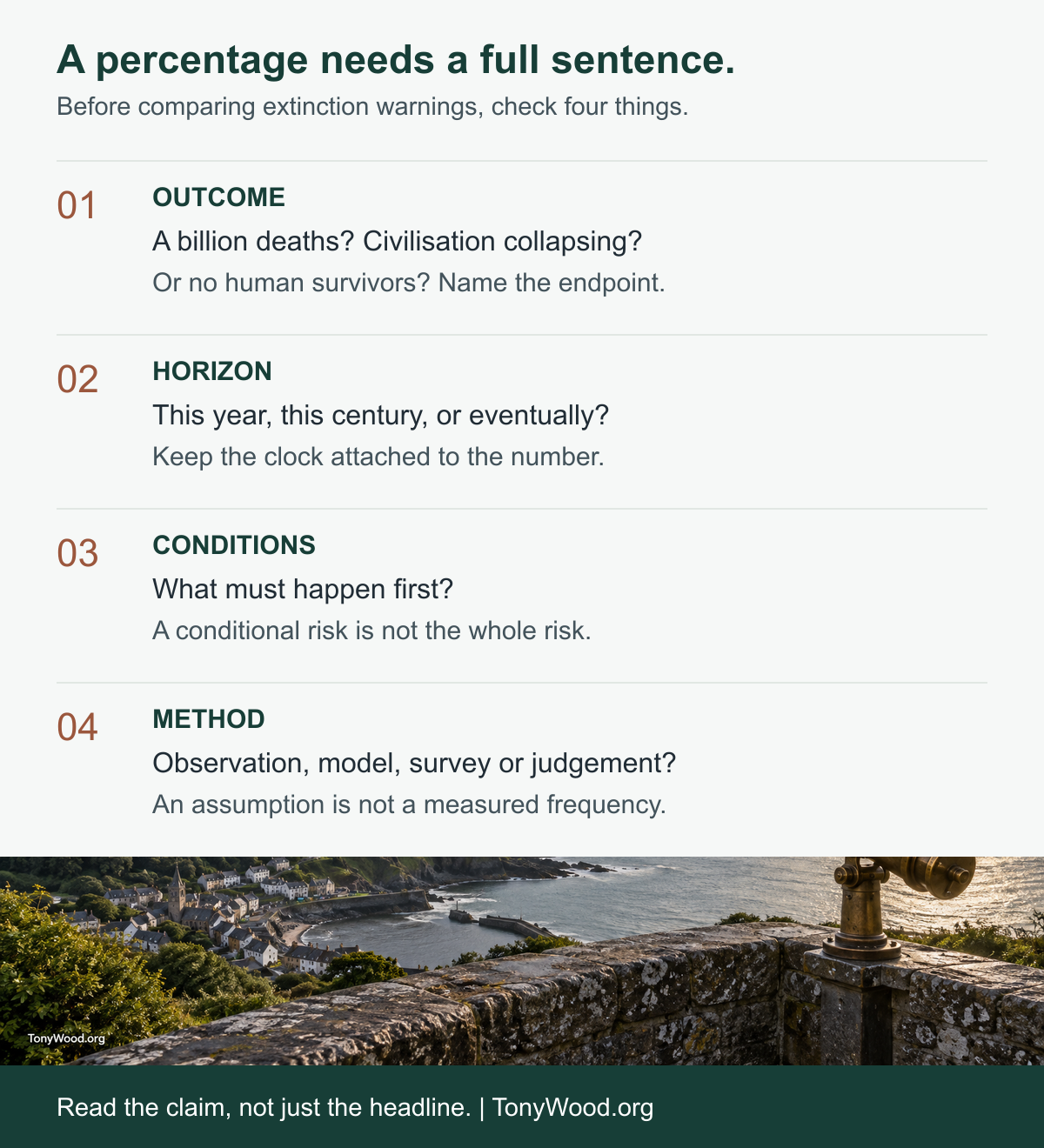
If somebody tells me there is a one-in-ten chance of the end of humanity, this is the information I want alongside it:
- The original source. A paper, interview or forecast question, not a screenshot of somebody reacting to one.
- The outcome. Everybody dead? A billion dead? A permanently damaged future? Define it.
- The deadline. A year, a century, or conditional on a technology being developed?
- The assumptions. What happens first? What protection or policy response is assumed?
- The method and uncertainty. Data, physical model, expert survey or personal judgement? Why this number rather than a broad range?
- The updating rule. What evidence would move the estimate up or down, and what practical action does the estimate support?
I am not asking scientists to stop warning us. I am asking us to get better at listening.
My starting suspicion was that there might be a familiar one-in-ten warning repeated through history. The sources gave me something less tidy, and more useful: a recurring difficulty in communicating uncertain, enormous consequences without losing the assumptions.
I remain excited about what agentics can do. That does not exempt them from scrutiny. Equally, being concerned about AI does not make an unsupported percentage more reliable.
Do not dismiss the warning. Do not worship the number. Ask what it means.
Research scope and limitations
Checked on 15 September 2026. This article uses the two supplied research briefs as leads, then checks selected original reports, papers, author accounts and institutional archives. The verified examples run from 1955 to the 2020s. It is not an exhaustive worldwide archival search, a systematic meta-analysis or an estimate of humanity's current extinction probability.
The search was predominantly English-language, with additional French, German and Spanish discovery queries. The resulting evidence is heavily weighted towards English-language academic and existential-risk literature. Repeated translations of one warning are not independent forecasts. Unindexed, paywalled and non-digitised material may be missing.
The Hempsell percentage remains explicitly secondary-source traced. For the 2015 plankton paper, the publisher abstract and university account were checked, not the subscription full text. The algae identification remains provisional. Book editions and web copies can have different PDF page numbers; printed page references are given where useful.
No worldwide maximum is claimed. All-cause estimates are not relabelled non-AI. Unresolved forecasts are not marked as failures. The generated coastal hero is an editorial illustration, not documentary evidence.
This continues the source-checking approach in Covid: What Actually Held Up? The point is to leave useful, inspectable information for people and their agents, as close to the underlying evidence as I can get.