Stop Paying The Data Tax: The Agentic-First Website Playbook Leaders Are Quietly Switching To
Most companies rely on platforms like LinkedIn or PitchBook to share public profiles and key information.
Research library
Longer papers, playbooks, and frameworks for leaders who need practical depth on agentic systems, governance, and operational change.
Most companies rely on platforms like LinkedIn or PitchBook to share public profiles and key information.
A leadership-level, plain-English guide to treating tokens as a hard operating limit, building token budgets into every proof of concept, and putting Finance in control before agentic scale breaks production.
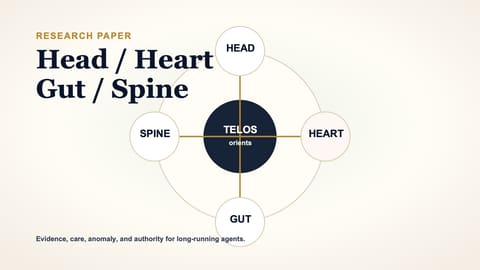
A white paper exploring how the architecture of agentic employees – crews, flows, intent, memory, and style – reflects the core functions of human cognition. Drawing on neuroscience and AI research, it offers a shared vocabulary for building adaptive, persistent, and trustworthy agentic systems.
A practical, code-first framework for designing long-lived agentic employees, mapping modern agentic architectures to established concepts from neuroscience to create shared understanding across engineering, leadership, and governance.
A practical, leadership-level operating model for managing AI agents like a growing team: span of control, RACI, shepherd agents, definitions of ready and done, and trust rules that protect focus.
Document Type: White Paper Position: Practitioner-led cognitive architecture proposal
As agentic artificial intelligence systems transition from episodic task execution to continuous operation, the design of memory becomes a critical and under-examined challenge. Prevailing approaches treat memory as an accumulation problem, prioritising exhaus
Why leaders must stop treating AI as a magic box, and start running agentic workflows like a real team before the next Deloitte-style scandal lands on their desk.
How JARVIS-style agentic crews and conversational AI are turning week-long projects into six-hour workflows for real teams.
Why traditional hierarchies are breaking, how agentic systems enable outcome-based
AI agents promise the power to multiply process speed, but there’s an elephant in the boardroom: budget blind spots. Here’s what too many executive teams are missing in 2025.
For years, the holy grail of AI development has been the elimination of bias. We have been told that the ideal AI is a perfectly neutral engine for processing facts. But what if that is completely wrong?
Agentic AI is shifting from technical prototype to everyday teammate. How you set its cultural “operating system” will make or break your results.
The United States federal government has struck a deal to provide every executive branch agency with ChatGPT Enterprise one dollar per agency, for a whole year. That’s not a typo. It’s "government leading by example using the best in AI to improve delivery for
Morning meetings sometimes challenge your thinking in ways you didn’t expect. Today, someone floored me with a simple question: Would you pay extra for higher intelligence—in people, or in digital agents?
The mood at LegalTechTalk O2 this year was unmistakable: legal technology is no longer a sideshow. Boardrooms are debating not “if” but “how soon” agentic AI can reshape their companies’ legal engines. As I took in the candid backroom stories, one question tie
Startup innovation isn’t just moving faster it’s changing shape beneath our feet. In less than a year, generative AI platforms have turned the old MVP (Minimum Viable Product) dynamic on its head. For boards, investors, and CxOs, the new rule is already clear:
Leaders are rethinking what smarter AI looks like not chasing limitless data, but balancing the best of human insight, self-improving models, and robust governance.
Most executives have seen the hype around GPT-3 and GPT-4. Now, AI is entering a new phase that will set apart tomorrow’s winners: the rise of orchestrated, multi-agent systems—built not for text prediction, but for dynamic, actionable business change.
Artificial Intelligence (AI) is no longer just the subject of science fiction—it's rapidly transforming every aspect of our lives, from the way we communicate to how we work, learn, and innovate. As the UK positions itself at the forefront of the global digita
The United Kingdom is at a pivotal crossroads, where the integration of artificial intelligence (AI) into education is not only a profound opportunity but a critical necessity. As AI fundamentally reshapes every sector, from healthcare to finance, it becomes c
Every UK board will soon face a new agenda item: not if, but how to empower agentic AI inside the organisation. In 2025, the CEO’s best advisor—and biggest challenger—may not be human.
Are you spending more time firefighting admin than unlocking growth? Agentic AI is quietly revolutionising UK boardrooms—delegating workflows, not just automating tasks. With April’s new R&D credits and regulatory clarity, first-movers could unlock seven-figur
UK executives now lose over 16 hours weekly chasing usable information—while competitors seize the initiative. Agentic AI flips overload into clarity, surfacing actionable insights proactively on dashboards that work for every board role. The upside? Quicker d