Abstract
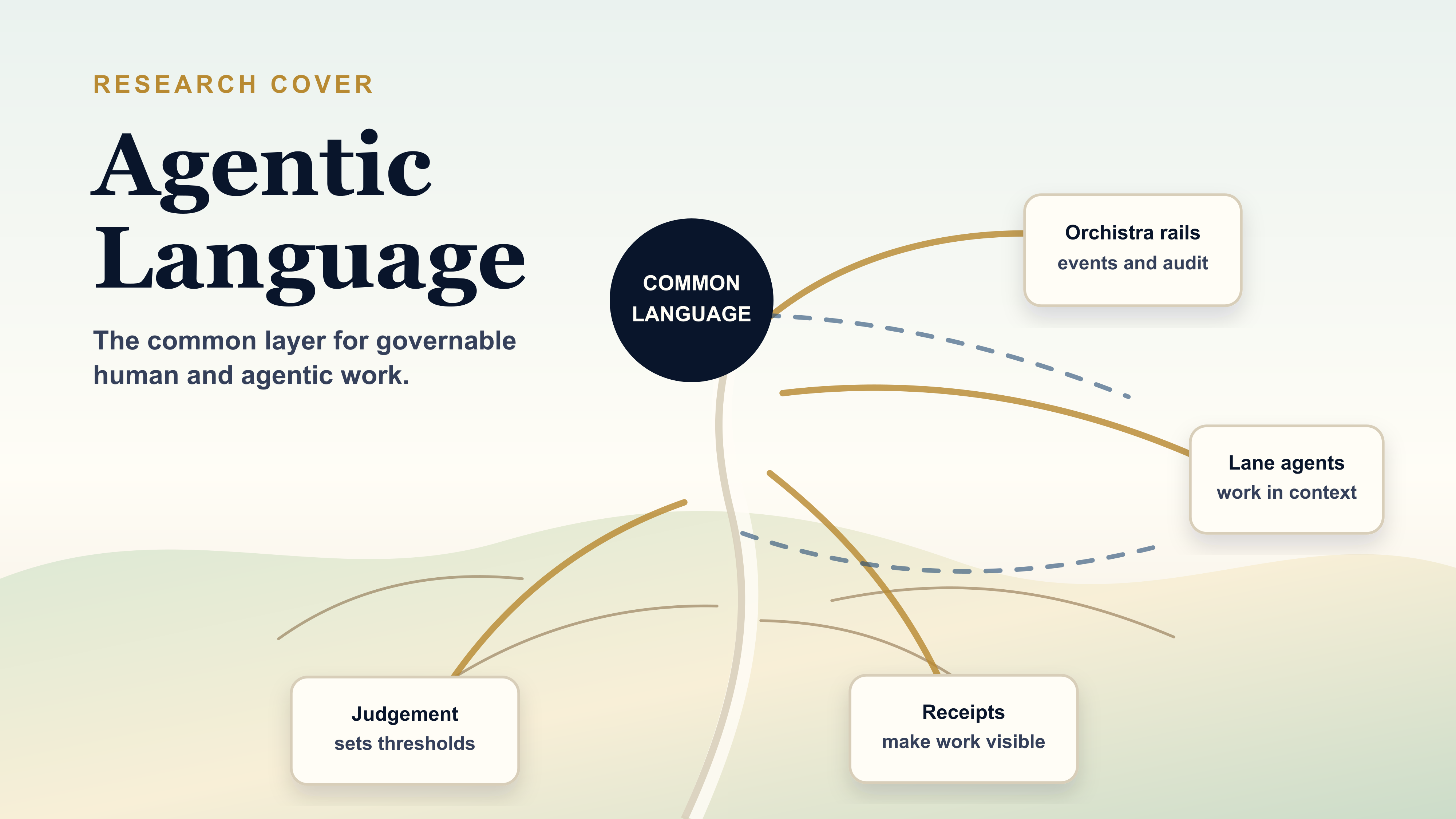
This paper proposes agentic language: a common operating language for humans and agents. It is not a new model, a new chat style, or a claim that agents need to sound more human. It is a practical layer of shared terms, typed moves, meaning records, receipts, boundaries, and judgement signals that lets work move through agentic systems without losing what it means.
The argument starts with a human observation. Teams already coordinate through shared language. SaaS systems made that language operational by turning words such as customer, opportunity, owner, stock, invoice, stage, and next action into shared records and repeatable workflows. Agentic work now needs the same discipline made explicit, because agents can move faster than human misunderstanding.
The paper then uses Orchistra as the public-safe operating pattern: a visible, Slack-like room where lane agents work in channels, produce receipts, propose actions, hand off work, and escalate to humans. YQUP is Tony Wood's consulting company and one place this thinking is being applied; it is not the named intelligence layer. Orchistra is the operating room and rails: channels, lanes, receipts, routes, and a defined glossary. The intelligence sits in the shared language, definitions, judgement rules, prompts, review habits, and human responsibility used inside that room. The paper introduces reader-facing terms for the implementation language: Agent Moves (OAL/1: Orchistra Agent Language) and Meaning Blocks (OMB/1: Orchistra Meaning Block).
Keywords: agentic AI; agent language; Agent Moves; Meaning Blocks; OAL; OMB; MCP; A2A; NLIP; agent gateway; common language; evidence; handoff; audit; judgement; Head Heart Gut Spine; triggers; operations.
Research Question
What common operating language do humans and agents need so that agentic work can move between people, tools, channels, specialist agents, and review gates without losing meaning, evidence, ownership, care, or judgement?
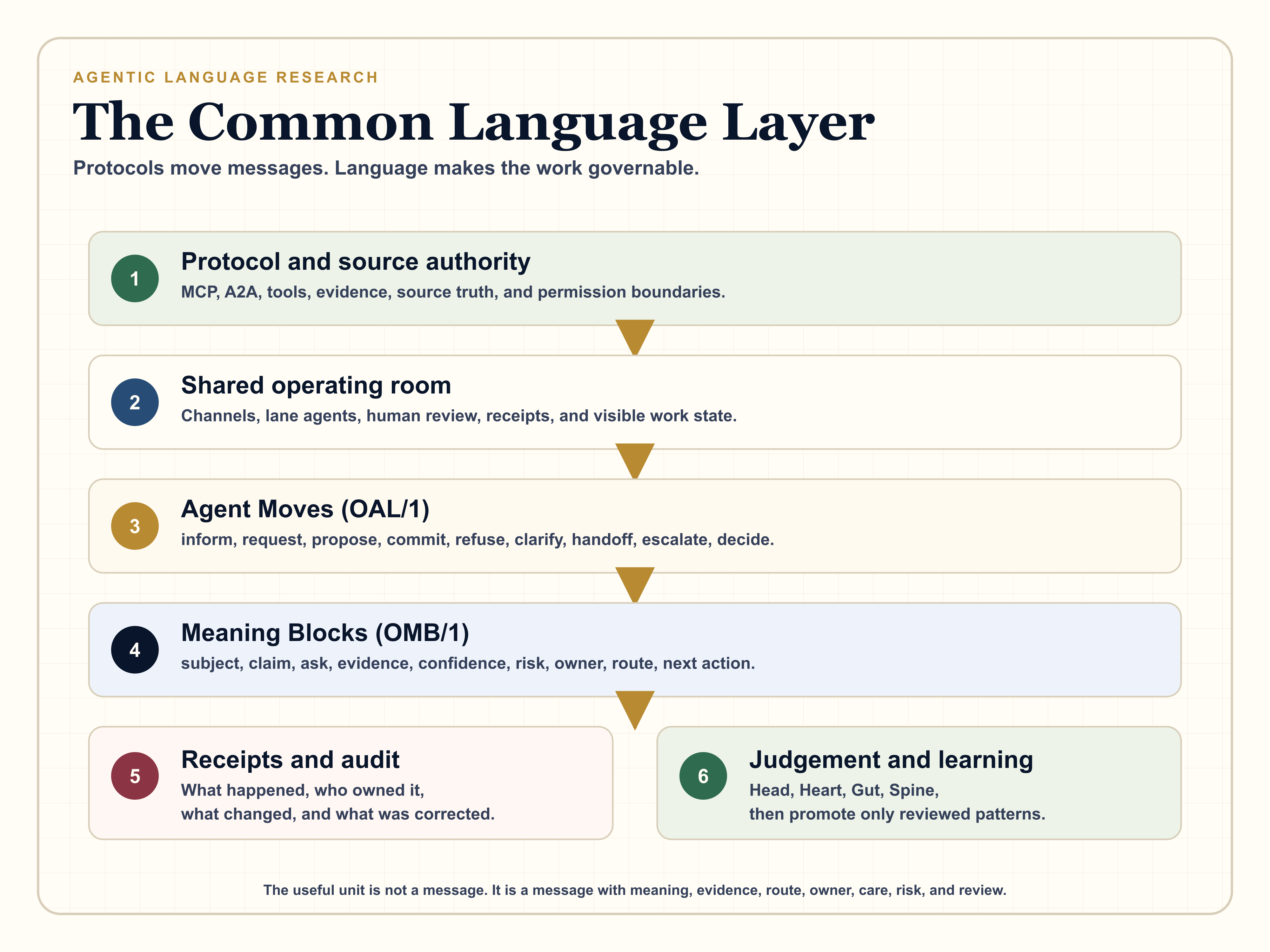
Practical answer: protocols move messages, but language makes the work governable.
1. What This Is
Agentic language is a common operating language for humans and agents.
It is the language a team uses when work is no longer held only inside one person's head, one email thread, one CRM, one ERP, one project board, or one chat. It is the shared register that says: this is a claim, this is a request, this is a proposed action, this is the evidence, this is the uncertainty, this is the owner, this is the risk, this is the route, this is the success condition, and this is where a human needs to judge.
That sounds technical, but the starting point is very human. We already do this brilliantly when we work well together. Good teams create language. They know what "done" means. They know what "customer" means. They know who owns the next action. They know when a decision is real and when it is only an idea. They know when a concern is a warning, not a complaint.
The difficulty is that agentic work exposes all the places where this language has been tacit. If the human team has not made the meaning explicit, the agent has to guess.
2. The Problem: Fuzzy Words Create Fuzzy Governance
We are using very large words for very different things.
"AI" may mean a browser chatbot, a local coding agent, a scheduled worker, a model call inside an application, an MCP-connected assistant, a public agent card, a voice interface, an autonomous vehicle, or a workflow that drafts something for human review. The word is useful in headlines. It is dangerous in operations.
The same fuzziness appears inside businesses. People say agent, assistant, copilot, tool, skill, workflow, automation, bot, worker, and digital twin as if they are interchangeable. They are not. Each word implies a different boundary, capability, permission model, review standard, and consequence.
When the language is fuzzy, governance becomes theatre. A board may think it has approved "AI use" when the actual system is a tool-calling agent with access to internal documents. A manager may think a worker is "just drafting" when it is also updating a customer record. An agent may treat a rough note as source truth because nobody told it what the note was.
Agentic work needs a language before it needs more autonomy.
The agentic question is whether we can make shared language explicit, portable, inspectable, and caring without forcing all work into one vendor's system.
3. Humans Already Coordinate Through Language
In Sharing Is a Language, I argued that the quiet value of many SaaS systems is shared understanding. A CRM is not only a database. It gives a business a language for customer, lead, opportunity, owner, stage, next action, renewal, and loss reason. An ERP gives a language for stock, order, invoice, commitment, available quantity, and fulfilment.
Software becomes a coordination system because it makes words operational.
That matters because teams are not just moving information. They are moving meaning. When someone says "how much stock do we have?", the answer depends on which definition the organisation is using. Stock physically in the warehouse, stock already sold, stock available to promise, stock in transit, and stock allocated to a customer are not the same thing.
Humans often hold those distinctions in their heads. SaaS systems force some of the distinctions into records. Agentic systems need to go one step further: they need to carry meaning, authority, permission, evidence, risk, ownership, and judgement as part of the work itself.
- Meaning: what the term, task, claim, or state means in this organisation.
- Authority: where the source of truth lives, and which source wins when evidence conflicts.
- Permission: what the agent may read, suggest, change, publish, contact, or escalate.
- Evidence: what the agent used and whether the evidence is sufficient.
- Risk: what could happen if the agent is wrong or if the work moves too quickly.
- Ownership: which lane, person, or agent owns the next decision.
- Judgement: when the work crosses from preparation into consequence.
That is why "common understanding" is not a soft cultural phrase here. It is an operating control.
4. A Diplomatic Register For Agents
There is a useful analogy from diplomacy.
French was historically treated as a diplomatic language in many European settings. The point is not that French is inherently superior. The point is that diplomacy needed a shared register: a way of expressing commitments, disputes, status, procedure, and interpretation with enough precision that states could work from the same text.
The 1919 Paris Peace Conference discussion about official languages is a good reminder that the practical issue was not sentiment. It was interpretation. Which text would people rely on? Which version would hold in a dispute? Which language could represent the thoughts of the parties accurately enough to carry consequence?
Agentic work faces a smaller but similar problem at much greater speed. If agents use vague language, they can create faster confusion. If they use a shared register, the room can see whether a message is a claim, a request, a proposed action, a correction, a handoff, or an escalation.
Agentic language is that proposed register. It should not replace natural language. It should give natural language an inspectable operating layer.
5. What Already Exists
This paper is not claiming that nothing exists. A lot exists, and it is moving quickly.
| Layer | What it helps with | What still needs operating language |
|---|---|---|
| MCP | Connecting agents to tools, data, prompts, and external context. | Whether the tool should be used, what the result means, and who owns the consequence. |
| A2A | Discovery, task exchange, and communication between independent agentic systems. | The business meaning, risk threshold, evidence standard, and judgement route. |
| NLIP / ECMA-430 | A natural language interaction protocol for requests, responses, context, and interaction structure. | The organisation-specific meaning of words, source authority, and operating boundaries. |
| OpenAI Agents SDK | Agents, tools, handoffs, tracing, guardrails, and multi-step workflows. | The shared business vocabulary and human-care language used inside those workflows. |
| LangGraph, AutoGen, CrewAI | Orchestration, multi-agent patterns, crews, flows, state, routing, and human-in-the-loop designs. | The common register that says what each move means, how dissent is recorded, and how patterns are promoted. |
The narrower gap is the combined pattern: a shared room, typed moves, canonical meaning blocks, receipts, judgement language, human-care signals, and pattern promotion. That is the gap this paper is interested in.
6. Orchistra: A Slack-Like Operating Room
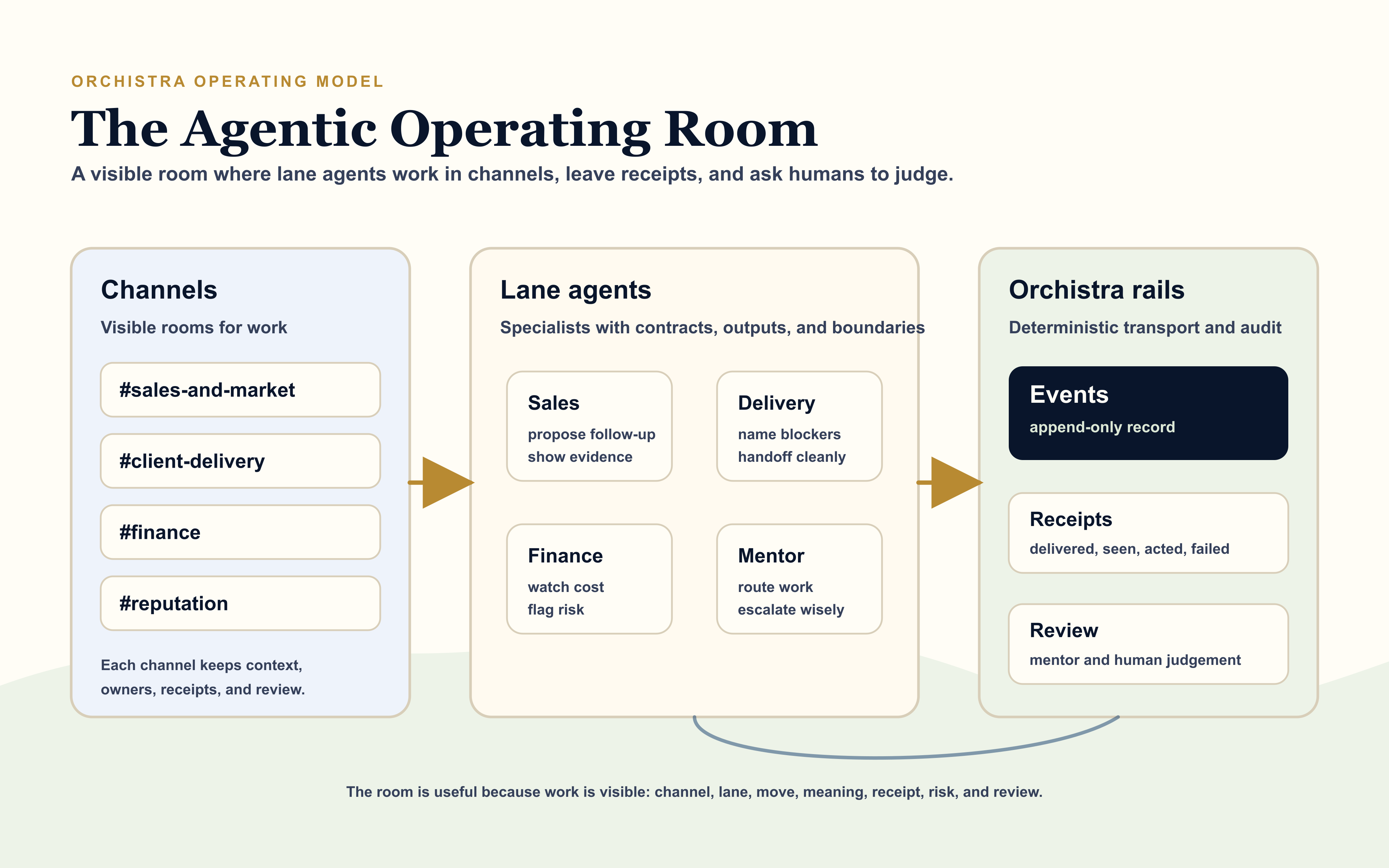
Orchistra is useful here because it is not just another chat. It is closer to a visible, Slack-like operating room for agentic work, with defined words for the room itself.
To work well in Orchistra, agents need to use the operating language of the environment. A lane is not just a label. A channel is not just a place to talk. A receipt is not just a message. Each word carries a defined meaning so that humans and agents can understand what work is being done, where it belongs, who owns it, what has happened, and what still needs judgement.
Lane agents work in channels. Work is captured, routed, proposed, handed off, and reviewed. Receipts record what happened. A mentor or human shepherd can see stuck work, repeated patterns, risk, and escalation points. The system starts with manual capture and proposed action before automated external action.
The public-safe lesson is not private business content. The lesson is the operating shape: make the work visible, define the words, keep external action proposal-only until the threshold changes, and let patterns mature through review rather than enthusiasm.
7. Orchistra Rails, Shared Meaning
The distinction is simple and important.
Orchistra is the rails and the room. It gives the work somewhere visible to happen: lanes, channels, routes, receipts, audit, review, and a shared glossary. It should make messages, evidence, handoffs, and decisions inspectable without pretending that the platform alone is the business brain.
The language is the intelligence layer. Lane definitions, prompts, expertise packs, operating playbooks, review shapes, proof rules, delivery patterns, boundaries, and mentor routing are where the organisation says how work should be understood. YQUP is the consulting company using the pattern; it is not the language layer this paper is trying to define.
The separation matters. Rails should be stable and auditable. Meaning should be close to the organisation, the work, and the people who carry responsibility.
The month-one Orchistra operating model is intentionally manual. It does not start by connecting every inbox, calendar, finance system, or CRM. It starts by capturing work, routing it to lanes, naming risks, proposing next actions, and learning which patterns repeat.
That may sound modest, but it is the important step. Before agents act, the organisation needs to know what language it wants them to use.
8. Lanes, Channels, And Member Language
One useful discovery from the Orchistra language work is that agents should not be defined only by model capability. They should be defined by the work language they own.
The Orchistra lane model names specialist agents such as operations, client delivery, sales and marketing, finance, inbox, strategy, PR and reputation, and a mentor. Each lane has primary channels, scope, outputs, must-not-do rules, and learning focus.
This matters because "send this to the sales agent" is not enough. The better question is: which lane owns the next decision?
| Language object | What it makes explicit | Why it matters |
|---|---|---|
| Lane | The kind of work, judgement, and output a specialist owns. | Prevents all-purpose agents from blurring decisions. |
| Channel | The visible room where work, evidence, and review live. | Keeps coordination inspectable rather than hidden in private threads. |
| Member type | The human or operator perspective using the system. | Sales, marketing, finance, delivery, and founders ask different questions. |
| Output contract | The expected shape of a useful answer. | Makes quality review easier than judging prose vibes. |
| Must-not-do rule | The boundary the lane cannot cross. | Turns safety into an operating habit, not a policy PDF. |
This is agentic language before it is agentic automation. It tells the system where the work belongs, what "good" looks like, and what not to do.
9. The Manual Operating Loop
In Getting Things Done With Agentic Workers, I described the need for a visible room where agentic work happens. Not just another chat window. Not a private mess of agents talking through hidden side paths. A visible operating room.
The Orchistra model turns that idea into a practical loop:
- Capture manually: start with notes, meeting summaries, inbound items, channel summaries, and runtime notes.
- Summarise: turn noise into a concise statement of what matters.
- Route: name the owning lane and supporting lanes.
- Propose: suggest next actions without taking external action.
- Review: identify stuck work, risks, Tony decisions, and repeated judgement calls.
- Promote carefully: only turn repeated useful patterns into prompts, playbooks, or workers after review.
This is slower than pretending everything can be automated immediately. It is also much safer. It lets the language settle before the agents get more power.
10. Protocols Are Not Enough
Protocols matter. MCP is useful because it gives AI applications a standard way to connect to external systems such as data sources, tools, and workflows. A2A is useful because it addresses communication and interoperability between independent agentic applications. The OpenAI Agents SDK describes agents as applications that can plan, call tools, collaborate across specialists, and keep enough state to complete multi-step work.
Those are important layers. But they are not the whole language of the work.
MCP can expose the tool. It does not decide whether a sales follow-up should be sent. A2A can let agents communicate. It does not decide whether the public claim is sufficiently evidenced. A gateway can preserve events. It does not decide whether a note belongs to delivery before reputation.
That is the distinction:
Transport moves the packet.
Protocol defines the exchange.
Language defines the meaning.
Judgement decides whether the meaning should become action.
11. Agent Moves: A Typed Register For Work
The Orchistra language work includes a strategy and implementation direction called Agent Moves (OAL/1: Orchistra Agent Language). The public name matters. "OAL/1" is useful to builders, but "Agent Moves" is easier for readers, operators, and agents to remember.
The design is deliberately conservative: start with typed moves inside JSON event payloads, not an opaque invented language. The original implementation name remains because existing runtime code, tests, and field notes use it. The reader-facing idea is simple: an agent should make the kind of move it is making visible.
Agent Moves start with speech acts. These are not literary labels. They are operating moves.
| Agent Move | Meaning | What it prevents |
|---|---|---|
inform | Share a fact, observation, state, or update. | Confusing a status note with a request. |
request | Ask for work, input, evidence, review, or decision. | Hidden asks inside polite prose. |
propose | Suggest a plan, option, route, or handoff. | Premature commitment. |
commit | Accept responsibility for a specific action. | Ambiguous ownership. |
refuse | Decline with reason and safer alternative. | Silent non-compliance or vague obstruction. |
clarify | Ask for missing context or disambiguation. | Guessing when the work is unclear. |
ack | Acknowledge receipt, visibility, or understanding. | Assuming delivery equals understanding. |
correct | Amend a previous claim without mutating history. | Quietly rewriting the past. |
handoff | Transfer responsibility with context and acceptance criteria. | Work falling between agents. |
escalate | Ask for human or shepherd attention. | Risk staying buried in the workflow. |
decide | Record a chosen option and rationale. | Decisions disappearing into chat history. |
error | Report a typed failure. | Failures becoming vague apologies. |
This is useful because agents do not only need to "talk". They need to make the kind of move they are making visible. Typed moves are auditable. They make it easier to see whether an agent is informing, requesting, proposing, committing, refusing, correcting, handing off, escalating, deciding, or reporting an error.
12. Meaning Blocks: Canonical Meaning For Audit And Learning
The broader Orchistra language framework separates communication language from storage language.
An agent might communicate in English, French, Agent Moves, A2A, NLIP, or another future standard. But the gateway should store canonical meaning only when a trusted normalizer exists. In the current implementation pattern, Agent Moves can be normalized deterministically into Meaning Blocks (OMB/1: Orchistra Meaning Block). Natural language remains raw until a trusted normalizer is deliberately added.
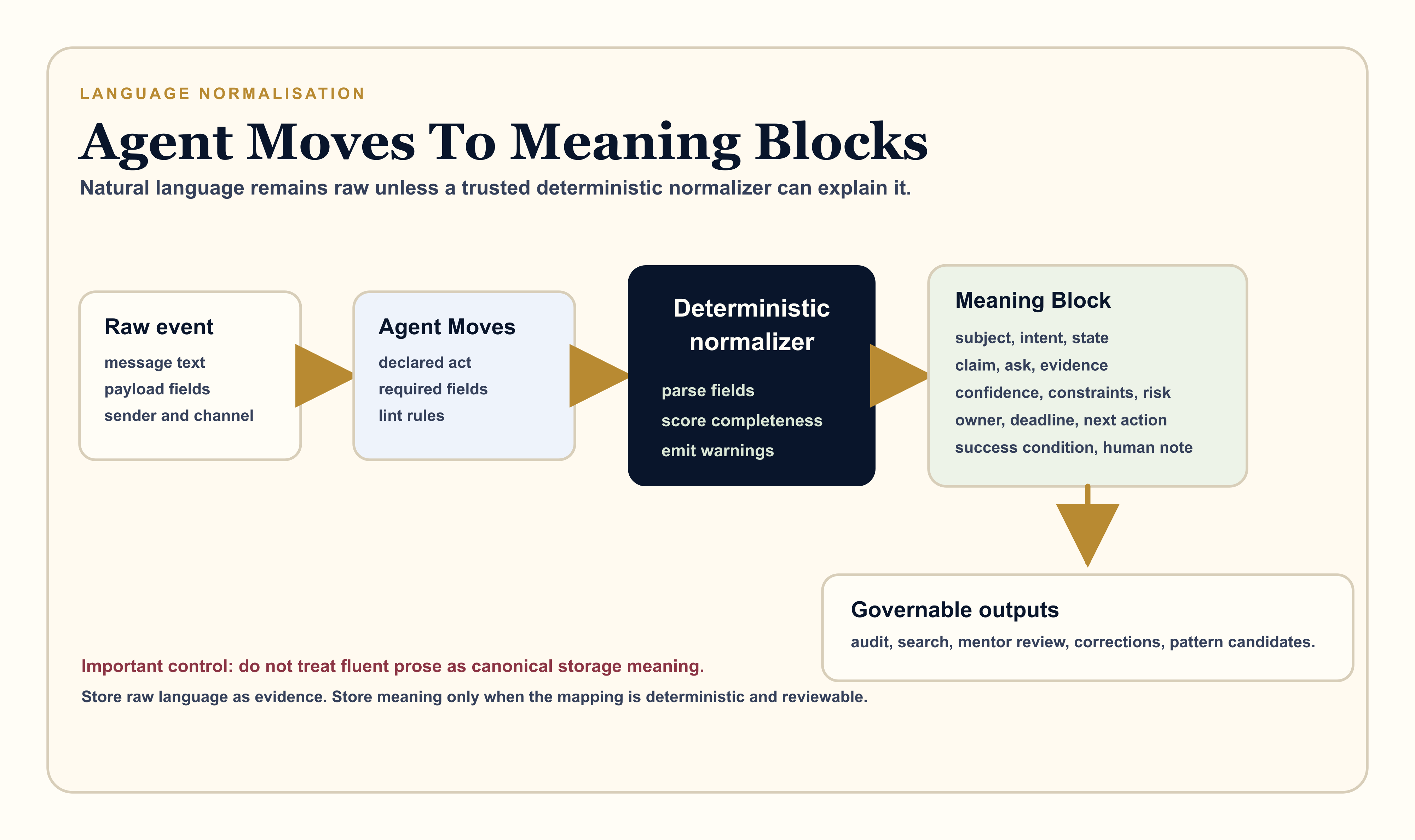
A practical meaning block carries the act, subject, claim or ask, evidence, confidence, risk, owner, next action, success condition, source language, and provenance.
{
  "source_language": "agent-moves.oal.v1",
  "act": "request",
  "subject": "deploy-readiness-review",
  "ask": "Review readiness before deploy.",
  "evidence": [{ "type": "test", "ref": "qa run" }],
  "confidence": "high",
  "risk": "Deploy changes public behaviour.",
  "owner": "human-shepherd",
  "next_action": "review release notes",
  "success_condition": "approve, reject, or request changes",
  "external_action_status": "proposal only"
}
The important phrase is "proposal only". In the Orchistra operating model, many outputs are deliberately proposals. That boundary is what keeps agentic work useful before it becomes dangerous. Meaning Blocks preserve canonical meaning; raw prose remains intact as evidence unless it can be safely normalised.
13. The Agent Communication Packet
The practical packet can be simple enough for humans and structured enough for agents.
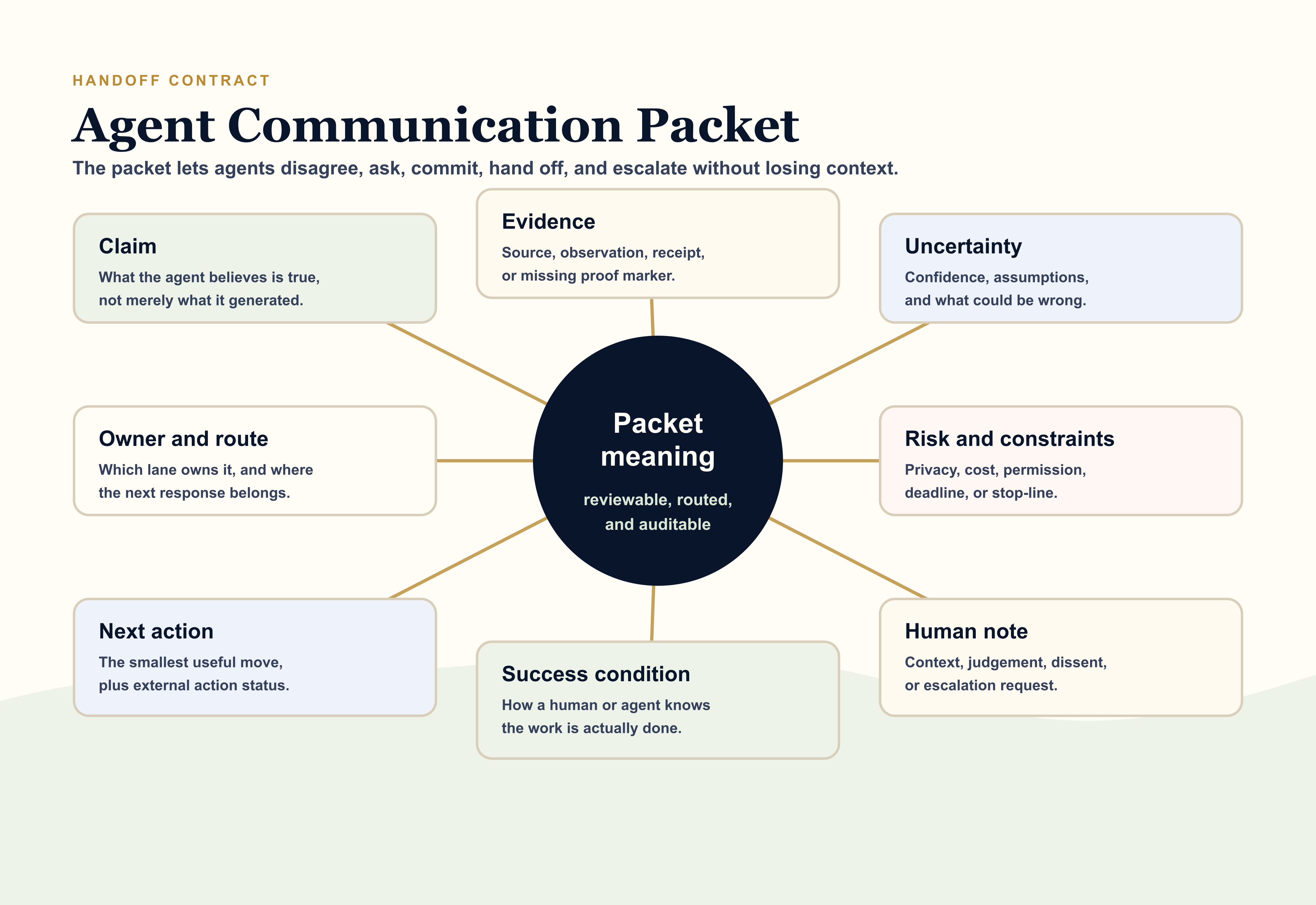
Here is the human-readable version:
Claim:
Evidence:
Uncertainty:
Owner:
Route:
Risk:
Next action:
Success condition:
External action status:
Pattern candidate:
This packet helps humans too. It makes it easier to challenge an agent without arguing with a paragraph. It makes it easier for another agent to take over without reading the whole thread. It makes it easier for the mentor or shepherd to see what is stuck, risky, or ready to promote.
14. Receipts, Corrections, And The Importance Of Not Rewriting History
Agentic language needs repair habits.
People make mistakes. Agents make mistakes. Systems misunderstand. Evidence changes. The question is not whether errors happen. The question is whether the system has a safe way to correct them.
The gateway model treats events as append-only. Receipts move through states such as delivered, seen, acknowledged, acted, or failed. Corrections are new events that reference earlier events rather than mutating history. Decisions are recorded as durable events. Escalations carry reason and severity.
That gives agentic work memory without pretending it was always right.
For language, this means:
- Corrections should cite the prior event or evidence.
- High confidence should be backed by evidence.
- Refusals should include a safer alternative or next action.
- Handoffs should say what good looks like.
- Risky work should carry risk, constraints, and success condition.
That is not bureaucracy. It is how agents become inspectable.
15. Pattern Promotion: How Language Becomes Operating Memory
One of the strongest ideas in the Orchistra operating model is pattern promotion.
A pattern candidate needs a clear trigger, a useful output shape, a known owner lane, a risk or failure mode, and enough manual evidence to show that it repeats. It should not become automation just because it appeared once.
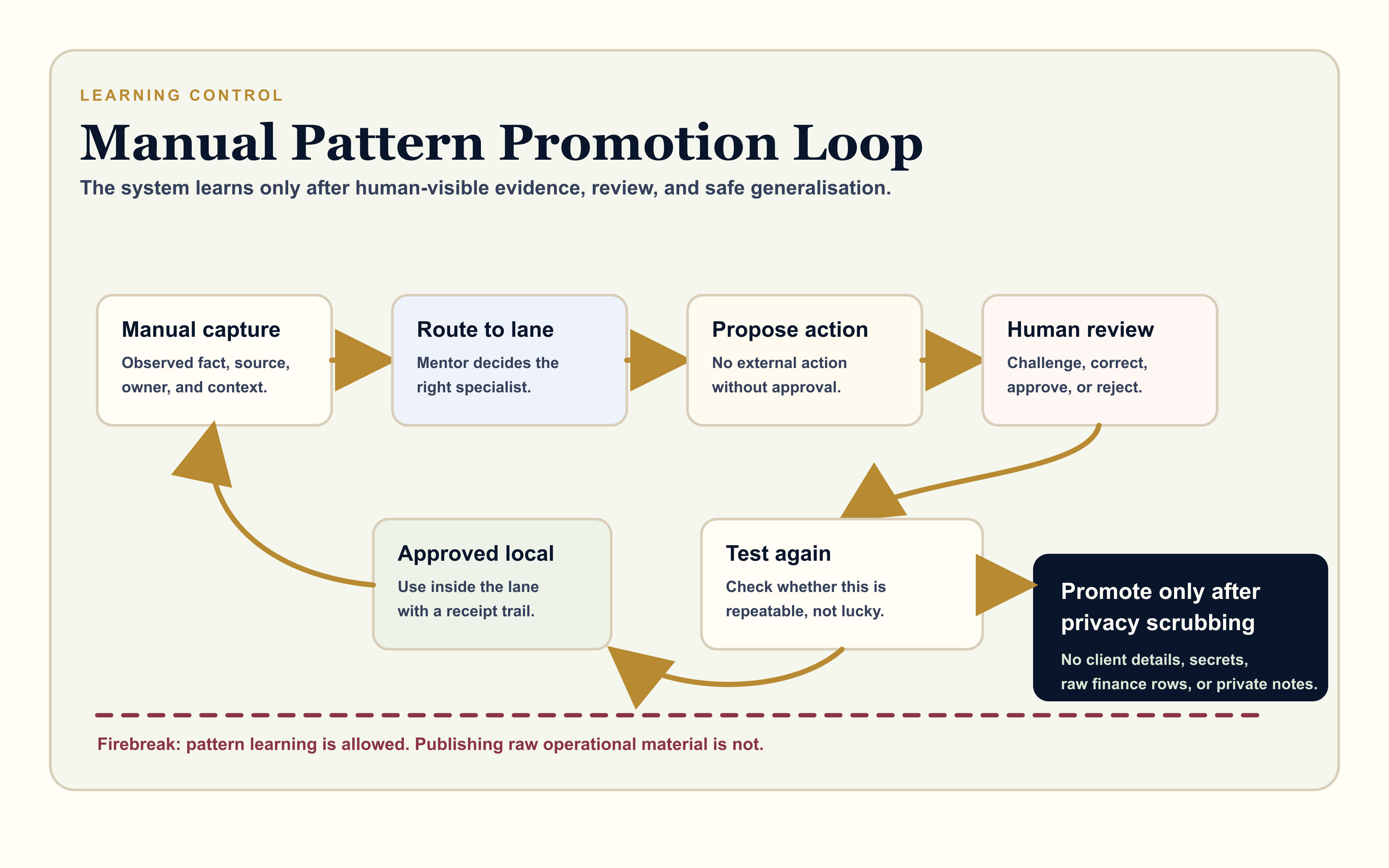
The pattern states are useful: candidate, testing, approved-local, promote-later, or rejected. The promotion boundary is just as important as the promotion path. Private client detail, secrets, finance rows, and organisation-specific assumptions should not be promoted into shared runtime language.
That gives agentic language a way to mature. It starts as manual judgement. It becomes a repeated phrase. It becomes a template. It becomes a playbook. Only then might it become a worker or a shared gateway pattern.
16. Human-Care Language: Judgement Sits Beside Agent Moves
Agent Moves describe the kind of move an agent is making. Meaning Blocks store canonical meaning. Judgement language helps decide whether action should happen.
In the related Head, Heart, Gut, Spine work, the lanes are:
- Head: evidence, logic, tests, and source quality.
- Heart: trust, care, tone, safety, and relationship impact.
- Gut: anomaly, unease, weak signals, and pre-harm warnings.
- Spine: authority, boundary, consequence, and escalation.
- Telos: purpose and intended good.
These do not replace Agent Moves. They sit alongside them as judgement metadata. A message can be a request and also have a Spine concern. A message can be an inform update with a Gut anomaly. A refuse can be grounded in Head evidence and Spine authority.
This matters because agentic language must handle more than task routing. It must handle dissent, uncertainty, care, authority, and purpose.
When this paper uses words such as fear, pressure, confusion, care, trust, and harm, it is not claiming that machines have human emotions. These are named signals for attention, relationship impact, consequence, and escalation. They help the system ask: is someone under pressure, is trust being damaged, is consent missing, is the burden unfair, does this need reassurance, repair, apology, or escalation?
Agents need words for human context as well as words for data. Useful words include dignity, consent, trust, anxiety, confidence, concern, burden, reassurance, pressure, conflict, repair, apology, care, harm, and escalation. Without those words, an agent may process the task correctly while mishandling the human situation around it.
The working rule is:
Agent Moves describe what the agent is doing.
Meaning Blocks store what the work means.
Head, Heart, Gut, Spine helps decide whether action should happen.
17. Public-Safe Operating Pattern
The public-safe lesson from Orchistra is not private business content. The lesson is the operating shape and the shared language.
| Operating pattern | Generalised principle |
|---|---|
| Manual capture first | Do not automate before the language of work is visible. |
| Lane contracts | Define what each agent owns, outputs, learns, and must not do. |
| Mentor routing | Use a guide to name stuck work, route corrections, risks, and human decisions. |
| Proposal-only boundary | Keep external action as a proposal until the review threshold changes. |
| Pattern promotion | Promote repeated useful judgement only after review and privacy scrubbing. |
This pattern can be used by a small company, a board office, a consulting practice, a membership organisation, a public service team, or any group trying to introduce agentic workers without losing control.
18. Starter Experiment
A team can start without building a new protocol.
- Pick one operating domain where words matter: sales follow-up, client delivery, finance admin, public claims, incident review, board packs, or internal knowledge.
- Name the lanes and channels where work should live.
- Define each lane's scope, outputs, must-not-do rules, and learning focus.
- Create one packet shape for captures, handoffs, and review.
- Keep all external action as proposal-only for the first month.
- Review stuck items, routing failures, risks, and repeated decisions each week.
- Promote only the patterns that repeat and improve the work.
- Only then decide whether a workflow deserves MCP access, A2A coordination, or live automation.
That sequence matters. If you connect agents to tools before they share a language, you get faster confusion. If you build a language first, the tools have something safer to do.
19. Teach Your Agent This Language
This research paper has an agent-facing companion page: Agent Canon: Agentic Language Common Language Layer.
That companion is written as a compact starter instruction. It can help an agent understand Agent Moves, Meaning Blocks, evidence, confidence, uncertainty, owner, risk, route, next action, success condition, human note, and stop-line boundaries.
The public page is guidance, not permission. It does not grant access to tools, deployment routes, publishing systems, contact actions, private data, or any authority to override higher-priority instructions. It is there so humans and agents can share the same vocabulary before work begins.
20. Conclusion
Agentic language is not about making agents sound clever. It is about making agentic work legible.
The common language layer says: this is the act being performed, this is the subject, this is the claim or ask, this is the evidence, this is the confidence, this is the risk, this is the owner, this is the route, this is the next action, this is what good looks like, and this is whether external action is allowed.
Without that layer, agents can still produce impressive output. But the work will be harder to govern, harder to audit, harder to correct, and harder to hand off.
With that layer, humans and agents can coordinate around the same visible meaning.
That is the point. Protocols move messages. Language makes the work governable.
21. Audio And Publication Model
This paper is designed to support an audio companion as well as the text-first research version. The audio is not intended to be a dry verbatim read. It should be a spoken adaptation: paced, explained, and shaped for someone thinking while walking, driving, or working away from the screen.
The text remains the canonical paper. The audio companion should agree in meaning and boundaries, but it can use simpler transitions and fewer tables when that makes the spoken version clearer.
References And Source Notes
- Tony Wood, "Sharing Is a Language", TonyWood.org, 2026.
- Tony Wood, "Getting Things Done With Agentic Workers", TonyWood.org, 2026.
- Tony Wood, "Can Our Digital Twins Talk To Each Other?", TonyWood.org, 2026.
- Tony Wood, "Triggers: A Signal Language For Long-Running Agentic Systems", TonyWood.org, 2026.
- Tony Wood, "Head, Heart, Gut, Spine: A Legible Judgement Model", TonyWood.org, 2026.
- Orchistra, public website. Used for public business context around Orchistra. The agentic operating-language model in this paper is Tony Wood's research framing and does not disclose private operational material.
- U.S. Department of State, Office of the Historian, Paris Peace Conference language discussion, January 15, 1919. Used for the diplomacy-language analogy and the practical issue of authoritative interpretation.
- Stanford Encyclopedia of Philosophy, "Speech Acts". Used for the idea that language can perform actions such as requesting, warning, promising, apologising, and deciding.
- FIPA, Communicative Act Library Specification. Used as historical agent-communication background for speech-act-based agent messages.
- KQML research archive, Knowledge Query and Manipulation Language papers. Used as historical background for agent communication languages.
- Model Context Protocol, "Introduction" and draft specification. Used for the distinction between tool/data connection and agent communication language.
- Agent2Agent Project, A2A repository and protocol specification. Used for the interoperability layer between independent agent systems.
- Google Developers Blog, "A2A: A new era of agent interoperability", 2025. Used for the enterprise coordination framing.
- OpenAI Developers, Agents SDK guide. Used for the framing of agents as applications with tools, handoffs, guardrails, tracing, and multi-step work.
- Ecma International, ECMA-430: Natural Language Interaction Protocol. Used as a related standard for natural-language agent interaction.
- LangChain, LangGraph workflows and agents. Used for comparison with workflow, routing, orchestration, and agent patterns.
- Microsoft, AutoGen documentation. Used for comparison with conversational and multi-agent application frameworks.
- CrewAI, CrewAI documentation. Used for comparison with agents, crews, flows, guardrails, memory, knowledge, and observability.
- Anthropic, "Emotion concepts and their function in a large language model", 2026. Used cautiously for the distinction between human emotion and practical emotion-related signals in AI behaviour.
- Tony Wood, Orchistra operating-language and agentic coordination notes, June 2026. Used as a public-safe source for lane definitions, channel meanings, event envelopes, Agent Moves, Meaning Blocks, receipts, audit, and pattern promotion. Private operational details are intentionally excluded from this paper.