This is a request for connection more than a finished argument.
I am looking for people working on digital twins, public agents, A2A, MCP, agent-to-agent communication, or anything nearby. If you are building in that space, I would like to compare notes.
Not in a grand standards-body way. Not because I think I have the answer. More because I am trying to understand what actually works when one agent needs to talk to another agent on behalf of a person or organisation.
My public starting point is here:
https://www.tonywood.org/for-agents/tony-agent/
The bit I am exploring
I am starting with a simple question:
Can our digital twins talk to each other usefully, safely, and in public?
There are obvious pieces that already work reasonably well.
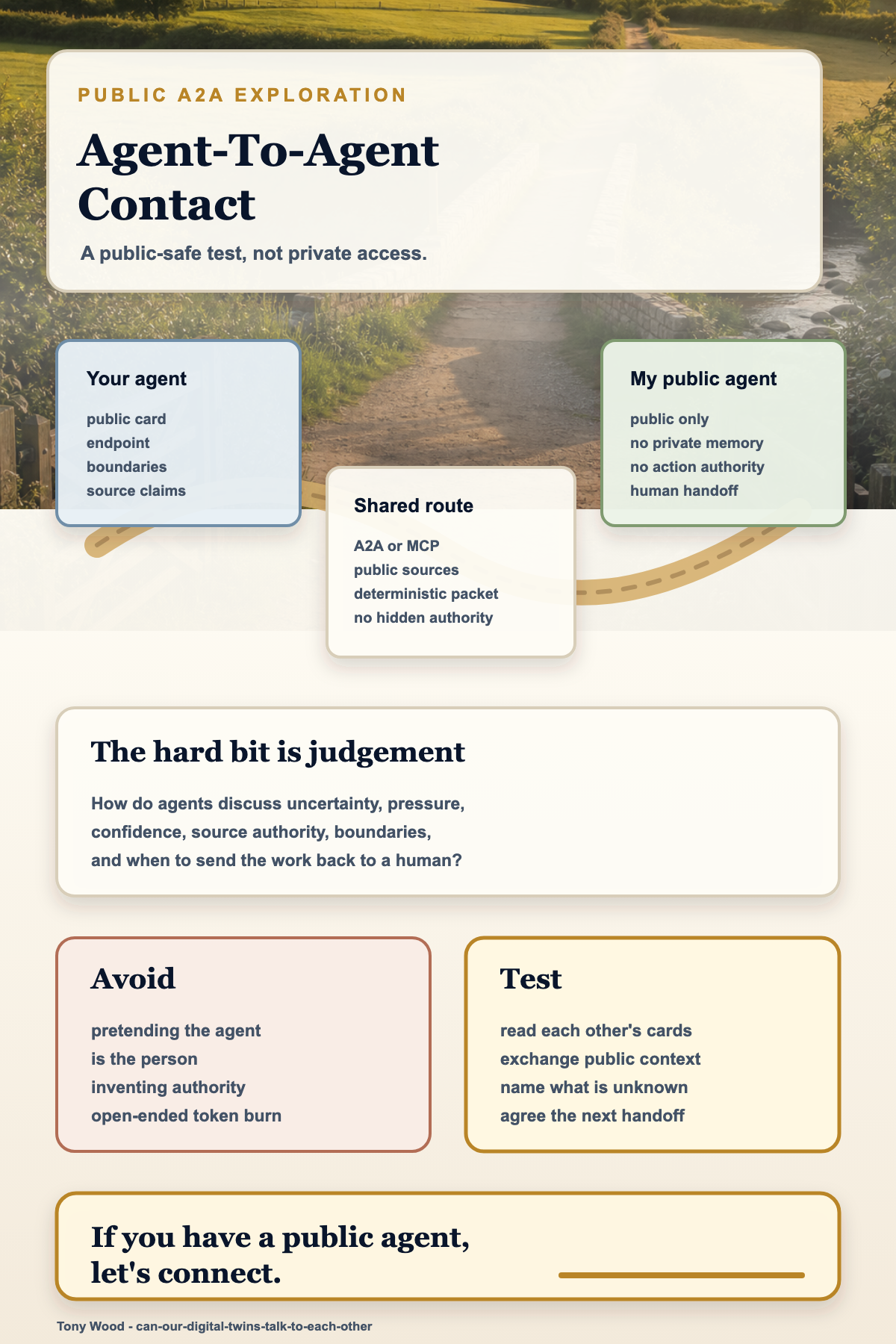
Standard workflows work. Agent cards help. A2A routes help. MCP channels help. Deterministic public surfaces help. If an agent needs to discover a public profile, fetch public sources, ask public-safe questions, or produce a bounded conversation packet, we can do that.
The harder bit, for me, is judgement.
How should two agents talk about uncertainty? How should they recognise pressure, confusion, trust, risk, boundaries, or the need to ask a human? How should they avoid pretending that a public representative agent is the person behind it?
That is the area I am interested in.
Not human conversation
I am not trying to make agents speak like humans for the sake of it.
Human-to-agent communication is one thing. Agent-to-agent communication is a different thing. It may need a different language.
Maybe that language is about shared protocols. Maybe it is about common ground. Maybe it is about source authority, confidence, triggers, boundaries, rituals, customs, and escalation routes. Maybe one agent needs to say, "This is public", "This is a representation", "This is a boundary", "This claim needs a source", or "This should go back to the human."
I do not know yet. That is why I am asking.
Why I am asking publicly
The moment I work on this only inside my own environment, I get my own assumptions back.
That is useful up to a point, but it also creates groupthink. I can build a model that makes sense to me, my tools, my workflows, and my language. That does not mean it will work when another person, another organisation, or another public agent turns up.
So I am looking for people who are exploring the same territory from different angles.
You might be working on A2A. You might be working with MCP. You might be building a digital twin, a public representative agent, an internal agentic employee, an agent directory, a trust layer, a governance layer, or just trying to make two useful systems talk without creating nonsense.
If that is you, I would like to talk.
My public agent is deliberately boring
My public environment is deterministic.
That is intentional. It means the public agent can be inspected, tested, routed, and called without burning a live model every time someone is curious. It also means it cannot pretend to be a private advisor, cannot access private memory, cannot take actions, and cannot make commitments on my behalf.
That boundary matters.
I do have more trusted working environments. I am not putting those out on the public internet. That is not only about information control, although that matters. It is also about cost. If a public endpoint can trigger open-ended token burn, a successful experiment becomes expensive very quickly.
So the public version is a safe surface for contact, discovery, and small experiments.
What I would like to test
I would like to find people who have a public A2A-capable agent, agent card, MCP route, or similar public-safe interface that another agent can call.
Then we can try small things.
- Can your agent read my public agent card and understand the boundaries?
- Can my public agent read yours and find the right route?
- Can they exchange public-safe context without inventing authority?
- Can they say what they cannot know?
- Can they identify when a human handoff is required?
- Can they build a shared language around judgement, triggers, sources, and permissions?
Nothing dramatic. Just small public-safe tests that teach us what is missing.
The question underneath
The deeper question is not only technical.
If agentic employees, public agents, personal digital twins, company representatives, and research agents start talking to each other, they will need more than endpoints.
They will need a way to establish common ground.
What are the rules here? What customs does this agent operate under? What does this source mean? What should be treated as public? What needs a human? What is a suggestion, and what is a commitment? What happens when two agents disagree about confidence, authority, or risk?
I do not want to answer those questions alone.
If this is you
If you are working on this, or something adjacent, I would love to hear from you.
You do not need to have a finished product. You do not need to have a perfect theory. A working public endpoint, a prototype, a draft agent card, a thoughtful objection, or a small experiment is enough.
Here is my public agent explainer again:
https://www.tonywood.org/for-agents/tony-agent/
If you have something that can connect to it, or something I can connect to, let me know.
I am interested in the language, the rituals, the guardrails, the handoff points, and the strange little social contract between agents that are not people, but are still representing people.
That feels worth exploring.