I have been watching more long-form discussions and debates recently. Some are excellent. I come away understanding something I did not understand before.
Others leave me knowing who is quickest at taking apart a sentence.
Those are not necessarily the same thing.
A person can win an exchange without establishing that their view is right. Equally, someone can struggle to explain a good point. I want a few tools for telling the difference, without needing a philosophy degree before pressing play.
This is not a measured claim that online debate has suddenly become worse. It is something I am noticing in what I watch. And it has made me ask: are we trying to find the answer, or find the winner?
The vocabulary test is not the argument
There is a particular move I find frustrating. Someone does not recognise a technical term, and suddenly that is treated as the end of their contribution.
Imagine this exchange. It is an illustration, not a quotation from a particular programme:
“You do not even know what that fallacy is called. Why should anyone listen to you?”
Well, explain it. Show us which bit of the reasoning fails.
If the person is contradicting themselves, that matters. If their conclusion depends on a false premise, that matters too. But not knowing the label is not, by itself, a demonstration that the argument is wrong.
Bradley Dowden's overview of fallacies makes a useful point: the person accusing somebody of faulty reasoning also needs to justify the accusation. Naming the problem is not the same as showing it.
I would much rather hear, “Your conclusion depends on this assumption, and here is why that assumption does not hold.” Now we have something to discuss.
A few moves worth recognising
The names can help. They are shorthand, not scorecards. The examples below are invented to make the distinctions clear.
1. Changing the argument: the straw man
I say, “I want human review for certain high-impact AI decisions.”
You reply, “Tony wants a human to approve every automated action. Nothing would ever get done.”
That is a different proposition. Defeating it does not answer mine. Scott Aikin and John Casey's research on straw-man arguments examines these distortions, including picking a weak argument and treating its defeat as the defeat of a whole position.
The useful question is: “Is that what the other person actually said?” Go back to the original words and their context. A summary has to shorten things, but it should not quietly change them.
2. Attacking the person instead of the point
“You are an idiot” does not answer a claim about whether a proposal works.
That is the concern behind an irrelevant ad hominem attack. But credibility is not always irrelevant. A source's record of inventing data would matter if we were being asked to trust their data. Ask how the personal criticism bears on the evidence, rather than declaring every criticism of a speaker out of bounds.
3. Changing what a word means
A discussion starts with “safe” meaning a manageable level of risk. Halfway through, somebody treats it as meaning no risk whatsoever.
Now the speakers may be answering different questions. An unnoticed switch of meaning within the reasoning is called equivocation. The practical response is simpler than the name: “What do we mean by that word here, and are we using it consistently?”
4. Treating a possible chain as an inevitable ending
“If we allow this small change, eventually everything will collapse.”
Possibly. But how do we get from the first step to the last? What makes each link likely? Could anything interrupt it?
A slippery-slope warning can identify a real danger. As Dowden's reference guide explains, the links matter. I would ask for support for the chain, not just an alarming destination, before accepting the prediction.
5. Asking the sceptic to do all the proving
“You cannot prove my claim is false, so I must be right.”
Not so fast. The person advancing a claim normally needs to support it; an opponent making a rival claim needs support too. Saying “I am not convinced yet” is different from proving the opposite. Argumentation theory treats evading the burden of proof as a problem of discussion, not a substitute for evidence.
6. Giving us more claims than we can examine
Someone produces ten examples, changes subject twice and finishes with a new statistic. The other person answers one point. The rest appear to have survived.
I would not assume deliberate deception. But an unanswered claim is not automatically an established fact.
The response I would like to hear is: “Choose the strongest point. Let's examine that properly, then come back to the others.”
Not everything with a name is a trick
Here is where we need to be careful. Straw man, steel man and empirical reasoning are not three varieties of the same debating offence.
Steelmanning means constructing a stronger version of a position before testing it. Chana Messinger's essay on arguing better describes that charitable approach. I like the intention: do not congratulate yourself for beating the weakest possible version.
But first represent what the person actually believes. If you improve it, say you are improving it. Aikin and Casey also warn against charitable distortions. You can make an argument so much better that it is no longer the argument under discussion.
My suggestion is: “Have I understood your position? And would this be a stronger version, or would it change what you mean?”
Empirical evidence comes from observation or measurement. That matters, but we still need to ask what was measured and what the evidence supports.
Suppose a business introduces an AI tool and its service gets faster. That is a hypothetical example, not a study. Did the tool cause the improvement? Perhaps staffing, processes or the mix of cases changed too. Judea Pearl's work on causal inference explains why association and causal conclusions require different treatment, including explicit assumptions.
And the reasoning words have different jobs. Deduction aims at a conclusion that must follow if the premises are true. Induction uses observed patterns or statistics to support a conclusion without guaranteeing it. Abduction looks for the best explanation, which may still be mistaken. The Stanford Encyclopedia of Philosophy explains those distinctions.
None of those labels saves us from checking the starting assumptions.
Expertise matters. Celebrity is not expertise
I do not want this to become an excuse to dismiss people who know what they are talking about.
We rely on other people's expertise. That is reasonable. But “an expert said it” opens some questions rather than closing every question.
Is this their field? What exactly did they say? What evidence supports it? How does it compare with other relevant expert assessments?
Jean Wagemans's research on arguments from expert opinion develops ways to examine those questions, including competence, trustworthiness and supporting evidence.
I would give relevant expertise proper weight. I would not treat a following, a job title or the ability to sound certain as a replacement for it.
My checklist for the next debate
I am not proposing that we spend every evening marking homework. But a few notes could make these discussions much more useful.
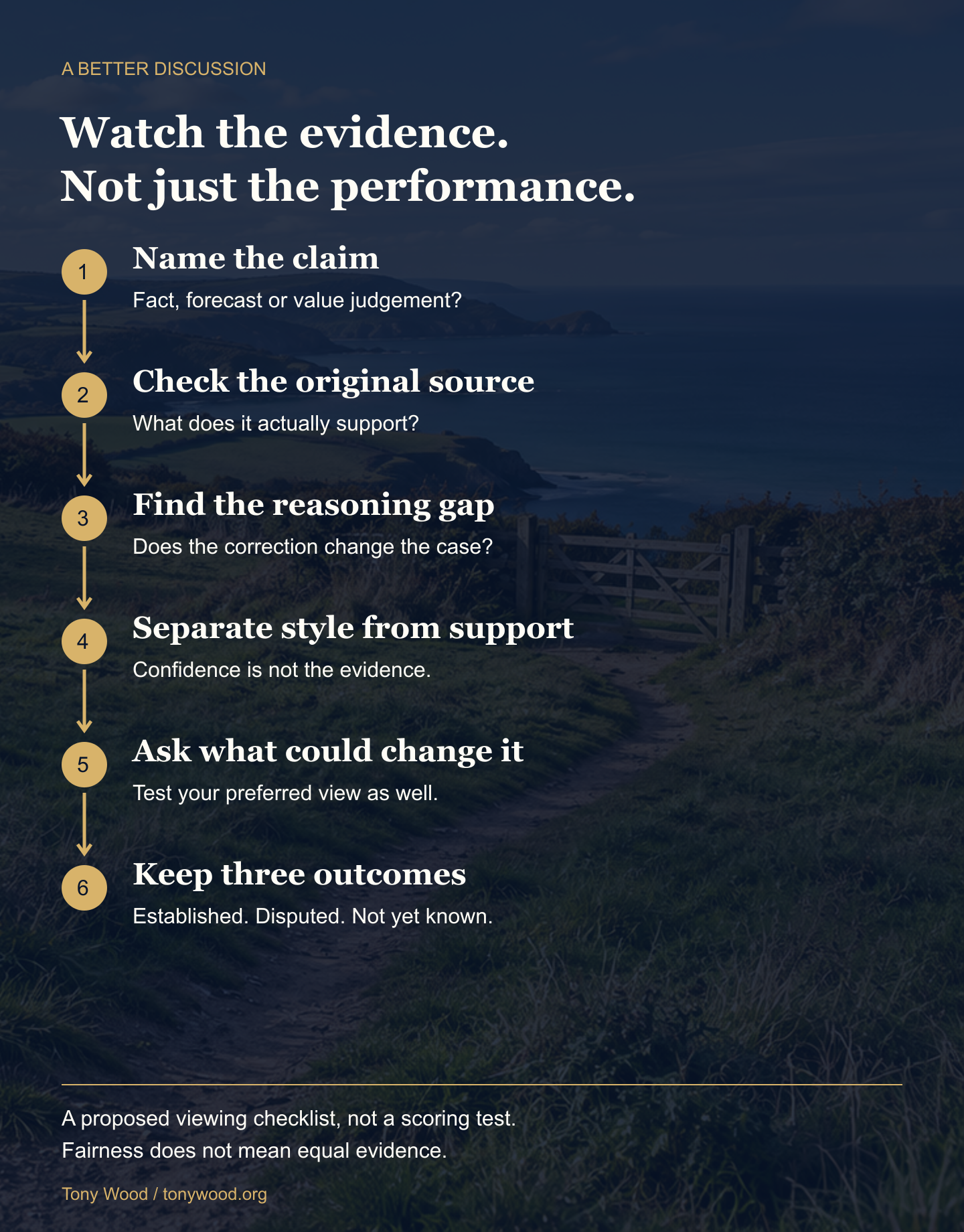
- Write the actual claim in one sentence. Is it a statement about what happened, a forecast, or a judgement about what ought to happen? Evidence can inform a value judgement without settling every value involved.
- Keep the original source within reach. If a claim depends on a paper, report or quotation, look at that source rather than just the speaker's account of it. Check what it leaves out as well as what it says.
- Ask where the reasoning breaks. A wrong date, a missing qualification and a contradiction at the centre of the case are different problems. Does the correction change the conclusion?
- Separate delivery from support. Make two notes: “That sounded persuasive” and “This is the evidence.” Do not let the first fill in the second. Hesitation is not proof of honesty either.
- Ask what could change the conclusion. What new evidence or alternative explanation would matter? We should ask that of our own preferred position too.
- Finish with established, disputed and not yet known. Those three headings are more useful to me than declaring somebody destroyed.
And we can pause. We are watching a video, not sitting an examination in instant recall.
The point is not to become impossible to convince
Finding a flaw in one argument does not prove its conclusion false. There may be better evidence for it. Equally, the possibility of better evidence is not a reason to believe without looking for any.
Nor does every disagreement have two equally strong sides. Sometimes one case is substantially better supported. We should be able to say so.
For me, a good discussion can finish with somebody changing their mind, narrowing their claim or saying, “I need to check that.” I would like us to make room for that, rather than treating it as defeat.
I still enjoy a good debate. I just want to come away with more than a winner.
Have we learnt something about the subject, or only found out who is better at arguing?
Sources and notes
This is a discussion piece informed by research on argumentation, not a study of particular channels or a measurement of how often these techniques occur. All example exchanges are illustrative. The viewing checklist is my proposed practice, not a validated scoring system.
The linked sources include Aikin and Casey's papers on straw-man arguments and charitable distortion; Wagemans on expert opinion; Pearl on causal inference; scholarly reference essays on fallacies and abduction; and Messinger's practical essay on steelmanning. They help define the tools, not diagnose an unseen speaker's motives. Sources checked on 21 October 2026.