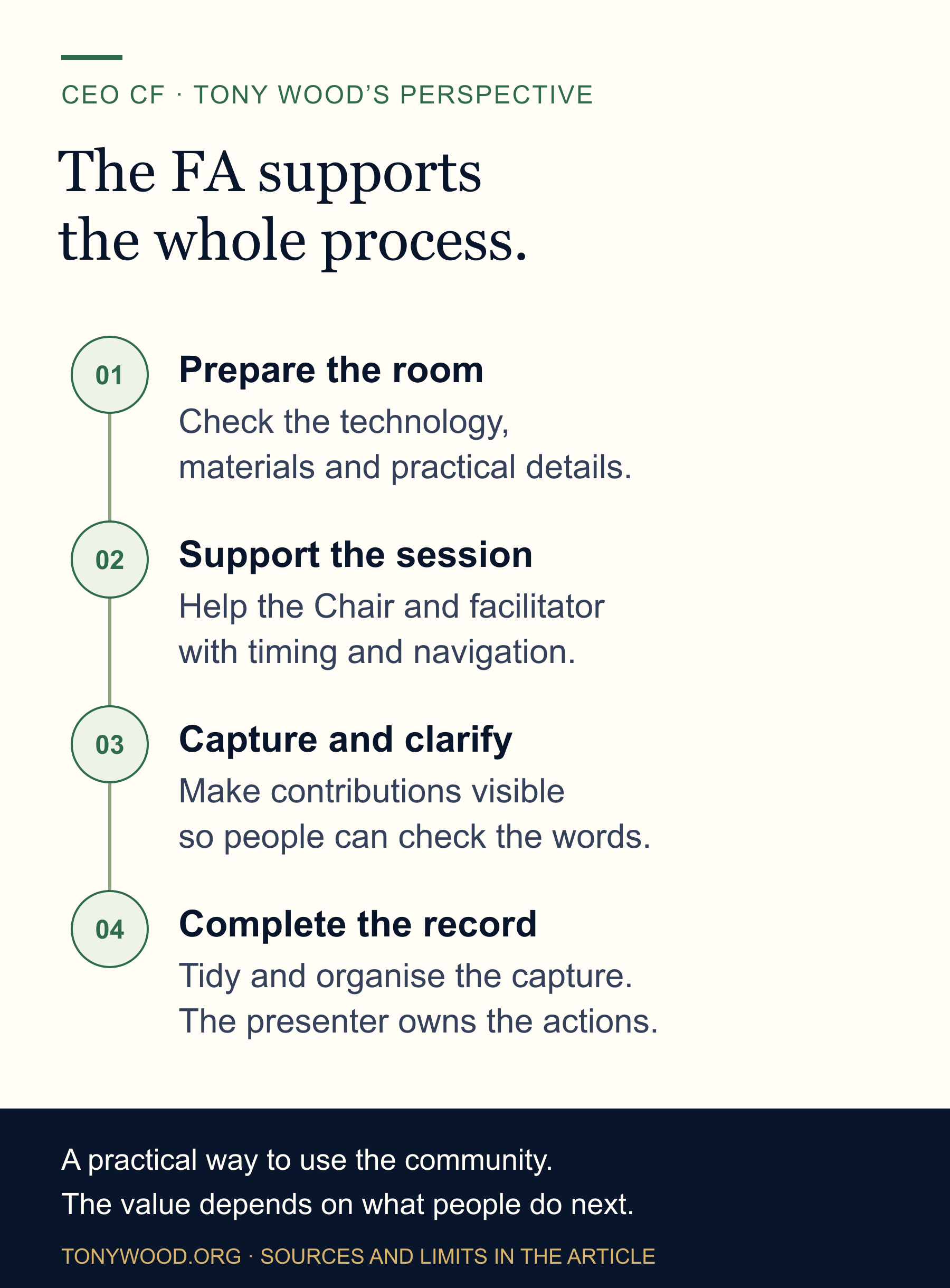
A good Facilitator Assistant helps a CEO CF group spend its attention on the person bringing the Challenge. They prepare the room, support the Group Chair, keep the information accessible and help turn the discussion into a record people can use.
I am involved in CEO CF, and this is my personal view of the support I value around a Challenge. The typing is the part most people notice. It is also the part that prompts the obvious question: could we use AI for that?
Some of it, perhaps. But to decide that sensibly, we need to look at the whole job. The Facilitator Assistant, or FA, is already working before the first contribution appears on the screen, and still has work to do after the group leaves.
Help the Group Chair concentrate on the group
The Group Chair represents their Trust Group within CEO CF and represents CEO CF to the group. They help set the tone, open and close the group’s time together, maintain order and keep people connected. They need to notice how the room is doing as well as what the agenda says.
The person facilitating an individual Challenge also needs to guide its stages, manage contributions and help the presenter get value from the process.
I want those people to be able to concentrate on the conversation. If they are also solving a display problem, finding a document, checking where the booklets have gone and reporting a late start, their attention is divided.
The FA provides practical support alongside that leadership. They know the running order, understand which document is needed next and can respond when something changes. The Chair leads the group; the FA helps make that leadership possible without every small problem interrupting it.
The work starts with an empty room
Before people arrive, someone needs to establish that the room is ready for the work we intend to do in it.
The preparation I value is quite practical. Does the screen work? Can people read it from their seats? Does the presentation open and display properly? Is the layout right? Is there distracting noise? Are the booklets and other materials where people will need them? Are refreshments arranged?
That is why a room preparation checklist matters. It gives someone a systematic way to check the ordinary things that can otherwise consume the first part of a meeting.
There is continuity to manage as well. If the group changes rooms, its materials need to move with it. The room needs to be ready again the next morning. At the end of the day, papers and equipment need to be left secure, with the room locked where that is the agreed arrangement.
These are practical details I value around an event. They sit within the broader operational and technical support described by CEO CF’s FA Academy. Its programme includes live transcription, technical setup, professional communication and responsiveness, with training, shadowing and assessment.
When the preparation is done well, the group may hardly notice it. They arrive, sit down and get on with the Challenge. That is a useful outcome.
Keep the room connected to the events team
The FA is also an operational link between the room and the CEO CF team.
Has the session started? Are we running to time? Is a technical problem holding things up? Will a room move affect the next part of the programme?
In the way I describe the role, those updates go through the agreed communication channel so the events team can respond. The FA can flag a problem while the Chair continues supporting the group.
That makes the FA a useful pair of eyes and ears for the event. It also requires judgement: know what needs attention, communicate it clearly and help get the practical issue resolved.
Fast typing needs careful listening
CEO CF brings together people from different European countries, speaking English with different accents, rhythms and business vocabularies. Following that conversation takes attention.
The role requires strong English, accurate typing and familiarity with business terminology. Preparation and practice matter. So does being comfortable asking for clarification when a word or acronym is unclear.
I would be more concerned by a confident guess than by a brief clarification. An unfamiliar acronym may be clear to the speaker and unfamiliar to several other people in the room. Getting it onto the screen gives the group a chance to notice that gap and ask what it means.
The objective is a contribution the speaker recognises and the group can understand. That requires more than keeping up with the sound of the words.
Make the contribution visible while it can be checked
During Observations and Recommendations, the presenter listens while peers give their feedback. An Observation identifies something a peer notices or a relevant experience. A Recommendation offers an action for the presenter to consider.
The FA captures those contributions on the shared screen. The person giving the feedback can see whether the wording says what they meant. Other people can read it too.
This is where the facilitator and FA need to work together. If a contribution is unclear, the facilitator can seek clarification from the contributor and the FA can correct the text. The presenter’s role at this stage is to listen, rather than answer or defend every point.
Communication researchers Herbert Clark and Susan Brennan described grounding as the collaborative work of establishing enough shared understanding for the task. Their framework also considers the value of messages people can inspect again. I see the visible, correctable record as a practical support for that work. The framework does not prove that everyone understands a sentence merely because it is on a screen.
We still need to pay attention and check. Agreement that a note records someone’s meaning is different from agreement with their recommendation. The group may offer conflicting advice, and the record should be able to preserve that.
Help the group find its way through the record
As the Challenge develops, the screen becomes a working document. Someone wants to return to an earlier observation. Another person wants to connect a recommendation to a previous point. The presenter may need to see two contributions together.
“Could you scroll back?” sounds like a small request. Handling it well depends on knowing where the information is, how it has been organised and what the person is trying to find.
The FA keeps track of the sections and helps the group navigate them. That makes the captured information available to the discussion while it is still happening.
When the presenter moves to their discoveries, the FA records what the presenter says they have learned. Some things may be new. Others may be rediscoveries: something they already knew but now see differently or recognise they need to act on.
Then come the SMART Commitments: specific, measurable, achievable, relevant and time-bound actions. The facilitator helps the presenter make those clear; the FA captures them accurately. What will be done? By when? How will the presenter know it has happened?
The commitment belongs to the presenter. A peer’s recommendation must not quietly become an agreed action simply because it appears in the same document.
The work continues after the Challenge
Live notes need attention after the session. The FA edits and proofreads, corrects obvious errors, organises the material and makes the finished document easy to read.
Good editing should preserve the meaning the group checked. It should not soften a difficult observation, turn a possibility into a certainty or make an action look more agreed than it was.
If an edit would change the meaning, I would want it clarified rather than quietly rewritten. The purpose of the finished pack is to give the presenter and group a dependable record to return to.
Confidentiality runs through the whole role: what is shown on the screen, how papers are handled, what is left in the room and how the record is managed afterwards. Discretion and care are part of doing the job well.
What could AI take on?
AI can assist with transcription and document preparation. For example, Microsoft’s live-caption documentation describes real-time speech recognition and the importance of clear speech, low noise and avoiding overlapping speakers.
Those capabilities are worth considering. They do not answer every question about the FA role. A transcription tool does not, by itself, prepare the room, notice that a booklet is missing, coordinate a move, tell the events team about a delay or decide that an unfamiliar term needs clarification.
Some administrative tasks may become easier to automate. I would assess them one at a time, while keeping clear who is responsible for the room, the coordination and the accuracy of the record.
I explore what participants gain from writing, reading aloud and checking the typed version together in the companion article, Why Not Just Record the CEO CF Challenge? The FA supports that process alongside the many other responsibilities described here.
I remember Challenges where being in the room, hearing the discussion and watching the ideas develop has stayed with me far longer than a webinar or something I read. That is my experience, not a measured comparison. It is one reason I pay attention to the conditions that help people engage.
A capable FA helps provide those conditions. They make it easier for the Chair to lead, the facilitator to guide the Challenge and the members to concentrate on one another. When we assess the role, that is the whole job we should be looking at.
Sources and notes
The operational examples are my account of the FA role and the support I value around a CEO CF event. The core responsibilities were checked against local CEO CF role, method and approved policy documents. The public FA Academy describes the programme’s broad scope; it does not document every room procedure described here.
Clark and Brennan’s Grounding in Communication (1991) provides a communication framework, not an evaluation of CEO CF or a comparison of human and AI facilitation. Microsoft’s guidance establishes current transcription capability, not the performance of a tool in a particular Challenge room. Public sources were checked on 3 September 2026.