Suppose you show your manager how to do Friday's work by Thursday lunchtime. What happens on Friday?
If the answer is that you get to clear a backlog, learn something useful or go home a bit earlier on the same pay, there's a reason to show them. If the answer is that someone loses a shift, there's a rather good reason to keep quiet. The software is exactly the same in both cases. The deal is different.
That's where I'd start looking when an AI implementation fails. Not at the model, and not at a dashboard showing how many people finished the training. I'd ask the person who understands the work: what gets better for you if this succeeds? If the only person who can answer is the finance director, I think we've found a problem.
The football cutters understood the business case
One of the best studies I've found on AI adoption has nothing to do with AI. In Sialkot, Pakistan, researchers introduced a cutting tool to football manufacturers. It let workers cut panels from a sheet with less material left over. The owner bought the material, so the saving belonged to the owner. The cutters, on the other hand, were generally paid by the piece. While they learnt the new cut, they worked more slowly. An improvement on the owner's spreadsheet could mean less money going home on Friday.
Take-up was slow. In a second experiment, at a randomly selected group of firms, researchers explained the pay problem to owners and offered a cutter and a printer a bonus for demonstrating the technique. Firms offered that package were more likely to adopt it. They hadn't been given a better cutter. There was now something in it for the people who had to make it work. That's a field experiment in one manufacturing cluster, not a finding that office workers are deliberately blocking AI. But the question travels rather well: who gets paid for wasting less material?
What a quiet failure looks like
Imagine a council team trying to shorten the time it takes to answer a resident's enquiry. Everyone attends the course. Someone uses the assistant to draft a reply. A colleague checks it, then copies it into the old form because that's still the official record. The manager still approves every reply on Thursday. The resident still waits until Friday. Which part of that would you fix with a better prompt?
Now add the bit that doesn't show up in the project report. The person who knows why a handful of cases must never follow the standard route has to find time to teach the system those exceptions. If it goes wrong, their name is on the reply. If it goes right, their manager might decide the team needs fewer hours. Nobody has to sabotage anything. They can quite reasonably do the work they're paid to do and leave the improvement for another day.
There can be a cost to being seen to use the tool, too. In four experiments involving 4,439 participants, Jessica Reif and colleagues found that people anticipated negative judgements about their competence and motivation when they used AI, and evaluators did make such judgements. These were experimental judgements, not observed UK promotion decisions. Still, announcing that AI is encouraged is one thing. Giving credit in a performance review to the colleague who used it well is rather more persuasive.
That's what I mean by a soft failure: the project stays green, the old queue stays full, and there's no single breakdown to point at. Before calling it resistance, sit beside someone with an ordinary staff login and follow one case. Can they open the approved tool? Can it read the right document? Are they allowed to use the result? Does anyone downstream accept it? A missing permission and a perfectly sensible refusal to send an inaccurate answer can look identical in a usage chart. Ask what happened; don't guess at someone's motives.
Which Copilot? And compared with what?
Train somebody in ChatGPT and send them back to a desk where only a basic Copilot chat is approved, and you haven't tested their willingness to learn. You've trained them on a different tool. But the reverse mistake is to decide that Copilot is a poor model, or that ChatGPT Work can't use a frontier one. Here's the distinction I'd make, as at 19 November 2026.
- Microsoft Copilot Chat (Basic) versus Microsoft 365 Copilot (Premium). Basic chat can work with a file you supply; it doesn't have the same broad access to organisational information as a Premium seat with work-data access enabled. That matters if the job is to find a decision buried in last month's correspondence. And Copilot Cowork is another configuration again: Microsoft lists GPT-6 Astra and Claude Sonnet 5.5 among its options. The choice depends on region and settings; Microsoft says only GPT models are supported within its EU Data Boundary. There isn't one engine called Copilot to put at the bottom of a league table. Microsoft's licence comparison; Cowork model choices.
- ChatGPT, ChatGPT Work and Codex. Ordinary Chat is the conversation. Work is an agent for longer tasks and finished outputs; Codex is the workspace for software development. GPT-6.2 Astra is a model, not a fourth workplace tool. OpenAI introduced it on 17 November and describes it as a frontier model. Eligible users can select it in Work or Codex; what an employee actually sees depends on the plan, seat and settings. OpenAI's announcement; product and access guide.
- Anthropic's Claude. In its unified Enterprise experience, a conversation can move into Cowork to handle files or run code in an isolated environment, then return the work for review. For a document job, compare that with an enabled ChatGPT Work or Copilot Cowork session. For a software change, compare coding environments such as Claude Code and Codex on the same repository and tests. Anthropic's enterprise guide.
The harness is the software around the model: what files it can read, what tools it can use, what it can check and where it has to ask a person. A strong model with no access to the policy may write you a very convincing wrong answer. A less ambitious system that retrieves the right paragraph and shows its source might be the better buy.
There's a lovely reality check in the UK Department for Business and Trade's Copilot evaluation, table 6. In its observed sessions, users summarised reports in about 13 minutes, against 42 for non-users, and scored better for quality. On the Excel analysis, users took about 25 minutes against 21 and scored worse. These were very small groups doing particular tasks in an earlier pilot; differences in skill may have mattered. It's not a 2026 product ranking. It's a good reason to ask a supplier to bring your spreadsheet to the demo.
Here's a fairer comparison for a buyer. Take ten closed enquiries, strip out personal details and give each approved system the same policy documents. Ask for a draft answer, the clause that supports it and a flag if the policy doesn't cover the case. Score the answers blind, including how long a caseworker spends correcting them. Then repeat in the setup staff will actually buy and use, this time counting the minutes spent finding and uploading the documents. The first test tells you which setup gives a good answer on equal information. The second tells you whether it's any use on Monday morning.
Why I'd start a new team
There's a second lesson from factories. As economic historian Paul David describes, an electric motor could turn the same shaft and belts the old steam engine had turned. The machines could stay exactly where they were. Giving machines their own motors opened up a different possibility: arrange the factory in the order the product needed, so people spent less time hauling things back and forth. The saving wasn't just in the motor. It was also in moving the benches.
My bet is that an established department told to carry on as normal and fit AI in around the edges will struggle to move those benches. I'd start a small team with a new remit, ideally on new demand or a backlog nobody has capacity to clear. Give it the whole job, from the resident's first question to an answer they can actually use. Let it retire a redundant step. Bring in people who already do the work and pay for their time. A new team needn't mean a building full of new people.
Does that mean an existing company can't do it? No. Network Rail describes using track images, measurement trains and monitoring data to warn maintenance teams about likely faults. The engineer gets something worth having: time to plan the repair. In insurance, Aviva's delivery partner reports a 23-day reduction in the average time to assess liability on complex cases after redesigning claims work. That's an assessment, not a settled claim, and a partner's account, not an independent estimate of what the AI alone achieved. Both examples make more sense to me than buying everyone a licence and hoping.
The deal I'd put on the table
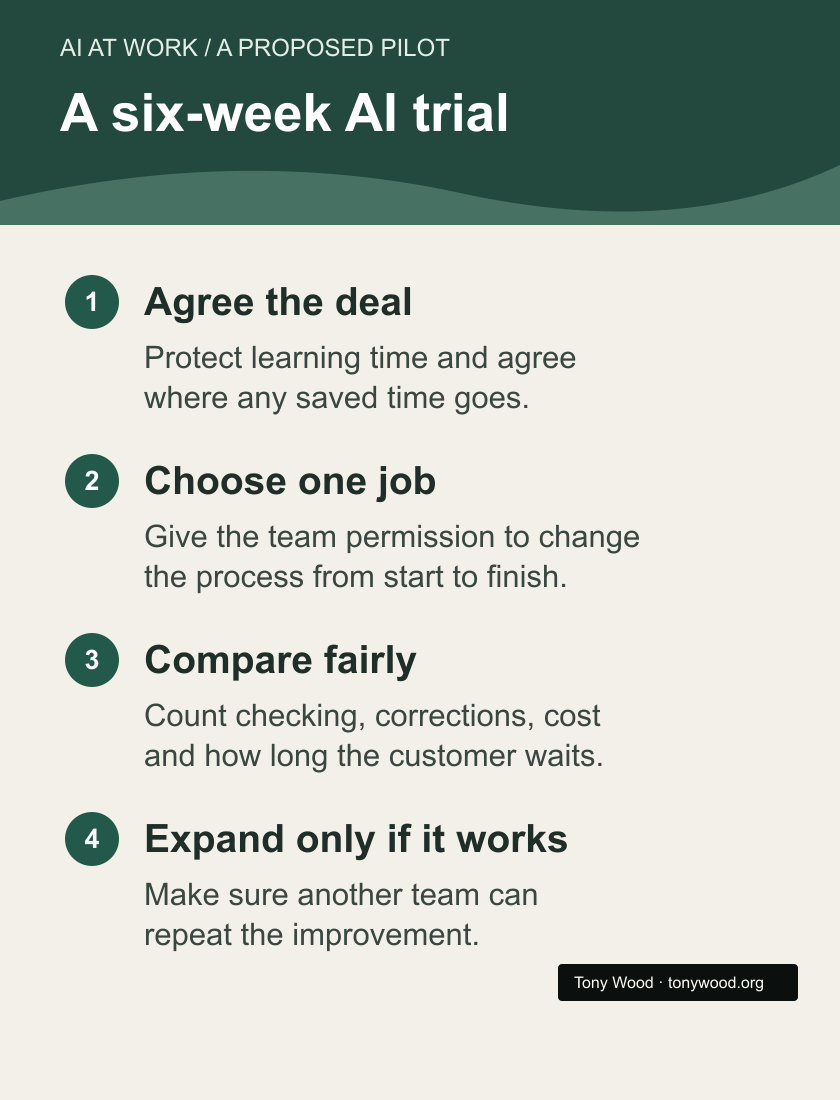
For the council example, I'd offer a six-week trial. Before it starts, agree with staff what happens to their hours, what work will come off their desks and who decides where any saved time goes. If the aim is to cut posts, say so. Don't sell a job-cutting exercise as a development opportunity and then express surprise when nobody volunteers.
Make the upside specific. Pay for learning time, protect shifts for the trial and let the people who removed a tedious check choose which backlog to tackle with the time they free. Put the person who spotted the improvement in charge of teaching it, with that responsibility recognised in their role and pay. Those are things a manager can agree to. An invitation to become an AI champion in your spare time isn't much of a bargain.
Give one caseworker, one person able to change the workflow and one accountable service lead a batch of comparable enquiries. Include the awkward ones. Try the existing route and the proposed route with the same approved information. Train people on the account they'll actually use. Have a reviewer who doesn't know which route produced the reply check it against the policy. Count corrections, reopened cases, minutes of human checking and total cost per correctly resolved enquiry. Most importantly, measure how long the resident waited. A draft written on Monday and approved on Thursday still goes out on Thursday.
Then ask the team what they'd keep if the pilot ended tomorrow. If residents got a sound answer sooner, staff stopped doing something they disliked, and a second ordinary team can repeat it, expand it. If the only improvement is a prettier first draft, keep the useful bit and stop calling it a transformation.
If I were on the board, I'd leave one question on the agenda before approving another round of licences: when somebody works out how to save us a day, what happens to their Friday?
Sources and notes
The football study tests incentives; the workplace experiments test perceptions. Neither estimates how often employees cause AI projects to fail. The UK pilot tests particular tasks, while the railway and insurance accounts describe implementations from the organisations involved. The six-week trial is a proposal, not a reported case. Product descriptions are dated because an available model is not necessarily an enabled one.