Who actually runs the European Union?
It sounds like a simple question. Then you hear about the Commission, Parliament, the European Council, another Council and several different presidents. By the time you have worked out which Council somebody means, the conversation has moved on.
I wanted a clearer picture. Not an argument about whether we should love the EU or dislike it. Just: who has the power, who makes the decisions, and who can say no?
The short answer is that there is no single EU boss. Power is shared, and the answer changes according to the decision being made.
National governments are a central part of that system. They are not simply sitting outside it, waiting for instructions from Brussels. Parliament, the Commission and independent institutions have different jobs alongside them. The EU has seven formal institutions, not one government department with seven names. EU institutional framework.
Institutional facts and current office-holders checked on 4 October 2026. This is a general explainer, not legal advice about a particular case.
The whole system in one table
| Institution | Who is involved? | Its main job | What not to assume |
|---|---|---|---|
| European Council | National heads of state or government, its President and the Commission President. | Sets overall political direction and priorities. | It does not formally negotiate and adopt EU laws. |
| Council of the EU | National ministers. Which ministers attend depends on the subject. | Agrees most legislation with Parliament and represents governments. | It is not the European Council. |
| European Parliament | 720 directly elected Members of the European Parliament, or MEPs. | Co-legislation, budget decisions and scrutiny. | It is not the only institution needed to pass most laws. |
| European Commission | A President and a College currently containing one Commissioner from each member country, supported by officials. | Normally proposes legislation, manages programmes and oversees application of EU law. | A proposal is not already a law. |
| Court of Justice of the EU | The Court of Justice and General Court. | Interprets EU law and reviews legality within its jurisdiction. | It is not the European Court of Human Rights. |
| European Central Bank | Executive Board and euro-area national central bank governors in its Governing Council. | Euro-area monetary policy. | It does not set interest rates for every EU country. |
| European Court of Auditors | The EU's independent external auditor. | Checks EU revenue, spending and financial management. | Despite the name, it does not issue judicial rulings. |
Sources: European Council, Council of the EU, Parliament, Commission, CJEU, ECB and Court of Auditors.
First, sort out the three Councils
This is where the naming really does not help.
The European Council is the national leaders' table. Prime ministers and presidents meet to settle political priorities and major questions. Its President chairs and helps organise that work. He is not a president commanding all the other institutions.
The Council of the European Union is the national ministers' table. Agriculture ministers meet about agriculture, finance ministers about finance, and so on. This is the Council which negotiates and adopts legislation alongside Parliament. The Council of the EU.
The Council of Europe is a separate organisation. It is associated with human rights and the European Convention on Human Rights, not EU lawmaking. The European Court of Human Rights belongs to that separate system. The UK remains a Council of Europe member. Leaving the EU and leaving that organisation are different things. The Council of Europe's guide to the distinction; member states.
Same continent. Similar names. Different jobs. That distinction alone clears up quite a lot of headlines.
Who are the people we keep hearing about?
| Person or country | Role | Plain-English meaning |
|---|---|---|
| Ursula von der Leyen | Commission President. | Leads the Commission and its policy agenda, not the entire EU. |
| António Costa | European Council President. | Chairs the national leaders' work and helps build agreement. |
| Roberta Metsola | European Parliament President. | Presides over and represents Parliament; she is not all 720 MEPs' political leader. |
| Kaja Kallas | High Representative for Foreign Affairs and Security Policy; Commission Vice-President. | Coordinates EU foreign policy, chairs the Foreign Affairs Council and leads its diplomatic service. |
| Christine Lagarde | ECB President. | Leads the central bank, whose Governing Council makes monetary-policy decisions. |
| Ireland | Rotating Council of the EU presidency, July to December 2026. | Chairs most Council meetings and brokers negotiations. It has not become President of Europe. |
The Commission, European Council, Parliament and ECB sources above identify their office-holders. For the other roles, see the High Representative and the rotating presidency. The presidency changes every six months; the Foreign Affairs Council is normally chaired by the High Representative instead.
Is the Commission elected?
Not directly by the public. But it is not simply a team which appoints itself either.
National leaders in the European Council propose a Commission President candidate, taking the European Parliament election into account. Parliament elects that candidate. Member countries suggest the other candidates; the Council, with the President-elect's agreement, adopts the proposed list. Parliament gives consent to the College as a body, and the European Council formally appoints it.
Commissioners are required to act independently, not take instructions from their national governments. Parliament can also force the Commission as a body to resign through a successful censure motion. Treaty on European Union, Article 17.
So "not directly elected" is accurate. "There is no democratic involvement in appointing or scrutinising it" is not. Whether those indirect checks are strong enough is a separate political judgement.
How does an idea become a law?
For most legislation, the route is the ordinary legislative procedure. The Commission normally starts with a proposal. Parliament and the Council of the EU must then agree the same legal text; if they cannot, it is not adopted through that procedure.
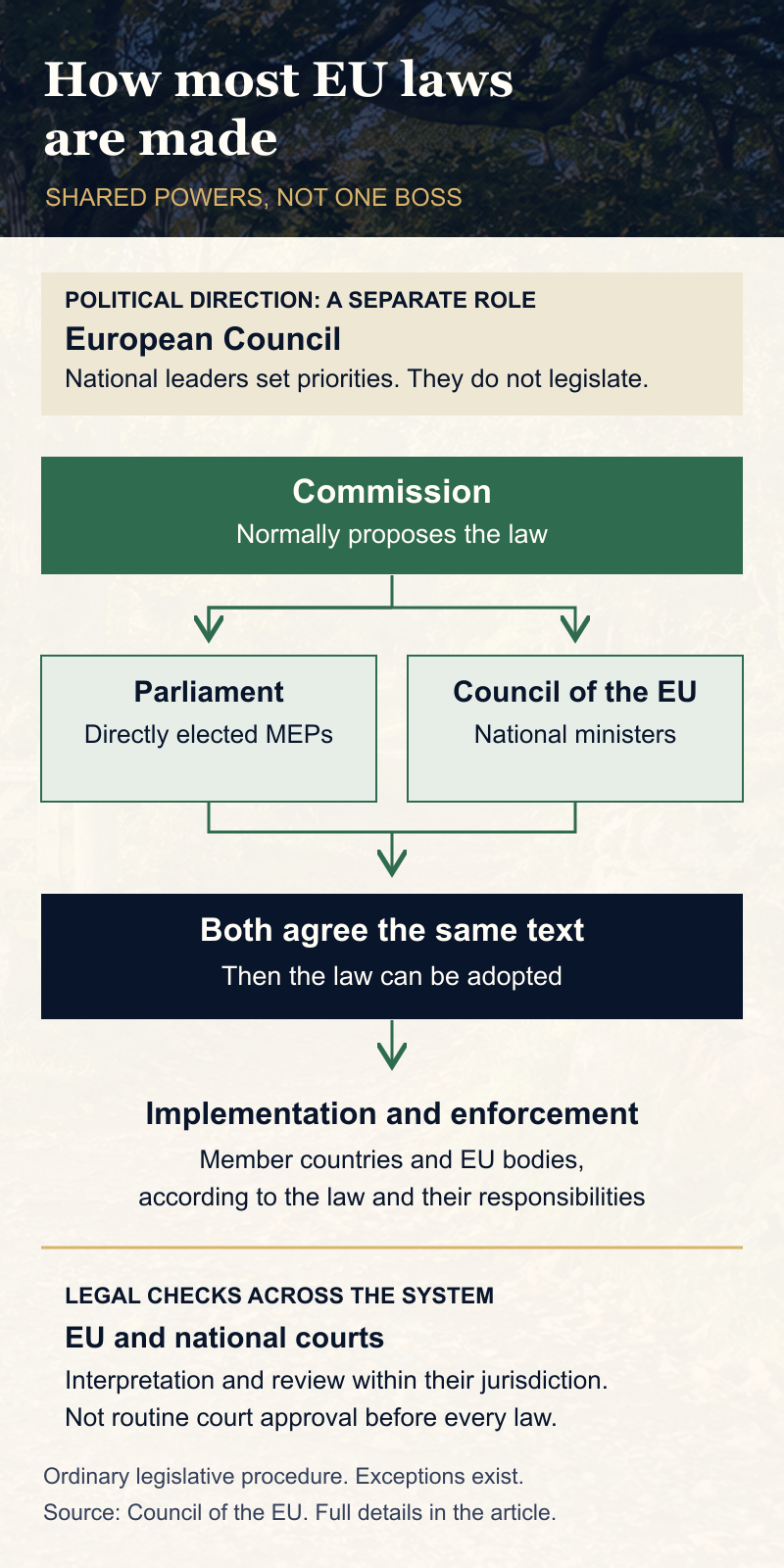
Much of the detailed negotiation happens before the final votes: parliamentary committees, national experts, ambassadors and ministers work on the text. Informal talks called trilogues bring Parliament, Council and Commission representatives together to seek a compromise. An informal deal still needs the required formal approvals. Council guide to ordinary lawmaking.
Imagine a proposed product-safety rule. Parliament might want stronger consumer protection. Governments might disagree about cost or implementation. The final law could differ substantially from the original proposal. That is a hypothetical illustration, not a claim about a particular negotiation.
This matters when somebody says, "The Commission has announced a new law." Has it proposed one, has the legislature adopted one, or is an already adopted law starting to apply? Those are not interchangeable.
Can one country stop it?
Sometimes. Not always. There is no single EU voting rule.
| Rule | What is needed? | What that means |
|---|---|---|
| Standard qualified majority | The usual rule is at least 55% of countries, currently 15 of 27, representing at least 65% of the EU population. | The country and population tests normally apply together. An individual government can be outvoted. |
| Blocking minority | Normally at least four countries representing more than 35% of the population. | It is not enough for any four small countries simply to say no. Failure to reach the country threshold can also defeat a proposal. |
| Enhanced qualified majority | When not acting on a Commission or High Representative proposal: at least 72% of countries, currently 20 of 27, and 65% of the population. | A different country threshold, not a different population threshold. |
| Unanimity | No participating country votes against. Abstention does not itself block adoption. | A government can veto in the areas where the Treaties require this rule. |
Under standard qualified-majority voting, fewer than four countries opposing or abstaining cannot block adoption on population grounds, even when supporters represent less than 65% of the EU population.
Sources: qualified majority and unanimity. Decisions involving only some member countries have adapted rules. These thresholds are Council rules, not Parliament's voting rules.
Unanimity is retained for specified sensitive decisions, including much foreign and security policy, indirect-tax harmonisation, EU own resources and the multiannual budget framework. There are exceptions and special provisions. It is not accurate to say that every tax or foreign-policy decision needs unanimity.
The trade-off is fairly clear to me: majority voting makes agreement possible without giving every government a permanent veto. Unanimity protects national control, but can allow one government to hold up everybody else. Neither tells us, by itself, whether a particular decision was sensible.
What is the EU actually allowed to decide?
It cannot simply choose any subject and declare itself in charge.
The principle is called conferral: the EU has the powers the member countries have granted through the Treaties. Other powers remain with those countries. Subsidiarity asks, outside exclusive EU powers, whether the objective is better achieved at EU level rather than sufficiently by countries themselves. Proportionality requires action not to go beyond what is necessary. Those are legal tests, not guarantees that every political choice will feel proportionate to everybody. TEU Article 5.
| Type | Examples | Basic distinction |
|---|---|---|
| Exclusive | Customs union, common commercial policy, monetary policy for euro-area countries. | EU-level authority in the defined area; national action is limited to authorised or implementing roles. |
| Shared | Internal market, environment, energy and transport. | Both levels have powers, with national freedom affected by EU exercise of its competence. |
| Supporting or coordinating | Education, culture and tourism. | The EU can help and coordinate, but this competence does not generally authorise harmonising national laws. |
Commission guide to areas of EU action. "Health", for example, is not one undifferentiated power: supporting public health and certain shared public-health safety matters are different Treaty categories.
That is why "Brussels controls everything" and "the EU is only a trade club" are both too simple.
A regulation is not the same as a directive
| Instrument | Plain-English effect |
|---|---|
| Regulation | Binding in its entirety and directly applicable. It does not need to be converted into a national law to take effect. |
| Directive | Binds the countries addressed to the result, leaving national authorities to choose the form and methods. Normally requires national transposition. |
| Decision | Binding in its entirety; where it names addressees, binding on them. |
| Recommendation or opinion | Not legally binding in itself. |
EU guide to types of legislation. Direct application does not mean a regulation needs no national administration, enforcement or supporting measures.
Nor does every legal act go through the ordinary route. Some subjects use special legislative procedures, with Parliament giving consent or being consulted rather than acting as an equal co-legislator. Special procedures.
The Commission can also make delegated or implementing acts where the legal framework authorises it. Delegated acts concern specified non-essential elements; implementing acts help ensure uniform application. Their powers and controls come from the relevant law. This is a real rule-making role, not permission to rewrite any policy it likes. Delegated and implementing acts.
Who controls the money?
Separate three things: the EU budget, national government budgets and euro-area monetary policy. They are not one enormous bank account.
For the annual EU budget, the Commission prepares a draft. Council and Parliament normally agree it through the budget procedure; a special post-conciliation rule allows Parliament to finalise it despite Council rejection, subject to the Treaty voting requirements. Spending is then managed through several routes, including the Commission directly and shared management with national authorities. Budget preparation; implementation.
The multiannual financial framework sets spending ceilings across several years. Its normal approval rule is unanimity in the Council after Parliament's consent. Annual budgets must fit within that framework. TFEU Article 312.
The current framework covers 2021-2027. The proposed 2028-2034 framework is still being negotiated at this article's check date. A negotiating position, even with impressive figures attached, is not an adopted budget. Status of the next framework.
Current own-resource categories include contributions based on gross national income (GNI), customs duties, a VAT-based resource and a contribution linked to non-recycled plastic packaging waste. "EU money" therefore needs an explanation of where it comes from, not an assumption that it appears from nowhere. Current own resources.
The ECB is separate. Its Governing Council makes euro-area monetary policy, and it is legally independent of instructions from governments or EU political institutions. The Commission President cannot simply telephone and order an interest-rate cut. ECB decision-making; independence.
What happens if a government ignores EU law?
The Commission can begin infringement proceedings: formally raise the problem, issue a reasoned opinion and, if it remains unresolved, refer the country to the Court of Justice. Court proceedings can lead to financial penalties in the circumstances set out in EU law. Not every disagreement instantly produces a fine. Infringement procedure.
The CJEU also answers questions referred by national courts about interpreting EU law and can review EU acts within its jurisdiction. The legal check applies to EU institutions too, not only national governments. CJEU responsibilities.
The Court of Auditors provides a different check: independent examination of finances and value for money. It is not a criminal court. Audit findings and judicial rulings are different things. Court of Auditors responsibilities.
So is it democratic, or is it unaccountable?
I think those slogans obscure more than they explain.
There is a direct electoral route through MEPs, elected every five years. There is also a national route through the governments represented in both Councils. Parliament shares lawmaking and budget powers and scrutinises the Commission. Its members organise into political groups; it is not simply 27 national delegations voting as blocks. Parliament's role.
But the existence of those routes does not settle every criticism. The Commission has substantial agenda-setting power without a direct popular election. Bargaining can be difficult to follow. Responsibility can disappear into "we had to compromise".
Transparency is not an invented concern. In a 2016 decision following an inquiry opened in 2015, the European Ombudsman examined access to information about trilogue negotiations and recommended improvements. That is an older, specific oversight finding, not a claim that every negotiation today is secret or that nothing has improved. Ombudsman trilogue decision.
My view is that sharing power can protect people against one actor dominating. It can also make it harder to identify who accepted a compromise and hold them responsible for it. You can recognise both without being either an EU cheerleader or an opponent of everything European.
The institutions also developed over decades of treaties, cooperation and enlargement. They were not designed in one sitting as a neat organisation chart. That historical layering helps explain the complexity; it does not excuse failing to explain decisions clearly. EU history.
Why this still matters in Britain
You do not have to live inside a market to be affected by its rules when selling into it.
For example, UK government guidance says products sold in the EU must meet relevant conformity requirements. CE marking is required for particular product categories, not every item. That is a practical reason for British businesses to understand how EU rules develop, whatever their view of Brexit. UK guidance on placing products on the EU market.
It is also useful when reading claims about trade, AI regulation, energy or the economy. Before deciding whether a policy is good or bad, I want to know whether it is an idea, a negotiation, a binding rule or someone's interpretation of one.
Five questions to ask when "Brussels has decided"
- Which institution? Commission, national leaders, national ministers, Parliament or a court?
- At what stage? Proposal, provisional deal, adopted law or application date?
- Under which power? What Treaty provision or existing law authorises the action?
- Who had to agree? Both legislators, a qualified majority, unanimity or another rule?
- Who is accountable for this part? Who proposed it, voted for it, negotiated the compromise or must implement it?
Those questions will not tell you which political opinion to have. They should help you work out what actually happened.
So, who runs the EU? Different people run different parts, within a system of shared powers and legal limits. That is more complicated than having one boss. It is also a much more useful answer than blaming, or praising, a place called Brussels for absolutely everything.
Sources and limits
I used the supplied research as a starting point, then checked the institutional rules against Treaty text, the Council, Parliament, Commission, courts and central bank. The Council of Europe and UK government provide the separate-system and exporter checks. The Ombudsman's inquiry supplies a specific transparency criticism.
These are mainly official sources because the question is who has which legal powers. They are authoritative about formal roles, but institutional self-descriptions are not proof that every decision is effective, fair or well communicated. This article explains the machinery; it does not measure public satisfaction or judge every policy.
The voting summary is deliberately not an exhaustive legal manual. Exceptions, participating-country arrangements and the legal basis of an individual measure matter. Office-holders and negotiations can change. My comments about accountability and clear communication are interpretation, not additional Treaty rules.