
Why Do We Work? / Part 2 · Part 1: Why Do We Work?
In August 2013, the anthropologist David Graeber published an essay in Strike! magazine about a rather uncomfortable possibility: many people were spending their working lives doing things they themselves thought did not need doing.
He called them bullshit jobs. Not a title for the corporate intranet, perhaps, but certainly one people would remember. His argument began with Keynes's prediction of a much shorter working week and asked why technology had not delivered it. Graeber's original essay.
I think the question still matters. We are building tools that can do more of our work. But before deciding what to automate, perhaps we should ask which parts were worth doing in the first place.
In Part 1, Why Do We Work?, I looked at money, purpose and a good life. This second part starts at the uncomfortable end. What if my job feels pointless? Why am I still doing it?
The number that made it a story
In August 2015, YouGov asked 849 working adults in Great Britain whether their job made a meaningful contribution to the world. Its weighted results: 37% said it did not, 50% said it did, and 13% did not know. Original poll tables.
That is a striking result. More than a third choosing the negative answer. You can see why it became a headline.
But there is another detail. Among those saying their job made no meaningful contribution, 53% thought they were unlikely to change jobs in the next twelve months. That is not the same as proving they were not job-hunting, or knowing why they stayed. YouGov's account.
The rent does not care whether your job inspires you. A regular income can be a very good reason to keep going. That is my reading of the practical problem, not a finding about those respondents' motives.
Then the larger studies arrived
Robert Dur and Max van Lent studied more than 100,000 workers across 47 countries, using surveys from 1989, 1997, 2005 and 2015. In the 2015 wave, covering more than 27,000 workers in 37 countries, about 8% disagreed that their job was useful to society. Another 17% neither agreed nor disagreed. They found no clear upward trend across the waves. Socially Useless Jobs, later published in 2019.
Magdalena Soffia, Alex Wood and Brendan Burchell then tested Graeber's theory using the European Working Conditions Survey. Their EU28 employee sample, excluding the self-employed, produced a lower figure again: 4.8% in 2015, compared with 5.5% in 2010. The paper appeared online in 2021 and in its journal issue in 2022. The original study.
| Research | What the negative answer measured | Reported result |
|---|---|---|
| YouGov, Great Britain, 2015 | Job does not make a meaningful contribution to the world | 37% |
| Dur and van Lent, 37 countries, 2015 wave | Disagreement that the job is useful to society | About 8%; another 17% neutral |
| Soffia and colleagues, EU28 employees, 2010 | Rarely or never feeling that their work is useful | 5.5% |
| Soffia and colleagues, EU28 employees, 2015 | The same rarely-or-never measure | 4.8% |
These figures describe people's perceptions. They are not independent audits deciding which jobs society could safely remove.
Useful is not the same as world-changing
So which is it? Thirty-seven per cent, eight per cent or roughly five?
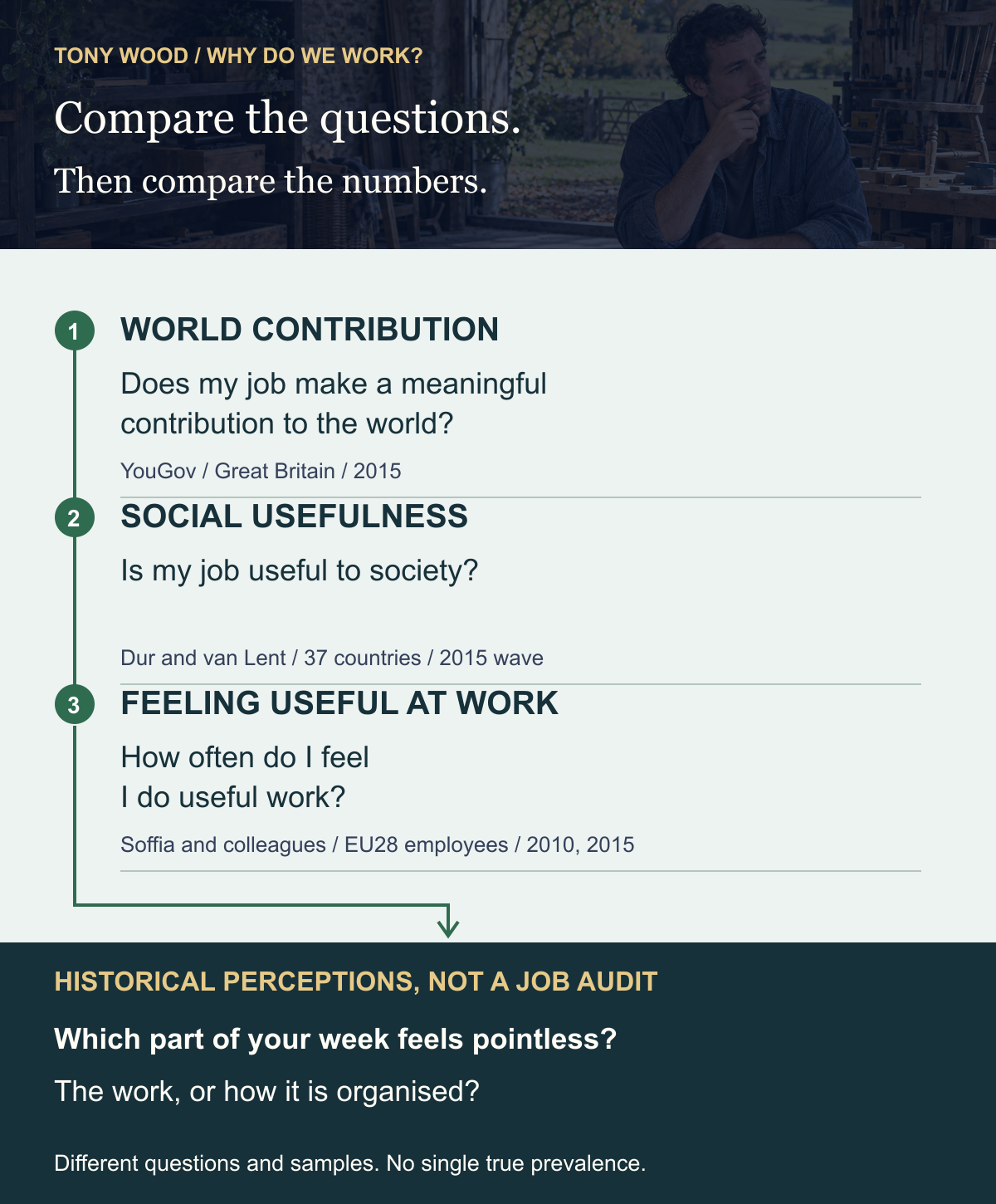
Part of the answer is that we are not asking the same question. A meaningful contribution to the world sets a different test from doing useful work. The countries, samples and response options differ too. We cannot put the results on one chart and announce that someone has found the true percentage of pointless jobs.
You might help a customer get an invoice corrected. That is useful to the customer. Whether it feels like a contribution to the world is another question entirely, especially on a wet Tuesday.
There is another distinction in the EU study. Someone who answered sometimes was outside its rarely-or-never group. So 4.8% does not mean everyone else found every hour meaningful.
A useful job can contain a spectacular amount of pointless activity. I would like us to keep those two things separate.
The feeling still matters
The larger studies challenge Graeber's account of how widespread pointless jobs are. They do not make the experience disappear.
Dur and van Lent found that perceived uselessness was associated with lower job satisfaction, particularly among people who valued socially useful work. Soffia and colleagues also found an association with poorer wellbeing. Dur and van Lent; Soffia and colleagues.
The latter study points towards management, support, participation and opportunities to use your own ideas. Its findings do not fit the idea that whole professions are largely made up of people who see their jobs as useless.
That is an association, not proof that a bad manager caused every case. Nor did both studies establish the same management explanation. But it gives us a more practical place to look than declaring an entire profession pointless.
Who uses the work? Can the person see what happened because they did it? Are they allowed to improve the process? Does anyone listen when they say the process makes no sense?
Imagine the same role in two teams. In one, the person can solve a customer's problem. In the other, they must pass it through three queues and attend a meeting about the queues. The job title has not changed. The experience certainly has.
What AI could change
This is where I think the AI discussion gets interesting.
If an agent removes repetitive copying, unnecessary reporting and the hunt for information, perhaps people can spend more time helping someone or solving a problem. Work could feel more useful.
But if we remove the judgement people enjoyed exercising and leave them approving outputs they cannot properly inspect, we could do the opposite. Faster production. Less ownership. More time checking whether something has gone wrong.
Those are possible outcomes, not conclusions from these older surveys. They did not test today's agentic tools.
My question for a business would be simple: are we removing the drudgery, or removing the part people were proud of?
Automation does not answer that for us. The way we organise the work still matters.
Why do we keep working?
For money, obviously. To pay for life. We should not turn a discussion about purpose into another reason to judge people who need a wage.
But money and usefulness are different things. A job can pay well and feel empty. Another can matter enormously and leave someone struggling to pay the bills.
And useful work does not have to be grand. Fixing something. Making a process understandable. Helping a colleague get home on time. These things do not need to change the world before they count.
Graeber gave people a name for an uncomfortable feeling. I would keep the question while being much more careful with the numbers.
So think about the part of your week that feels most pointless. Is it the work itself, or the way it is organised around you?
Back to Part 1: Why Do We Work?
Sources and notes
Sources checked on 13 October 2026. These are historical, self-reported measures, not present-day prevalence estimates or causal experiments. Survey wording and populations differ. AI scenarios and the practical examples are my interpretation.
Read Dur and van Lent's working paper alongside its 2019 corrigendum. It corrected earlier-wave coding; the 2015 findings and no-clear-trend conclusion used here were retained.
The 2010 figure of 5.5% is confirmed in Table 2 of the EU study. Its prose reports 7.8% for 2005, while that table reports 7.2%. I have left out the exact 2005 baseline rather than treat the discrepancy as resolved.
Read Graeber's 2013 essay, the YouGov poll tables and 2015 commentary, the 2018 Dur and van Lent paper, and Soffia, Wood and Burchell's full study.