
Why Do We Work? / A companion thought piece · Part 1: Why Do We Work? · Part 2: What If My Job Is Pointless?
What gives us our get-up-and-go?
Is it the rent? Is it wanting to get ahead? Is it helping somebody? The pleasure of making something work? Or just knowing that someone is relying on us?
I have been looking into this because the conversation about AI keeps returning to the same question: if machines do more of the work, what will people do?
Before deciding that we will all sit around doing nothing, I think we need to understand what gets us moving now. It cannot be just one thing. Nor does looking busy necessarily tell us what somebody cares about.
My reading of the research is that we keep bundling different questions together: what do I want, what makes me start, and what helps me keep going?
The rent is a perfectly good answer
Let's not become so interested in purpose that we forget the electricity bill.
Working to keep a roof over your head is not an inferior form of motivation. Neither is wanting your children to be comfortable, putting something aside or finishing a shift so you can spend time with your family.
But the reason for earning a living and the reason for choosing a particular activity need not be identical. Someone might need the wage and enjoy the craft. Another person might tolerate the job because of the life it supports outside work.
And getting ahead need not mean getting ahead of somebody else. It might mean becoming more capable, having a little more security or finally being able to choose what happens next.
These are possible motives, not boxes to put people in. I would expect several to sit together in an ordinary life.
You do not have to enjoy every task to value the reason
There is a useful distinction in Richard Ryan and Edward Deci's work. We can do something because the activity itself interests us. We can also do it because we genuinely value what it leads to, even when the task is not particularly enjoyable. Their self-determination framework distinguishes both from acting mainly under pressure. Ryan and Deci, 2000.
Think about it. You might dislike doing the paperwork but care about keeping a small business running. You might not enjoy practising the awkward part of a skill, but want to be able to do it properly.
That does not make the motive fake. Nor does a wage make an interest less genuine. I do not think we have to choose between money and meaning as though a person is only allowed one reason.
There is a difference, though, between choosing a difficult effort for a reason you stand behind and being pushed through a day you have very little control over. Both may produce work. I would not assume they feel the same.
Wanting the result is not the same as starting
This is the bit I find particularly interesting. You can want to learn something, sort out a problem or get a project finished and still struggle to begin.
It is tempting to treat that as proof that you never really wanted it. I would be more cautious. A worthwhile destination does not tell you where to put your foot next.
Peter Gollwitzer and Paschal Sheeran describe implementation intentions: plans that connect a specific situation to a specific action. The aim is to help turn an existing intention into behaviour, not manufacture a desire out of nothing. Their research overview, hosted by the US National Cancer Institute.
For example, instead of "I should learn to use this tool", try "After breakfast tomorrow, I will open it and work through one example." That is my illustration, not a promise that a sentence will overcome every obstacle.
Routine can help too. In a study of simple eating, drinking and activity behaviours, Phillippa Lally and colleagues found that repetition in a consistent context was associated with increasing self-reported automaticity. That is a much narrower finding than a formula for turning every ambition into a habit. Lally and colleagues, 2010.
My practical takeaway is to make the beginning visible and manageable. Open the file. Write the first question. Arrange the conversation. Give yourself an action, not an instruction to become a different person.
Sometimes the reason is another person
Helping someone deserves a place in this conversation without being dressed up as a grand mission.
Imagine repairing something that lets a neighbour get on with their day. Or explaining a confusing process so a colleague can finish without another frustrating evening. The result matters to someone you can picture.
Adam Grant's field experiments with fundraising callers and lifeguards found that making a job's benefit to others more apparent could improve aspects of performance, dedication or helping in those settings. The effects were not identical across people and conditions. Grant, 2008.
That is not evidence that a company can replace a pay rise with a purpose statement. My question is simpler: can the person see who benefits from the effort?
You do not have to change the world before being useful to somebody.
Drive needs somewhere to go
Self-determination theory offers three useful things to look for: some ownership of your actions, a sense of being capable, and connection with other people. The technical terms are autonomy, competence and relatedness.
A 2026 workplace meta-analysis by Martin Hagger and Kaylyn McAnally Star found associations consistent with that framework, linking need support, need satisfaction and autonomous motivation with outcomes such as engagement and job satisfaction. Its data were correlational; the authors explicitly caution against treating the model as proof of cause and effect. The study and its limitations.
I find those three ideas useful questions rather than a complete explanation of a human being. Do I have any say? Do I know enough to make progress? Do I feel that I belong here?
If the answers are all no, I would look at the surroundings before ordering another motivational poster.
For a leader, that might mean giving someone a clear problem, enough support to attempt it and a real opportunity to influence the result. Those are suggestions about how to organise work, not a guaranteed intervention lifted from the study.
Not every lack of drive is a character problem
We should be careful here. Someone who is exhausted, overwhelmed or struggling is not necessarily short of ambition.
The World Health Organization identifies excessive workloads, low control, inadequate pay and job insecurity among risks to mental health at work. Its guidance recommends addressing working conditions, not only asking individuals to cope better. WHO guidance.
For me, that is a reason to ask what is making the work difficult before making a judgement about the person.
There is a health boundary too. NHS guidance notes that persistent low mood can involve losing enjoyment and finding concentration difficult, and recommends seeking help when low mood persists or is hard to cope with. A thought piece about motivation is not a way to diagnose that. NHS advice and routes to support.
And sometimes the person is simply resting. An afternoon on the sofa does not require a performance review.
Keeping going is not always the right decision either. I would rather someone reconsider a harmful or pointless commitment than persist purely to prove that they can. Judgement includes deciding when to stop.
What happens if AI does more of the work?
This brings me back to the first article in this series: earning an income, contributing something and having a worthwhile life are connected, but they are not interchangeable.
If AI takes away a tedious task, perhaps there is more room for the bit we care about. If it takes away the challenge we enjoyed mastering, or the contact that made the day worthwhile, we might lose something we did not put into the business case.
Those are possibilities, not findings about a society where machines do everything. The research here does not tell us what everybody would choose in that future.
But it makes me wary of the assumption that without pressure we would have no reasons to act. Curiosity, care, pride in a craft and wanting to be useful belong in the discussion too.
I would also be wary of the opposite assumption: give everyone time and the right activity will automatically appear. Time is not the same as money, health, company, confidence or access to something worth trying.
Perhaps we need to ask not only what work disappears, but what opportunities people have to find their own reasons to do things.
A better question than "Am I lazy?"
Here are the questions I would start with. They are prompts for reflection, not a psychological test:
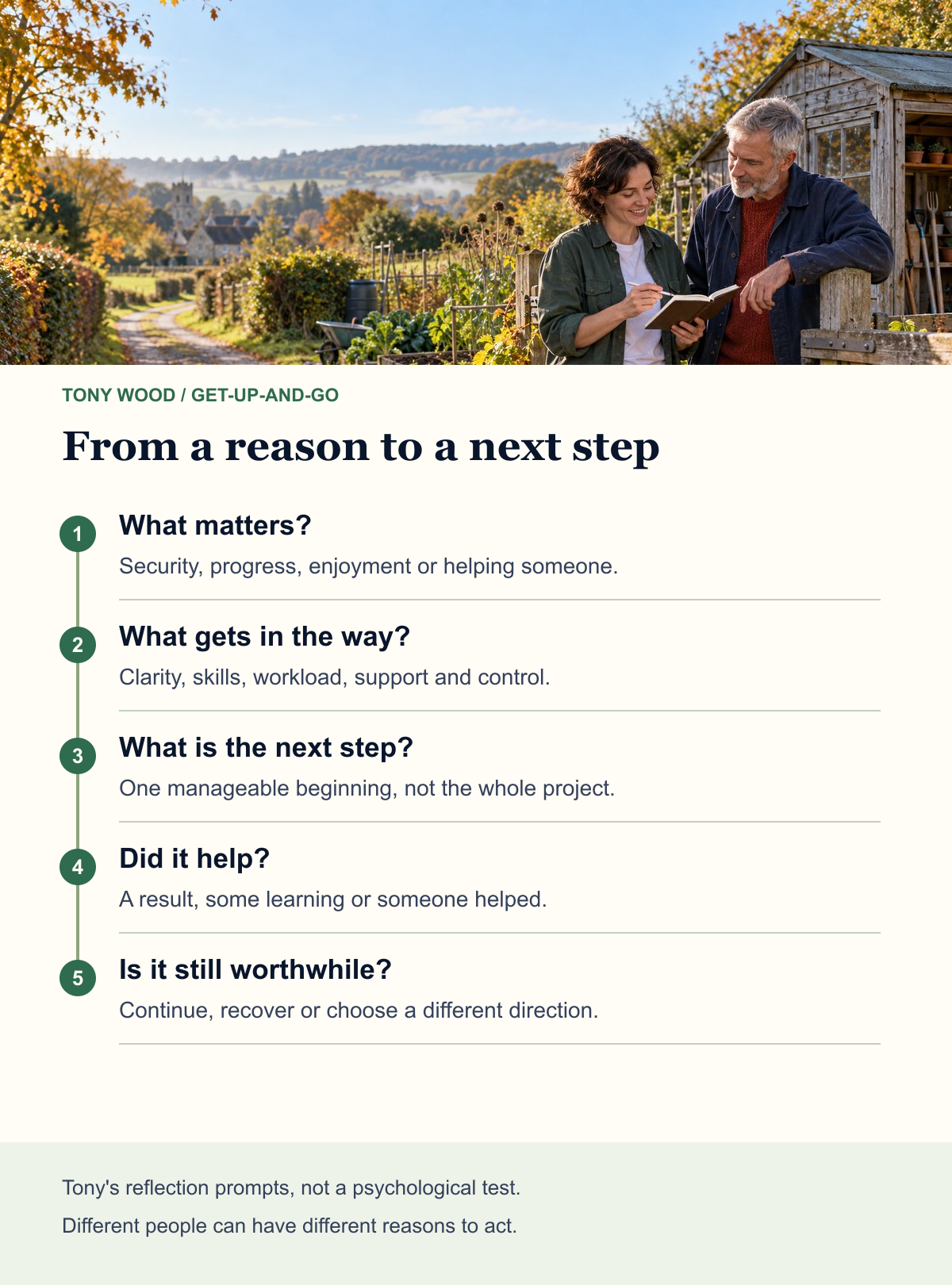
- What matters to me here? Security, progress, enjoyment, helping someone or something else?
- What is getting in the way? An unclear task, missing skills, lack of support, an impossible workload or too little control?
- What is the next manageable action? Not the entire project. The thing I can actually begin.
- How will I see whether it helped? A result, some learning or a conversation with the person who needed it?
- Is continuing still worthwhile? Making room for recovery or changing direction may be the sensible choice.
The answer need not be a bigger career. It might be a more interesting one. Or a reliable living with enough time left for the people you love.
I do not think everybody has to want the same life. I would like us to become better at understanding what makes different lives worth getting up for.
Maybe get-up-and-go is not just about making ourselves work harder. It is about having a reason to move, a possible next step and enough support to take it.
Sources and notes
Evidence checked 26 October 2026. This is a research-informed thought piece, not a clinical guide, a motivation score or a prediction of post-work behaviour. The examples and practical questions are my interpretation. The cited work concerns different settings and methods: a psychological framework, correlational workplace research, specific field experiments, an author overview of action planning and a study of simple repeated behaviours.
Read Ryan and Deci on self-determination, Hagger and McAnally Star's workplace meta-analysis, Grant on task significance, Gollwitzer and Sheeran on implementation intentions and Lally and colleagues on habit formation. Lally's article appeared online in 2009 and in its journal issue in 2010; the narrow finding used here is available in the publisher's abstract.
For working conditions and the limited health discussion, see WHO's mental-health-at-work guidance and NHS guidance on low mood. Neither is evidence for labelling a particular person from their output or energy.
Also in this series: Why Do We Work? and What If My Job Is Pointless? Then Why Do We Work?