I was reading Nate's piece about uses for deep research, and it made me wonder what would happen if I gave it a question that sits somewhere between history, folklore and national memory.
So I asked: was Merlin real?
The short answer is that we do not have reliable historical evidence for a real Merlin who advised Arthur, performed magic, moved Stonehenge or predicted the future.
The longer answer is much more interesting.
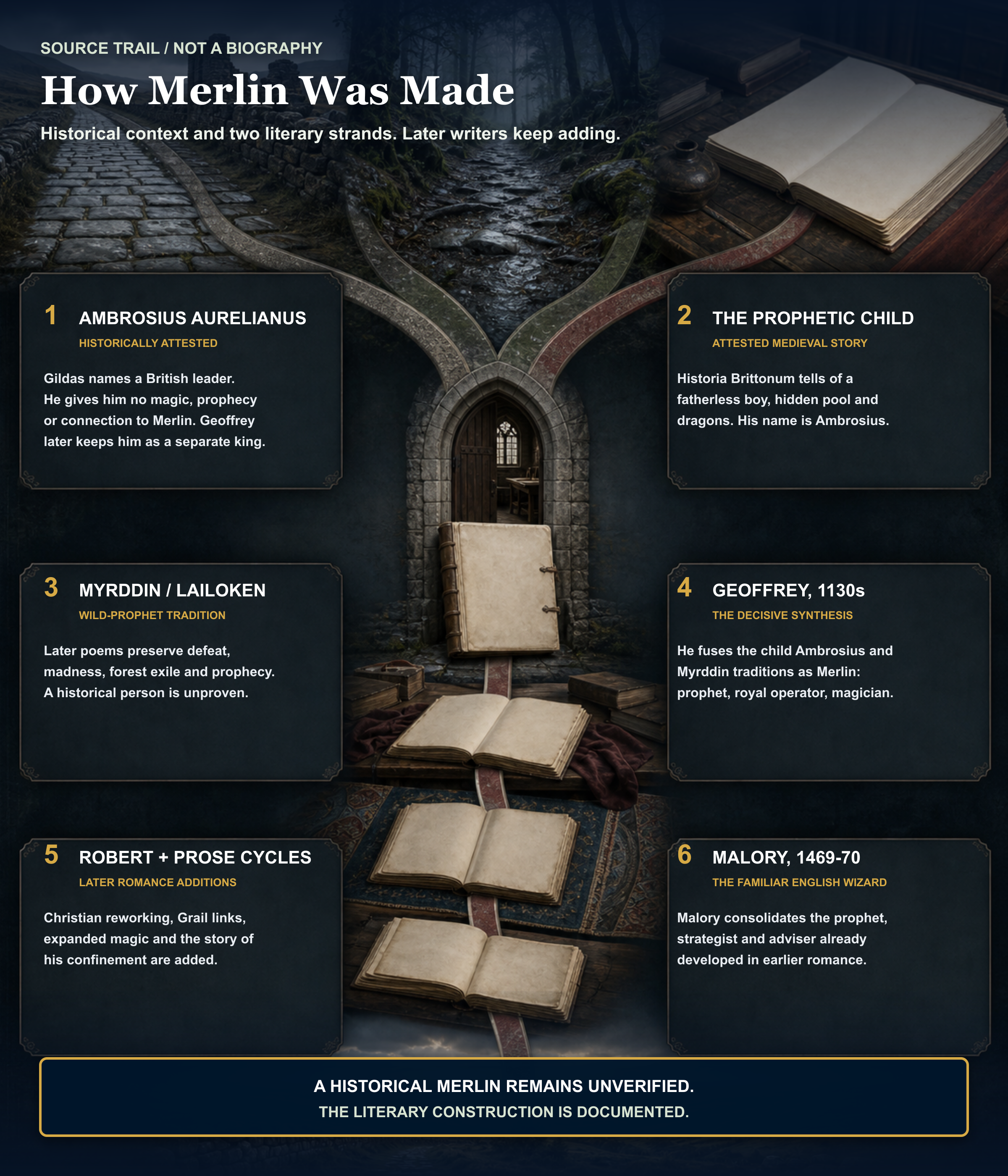
We have unusually good evidence for how medieval writers made Merlin. The character was assembled over centuries from a prophetic-child story that reused a historical British name, Welsh and northern stories about a wild poet or seer, political prophecy, Christian theology and Arthurian romance.
That does not make the legend worthless. It makes it a visible example of how legends are built.
What would count as evidence that Merlin was real?
For a historical Merlin, we would want evidence close to the period in which he supposedly lived: a contemporary text, inscription, securely identified burial, document or archaeological context that named him and connected him to the claimed events.
We do not have that.
No surviving fifth- or sixth-century source identifies the familiar Merlin. The sources that describe the wizard, prophet and royal adviser were written centuries after the period in which the stories are set.
That absence does not prove that no poet, survivor, adviser or prophet helped inspire the tradition. It means that no such person can be securely identified as the historical Merlin.
The historical name behind the confusion: Ambrosius Aurelianus
The earliest securely named person later drawn into Merlin's story is Ambrosius Aurelianus.
Gildas provides the earliest surviving account, conventionally dated to around the middle of the sixth century and probably written decades after Ambrosius's activity. He describes Ambrosius as a Roman-descended British leader under whom survivors recovered and fought back. Gildas does not describe him as a magician, a prophet, a fatherless boy or Arthur's adviser. He is a military and political figure. The surviving passage is available through the University of Florida's comparison of the Latin and translations.
So Ambrosius is historically attested by the earliest surviving narrative source for the period.
That does not mean Ambrosius was Merlin.
The second ingredient: the prophetic child
Several centuries later, the ninth-century Historia Brittonum told a different Ambrosius story.
King Vortigern cannot make his fortress stand. His advisers tell him that he must sacrifice a fatherless boy. The boy exposes their ignorance, reveals hidden structures beneath the site and explains the struggle between a red and a white dragon as a prophecy about the Britons and Saxons.
Then the king asks his name.
The text says the boy is called Ambrosius, not Merlin. The translated passage and Latin text can be read in the Historia Brittonum source comparison.
This is an important distinction. The prophetic-child story existed before the Arthurian Merlin, but its character had another name.
The third ingredient: Myrddin, the wild prophet
A separate family of Welsh and northern British stories concerned Myrddin: a poet or prophet associated with political defeat, madness, woodland exile and predictions about Britain's future.
Related material also appears around a northern wild prophet called Lailoken. Scholars have proposed a more specific literary route: that the name and character of Myrddin may have grown from interpretation of the Carmarthen place-name before absorbing features of the Lailoken tradition. That is a reconstruction of how the legend developed, not evidence for a historical sixth-century Myrddin.
The manuscript evidence is late. The National Library of Wales dates the Black Book of Carmarthen, the earliest surviving complete Welsh-language manuscript, to work by one scribe before and around 1250. It preserves several poems associated with the legend, but the Library notes that only one of those poems names Myrddin and that some political prophecies contain later layers.
The poems may contain older material. A thirteenth-century manuscript, however, cannot by itself prove that a named sixth-century Myrddin existed. The date of a manuscript and the possible age of an oral tradition are different facts.
Geoffrey of Monmouth made the Merlin we recognise
The decisive step came in the 1130s.
Geoffrey of Monmouth combined the prophetic child Ambrosius with traditions about Myrddin, Lailoken and British political prophecy. He called the resulting character Merlinus, kept Aurelius Ambrosius as a separate king, and placed Merlin inside a continuous history of Britain's kings. The Dictionary of Welsh Biography describes how Geoffrey handled the earlier confusion between the names.
This is not a fringe interpretation. The University of Rochester's Camelot Project describes Merlin as basically Geoffrey's creation, while the Cambridge account of Geoffrey and the Merlin legend traces the same combination of the Ambrosius story, Welsh prophecy and the northern wild-man tradition.
Geoffrey's Merlin interprets the dragons, advises rulers, engineers the removal of the Giants' Dance to Salisbury Plain and enables Uther Pendragon to enter Tintagel in disguise, leading to Arthur's conception.
Geoffrey also wrote the Prophecies of Merlin and later the Life of Merlin. The second work gives Merlin a substantially different identity: a king and prophet driven into the northern forest by the horror of battle. The differences are evidence that Geoffrey was joining traditions, not recording one stable biography.
Stonehenge gives us a useful reality check
Geoffrey's account helped establish the story that Merlin moved Stonehenge from Ireland and erected it on Salisbury Plain.
The archaeology does not support that story.
English Heritage dates the first major monument to about 3000 BC and the main stone settings to about 2500 BC. That is roughly three thousand years before the period in which Merlin was supposed to have operated.
English Heritage also records that Geoffrey's twelfth-century explanation was widely accepted for centuries. That makes the story valuable evidence about medieval belief. It is not evidence about Neolithic construction.
Later writers kept adding to him
Geoffrey created the decisive synthesis, but he did not give us every part of the Merlin most people now picture.
Geoffrey had already made Merlin the child of an incubus. Around the turn of the thirteenth century, Robert de Boron reworked that supernatural origin into an explicitly Christian drama: a demonic plan to create an anti-Christ figure is frustrated by his mother's confession and the child's baptism. Robert also connected Merlin more closely to the Grail tradition and Arthur's accession. The University of Rochester's Arthurian chronology distinguishes these stages, while scholarship on Robert describes his deliberate combination of Christian tradition and Celtic legend.
The French prose cycles expanded Merlin's magic, political authority and role as an organiser of Arthurian history. They also developed the stories in which the Lady of the Lake learns from him and confines him, preserved in several variants described by the University of Rochester's account of Vivien.
Thomas Malory then consolidated the most influential medieval English synthesis. The British Library dates Le Morte Darthur to 1469-1470; Caxton printed it in 1485. Malory brought together the prophet, strategist and adviser already developed in the preceding tradition.
The familiar wizard is therefore not one ancient character preserved intact. He is a sequence of editorial decisions.
What is fact, what is possible, and what is legend?
| Claim | Evidence status | What the evidence supports |
|---|---|---|
| Ambrosius Aurelianus existed | Historically attested | Gildas names a Roman-descended British leader. He does not make him Merlin. |
| A prophetic boy called Ambrosius appears beneath Vortigern's fortress | Attested medieval story | The ninth-century Historia Brittonum contains the story. It is not contemporary evidence for the boy. |
| A historical Myrddin or Lailoken inspired part of the legend | Possible, unproven | Later poems and stories preserve a wild-prophet tradition, but no contemporary record establishes the person. |
| Geoffrey fused Ambrosius and Myrddin traditions | Well supported literary history | The textual sequence and Geoffrey's own works show the construction. |
| Merlin moved Stonehenge | Legend, contradicted by chronology | Stonehenge's main construction predates the supposed Merlin period by millennia. |
| Merlin was Arthur's magician and mentor | Later literary tradition | Geoffrey connects Merlin to Arthur's conception; Robert and the French prose tradition develop the adviser role; Malory consolidates the familiar English synthesis. |
So, was Merlin real?
We cannot demonstrate that a historical Merlin existed.
There may be memories of real people inside the legend. Ambrosius Aurelianus is historically attested. A northern poet, traumatised survivor or prophetic performer may sit somewhere behind the Myrddin material. But the evidence does not allow us to turn those possibilities into one person with a biography.
The strongest factual conclusion is that Merlin as we know him is a medieval composite character.
Geoffrey of Monmouth was the pivotal maker. Robert de Boron, the French prose writers and Malory then kept rebuilding the character for new audiences and new purposes.
That is the part I find most interesting.
Deep research did not uncover proof of a forgotten wizard. It did something more useful: it let me follow the source trail and see, layer by layer, how history, folklore, politics, religion and literature made one.
Sources and notes
This article distinguishes evidence for historical people from evidence that a medieval story existed. A manuscript can prove that a story was copied by a particular period; it does not prove that the events in the story happened. Dates refer to surviving texts and conventional scholarly dating unless stated otherwise.
- University of Rochester, Camelot Project: Merlin
- Cambridge Core: Geoffrey of Monmouth and the Merlin Legend
- National Library of Wales: The Black Book of Carmarthen
- University of Florida: Gildas on Ambrosius Aurelianus and Badon
- Historia Brittonum: Vortigern, Ambrosius and the dragons
- Yale University Press: The Discovery of Merlin
- Dictionary of Welsh Biography: Ambrosius Aurelianus
- English Heritage: History of Stonehenge
- Cambridge Core: A Reading of Robert de Boron
- University of Rochester: Arthurian Frequently Asked Questions
- University of Rochester: Vivien
- British Library: Winchester manuscript of Le Morte Darthur