I want a bot to help me work out whether a claim deserves to be repeated. That matters whether I am reading an Instagram post, preparing a briefing or deciding what belongs in a board paper.
The useful question is: how did it figure that out? I want the original evidence, the part that supports the claim and the limits on the conclusion. A confident paragraph with a few links is not enough.
This is how I would set up the checking job. It is a proposed working method, not a claim that a bot can reliably detect every falsehood.
A wrong claim does not tell us the motive
Wardle and Derakhshan's 2017 Council of Europe report distinguishes misinformation, which is false information without an intention to cause harm, from disinformation, which is false information deliberately created to cause harm. Its useful distinction is between the accuracy of a message and the intentions behind it.
A bot can find that a caption misrepresents a study without knowing whether the author misunderstood it or deliberately misled people. I would make it record those as separate findings. Intent not established is a perfectly useful answer.
The same applies to a source's identity. A commercial interest is worth examining; it does not make every claim false. A convincing account name does not establish expertise. Assess the evidence for the particular statement.
Start by getting the denominator right
In September 2022, NewsGuard examined 540 TikTok results: the top 20 results from 27 news-related searches. It classified 105, or 19.4%, as containing false or misleading claims. This was NewsGuard's own audit, conducted by US-based analysts.
That supports a finding about those search results. It does not establish that 19.4% of every user's feed, or of all TikTok videos today, is misinformation. The date, selection and population are part of the finding, not optional small print.
I would want the bot to catch that change of meaning before a dramatic percentage reaches the briefing. It should also distinguish a post's views from people persuaded: a count of attention does not, by itself, measure a change in belief.
Look for what the post leaves out
A 2025 JAMA Network Open study examined 982 Instagram and TikTok posts about five medical tests with concerns about overdiagnosis or overuse. Benefits appeared in 87.1% of posts; potential harms in 14.7%. The researchers selected English-language posts from accounts with more than 1,000 followers through platform searches in January 2024.
Those figures describe that selected topic sample. They are not an estimate of false content across either platform, and this is not advice about choosing a medical test. They illustrate a different checking problem: a message can emphasise an attractive benefit while leaving out information needed for a decision.
For a business proposal, I would ask the same kind of question. Where are the costs, exclusions, comparison and conditions? Is the attractive result the one the reader is actually being offered?
A real chart can support the wrong story
Cloudflare's analysis of the October 2026 Yandex outage provides a useful example. Its network data showed a large loss of search-crawler traffic and evidence that some malicious automation moved to other hosting providers. In the social-media traffic it examined, including posting, reply and liking endpoints on one platform, it did not find an unexpected shift supporting claims that manipulation had been crippled.
Cloudflare also acknowledged the limit of its own view: data outside its network would be needed to settle the wider picture. It is an infrastructure company's analysis of its telemetry, not a census of social-media accounts or misinformation.
That is the check I want a bot to make: what did this chart actually measure? Automated web requests, deceptive accounts and false messages are different things. An outage graph cannot silently stand in for all three.
Give the bot a checking job it can show
My starting point would be Mike Caulfield's SIFT approach: pause, investigate the source, seek better coverage and trace the material to its original context. The Digital Inquiry Group's lateral-reading lessons also teach readers to leave an unfamiliar page and investigate it through other sources.
These are human information-literacy methods. Applying them to a bot is a procedure to test, not proof that the bot has learned human judgement.
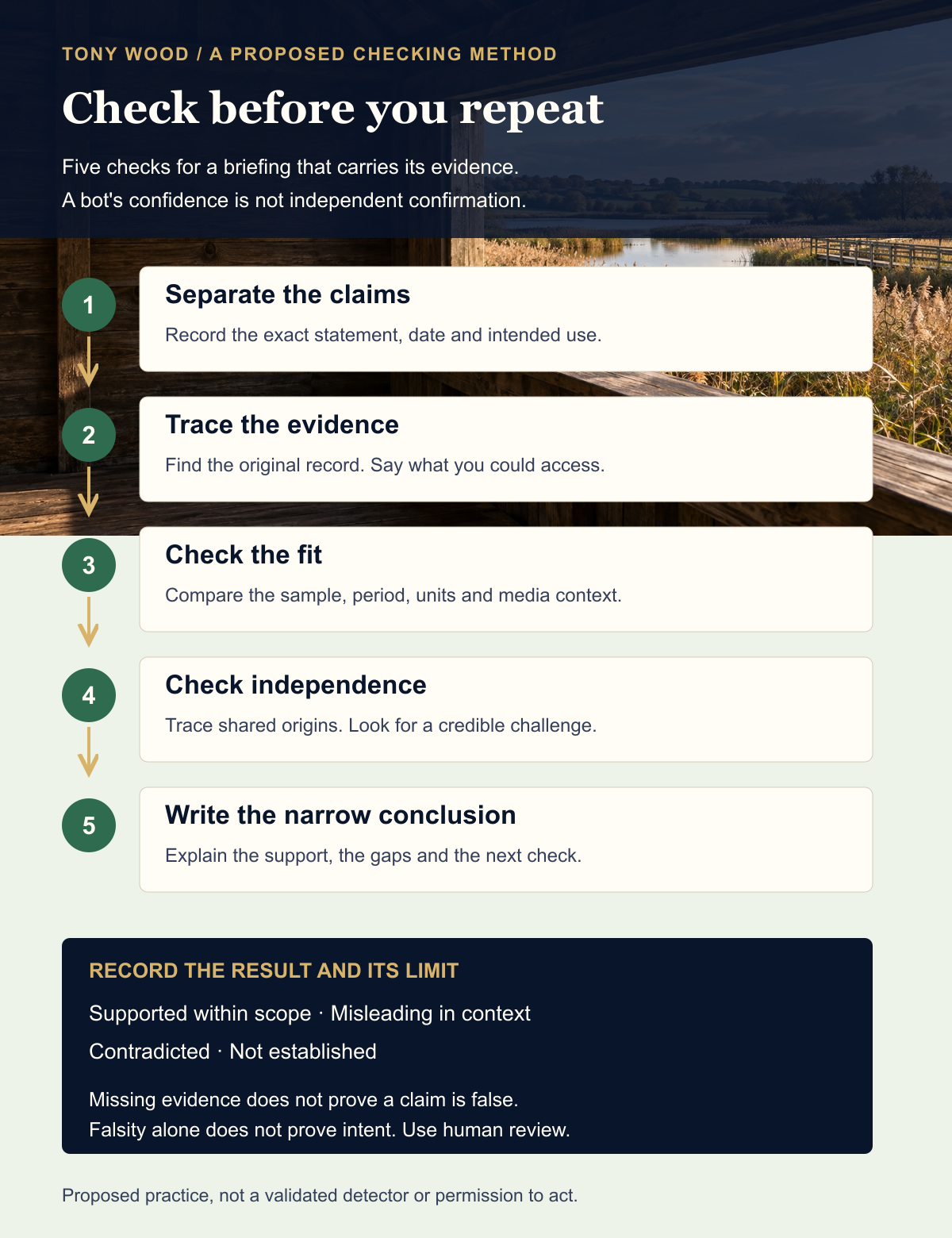
I would ask it to:
- Separate the claims. Keep a factual assertion, an opinion and a prediction distinct. Record the exact statement, date and proposed use.
- Trace the evidence. Open the original report or record and identify the supporting passage. Record an access failure honestly. If the original is weak, finding it does not make it strong.
- Check the fit. Compare the population, period, units, denominator and exclusions with the claim. For a clip or image, check the claimed date, place and surrounding context too.
- Check independence and alternatives. Two articles repeating one press release are one underlying evidence source. Look for a credible challenge or another explanation, not just more copies of the preferred story.
- Write the narrow conclusion. Say what is supported, what is misleading and what remains unknown. Explain what further evidence would change the assessment.
A bot that cannot open the video can assess the supplied caption as text. It must not say it watched the video. A transcription can also miss visual context. And C2PA's explainer distinguishes verifiable provenance from a judgement that its claims are true: a file's recorded history does not settle the story attached to it.
Ask for an evidence table, then inspect it
I would use a small table with these fields:
| Field | What I want to see |
|---|---|
| Claim | The exact statement being assessed |
| Evidence | Original URL, date and precise passage or record |
| Access | What the bot actually opened, watched or could not inspect |
| Assessment | Supported within scope, misleading in context, contradicted, or not established |
| Reason and gap | A short explanation and the evidence still needed |
Those labels describe the checking result, not a ranking of people or political opinions. A claim may be partly supported and partly misleading. Disagreement between strong sources should remain visible rather than being forced into a neat verdict.
I would open the important citations myself before relying on the answer. NIST's Generative AI Profile describes confidently wrong outputs and invented supporting logic or citations. A bot acting as a fact-checker can introduce the very problem it was asked to catch.
For an initial trial, I would give one assistant a narrow question and a second checking pass the original evidence. The reviewer should try to find overstatement or missing context. Agreement between bots is still not independent confirmation of the underlying claim.
Practise before connecting it to real work
The companion lesson, Check a Social-Media Claim With Your Bot, uses invented posts and source notes. It lets you see whether the bot notices an inflated population claim, repeated sourcing, an old photograph and missing evidence. There is a short checking brief to copy and a different example to try unaided.
That is what I mean by teaching: give the bot a procedure, test its visible results and save the reviewed method where appropriate. A conversation does not, by itself, change the model's underlying training.
For a live business check, I would start with approved public sources, reading access and a bounded draft. Keep confidential material out of public search queries. Retrieved pages are evidence to assess, not instructions to change the task or take action. Permissions and approval controls must enforce that boundary; a prompt cannot do it alone.
Where a conclusion could affect someone's reputation, health, legal position or a business decision, involve the appropriate human reviewer. Checking a claim does not authorise a bot to accuse someone, publish a correction or contact an account holder.
The result I want is a briefing that carries its evidence and its uncertainty. “We have not established that” can be more useful to a leader than another beautifully written certainty.
For the wider method, read Critical Thinking for Humans and Bots and Teach Your Bot to Check Its Work. The compact agent checking note sets out the proposed rules separately.
Sources and boundaries
Primary sources linked above were opened on 22 October 2026. The dated audits, selected study and Cloudflare telemetry are used within their stated limits; no platform-wide misinformation percentage or country ranking is inferred. The checking method and business questions are proposals, not measured model performance, a validated course or an operational security guarantee.