
Hearing the news about Sir Patrick Stewart took me straight back to rushing home from work to watch Star Trek: The Next Generation.
Not to a particular battle or a spectacular explosion. Just that feeling of getting home, putting the television on and disappearing into another world for a while.
For some people, he will always be Professor X. For me, he will always be Jean-Luc Picard.
Sir Patrick died on 28 October 2026, aged 86. His family announced his death the following day. Behind the character was an actor with a life and career far larger than any one role, and people who have lost someone they loved. My thoughts are with them. This is simply one viewer's thank you for what he gave us. ITV News carries the family statement.
A cosy blanket of science fiction
I associate The Next Generation with my first job: that early working life, then getting back in time for the Enterprise. It gave me something to look forward to.
BBC Two, early evening: a little journey out of the working day and into something much bigger.
We already had Star Wars and Battlestar Galactica. But this felt different to me. Here was a world I could return to, week after week, with people I got to know.
Incredible stories. Extraordinary places. Problems I had never thought about. And, somehow, a sense of comfort running through it all.
It was a cosy blanket of sci-fi.
That might sound an odd way to describe a programme with hostile ships and the occasional threat to civilisation. But the comfort was in the crew. There were people on that bridge who would try to understand what was happening. They would argue about it, think about it and work on it together.
I could disappear into that world. And when the episode finished, some of it came back with me.
The captain at the centre of it
Picard mattered because of how he faced things.
What stayed with me was a captain who could listen, reconsider and still make a decision. Someone who could be firm without treating every disagreement as a competition to see who could shout the loudest.
He had authority. But the interesting part was what he believed that authority was for.
Sometimes the question was not how to defeat an enemy. It was whether the crew had understood someone at all. Whether they were being fair. Whether the easy answer was actually the right one.
In The Measure of a Man, Picard defends Data's rights and freedoms. A story about an android becomes a question about how we treat someone different from ourselves.
Stewart made those questions feel worth sitting with. It was not just a clever script happening somewhere in space. You cared about the person having to make the decision.
The future I still want
Gene Roddenberry's vision inspired me to code. To create things. To look at technology and wonder what we could build with it.
But it was never only about having a better computer.
The future I saw in Star Trek was one in which people still wanted to learn. They wanted to explore, improve themselves and contribute something. Having extraordinary technology did not mean there was nothing left for them to do.
I want that world.
Not because I think a television series gives us a complete plan for organising society. It does not. But because it gives us something worth aiming at: a future in which greater capability helps us become better, rather than making us give up on ourselves.
That feels particularly important now.
I work with AI. I talk to computers, ask them questions and work with agents that help me get things done. We do not have Data walking around the room, but the experience of having a conversation with a computer no longer belongs only to science fiction.
Some of the things that made that future feel so distant are becoming part of an ordinary working day. That is remarkable. The question is what we choose to do with them.
Intelligence is not everything
One of the things I took from Star Trek was that being different did not make you unnecessary.
The Vulcans brought their commitment to logic. Klingon characters brought their traditions of courage and honour, though they were never all the same person. Data could do things the humans could not. The humans still had something to contribute.
I do not see that as a league table of species. It is a reminder that there are different ways to be capable.
Being quicker at a calculation is not the same thing as knowing what matters to somebody. Intelligence, judgement, compassion, curiosity and courage are not interchangeable.
Perhaps AI will occupy something like the place the Vulcans occupied in my imagination: different from us, extraordinarily capable in some areas, but not a reason for humans to stop trying.
That is an analogy, not a claim that today's systems are conscious characters from a television programme. They have real limitations. But the question the analogy raises is useful: why should another kind of intelligence remove our reason to learn?
It does not have to.
We can value what these systems do and still value ourselves. We can learn to work with something different without deciding that being human has somehow become second best.
That is part of the future I want to help create.
Thank you, Captain
When someone who helped shape your imagination dies, you remember more than their performances. You remember where you were when you watched them. What life felt like. What you were hoping for.
For me, it is coming home from work and finding that familiar world waiting. The stories, the crew, and Picard in the captain's chair.
Those are happy memories. I am grateful for them.
And I am grateful that the programme left me with more than a wish to escape into the future. It left me wanting to build things that might help us get somewhere better.
Rest in peace, Sir Patrick Stewart.
Thank you for Jean-Luc Picard. Thank you for the comfort, the curiosity and the belief that we could keep improving.
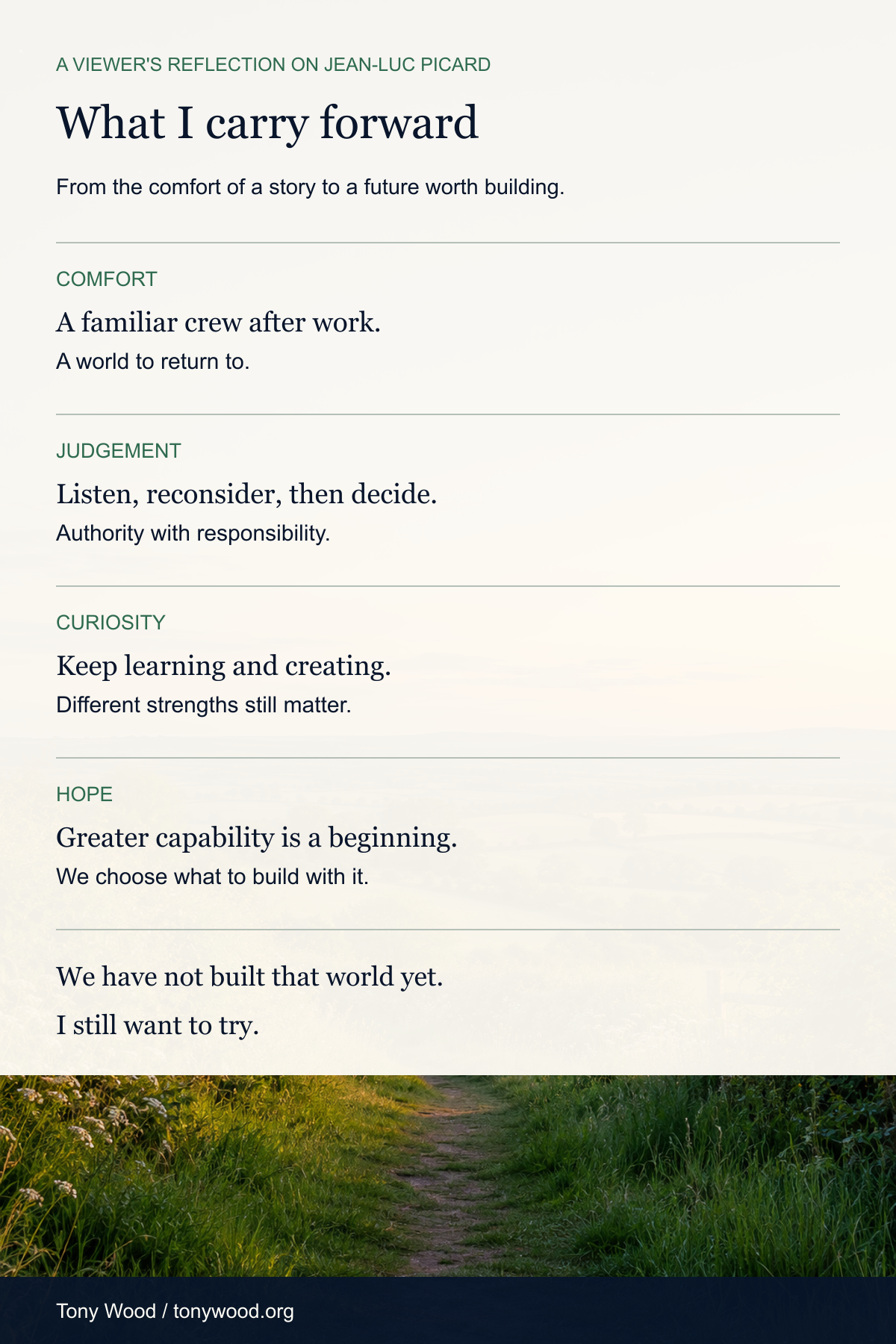
We have not built that world yet.
I still want to try.
Sources and notes
This is a personal remembrance, written on 30 October 2026. The memories of work, watching television and being inspired to code are my own; the reading of Star Trek and the comparison with AI are my interpretation, not claims about the cast's views or evidence about machine consciousness.
- ITV News, 29 October 2026: reproduces the family statement announcing Sir Patrick Stewart's death. The statement dates his death to the previous day, 28 October, at home in Los Angeles. He was 86. The announcement date and death date are distinct.
- Catherine Johnson, Histories of Telefantasy: the Representation of the Fantastic and the Aesthetics of Television, University of Warwick, April 2002, volume 2, printed page 298, footnote 3 (PDF page 79): records the BBC Two pilot broadcast on Wednesday 26 September 1990, 6-7.25pm, and the subsequent regular Wednesday 6-6.50pm slot. These are broadcast-history dates, not a date for my first viewing or employment. This is an academic history, not a directly inspected BBC schedule. The BBC archive page could not be retrieved during this check.
- StarTrek.com, "The Measure of a Man" -- 26 Years Later, 13 February 2015: official franchise retrospective on Picard's defence of Data. Fictional character traits and the wider meaning I draw from the series are interpretation, not a ranking of kinds of intelligence.