
Something rather clever happened during the GPT-6 Astra rollout.
OpenAI announced its new frontier model. Access began with a limited set of organisations and was due to reach paid ChatGPT plans over the following days. Predictably, everybody wanted the new thing immediately.
Then the rollout became messy. Some people had Astra. Many did not. ChatGPT and Codex were also having a bad day.
Normally, that combination produces a very familiar internet chorus:
Why have they got it? Why have I not got it? I pay too. Where is my button?
Then Tibo Sottiaux announced that paid subscribers would receive "one banked reset for every day" without Astra access.
And suddenly I had a completely different question.
Could you please put me at the back of the queue?
That is a masterstroke.
OpenAI did not merely apologise for a queue. It gave the queue an option value.
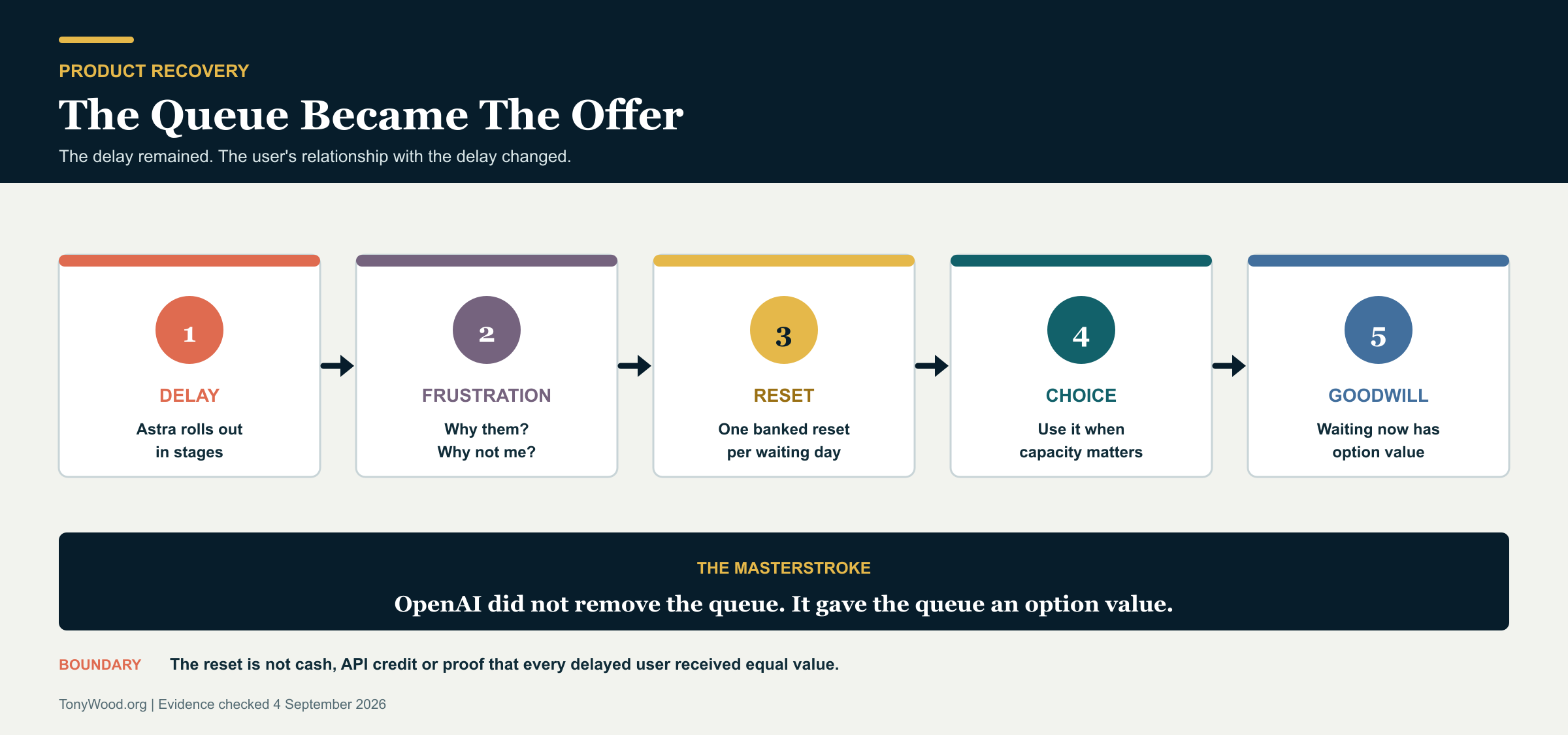
What actually happened?
OpenAI released GPT-6 Astra on 3 September 2026. It described a rolling release: limited organisations first, then ChatGPT Plus, Pro, Business and Enterprise over the coming days, alongside API and cloud availability.
For the familiar individual plans, OpenAI currently lists Plus at $20 a month and Pro at $200 a month. Business and Enterprise use different pricing arrangements, and eligibility for any particular reset offer still depends on the offer shown in the account.
Astra usage is included within existing subscription allowances. Extra credits can also be purchased. Pro, Business and Enterprise users are due to get Astra Pro, while Enterprise access is off by default until an administrator enables it.
This matters because the reset offer was about delayed access. It was not an ordinary weekly reset and it was not announced as a blanket service-outage refund.
Tibo's announcement on X said that, starting that day, a paid ChatGPT subscriber without Astra access would receive a banked reset for each day they remained without it. The post said the first reset would arrive in roughly three hours. Contemporary reports from PC Watch and ITmedia preserved the announcement while X was awkward to inspect without signing in.
The promise is simple. The mechanics are not. So let us separate them properly.
A reset is not just a reset
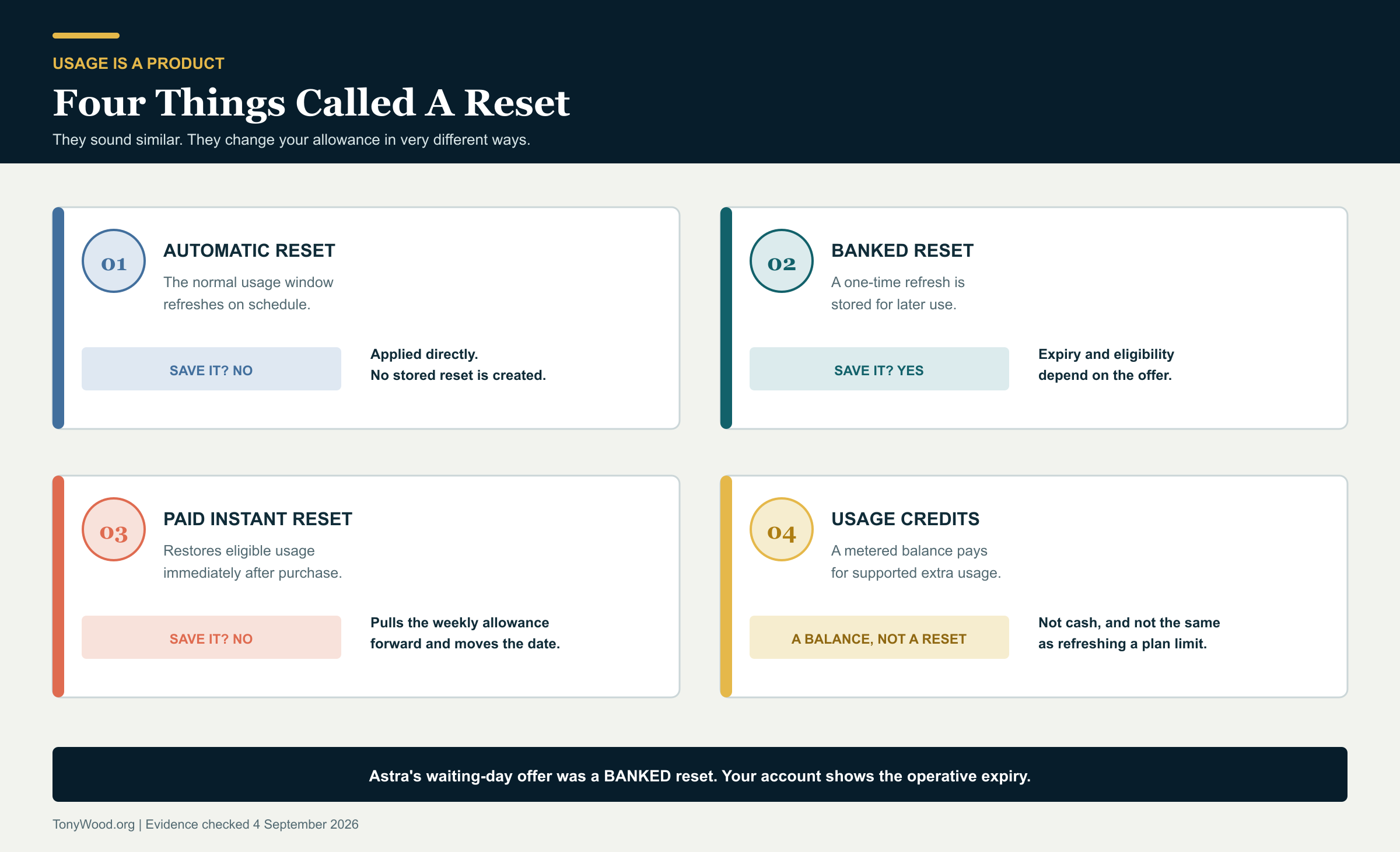
| Mechanism | What it does | Can you save it? | The important catch |
|---|---|---|---|
| Automatic reset | Refreshes an eligible usage window on its normal schedule, or through a specific global promotion. | No | It is applied directly. It does not create a token you can keep for later. |
| Banked reset | Stores a one-time Codex usage-limit refresh on your account until you use it or it expires. | Yes | Eligibility, delivery, limits affected and expiry depend on the offer, plan, workspace and region. |
| Paid instant reset | Immediately restores eligible five-hour and weekly Work or Codex usage for eligible personal accounts. | No | It pulls the normal weekly allowance forward, changes the reset schedule and cannot wait until you use the remainder. |
| Usage credits | Create a pay-as-you-go balance used after included allowance is exhausted for supported usage. | They remain as a balance subject to their terms | They are not a reset and are priced as metered usage. |
According to OpenAI's current banked-reset documentation, using a full banked reset refreshes the five-hour and weekly Codex windows and changes the weekly reset date. It is consumed only if at least one eligible window is actually refreshed.
That last detail is useful. If there is nothing to reset, the banked reset remains available.
Some earlier referral promotions gave banked resets a 30-day redemption period. That does not prove the Astra resets have the same expiry. OpenAI says expiry varies by offer and the date shown in your account is the one that matters.
A banked reset is also not cash, not API credit and not transferable. It is a button that refreshes a particular allowance under particular terms.
Why this worked so well
A normal compensation offer tries to make a customer whole after something has gone wrong.
This one did something more interesting. It changed the customer's decision.
- The delay became legible. One day waiting meant one specific benefit.
- The benefit was controllable. A banked reset could be used at a useful moment rather than disappearing into yesterday's allowance.
- The benefit matched the audience. Heavy Codex and Work users understand exactly what an extra full run can mean near a deadline.
- The message came from a recognisable human. Tibo speaks directly to the community and has become associated with usage resets.
- The apology contained action. The team still had to complete the rollout, but the user did not receive only another paragraph asking for patience.
This is the part I think Thibault and OpenAI understood particularly well: serious users live inside real project budgets.
We make decisions day by day about how much AI capacity we can afford to spend. When the allowance runs out, or another run becomes too expensive, the work does not continue through goodwill. We pause the project and go and do something else.
A banked reset recognises that operating reality. It does not merely say sorry. It gives someone another productive day, held until that day matters most. The people working close to those limits understand immediately why that is valuable. That is precisely why the offer feels unusually well judged.
The cleverest part is that early access and delayed access now have different advantages.
If you get Astra first, you get the new capability. If you wait, you accumulate future capacity on the already very capable tools you have today.
That does not make the two outcomes economically identical. Some users would rationally value immediate Astra access more than a reset. Others can do an enormous amount with GPT-5.6 Sol and would rather hold a reset for a major project.
But it gives both groups a reason not to feel entirely foolish.
There really was a bad day
On 3 September, OpenAI's status page recorded elevated errors across ChatGPT and Codex. The incident moved from investigation to mitigation and was marked resolved later that day. OpenAI said some Codex remote-control users might need to pair their mobile device again.
Anthropic separately recorded elevated errors across several Claude models. xAI also acknowledged Grok problems, and third-party reports saw a spike in Gemini complaints even though Google had not confirmed a Gemini incident at the time.
That is unusual, but we should not turn coincidence into causation. There is no public evidence that Astra caused the other providers' problems, or that all of the incidents shared one cause. The useful conclusion is much more ordinary: frontier AI services are becoming important infrastructure, and important infrastructure sometimes has a terrible Thursday.
Nor should we rewrite the reset announcement into outage compensation. The offer, as stated, was for each day a paid subscriber did not have Astra.
What are people waiting for?
Astra is not simply a slightly higher number in a model picker.
OpenAI is positioning it for computer use, browsing, software engineering, cybersecurity, science and professional work. The company says it is faster on computer-use tasks, better at multistep work and more able to preserve and retrieve context across long Codex sessions.
The published benchmark table reports Astra at 72.6% on OSWorld 2.0 compared with 65.7% for GPT-5.6 Sol, and 57.9% on Terminal-Bench 4.0 compared with 37.3% for Sol. OpenAI also says Astra is its first broadly deployed model to reach the Critical cybersecurity capability threshold.
Those are OpenAI's launch results, not a promise that Astra will be better for every real task. Benchmarks, production safeguards, harnesses, latency, cost and the quality of your instructions all matter.
API pricing starts at $10 per million input tokens and $50 per million output tokens for standard processing, with separate cache rates. Fast mode costs twice the standard rate. That alone should cure anybody of the idea that a banked subscription reset is the same thing as an unrestricted bag of Astra API tokens.
The Tibo bit
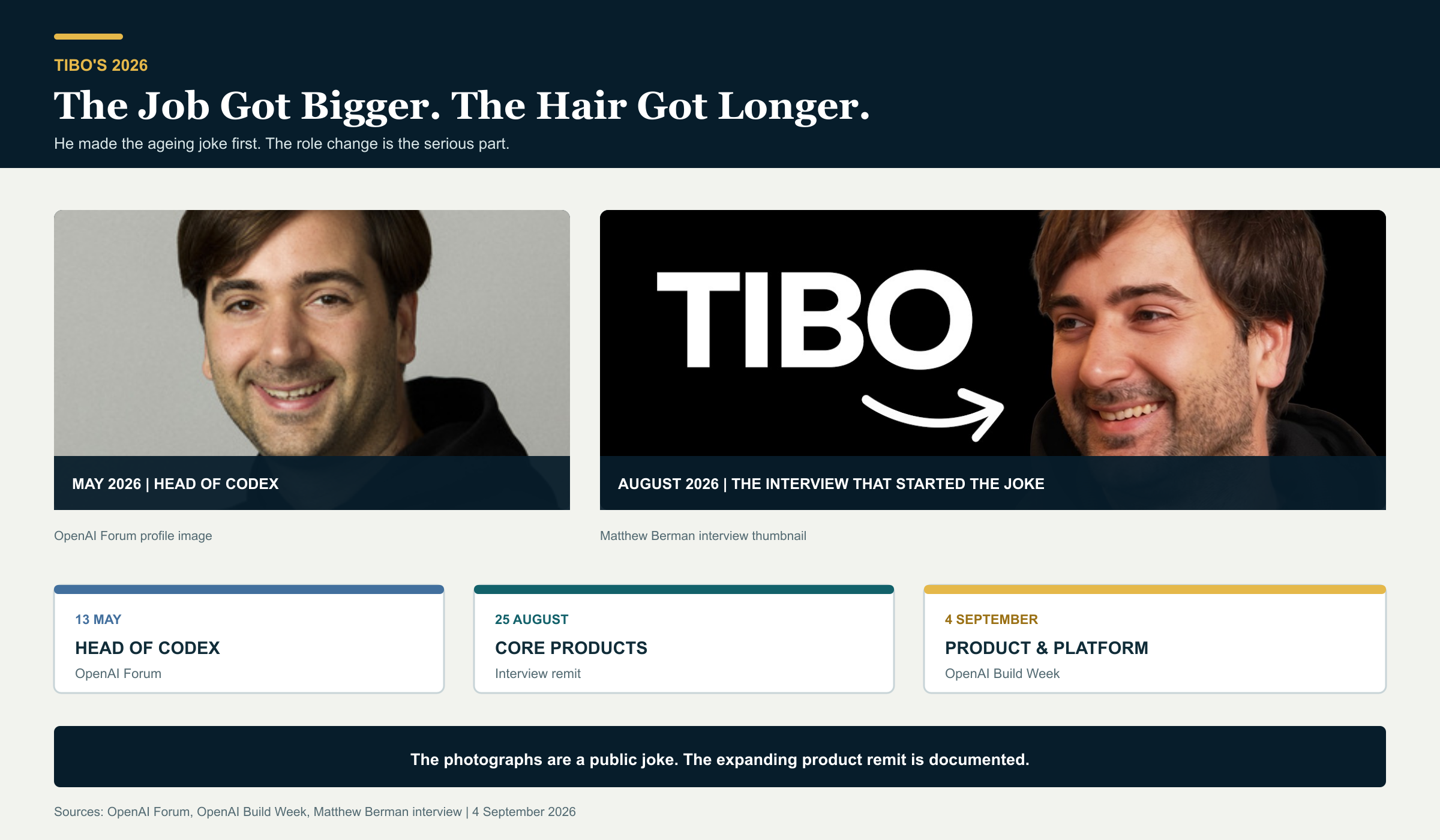
I initially described Tibo as the main Codex product person. That was true, but it is now incomplete.
An OpenAI Forum event in May called him Head of Codex. OpenAI's current Build Week page lists him as Head of Product & Platform. In an August interview, he said his remit covered the API, agent infrastructure, enterprise, ChatGPT, Work and Codex.
To be fair, Tibo started the ageing joke himself. In late August he posted that a few weeks at OpenAI can feel like years elsewhere, and colleagues joined the before-and-after gag. So the line in the graphic is affectionate and sourced, not a diagnosis.
I am still going to observe that frontier AI appears capable of compressing a decade into a quarter.
I say that with affection. Communicating through a rollout like this, while the product surface and audience are expanding at astonishing speed, must be brutally difficult.
What Tibo and the team have done well is make Codex feel as though someone is listening. Resets became a community ritual. Milestones got celebrated. Limits that might otherwise feel like a faceless billing system acquired a visible person and a sense of humour.
That does not excuse poor reliability. It does make recovery more human.
The product lesson
The lesson is not "give everybody free things whenever a launch is late". That becomes expensive, predictable and eventually meaningless.
The lesson is:
- Compensate in the currency your serious users value. Not every customer wants a discount or an apology email.
- Make the compensation optional. A stored benefit gives the customer agency.
- Tie it to a clear unit of inconvenience. One day waiting, one reset.
- Explain the boundary. What it refreshes, when it expires and who is eligible should be visible in the account.
- Keep shipping. A charming recovery cannot become a substitute for finishing the rollout.
I was expecting to write about a frustrating launch.
Instead, I found myself thinking: I already have GPT-5.6 Sol. I already have serious work to do. A well-timed full reset could be extremely useful.
So, Tibo, there is no rush on my account.
I can wait another day.
Sources and notes
Evidence checked 4 September 2026. Product availability, promotion eligibility and reset expiry can change quickly. Check the Usage view and offer shown in your own account. Tony's description of the reset as a marketing masterstroke is analysis, not an OpenAI claim.
- OpenAI: GPT-6 Astra announcement
- OpenAI: ChatGPT plan pricing
- OpenAI: GPT-6 Astra safety overview
- OpenAI Help: How banked Codex resets work
- OpenAI Help: Paid weekly Work and Codex rate-limit resets
- OpenAI Help: ChatGPT Desktop referral promotions
- Tibo Sottiaux: Astra banked-reset announcement on X
- PC Watch: contemporary report preserving the announcement
- ITmedia: contemporary report preserving the announcement
- OpenAI Status: Elevated errors across ChatGPT and Codex
- Anthropic Status: 3 September incidents
- Axios: overlapping ChatGPT, Claude and Grok outages
- OpenAI Forum: Codex is for Everyone
- OpenAI Build Week: Thibault Sottiaux role listing
- TechCrunch: interview with Thibault Sottiaux
- Tibo Sottiaux: the OpenAI ageing joke on X
- Business Insider via AOL: report on the ageing joke
- Matthew Berman: August interview with Tibo Sottiaux