
I have started using an AI PA. Her name is Amy.
She helps me organise my life, and I have started letting her email people to arrange things, making clear that she is my AI assistant. Which has left me with a question that is more about manners than technology.
Is that rude?
Other people have PAs who arrange meetings with me. They do not normally begin by asking whether I approve of them having an assistant. Somebody helps with the diary, and we get on with it.
So what changes when the assistant is an AI?
I do not want to pretend I personally did every bit of organising. But neither do I think delegating the admin should require a small apology every time we want a coffee.
Delegation is not the new bit
There are several different things hiding inside the phrase AI wrote this email.
I might ask an AI to help draft a message, read it, check it and send it as my own communication. Or I might authorise Amy to organise a meeting and let her handle the ordinary back-and-forth as my assistant. Or I could have a bot pretend to be me, conducting a personal conversation while the other person thinks they have my attention.
I do not think those deserve the same answer.
Researchers have been making related distinctions for some time. In their 2020 framework for AI-mediated communication, Jeffrey Hancock, Mor Naaman and Karen Levy distinguish how much the AI changes a message from how much autonomy it has to communicate without supervision.
It is a research framework, not a settled etiquette manual. But it gives us a better question than whether a machine touched the words: who is speaking, on whose behalf, and with what authority?
Amy should not have to pretend
For me, the starting point would be straightforward:
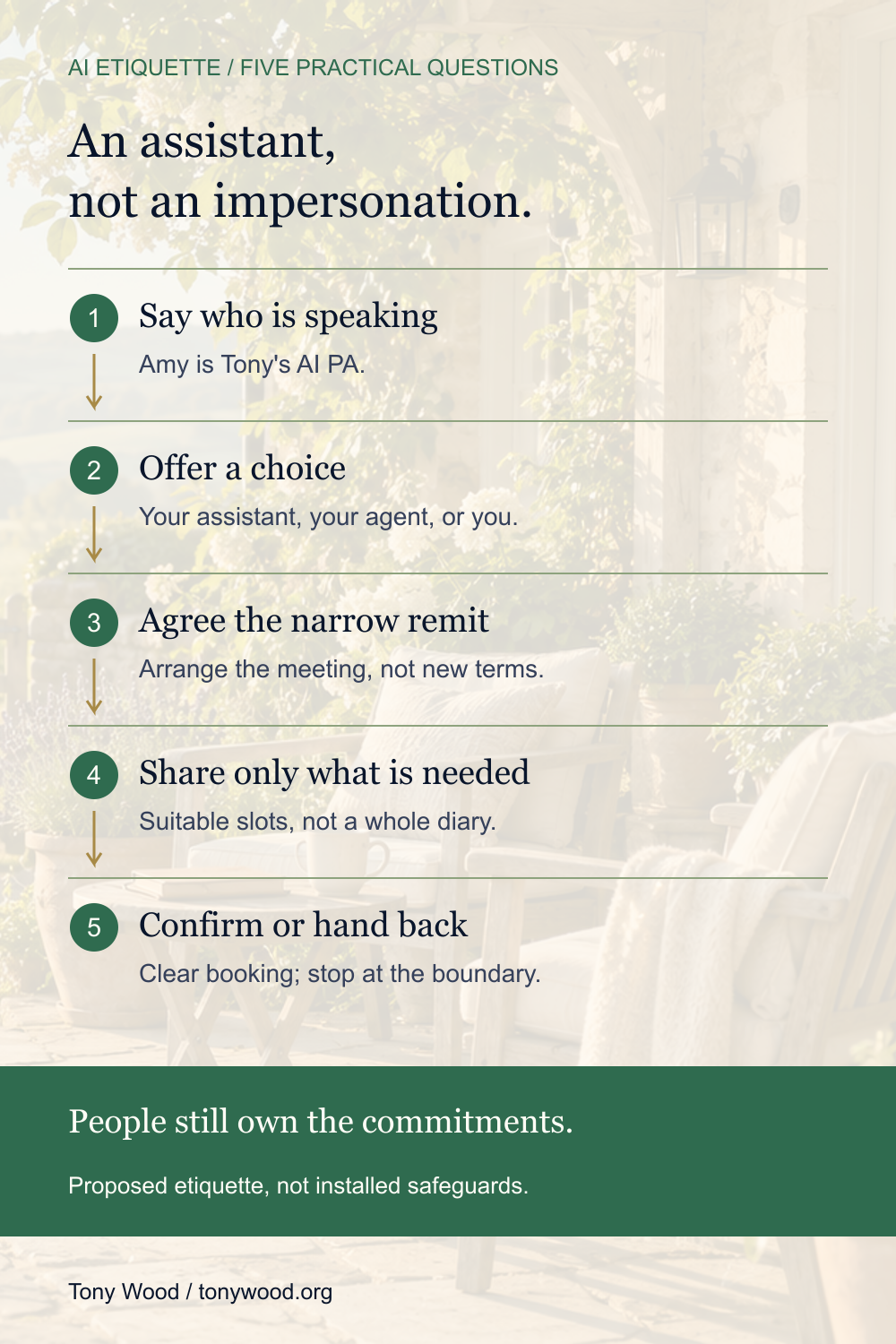
Hello, I am Amy, Tony Wood's AI PA. I am helping organise your meeting with Tony.
That is a proposed introduction, not a transcript of something Amy has sent. It says what she is and why she is there. Giving an assistant a name need not mean giving her an invented human biography.
I would put that information at the beginning of the interaction, not hide it below six paragraphs that invite you to believe you are talking to a person.
There is a difference between being friendly and borrowing somebody's trust under false pretences.
And I should be just as clear afterwards. Amy organised it for me is more honest than taking credit for admin I did not do. I still asked for the meeting. I still own my commitments. I have delegated a task, not disappeared from the arrangement.
Will people mind?
I would love a neat answer. The research does not justify one.
In Hohenstein and colleagues' 2021 preprint, controlled messaging experiments found benefits from AI-suggested short replies, including faster communication and more positive interpersonal evaluations. Yet believing a partner had used those replies was associated with less favourable judgements.
The distinction matters. Belief about the partner's use was measured, not randomly assigned as an announcement. The participants were crowdworkers doing a contrived desktop messaging task, not people arranging real meetings with an autonomous PA.
A different 2019 field experiment by Luo and colleagues found that disclosing a chatbot before an outbound sales conversation reduced purchases compared with undisclosed bots. That was structured loan-renewal selling at an Asian financial-services company, not British diary etiquette.
Neither study gives us a licence to conceal Amy. Nor does either tell us what all of my contacts will think. They suggest that reactions can involve expectations about the speaker, not simply whether the words are useful.
More recently, a September 2026 scoping-analysis preprint examined 52 human-computer interaction papers covering January 2016 to May 2026. It identified recurring issues around trust, agency and real-world integration, alongside limits such as small samples and artificial settings. That is a map of research, not a vote on whether Amy should book lunch.
My interpretation is that we should make room for different reactions without treating every objection as hostility to AI.
Do you have an agent I should talk to?
The wording I am using at the moment is along these lines:
There is an AI assistant if you prefer to work with or talk to it. If you prefer to talk to Tony, let me know.
That is my suggestion for etiquette: always put the option in. Offer the assistant, but make it just as clear that the person can speak to me. The AI should be a choice, not a barrier between us.
This is the question I would like Amy to ask:
If you have an assistant or agent you would prefer me to coordinate with, you are welcome to introduce us. If you would rather deal with Tony directly, that is fine too.
Human PA, AI PA, just you: let the other person choose. I am suggesting a courtesy, not claiming that we have already agreed an international standard for our diaries.
And choosing a human should not mean being punished with a maze of forms. No compulsory new account. No insistence that the other person install my preferred app. No five automated reminders because their reply did not fit the template.
The point of Amy is to reduce the organising work, not quietly move it onto everybody else.
I think an assistant that asks once, remembers an agreed preference appropriately and makes it easy to change that preference is demonstrating better manners than one that keeps explaining how efficient it is.
Two agents still need clear delegated authority
Agent-to-agent coordination is not just a fanciful extension of this. In its April 2024 discussion of advanced AI assistants, Google DeepMind explicitly considered assistants interacting with one another and with people who do not use them. This is vendor-affiliated ethics work describing possibilities and risks, not proof that autonomous scheduling is solved.
Here is the practical arrangement I would want:
- A known counterpart. A person introduces their assistant, or its identity is checked through an already trusted channel. A name and an impressive signature are not enough.
- A narrow brief. Arranging Tuesday's meeting does not authorise changing the commercial terms, inviting extra people or buying anything.
- Only the information needed. Suitable meeting slots, rather than a copy of either person's complete diary and all its private descriptions.
- A clear result. Date, time zone, duration, location and whether the booking is proposed or confirmed. One invitation, not competing versions.
- A stopping point. If the assistants cannot agree within a small, defined exchange limit, or encounter a sensitive or out-of-scope request, ask the people.
Those are my proposed controls. They are not evidence that Amy already has them, or permission for somebody else's agent to demand more access.
Two bots saying yes to one another is not the same as two people agreeing to change the deal.
Disclosure is not the whole privacy question
Someone can be perfectly happy to receive an email from Amy and still object to their confidential correspondence being copied into an unrelated service.
The ICO's AI transparency guidance covers explaining processing purposes, retention and who receives personal data. It is currently marked under review following the Data (Use and Access) Act. An AI signature does not, by itself, settle those questions or establish a lawful basis for every use.
There are legal rules about identity too. Article 50 of the EU AI Act includes a provider duty to design directly interacting AI systems so people are informed, unless the AI nature is obvious in context. That is not a blanket statement that every UK email drafted with AI needs a warning. The roles, territory and use matter; this is an etiquette proposal, not case-specific legal advice.
My practical preference is simpler: be open about the assistant, minimise what it shares, and check the actual data arrangements separately.
Delegate the admin, not the relationship
Finding half an hour in two diaries is one thing. Explaining why I have let somebody down is another.
I would be comfortable asking Amy to find a time. I would be much more cautious about letting her improvise a personal apology, negotiate something important or respond to somebody who is distressed.
That does not mean AI cannot help draft difficult words, translate them or make communication more accessible. It means I should recognise when the other person needs my attention and judgement, rather than a convincing simulation of them.
I also do not think good oversight means approving every harmless diary message forever. We should agree the remit, test it, keep an inspectable record, and require approval when the action falls outside it. Otherwise we have built an assistant whose main job is asking whether it can assist.
This connects with I Thought It Was Cultural Etiquette, Not AI Etiquette, my AI;DR piece. Passing along an unread recommendation as your considered judgement is not the same as openly delegating a tested, routine task.
The common question is what the other person can reasonably believe about the communication.
Are they hearing my decision? A suggestion from my assistant? An unconfirmed possibility? Are they able to ask for me?
I think that is where the etiquette should start.
If Amy is clear about what she is, respects your time and actually gets things organised, is that rude? Or is pretending I did all the admin myself the less honest option?
Sources and notes
Checked on 20 October 2026. Amy's use is my personal account. Example introductions, handoff rules and the coordination checklist are proposals, not reports of messages sent or safeguards already installed. The studies below do not provide a representative measure of acceptance of present-day AI PAs.
- Hancock, Naaman and Levy, 2020: conceptual framework; author-institution-hosted full text.
- Hohenstein and colleagues, 2021 preprint, version 1: controlled smart replies; not an autonomous-email or causal disclosure trial.
- Luo and colleagues, Marketing Science, 2019: structured financial-services sales calls; institution-hosted published paper.
- Chen and colleagues, September 2026 preprint: scoping review of HCI literature, not a consensus standard.
- Google DeepMind, April 2024: the report authors' accessible summary; vendor-affiliated normative analysis.
- ICO transparency guidance and EU AI Act, Article 50: distinct data-processing and AI-transparency questions, not a universal email-consent rule.