Ask a supermarket how many fridges it has and someone will probably find a number. Ask how many fridge controllers are in use, who can reach them remotely and which ones the supplier no longer supports. That's a different question.
Now try it with AI. How many agents are running? Which ones can send a message, change a customer record or spend money? Does that include the automation built by Finance, the pilot nobody formally closed, and the AI feature included in a product you already pay for?
If you don't know you have it, you can't protect it. And if you know its name but not who owns it or what it can do, you don't know enough to govern it. That's the next question after Who Patches the Fridges?
Start with what could go wrong
Get a short written mandate from the owner, board or relevant committee. Agree which entities, sites and services are in scope, who can see the evidence, who owns the register and who will challenge it. Start with what would hurt: payroll failing, confidential data leaving the business, stock spoiling, or an agent making a commitment nobody authorised. Work backwards from the service to the systems that let it happen.
The register needs to cover more than laptops and licences. Include servers, software, cloud services, integrations, important datasets and connected equipment like fridges and building controls. Include supplier-operated systems where your business depends on them. For AI, look for built-in features, custom assistants, model endpoints, scheduled workflows and connectors. Record the use, not just the brand: an assistant drafting copy and a bot sending it to customers are two different risks, even if they use the same model.
Don't make a second list that nobody reconciles. Keep one authoritative view, with stable IDs linking the records held by IT, Facilities, Procurement and the teams using AI. A small company can start with a controlled spreadsheet. A larger one can link its existing systems. The important thing is that two people looking up the same service get the same answer about who owns it.
What goes in the register?
- Identity and location. A stable ID, name, type, business purpose, site or environment, and where it actually runs. Record pilot, live, suspended or retired.
- Ownership and impact. Name the accountable person or role, who maintains it, and the business service or principal risk it supports. Say what stops working if it fails and how serious that would be.
- Dependencies and access. Link the systems, data and external services it depends on. Record who or what can reach it, including vendor and service accounts, and whether they can read, change or approve anything. Reference protected evidence; don't paste credentials into the register.
- Controls and proof. Record which version is actually running, how support and updates are handled, and how access is protected. Keep verification separate from lifecycle status: a system can be live and unverified. Link the last check or exercise, who verified it, when it was checked, and when it's due again. Record exceptions with an owner and a date.
- Extra fields for AI. Record the model or provider and version where visible, the deployed workflow or configuration, data sources, tools and service identity. Say in plain English what it may suggest, change, send, spend or trigger. Name the approver, where actions and approvals are logged, who can pause it and what happens to work already in progress. If a managed provider doesn't expose a precise model version, say so. Don't record a guess as a fact.
For example, a supplier-invoice assistant is permitted to read an invoice and draft a discrepancy for Accounts Payable. It is not permitted to send messages, change a supplier's bank details or release payment. Link the workflow to the mailbox, accounting system, provider and the identity it uses. Then ask a separate question: does its actual access enforce those limits, or are they just written in the instructions?
Reconcile the list against the real business
Start with the register you've got. Compare purchases and renewals with cloud and identity records, approved integration lists and deployment records. Walk a site with the people who maintain it. Ask suppliers for the equipment and services they actually operate. Ask teams what they're doing by hand, and what they've quietly automated. Make it safe to tell you. If reporting a useful but unregistered experiment earns someone a public telling-off, they'll keep the next one quiet.
Each source sees a different slice. A purchasing record won't show a free pilot. A corporate sign-in report won't tell you about every supplier-managed installation. A contractor invoice may say "refrigeration maintenance" without identifying a single controller. For connected equipment, follow the NCSC's guidance on gathering, validating and maintaining a definitive record. Use existing documentation, local operations knowledge and approved passive evidence first. Any active discovery needs approval from the operational technology owner and a check that it can be done safely.
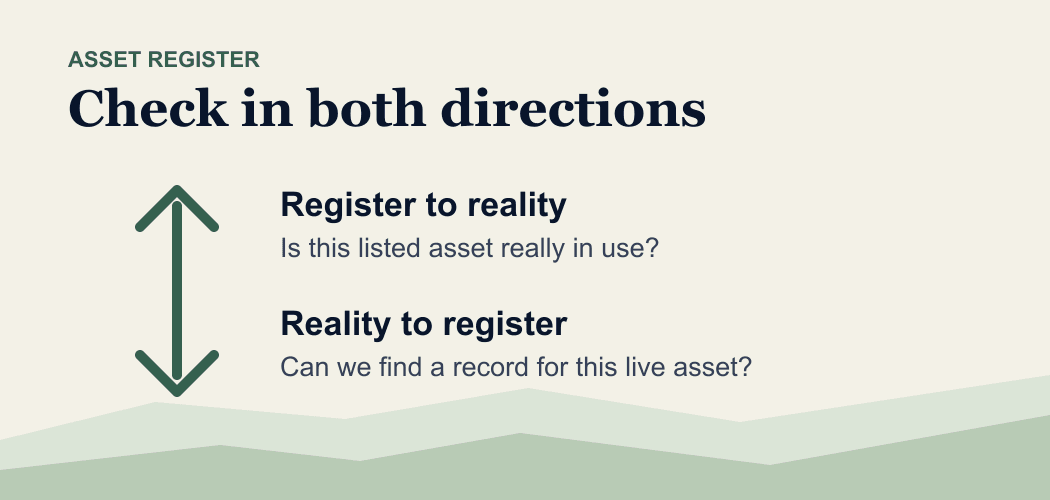
Check both directions. Pick an item on the register and trace it to something that's actually in use. Then pick something you can see in use and find its record. The second test catches what the first never will: the unlisted thing. Keep the scope, sources, date, sample and exclusions so somebody else can repeat the check. Don't delete a record just because it hasn't been seen recently; check whether it's idle, seasonal, disconnected or genuinely retired. Record an unresolved discrepancy as unknown, with someone to investigate it.
Test the rule and test the reality
This is where the governance audit earns its keep. Ask someone independent of the day-to-day process to test two things separately. Design: would the rule work if people followed it? Operation: is there evidence it worked on real changes and real systems? A rule might say every new agent needs an owner before it goes live. Take a risk-based sample of recent deployments and check the records, the permissions and the approvals. In a safe test environment, verify that an action outside the agent's authority is stopped and that somebody competent can intervene.
Say one workflow has a documented approval step but is using an account with wider permissions than it needs. Write the finding so a director can act: what should happen, what the evidence shows, why it happened, what could go wrong, who fixes it and by when. Close it when the change has been checked, not when somebody replies "done". Don't let a strong overall score hide a missing stop control on a system that can move money or affect safety.
Make it harder for the register to go out of date
Put the update where the work already happens. A purchase, installation or production release should create or update the record. So should a change of owner, supplier, model, connector or permissions. When something is retired, confirm that its access and schedules have gone and that any data it held is dealt with. Keep the change history. Use shorter review intervals for critical or externally connected systems, and recheck after an incident or material change.
At the board, don't lead with the total number of rows. Show what was reconciled and when, which sites or systems weren't covered, the unowned or unverified assets, and the overdue high-risk exceptions. Ask for evidence that the team can act on it. Try one question: If our AI provider changed tomorrow, which live processes, datasets and permissions would we have to review? Then try the same question for the refrigeration supplier. If you can't answer either without a week of emails, you've found something worth fixing.
The voluntary NIST AI Risk Management Framework ties the resources for maintaining an AI inventory to risk. Its companion playbook favours listing all systems or models, and suggests high-risk or high-stakes systems as a minimum. Start with the most important services; don't stop there.
For companies in the UK commercial companies or closed-ended investment funds listing categories, revised Provision 29 of the UK Corporate Governance Code applies to financial years beginning on or after 1 January 2026, on a comply-or-explain basis. It covers annual review of all material controls, not just cyber and AI. The provision calls for reporting on monitoring and review, a declaration on effectiveness as at the balance sheet date, and disclosure of ineffective material controls and what is being done about them. The register helps show what the board looked at. It does not prove the controls worked.
Start this week. Pick one operation you can't afford to lose. Follow it from end to end, give each dependency an owner, and check the gaps against the real world. Put a date against the first fix. Then do the next operation. What makes the register useful isn't how complete it looks. It's how quickly it tells you what to protect, who can act, and where you still don't know.
Download the starter asset register (CSV). The two example entries are fictional.