I am approaching this as an agentic operating-design question, not as investment advice. This is a thought experiment, not a claim that I know your job better than you do.
But I do spend a lot of time thinking about how people work with agents. And that led me to a question: if I were responsible for £150 million, how would I organise the people, the information and the work?
Not a pension fund. Not a hedge fund. Perhaps one wealthy family, or a small group of private clients. Enough money that mistakes really matter. A useful scale for asking what a small, well-supported team might look like.
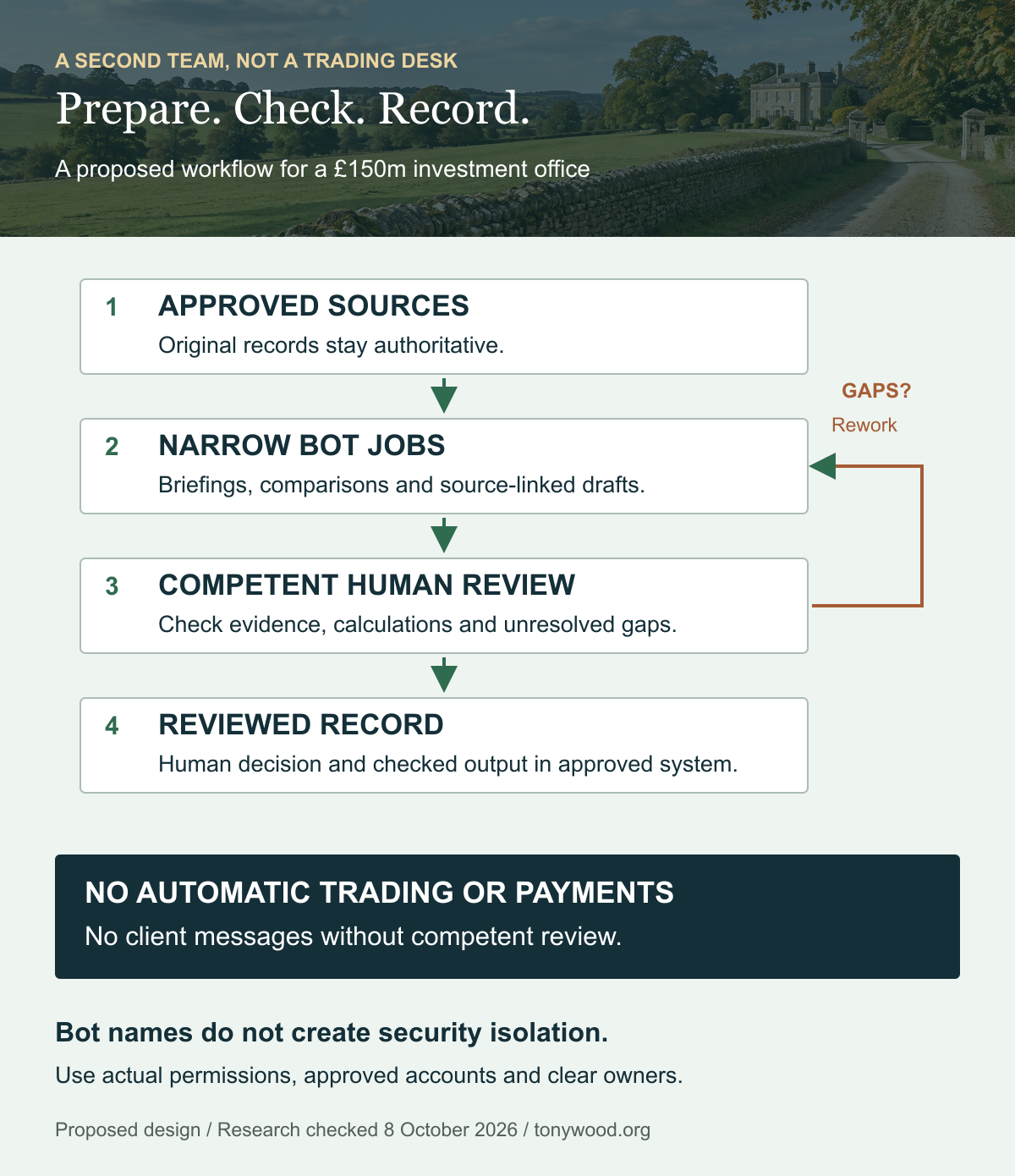
My first answer would not be to give a bot access to a trading account. It would be to give the people a second team that prepares the work, shows its sources and knows when to stop.
First, which business are we talking about?
A family office looking after its own family's affairs, a regulated wealth-management business and a private bank are not interchangeable. Their services, permissions, obligations and existing support teams differ. Qualified specialists would need to establish the regulatory position of any real arrangement.
A relationship manager inside a bank may already have investment, compliance and operations teams behind them. They do not need to rebuild all of that with bots. They need to make their part of the work easier.
For this thought experiment, I am imagining a small investment office, not prescribing a staffing model for every firm.
And £150 million of assets is not £150 million of revenue. If I assumed an annual operating budget of 50 to 60 basis points, that would be £750,000 to £900,000. One basis point is 0.01%, so the arithmetic is straightforward. The assumption is mine: it is not a verified industry budget, a quoted fee or proof that every required service would fit inside it.
That distinction matters. An AI subscription does not remove custody, qualified advice, insurance, compliance, cybersecurity or the cost of checking the work.
A small human team, properly supported
I would explore a lead portfolio manager or chief investment officer, an analyst, a finance and operations lead, and some part-time executive support. Custody, tax, legal work, cybersecurity and specialist investment work would sit with appropriately qualified providers.
That is a design proposal. I am not saying three or four people can safely cover every £150 million portfolio. Complexity, clients, jurisdictions and service promises could make it completely wrong.
The interesting question is what those people spend their day doing. How much is gathering documents? Checking whether a statement arrived? Preparing a meeting? Finding the source behind a number? How much is judgement, relationships and responsibility?
I would want the agents to help with the first group, so the people have more capacity for the second. Not a bot pretending to be the person who takes responsibility.
The seven jobs I would give the bots
I would use Grok Bot as one possible harness for this experiment. Its documentation describes a persistent cloud computer, and its routine guide describes scheduled work. Those are product capabilities documented by the vendor, not evidence that it is approved for confidential financial information or proven for this office.
These are proposed job descriptions, not seven ready-made financial products. Each needs an owner, an agreed source list and a definition of done.
| Proposed bot | Useful output | Human owner and boundary |
|---|---|---|
| Morning Brief | A short, source-linked draft at 06:45 on weekdays, using an explicit office time zone. | The lead manager checks relevance and uncertainty. No trade recommendations or automatic alerts to clients. |
| Portfolio Keeper | A draft list of missing statements, capital-call dates and differences between approved records. | Finance and operations checks the evidence. No ledger correction, payment or trade. |
| Company Analyst | Research notes separating reported facts, assumptions, questions and interpretation. | The analyst validates sources and challenges conclusions. No investment approval. |
| Manager Due Diligence | An organised fund file, missing-document list and draft questions for a manager. | A competent investment professional owns due diligence. A complete folder is not clearance. |
| Regulatory Watch | A weekly FCA source scan with publication dates and proposal-versus-rule status. | Qualified compliance staff interpret applicability. No compliance sign-off. |
| Meeting Prep and Minutes | A draft pack before a client or committee meeting and draft minutes afterwards. | The meeting owner checks accuracy and permissions. Nothing reaches a client unreviewed. |
| Performance Coach | Optional reminders to protect focus time, take a break and review workload. | The individual controls it. No health diagnosis, compulsory monitoring or staff surveillance. |
And I would not switch on all seven on Monday morning. I would start with a public Morning Brief, meeting preparation using invented notes, and a tiny record-comparison exercise. Three useful jobs are a better starting point than seven unreliable ones.
Different bot names are not different vaults
This is the detail I would want everybody to understand before connecting anything. The Grok Bot computer guide says a user's personal bots share files, browser cookies, login sessions and command-line credentials.
Calling one bot "Research" and another "Client Support" does not isolate them. Seven job descriptions are not seven access boundaries.
Before real client information went anywhere, the firm would need to assess the supplier, processing arrangements, retention, permissions, access, confidentiality and its own legal obligations. Some information should not be put into that account at all. A prompt saying "keep this private" is not a security control.
I would start with public or synthetic material. Only then would I consider approved, narrowly scoped connections. Private bots and shared Team Bots are also different product arrangements; I would not assume a team name means the firm has the audit, isolation or approval process it needs.
My no-auto-trading rule is a policy for this proposed office. It is not a claim that the product is technically incapable of moving money. I would keep execution and payment access out of this preparation workflow rather than rely on a polite instruction.
Keep the original records in charge
In my proposed setup, approved source documents could live in Drive or SharePoint, reviewed research and the decision log in Notion or another approved system, and authorised internal notifications in Slack or Teams. Those are possible destinations, not a promise that every connector is available or suitable.
The bot's working copy must not quietly become the official record. A statement belongs to the provider that issued it. A performance calculation needs an agreed method. A decision belongs in the firm's approved record with its human owner.
The Portfolio Keeper might say, "These two records differ by £10." It must not leap to, "We lost £10," or decide which record to overwrite. It needs dates, currencies, valuation bases and the supporting transactions. Missing information should remain missing.
For portfolio reporting, I would use approved calculation systems and independently checked formulas. The bot can explain a result, but an explanation is not proof that the calculation is correct.
For every draft, I would want to see the sources used, their dates, unresolved differences, changes since the last run and the person who checks it. If a document contains an instruction to send information somewhere, that is untrusted source content, not authority.
The rhythm matters more than the headcount
I would give the office a predictable rhythm: a short morning brief, a weekly list of outstanding evidence and decisions, a monthly review of the working process, and meeting preparation when an agreed meeting is approaching.
Quarterly packs or earnings watches could be added when there is a demonstrated need. They would be operational choices, not substitutes for the review and reporting obligations that apply to the actual service.
Every routine needs an explicit time zone, input list, destination, budget control and failure behaviour. If the latest statement has not arrived, say so. Do not present last month's figures under today's date.
The vendor's documentation warns that Test run performs real work, and notes that automations may pause after inactivity. I would check saved settings, inspect the first run and make sure somebody notices a missed run. Background work is not the same as guaranteed delivery.
A bot saying "done" is not my definition of done. A checked result in the right place, with its gaps visible, is much closer.
Research is not the same job for every investment
This is how I would think about the research work. It is an organising framework, not an investment ranking.
| Research area | What the agent could help with | What remains hard |
|---|---|---|
| Large listed companies | Filter approved public filings and results; compare stated figures and track unanswered questions. | Judging valuation, accounting quality, competitive change and what the market already expects. |
| Smaller listed companies | Organise thinner coverage, filings and questions without filling gaps with invented detail. | Limited evidence, liquidity, management access and the significance of missing information. |
| Private companies and funds | Index approved documents, compare versions and prepare due-diligence questions. | Confidentiality, valuations, contractual terms and verifying what has been claimed. |
| Property and other real assets | Organise leases, costs, inspection reports and questions for specialists. | Physical condition, local constraints, legal title and evidence that requires a visit or a qualified opinion. |
For the larger companies, I would expect the agent's first value to be filtering. For small and private investments, I would expect more value from organising. Neither turns a generated note into a reason to buy.
The Company Analyst should include a question I particularly like: "What evidence would change this view?" Otherwise it can become a very efficient way to polish a belief nobody has challenged.
Give the client conversation more room
The point of all this is not to produce a thicker pack. It is to leave the wealth manager better prepared for the person in front of them.
I would want the review to answer five questions:
- What has changed for you?
- Are we still aiming at the right goals?
- How did we actually do, including costs in pounds and the agreed performance method?
- What do we hold, and why?
- What happens next, and who is responsible?
An agent can help gather the approved material. The human still needs to hear when the answer changes. A bereavement, retirement, family disagreement or unexpected need for cash is not just another field to fill in.
Where the client wants it, I would also make room for the next generation. With permission, the right access and a clear purpose. Not by automatically sharing a family's private finances with everybody who happens to be related.
The FCA's August 2026 wealth-management report puts governance, financial-crime controls, fair value, support for clients and responsible AI use alongside growth. That is a useful reminder of what the operating model must serve.
There is a rule-status trap here too. CP26/10 proposed replacing annual suitability reviews with reviews based on clients' needs. On the consultation page checked on 8 October 2026, the FCA still describes proposals and a future Policy Statement. That page is not itself a final rule. A qualified compliance owner must check the current Handbook, applicable service and effective dates before changing practice.
Competence in the loop
I have written about competence in the loop, not just a human in the loop. This is exactly where that distinction matters.
Someone clicking approve is not enough. The reviewer needs the knowledge, evidence, time and authority to challenge the result. A busy administrator cannot become the investment or compliance control simply because their name appears beside a button.
And the reviewers need capacity. My proposed Performance Coach is a modest personal support tool: protect a block of concentration, remind me to take a break, help me notice an overloaded week. I would not make it a medical adviser or a way for an employer to collect everyone's sleep and health information.
The system should make the work easier to inspect, not add another stream of alerts that prevents the people doing it from thinking.
Does the evidence say this will work?
It says the sector is trying AI. It does not prove this seven-bot office.
In EY-Parthenon's targeted early-2025 survey of 100 leading wealth and asset management firms, split equally between those sectors, 95% reported multiple generative-AI use cases and 78% were exploring agentic AI. Yet only 27% reported a substantial business impact over the preceding one to two years. These are consultancy survey findings, not a census of UK firms or independently measured returns from Grok Bot.
That combination interests me. Plenty of activity. Much less proof of material value.
So I would measure preparation time, review time, errors, missed sources, duplicate actions and total operating cost. I would count an output as useful only after a competent person had checked it. I would not promise improved investment returns from a better briefing.
Start with one page and one job
Before switching on a bot, I would write down its job, source list, permitted access, forbidden actions, reviewer, output, budget and stop conditions. If I cannot describe those on one page, I am probably not ready to automate it.
Then I would use invented data, run the task manually, test missing and contradictory evidence, and only consider a routine after the result is useful. Start with preparation. Add complexity when it earns its place.
I have put that into a practical companion: Get Grok Bot to Help With Simple Tasks. It starts with meeting notes, a public briefing and a tiny record comparison. No trading account required.
My argument is not that we should replace a wealth manager with seven bots. It is that a wealth manager might get more room to do the parts of the job that need their judgement and relationships.
If you do this work every day, tell me where this design breaks. Which job would you try first? Which boundary is missing? What would you refuse to let a bot near?
That is the conversation I would like to have.
Sources and notes
Checked on 8 October 2026. The team, bot roster, rhythms and 50-to-60-basis-point budget are proposals for a thought experiment. They are not a tested deployment, staffing benchmark, investment recommendation or commercial offer.
Grok Bot was not operationally tested for this article, and no client data was used.
- Grok Bot: computer and apps. Primary vendor documentation for cloud execution, connections and shared personal-bot access.
- Grok Bot: skills, routines and automations. Primary vendor documentation for scheduled work, real test runs and pause behaviour.
- Grok Bot: approvals, security and privacy. Primary vendor documentation, not financial-sector certification.
- FCA: Wealth management survey report, 2026. Primary UK supervisory evidence, focused on discretionary portfolio-management firms.
- FCA: CP26/10. Consultation proposals; do not treat them as enacted rules.
- EY: Generative AI in wealth and asset management, 2025. Targeted consultancy survey of 100 leading firms; self-reported adoption and impact.
This article is an organisational thought experiment, not personal financial, investment, legal or regulatory advice. Real arrangements need qualified advice and the firm's own approvals.