
Someone asked me the other day which AI I would choose for a business. I don't think that's the first question. The first question is: what are you prepared to let it do?
Read a meeting transcript? Draft a reply for someone to check? Keep an eye on a job all week and tell you when it's slipping? Send something to a customer? Those are four different decisions. You can make all four without once asking which foundation model topped a benchmark.
My first pick for a proactive assistant, when I am allowed to use it, is Grok Bot. I'd still give Microsoft 365 Copilot a fair trial for work that stays in Teams, Outlook and Word. And if I had a European procurement requirement, I'd put Mistral Vibe Work on the shortlist now. Same company, possibly three different answers. Think about it. We don't buy one bit of software because it covers every job in the business. Why would we start with AI?
Why Britain starts with Copilot
The Competition and Markets Authority's investigation gives us something better than a hunch. Its October provisional assessment put Microsoft 365 Copilot offerings at 3.5 to 4 million monthly active users among UK organisational customers in July 2026, ahead of the other providers it examined. It includes paid and unpaid use. The comparison took the latest month available for each supplier, which wasn't always July. It isn't a count of paid licences, a ranking of all AI use in Britain, or a test of which product did the best job.
Microsoft gets a lot right for companies that already work in its software. The UK government's 20,000-person trial found Teams was the most-used Copilot application during the trial. Users estimated saving 26 minutes a day on average. That's self-reported time, not an observed return in cash or an increase in departmental output. A more recent DWP evaluation estimated 19 minutes a day across eight routine tasks using survey data and a non-random comparison group. Drafting, summarising and finding information are real work. If your team can do those things better or faster, that's a reason to use it.
What I wouldn't do is roll out the office assistant and say we've learnt how to manage agents. Microsoft can do more: on 17 November it announced general availability of Copilot Home with Cowork for multi-step work. It also documents scheduled and event-triggered Workflows in Frontier, where its long-running Autopilot agent is rolling out separately. That's not the same as saying it's in your UK team's tenant, switched on, and approved for the job. In the kind of proactive work I want to do, the default office rollout feels well behind the dedicated agents. I wouldn't put a number of months on it. I'd ask you to show me what your people can run on Monday morning.
What I'd actually put in the trial
A model is the engine. The product around it decides what the engine can see and do, whether work continues after you've closed the laptop, and what you get back when something goes wrong. You can have an excellent engine and still spend half your morning copying information between windows.
- Microsoft 365 Copilot: start with the work that's already in Microsoft 365.
- Meeting notes, searching internal documents and getting a first draft are sensible tests. For recurring work, test the actual workflow or agent feature your tenant has. Microsoft's enterprise data protection documentation describes how it applies identity and permissions. That's useful, but it doesn't make inappropriate access to a shared folder appropriate.
- Grok Bot: my first choice for continuing work across tools.
- Grok Bot launched in beta on 11 August for eligible subscribers. The announcement didn't list a UK exclusion for the standalone app, and it was a tool I could actually use here to get my briefing running. That's the distinction that matters to me. I could hand over a recurring job and see what came back. It doesn't mean every UK account had access on day one, or that every feature works here. The separate @bot tagging feature on X, for instance, still excludes UK accounts.
- OpenAI Dots: the risk is building around access you don't have.
- OpenAI introduced Dots on 29 September and began rolling them out to eligible plans and markets. Eligible Enterprise, Edu and Healthcare workspaces moved to default access on 18 November unless an admin opted out. That's 50 days after the announcement, but it wasn't the start of all business access: Business Premium was included in the original rollout in eligible markets. The 19 November Business Standard announcement named eligible US members. The setup guide lists Business Standard and Premium in supported regions, but doesn't confirm whether that rollout has reached UK Standard seats. As at 25 November, nearly two months after the announcement, UK personal Plus and Pro accounts still aren't eligible. Paying for Pro doesn't fix that, and using Codex doesn't give you a Dot. If I were buying for a team, I'd ask them to show it working on the actual UK seats we plan to use.
- Claude Duet: the new proactive agent. Cowork is what I'd test today.
- Anthropic introduced Claude Duet on 21 October. It's designed to notice what needs your attention and keep working when you step away. Anthropic still lists it as a US-only research preview for eligible Pro, Max and Ultra subscribers, with access by invitation. It isn't a UK option, and Team and Enterprise aren't included in the preview. Claude Cowork already supports scheduled tasks on paid plans, so I'd give it the same recurring job in the trial. That's not the same as having Duet watch for things you haven't asked it to look for yet.
- Meta Muse: now available to UK consumers.
- Meta launched Muse in the UK on 23 November. So Grok Bot isn't the only personal agent you can use here now. Muse is interesting for everyday tasks; consumer availability doesn't prove it meets your business's data, approval or audit requirements.
- Mistral Vibe and Cosine Lumen: test what's available; watch what's planned.
- France's Mistral documents Vibe Work for multi-step work across connected apps, including scheduled tasks in a preview open to eligible users. Vibe Code is the coding option, not another name for the same workflow. Britain's Cosine is worth following for coding and controlled deployment. Its Lumen Sovereign roadmap lists alpha access and targets commercial launch in the first quarter of 2027. That's a plan, not a service I'd make a production dependency today.
This is why I'd put available to the people doing the work on the buying checklist. Don't buy against a launch video or a roadmap. Test the country, plan, account and feature you'll actually use. That's also how I'd read my Shepherd Field: I track whether a tool can carry on with the work and whether it keeps the person in charge. My personal pick isn't an independent safety score.
For European options, I've just written What Is Agentic First? It explains how to start with a job and use the Open Tool Directory to find software an agent can work with. Search by task or by the product you're replacing. Then check where the company is based, where the data goes and what the agent can actually read or change. The directory gives you leads. It doesn't do the procurement for you.
A board is allowed to say no
If your board doesn't want to buy from an Elon Musk company, or has decided it will use European suppliers for a particular class of work, that's a decision it can make. No judgement. But put the reason in the decision and be honest about the trade-off. If the excluded tool really would deliver more value, show what the difference is. You can't say you've given up profit you haven't measured. And if the alternative gives you a better exit route or keeps sensitive work under your control, that's value too.
Be specific about what you mean by European. A supplier's ownership, where it stores your files, where it runs the model and which other companies can process the data are different questions. If the rule is no US suppliers, Microsoft is a US supplier. If the rule is approved processing in specified locations with agreed contractual controls, ask for evidence against that rule. My piece on what happens if the US switches off Britain's AI asks the next question: could you move the work if the supplier stopped serving you?
Productivity is what comes out of the work
Britain is moving. In the 2026 government adoption survey, 32% of UK private-sector businesses with at least five employees in the sectors surveyed reported using or piloting AI, up from 16% in the 2025 wave. The ONS's separate analysis found that adopters with ten or more employees reported around 1.6 types of AI technology per business in June 2026, a measure of breadth rather than depth. Meanwhile, the ONS's November release put UK output per hour 2.5% higher in the third quarter of 2026 than a year earlier, using its new headline method. Output grew and measured hours fell. Encouraging. It doesn't tell us how much, if any, was due to AI.
What can we say about the work itself? A published study of 5,172 customer-support staff found 15% more issues resolved per hour on average with an AI assistant in that setting. An experiment across 66 firms with Microsoft 365 Copilot found less time spent on email among users, but no detectable change in the quantity or mix of work from giving individuals access. Some of the authors worked for Microsoft. Both findings can be true. Saving time in an inbox and getting more customer problems resolved are different results. Neither study tells me what switching from Copilot to Grok Bot will do for your company.
The management gap matters more than the model gap
Britain has some excellent managers. It also has plenty of people who've been given a team and left to work out how to manage it. In CMI's 2023 research with YouGov, 82% of surveyed managers reported entering management without formal training. That's not a headcount of bad managers. The ONS found that higher management-practice scores were associated with higher productivity, but it also found that lower-scoring firms had been catching up. When the policy debate turns into whether Britain has bad managers, I'd ask a more useful question: are employers giving people the time, training and authority to get better at managing?
I made a similar point in Managers Already “Vibe Code”. Can you brief someone clearly? Agree what good looks like? Spot when work is going off track and give feedback that changes the next result? That's much closer to managing an agent than knowing how many parameters its model has. Knowing where authority stops matters even more when the work carries on while you're not there.
I'd put the business owner in charge of the work, with people and operations teams helping with training and job design. IT and security still need to own identity, permissions, integration and the technical controls. I wouldn't leave the whole thing to IT any more than I'd ask HR to build the identity system. In a bigger company that's a case for a Chief Agentic Officer or equivalent accountable lead. In a small company it could be someone you've already got. The title matters less than giving them authority, time and a clear remit.
Try one job properly
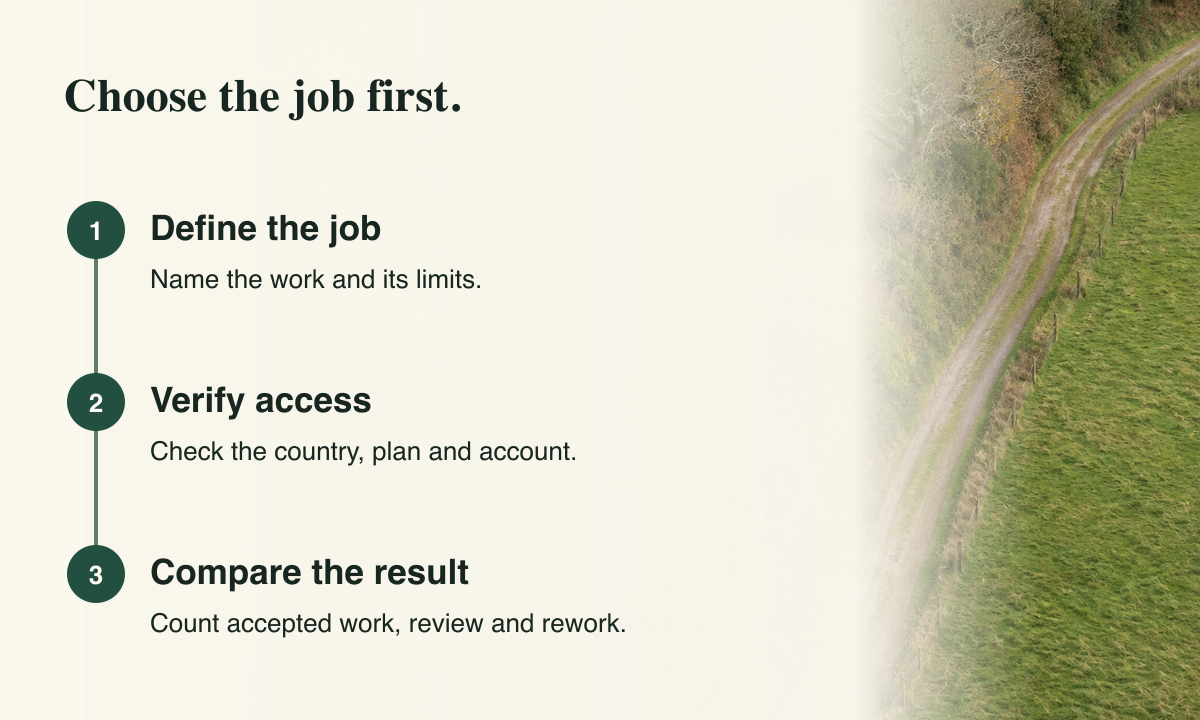
Take a recurring job: every Friday, tell me which supplier renewals need attention next week. Use approved copies of the register and contracts. Give the office assistant, the proactive agent and any viable European alternative the same evidence and deadline. See which can flag a missing notice period, show where it looked and tell you what it couldn't verify. No emails, commitments or live system changes in the first trial.
- Write the limits first. Name the data it can read, who owns the output and who can stop it. Define what needs a human decision. If it fails, the team needs to know before the deadline.
- Compare with how you work today. Use a few real or representative cases, including awkward ones. Count accepted results, missed items, false alarms, human checking time and rework. Include licence and operating costs. Don't score an attractive draft as a job completed.
- Decide what to do with the time. If you get an hour back, use it to move a renewal forward, clear a backlog or help a customer. If all you've done is create an extra Friday report to read, you've learnt something too.
- Check you can run it without that supplier. Keep the brief, examples, rules and evidence in a form you control. Practise switching to a backup or doing the work manually before you need to.
Give the managers time to learn on work that's worth doing, and tell the team what it gets out of it. If people have no reason to make the trial work, the licence won't solve that. For government, I'd back both ends: British and European compute and suppliers, and the skills to put them to work. The UK's AI Skills Boost and the EU's Apply AI Strategy are places to start. What I'd like to see more of is training managers to delegate and check real work, and procurement that lets credible alternatives compete on the same task.
So which AI would I choose? Show me the job, the rules and the person who carries the can. Then show me the work. The choice gets much easier after that.