I've usually got three machines running, with one or two agents on each. You'd think that with all that going on I'd be flat out. One of the things I do quite a lot now is wait.
Five minutes. After forty years of finding something to do whenever there's a gap, five minutes feels like an eternity. I can open my email, check another machine or start another agent. I can make myself look busy without having a particularly good reason to do any of it.
Or I can sit there and think about what I'm going to ask my agents, or my people, to do next. That might be the most useful thing I do all morning.
Am I doing something, or am I being effective?
At school it was, don't daydream. Get on with something. Later, being a working manager meant that when I wasn't managing people, I was doing other work. I understand why. There was plenty to do. But I got so used to filling the gaps that an empty five minutes began to feel like a problem in its own right.
Think about it. If I walk round an office and see someone looking out of the window, my first reaction might be to wonder what they're doing. I probably wouldn't ask the same question of someone typing furiously. But I don't know what either of them is getting done. You can be doing something all day and still fail because you're doing the wrong stuff.
Agents make that very obvious. I can keep all three machines occupied and get three well-written answers to the wrong question. The thing I needed to improve wasn't the number of jobs running. It was the question.
What happens if you leave the problem alone?
Researchers call it incubation: you get to grips with a problem, put it down for a while, then come back to it. In a 2012 experiment by Benjamin Baird and colleagues, people who did a simple task in the break improved more on originality scores for prompts they'd already seen than people who did a demanding task, rested or had no break. The same advantage didn't show up on new prompts. That's a good reason to give yourself a question before you step away. It isn't a reason to expect a brilliant idea every time you switch off.
Walking is worth a look too. A 2026 review of 23 studies with 1,036 participants, most of them students in further or higher education, found reasonably good evidence that walking helped with generating ideas. Across the 20 studies pooled for idea generation, the difference was 0.93 standard deviations, a sizeable difference on those tests, not a 93% gain in productivity. The evidence that walking helps people narrow down the options and find a solution was much less certain.
I like that distinction. A walk might help me think of another way to do something. Back at my desk I still have to check whether it will work. As for going to a gallery and looking at one painting properly, that's my suggestion, not what those studies tested. The point is to give yourself somewhere to go that isn't another inbox.
What to do with five minutes
Say I've asked two agents to compare a set of supplier renewals. While they work, I could open another task. Or I could ask myself what would make me change supplier. I might realise the next useful instruction isn't to make a bigger comparison table. It's to check which contracts have a notice deadline we could miss and which dates we still haven't verified. Same five minutes; a much better brief.
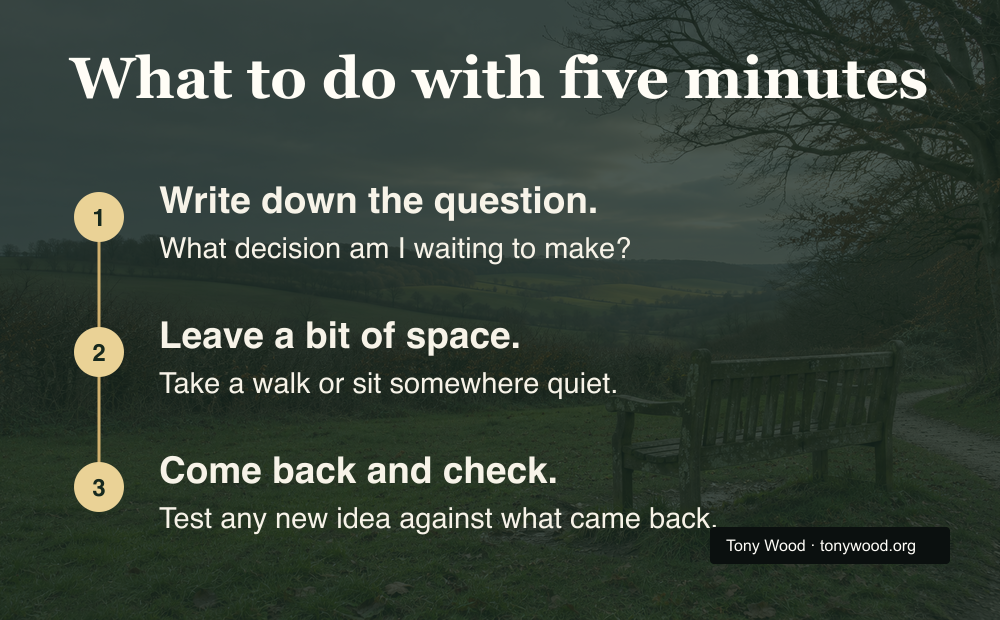
- Write down the question. What am I waiting for, and what decision does the answer need to help me make?
- Leave a bit of space. Walk outside, look out of a window, or sit somewhere quiet. Take five minutes if you've got five. You don't have to fill them with another job.
- Come back and check. Did I spot another option, an assumption to test or a better question to ask? Check it against what came back before you change course. Carry on if nothing has changed.
Sometimes you do have to switch tasks. In two experiments in a four-study paper by Sophie Leroy and Theresa Glomb, a brief plan for returning to interrupted work helped protect performance on the new task when people expected to be under time pressure on returning to the old one. My version is a line on a pad: where I stopped, what I'm waiting for and what I'll check first. It's easier than asking myself to remember where I was on three machines at once.
What I'd ask my team to do
I'd make it normal to say, ‘I want a bit of time to think about that before we start.’ I'd say it myself. And when someone comes back, I'd ask where they'd start now, or what they'd do differently, not how many minutes they spent thinking. We can look over time at whether our briefs are clearer and whether we have to redo less work. We don't need a pondering KPI.
Of course, if something's on fire or a customer is waiting for an answer you already have, crack on. If an agent is stuck, go and see why. Pondering isn't an excuse to leave someone in the dark. And not every break owes you an insight. Some days a walk is just a walk.
I've written before about the difference between getting better and getting the work done. This is the bit I still find hard: when the work is already going on without me, can I leave it alone long enough to think about what ought to happen next?
The next time you've got five minutes while an agent is working, try not filling them. Give yourself time to ponder.
Sources and notes
Baird and colleagues, Psychological Science, 2012: a laboratory experiment on creative incubation.
Thabane and colleagues, PLOS One, 2026: a review of walking and creative thinking.
Leroy and Glomb, Organization Science, 2018: research on interruptions and a brief plan for returning to work. The University of Washington's account describes the two experiments that tested the plan.