
Before you buy another AI influencer's prompt pack, I would do something else.
Open the tool. Give it a real job. Work with it.
That is my advice. Not because nobody can teach you anything useful, but because I think a lot of people are buying preparation when what they need is practice.
The secret prompt. The perfect skills library. The collection of Markdown files that will apparently make everything work. Another tip about saving a few tokens.
Come on. At some point, you have to use the thing.
You are not starting with nothing
When I open a modern AI tool, I am not starting with an empty box that needs an influencer to teach it what software development is.
My experience with these tools is that they already give me a great deal to work with. Coding, research, drafting, organising information: I can start a useful conversation about the work rather than spending the afternoon installing someone else's idea of how every job should be done.
That does not mean the model knows my company. It does not mean it understands my customers, has the right permissions, or knows what I count as a good result. And it certainly does not mean I can hand it consequential work and stop checking.
But those are the gaps I want to fill: my context, my requirements and my judgement.
I do not want to buy a generic set of instructions simply because someone has made them sound like the missing ingredient.
A Markdown file is not magic. It is not useless either.
There is a distinction here.
A useful instruction file might explain how your project is structured, where its records live, what needs approval and how you check the result. That is valuable context.
Codex officially supports project guidance through AGENTS.md. Claude Code supports persistent project instructions through files such as CLAUDE.md. These are ordinary ways to give the tools information about your work, not secret techniques you have to buy. OpenAI's project guidance; Claude Code's instruction and memory guide.
What I question is the assumption that importing a stranger's large instruction pack will automatically improve my setup.
Does it fit the work? Do I understand it? Is it still current? Does it conflict with the instructions I already have? Can I see what becomes better when I use it?
If I cannot answer those questions, I would rather start with a clear brief and add the instructions I actually need.
And an instruction saying "do not send" is not the same as a technical control preventing a send. Keep permissions and approval controls in place; prose alone is not a security boundary.
The harness can handle some of the choices too
The harness is the working environment around the model: the tools, files, connections, memory and controls that let it do something useful.
Some of the choices are moving into that environment as well.
For Grok Bot, the current documentation says Cursor manages model selection. There is no customer-facing model picker, and the serving mix can change without a guaranteed fixed set of vendors. Grok Bot's model-selection documentation.
That is managed selection, not a promise that every task uses the best possible model. Nor is it a guarantee that any particular provider will be used. If provider restrictions matter to your business, verify them before connecting your data.
My point is simpler: you do not necessarily have to become an expert in every model before doing your first useful piece of work.
Use the choices your tool actually offers. Learn what works for your tasks. If you want to go deeper into choosing models and effort, I have written about why I do not use my smartest AI for everything.
Start with one real piece of work
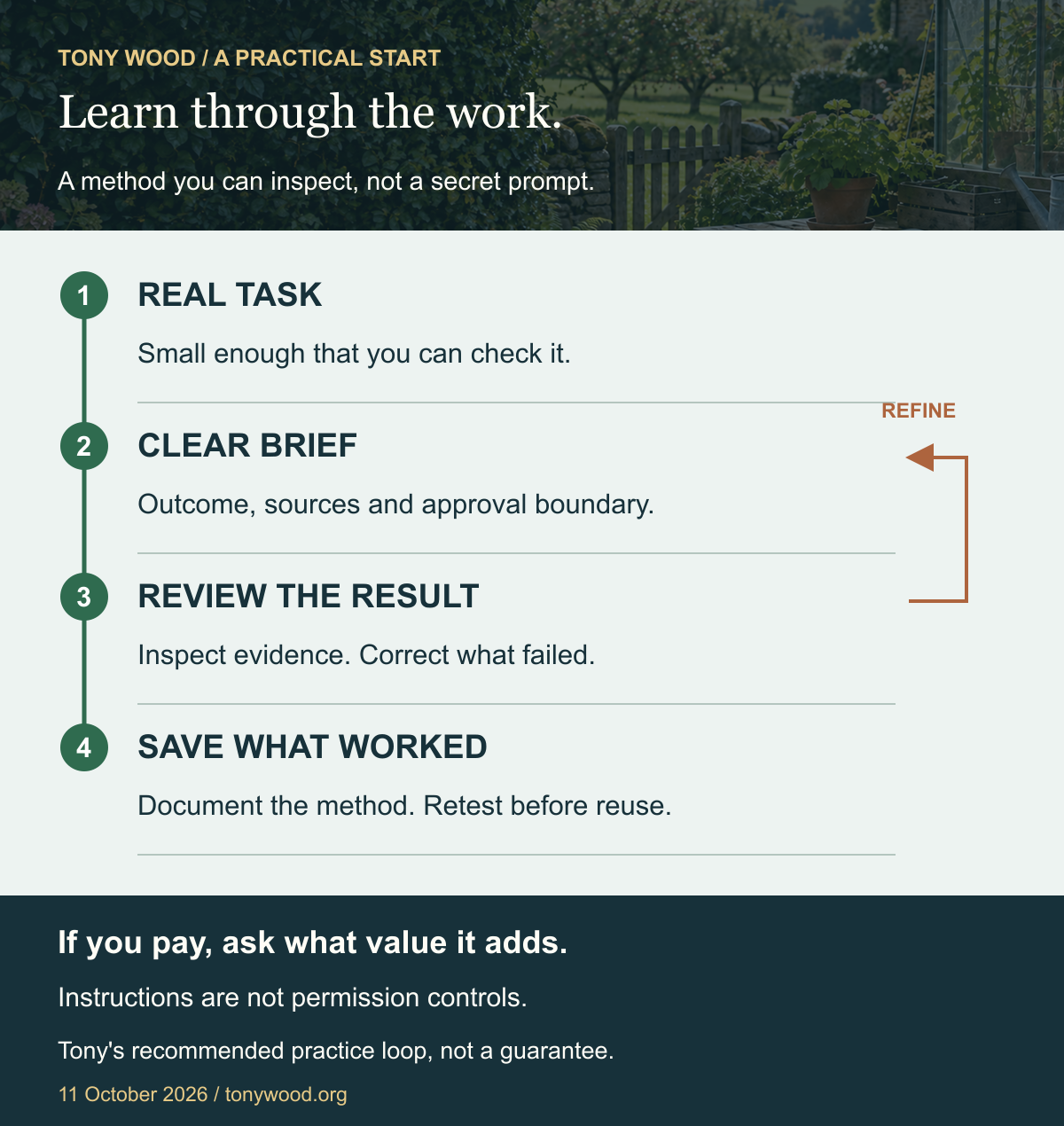
Pick something small enough that you can check it.
Perhaps you want to compare two public supplier proposals. Organise a set of documents you are allowed to use. Research a question and show the original sources. Improve a page on a test website. Draft a response without sending it.
Explain the outcome you want, what information it should use and where it should stop. Then watch what happens.
When it gets something wrong, work through it. Was the brief unclear? Did it lack information? Did it choose the wrong method? What evidence would let you tell the difference?
That is where I think the useful learning happens. You are learning how to work together, not simply learning a set of words to paste.
Once a method works, ask the tool to help you document it. Keep the inputs, steps, checks and approval points. Test it again before deciding it is ready for repeated use.
Grok Bot's own guidance follows that order: start with a one-time task, make the method reliable, save it as a skill, and then consider automation. Skills and routines documentation.
If you pay, pay for something useful
I am not against paying a good teacher, a specialist or someone who helps you get an integration working. There is a difference between selling a mystery and helping you solve a problem.
A course with feedback could be useful. So could a maintained workflow that fits your actual systems, or expert help in an area you do not understand.
Before buying a pack, I would ask:
- What specific problem does this solve for me?
- Can I see it work on a task like mine?
- Which tools and versions has it been tested with?
- Who maintains it when those tools change?
- Can I inspect its instructions and understand its access requirements?
- Am I paying for useful support and feedback, or just a folder of text?
If it genuinely helps, fine. But I would want that value to be demonstrated, not inferred from how confidently it is being sold.
And if the pitch is about saving tokens, look at the whole job: the cost, the result, the checking and the rework. A smaller token count is not a useful saving if the work is wrong or takes you longer to repair.
The important investment is practice
For me, the important thing is the time spent working with the tools. Asking questions. Giving them useful context. Looking at what they did. Learning to judge the result.
Not endlessly preparing to start.
You do not need to know everything before you begin. You do need a manageable task, appropriate access and a way to tell whether it worked.
I have training material on this site to help you get going, including using Grok Bot for simple tasks. Use it if it helps. The aim is to get you working, not to give you another pile of reading that keeps you away from the work.
So, before you buy another AI influencer pack, try the tools on something real.
Learn what you need. Keep what works. Get going.
Sources and notes
This is my view, based on working with these tools, not a study proving that every paid pack or course is ineffective. No particular influencer is being accused of dishonesty. Paid expertise can be worthwhile; my recommendation is to ask what it contributes to your work.
Product facts checked on 11 October 2026 against the official documentation linked above. Vendor documentation describes supported features, not guaranteed performance. The Grok Bot model-selection description does not establish that it uses every provider, or always chooses the optimal model for a task. Instructions and skills supply context and methods; they do not replace human judgement or access controls.