We keep hearing about Britain's debt. How much we owe. How much the interest costs. How difficult it is to get the numbers down.
And I found myself asking a fairly simple question.
If the government is paying interest to somebody, could that somebody be us?
Could people in the UK buy some of that debt and use it as an income? Not a clever trading scheme. Not a promise of free money. Just a way to understand the other side of a number we normally hear about as a problem.
The answer is yes. We can already do it. People can buy government bonds, called gilts, and government-backed savings products through NS&I. The interesting question is how those work, who receives the income now, and whether wider participation would be useful.
There is one important qualification: government-backed does not mean guaranteed to beat inflation. Nor does buying the debt make the country's bill disappear. This is a thought experiment and a researched explainer, not a recommendation to buy an investment.
Where does the government borrow from?
The government does not take out one enormous loan from a single bank. It raises money through a range of instruments, principally gilts, Treasury bills and NS&I savings. HM Treasury sets the financing remit; the UK Debt Management Office, or DMO, carries out the wholesale borrowing programme. HM Treasury's debt-management report explains the framework.
A gilt is a sterling-denominated UK government bond. You own a financial claim on the government: the payments set out in that bond's terms. You do not own a piece of a hospital or get a vote on the Budget. The issuer is the UK government, so this is not an England-only borrowing scheme.
A conventional gilt pays fixed interest, called its coupon, normally every six months. At its maturity date, the government repays the nominal amount, also called face value. That is not necessarily the amount you paid for it. The DMO's plain-English guide sets out these cash flows.
New gilts are sold through auctions and syndications, where a group of banks helps place an issue with investors. Dealers help distribute them, and investors can subsequently trade them. The bank involved in selling a bond is not necessarily the person who ends up owning it. Treasury's issuance framework describes those routes.
Who actually owns the debt?
The DMO's April-June 2026 review reproduces ONS ownership figures for Q1 2026. That date matters: the ownership table is older than the quarter in the report's title.
It records about £2.20 trillion of gilts at market value. This is a gilt-ownership snapshot, not the whole national debt and not its face value.
| Holder category | £bn | Share |
|---|---|---|
| Overseas | 739.1 | 33.6% |
| Insurance companies and pension funds | 443.4 | 20.2% |
| Other financial institutions and private non-financial corporations | 408.3 | 18.6% |
| Bank of England Asset Purchase Facility | 365.9 | 16.6% |
| Monetary financial institutions | 238.1 | 10.8% |
| Households and non-profit institutions serving households | 3.0 | 0.1% |
| Local authorities and public corporations | 1.0 | 0.0% after rounding |
| Total | 2,198.7 | 100.0% |
Source: DMO Quarterly Review, April-June 2026, page 3, using ONS data. Rounded rows need not add exactly to the total; 0.0% is not zero holdings.
Overseas is not shorthand for foreign governments. The table does not identify each ultimate overseas investor. Nor is the Bank of England's portfolio a household investment account.
And that 0.1% household figure does not mean ordinary people receive only 0.1% of the benefits. Pension and investment funds can hold gilts on people's behalf. NS&I savings are outside this gilt table. Direct ownership and indirect exposure are different things.
So the debt is not simply something Britain owes to outsiders. There is already a substantial domestic side to it.
What income would a gilt provide?
Let's use a deliberately simple, hypothetical example. These are not today's market prices, and I am leaving tax, dealing fees and accrued interest out for the moment.
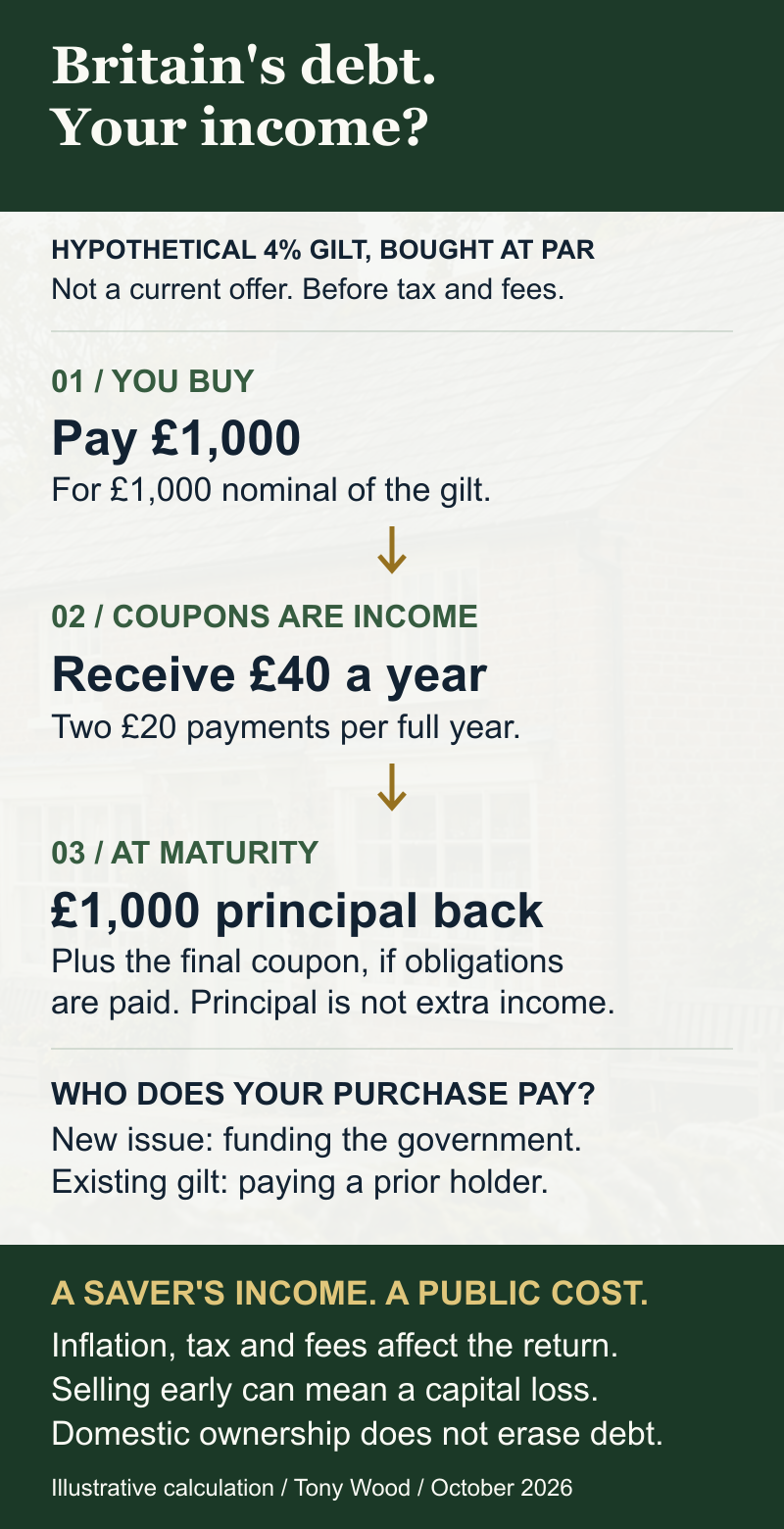
Suppose you buy £1,000 nominal of a conventional 4% gilt for £1,000. Buying at its face value is called buying at par.
| What happens | Amount | What it means |
|---|---|---|
| You buy the gilt at par | £1,000 | Your initial capital goes into the purchase. |
| First six-month coupon | £20 | Interest income. |
| Second six-month coupon | £20 | Another interest payment; £40 for a full year. |
| At maturity | £1,000 principal, plus the final coupon | Principal is returned capital, not an extra £1,000 of income. |
Yes, the coupon is income. That part of the thought experiment is quite right.
The number on the gilt is not the whole return
Now suppose somebody charges you £1,100 for exactly the same £1,000 nominal holding. The annual coupon is still £40. The principal repayment is still £1,000.
You receive about 3.64% of your purchase price in annual coupons, but that is only the current income yield. It ignores the £100 capital loss at maturity.
Yield to maturity takes the purchase price, remaining coupons and final repayment into account. It is not interchangeable with the coupon rate. The standard calculation also assumes coupons can be reinvested at that yield. The DMO explains the distinction.
That is why a gilt labelled 4% is not an automatic promise of a 4% total return on whatever you spend.
There is another small but important detail: purchases can include accrued interest owed to the previous holder. The headline, or clean, price is not necessarily the complete bill. HMRC's accrued-income guidance explains why that matters.
Can ordinary people actually buy them?
Yes. The DMO lists stockbrokers, banks and its own retail Purchase and Sale Service as access routes. Provider availability, minimum orders and fees vary.
The DMO service is administered by Computershare. Buying through it requires membership of its Approved Group, which is for UK residents who meet identity and source-of-funds checks. It is a secondary-market, execution-only service, not personal advice and not a way to set your own maximum purchase price. The official service description is worth reading before using it.
Access is not free. At the check on 4 October 2026, its published charge for purchases up to £5,000 was 0.7%, with a £12.50 minimum. That minimum makes small purchases relatively expensive. These are the service's charges, not a universal tariff for every broker. Check the DMO's current charges and terms.
And there is a distinction I would not want to gloss over. Buying a new issue provides financing to the government. Buying an existing gilt normally pays its previous holder. You acquire the right to future payments; you have not necessarily given the Treasury new money that day.
We already have government-backed savings
This is not a proposal to invent government-backed household saving from scratch.
NS&I already raises retail finance for the government. A Treasury answer to Parliament confirms that funds raised through these products flow to the National Loans Fund. That is the existing arrangement.
| Route | What you receive | Important distinction |
|---|---|---|
| Individual conventional gilt | Its coupons and nominal repayment at maturity. | A tradable investment, not an instant-access deposit. Purchase price matters. |
| NS&I Income Bonds | Monthly interest at a variable rate. | Easy-access savings, despite the name. The rate can change. |
| British Savings Bonds: Guaranteed Income Bonds | Monthly interest at a fixed rate for a fixed term. | Government-backed savings, not a market-traded gilt. Capital cannot normally be withdrawn before maturity. |
| Premium Bonds | A chance of prizes. | No interest and no guaranteed personal prize return. Not dependable income. |
The interest from Income Bonds and Guaranteed Income Bonds is taxable, although allowances may mean no tax is due. Premium Bond prizes are free from UK Income Tax and Capital Gains Tax. Government backing does not make every product tax-free.
As a dated example, NS&I's Income Bonds page showed 3.69% gross, 3.75% AER, variable, with a £500 minimum, when checked on 4 October 2026. Gross is the annual cash-interest rate before tax; AER expresses the equivalent with compounding. Interest is paid out monthly, so you should not treat the higher AER as cash automatically added to that account. Read the live product terms.
You can also own gilts indirectly through a fund. But a typical rolling bond fund is not the same as owning one gilt until a known repayment date. Its holdings change and its price can fall. The US securities regulator's bond-fund guide explains those general mechanics; it is not UK tax guidance or a product recommendation. Cash income also depends on the fund and share class: HMRC distinguishes income classes from accumulation classes, which retain and reinvest income rather than pay it out in cash.
Will the income be above inflation?
Not necessarily. That is the part I needed to check rather than assume.
A fixed nominal payment does not increase just because your food, rent or heating becomes more expensive. Here is the arithmetic for two hypothetical one-year returns, before tax and fees:
| Nominal return | Inflation | Real return |
|---|---|---|
| 5% | 3% | About +1.94% |
| 5% | 7% | About -1.87% |
Calculation: (1 + nominal return) / (1 + inflation) - 1. The same cash return can increase or reduce purchasing power.
Index-linked gilts address a different need. Their coupons and principal are adjusted using RPI, with a lag. But the price you pay still matters, and your own cost of living is not identical to that index. Index-linking is not a promise of a positive after-tax real return at any purchase price. The DMO's index-linked documentation explains the terms.
What are the other catches?
You may need the money before maturity. If you sell a gilt, you get its market price, which can be below what you paid. Longer-dated bonds can be especially sensitive to changing interest rates. Holding to maturity removes the need to accept that day's sale price, but does not remove inflation risk or the difference between your purchase price and the principal repaid.
Tax changes the income you keep. For an individual UK investor, conventional gilt interest is generally taxable savings income, subject to applicable allowances and wrappers. Gains on individual gilts are generally exempt from Capital Gains Tax. These are different rules, not a blanket tax-free return. HMRC's gilt-interest notes, savings allowances and gilt capital-gains guidance set out the distinction.
Do not assume a gilt fund inherits that exemption for its investors. HMRC treats unit-trust units under the normal share capital-gains rules. Gilt strips also have separate income-tax rules. This article is about ordinary gilts, not a tax strategy.
You need capital in the first place. £40 a year from £1,000 is income, but it is not a living. In the same 4%-at-par illustration, £10,000 produces £400 a year and £100,000 produces £4,000, before tax and costs. Anyone struggling to pay the rent may not have spare money to buy the asset.
That matters enormously if we are talking about benefits for the population, rather than another useful option for people who already have savings.
Would domestic ownership solve the debt problem?
No. It changes who receives some of the payments. It does not cancel the government's obligation.
From my perspective as a saver, the coupon is income. From the government's perspective, it is expenditure. If I also pay tax, I can be on both sides of that arrangement. But the people receiving the coupons and the people funding public services are not identical groups.
There is no national free-money machine hiding here. Borrowing more simply to pay more interest to ourselves would create an obligation as well as an asset.
Nor would shifting all savings into gilts necessarily make Britain better off. Money has other uses: homes, businesses, pensions and investment elsewhere. Ownership matters, but so does what the borrowed money enables us to do.
The Treasury's framework explicitly balances financing costs and risk, and NS&I's role includes balancing taxpayers, savers and the wider financial sector. Those objectives are already part of the policy.
The thought experiment worth having
So I would frame the question slightly differently now.
Not, "Why are British people forbidden from earning income on government debt?" We are not.
How do we make an existing opportunity easier to understand, easier to access, and useful to more people?
I would want clear explanations of the cash income, the price paid, the repayment date and the risks. I would want to know whether small purchases can be made without fees swallowing the benefit. And I would want people to understand what their pensions already own before assuming they are completely excluded.
Government-backed income products already exist. Perhaps the job is to make those routes clearer and better, rather than announce a new idea that looks suspiciously like NS&I with a different badge.
But I would also ask the harder question: how do households build enough savings to participate at all? An attractive income product is not much use to somebody who has nothing left at the end of the month.
I would not shut out overseas investors, force pensions to buy particular assets, or promise everyone an inflation-beating return. I would investigate broader voluntary participation, transparent costs and sensible savings access.
Because the original question still interests me.
We talk about debt as a bill. It is also an asset for whoever holds it. Could we do more to help people understand, and participate in, that other side?
Sources and boundaries
Research checked on 4 October 2026. Ownership uses the dated ONS series reproduced in the DMO's April-June review, not an estimate of today's holders. Rates and access terms can change. Worked examples are hypothetical calculations; they are not product quotes or promised returns.
The main sources are the DMO ownership review, gilt guide and retail documentation; HM Treasury's financing framework; NS&I's linked product terms; and HMRC's linked tax guidance. These are issuer, official-statistics, product-provider and tax-authority sources respectively. Their factual descriptions do not settle the wider policy question, which is my interpretation.
This is general financial education, not personal investment or tax advice. Whether any route suits you depends on your finances, access needs and risk tolerance. Read current terms and take qualified advice where needed.