
I often hear a version of the same thing from people considering CEO CF. They know they would benefit from coming. They want to get involved. But first, they need to get a few things sorted. They need more time. More headspace.
I understand that feeling. It was the situation I was in when I joined.
I was running my company and dealing with difficult relationships with other directors. The team was great. Communication with the other directors was challenging, and it was something I was dealing with every day.
I would have loved some extra time. I made time to go anyway.
The problems were why I went
I would arrive on Wednesday at around 5pm and leave on Friday at around 3pm. Less than 48 hours there, with travel on top. A little under two days in which to step outside the daily pressure and spend time with people who understood the responsibility of running a business.
For me, CEO CF was the one thing that kept me going.
I cannot put a neat financial return on that. But it explains why, when someone tells me they need more headspace before they can come, I want to ask where that headspace is going to come from.
If you are waiting until the difficult situation has resolved itself before you make space to think about it, you may be waiting for exactly the thing you need help to do.
Where are you getting your balcony time?
When you are running a company, there is always something in front of you. There is a conversation you need to have, a decision somebody is waiting for or something that has gone wrong and needs your attention.
It is easy to spend the whole week responding.
The leadership idea of getting on the balcony, associated with Ron Heifetz, is about gaining enough distance to see what is happening while you are involved in it. Harvard Business Publishing describes that shift in perspective. It is a useful way to think about the time I made for CEO CF.
Where are you getting that time? Where can you talk plainly about the situation, including the bits you have not worked out? Who can ask whether the problem you are trying to solve is actually the right problem?
You can read books, watch videos, attend conferences and work with consultants. All of those can help. A Challenge gives you something very particular: a group of peers working with you on the situation you are actually facing.
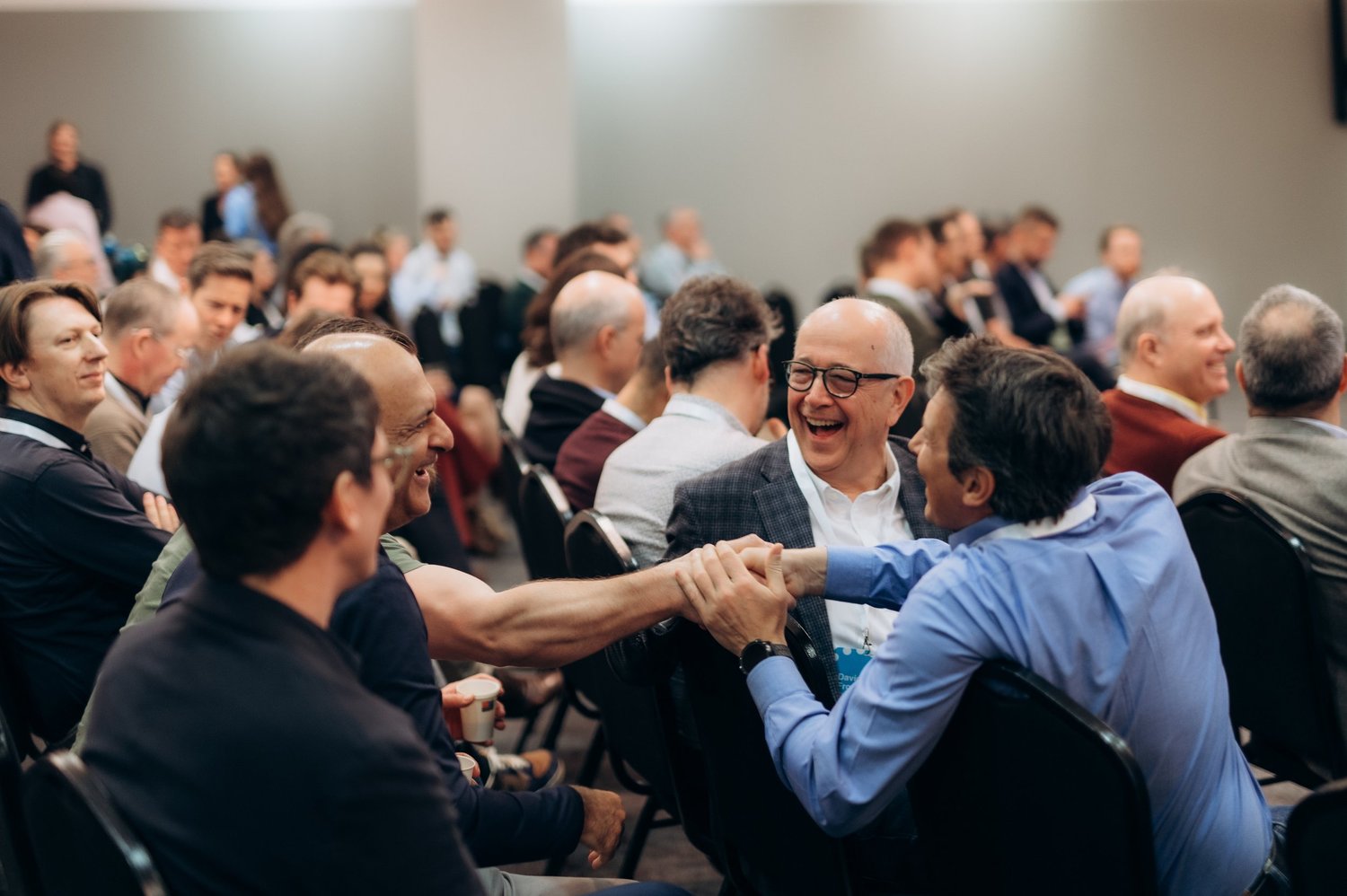
For 75 minutes, the room works on your Challenge
Picture 13 leaders in a room, including you. The 12 other people bring their experience of leading businesses, making difficult decisions and living with the consequences. Some may recognise a situation like yours. Others may see something you have stopped noticing.
You have prepared your Challenge. You explain what is happening. The group asks questions before moving into observations and recommendations. You then work through what you have discovered, what you have rediscovered and what you are going to do.
For those 75 minutes, your issue receives sustained attention. You have to participate. You have to let people understand enough of the situation to be useful.
That is what I mean by a sit-forward event. It asks something of you. It also asks something of everyone else in the room.
The group size varies: CEO CF describes its groups as typically eight–14 members, drawn from non-competing businesses across Europe.
What would that much CEO time be worth?
I wanted to test the thought that one Challenge could be worth €20K. If you tried to buy that much attention from experienced CEOs, what number would you put on it?
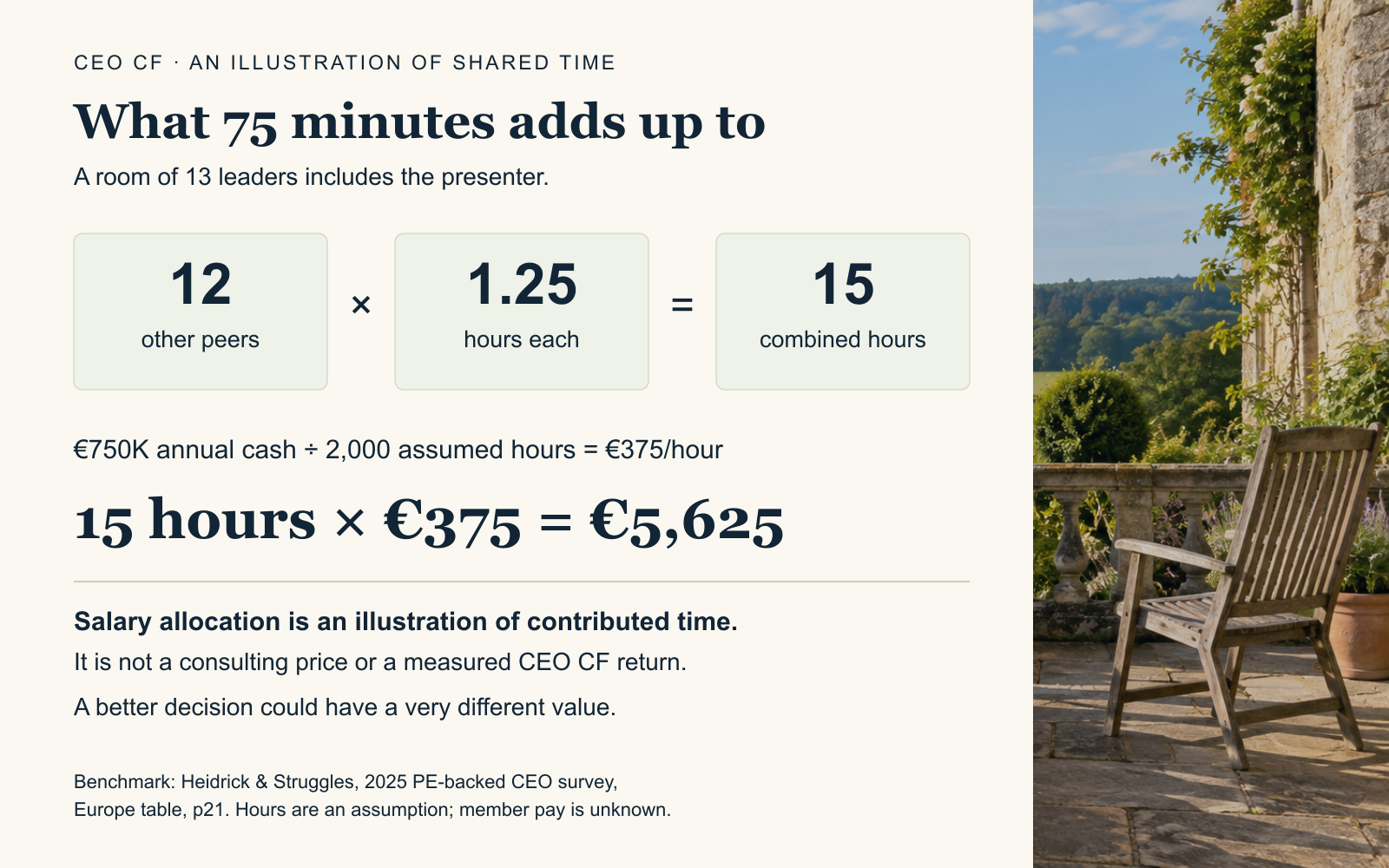
There is a useful benchmark in Heidrick & Struggles’ 2025 survey of private equity-backed CEOs. Its Europe table reports average total cash compensation of €750K. That describes the survey group; it does not tell us what CEO CF members earn.
Assume 2,000 working hours a year for the calculation. That allocates €375 to an hour. The 12 peers giving 75 minutes each contribute 15 hours of combined time.
12 peers x 1.25 hours x €375 = €5,625.
With 12 people in the room including the presenter, the equivalent is about €5,156. So this illustration gives roughly €5.2K–€5.6K. More working hours in the annual assumption would reduce those figures.
This is a way to picture the time being contributed. Compensation is not a consulting rate, and the calculation is neither a quote for hiring these people nor a valuation of the advice.
The €20K question is about the decision
The value to your business depends on what changes afterwards.
Consider a hypothetical €200K commitment. If a better decision avoided 10% of that cost, while delivering what the business needed, the difference would be €20K. That is an illustration of the arithmetic, rather than a reported CEO CF result.
A useful Challenge could help you examine a commitment like that. It could also help you recognise that the difficult conversation you keep postponing is the work you need to do first. There may be no immediate saving to count.
Could one Challenge be worth €20K? Potentially, if it changes a consequential decision enough to create that value. The result has to come from what you learn and do. You cannot establish it simply by adding up the salaries in the room.
For me, the more immediate value was having somewhere to work through the pressure I was under, with people who understood what it meant to carry that responsibility.
You also give your time
Pure peer collaboration works because everyone contributes. When somebody else brings their Challenge, you listen carefully, question your first reaction and think about what from your own experience might help.
That can make you examine your own business too. Somebody else’s situation may put a familiar problem in a different light.
Members come together in their groups three times a year, with contact between meetings. The relationship continues. There are people to come back to, to tell what happened and to ask for another perspective.
There is energy in being able to open up, contribute and spend time with people facing the responsibilities of leadership. My reason for going was never going to fit neatly into an hourly calculation.
Practice makes permanent
Doing something repeatedly can make it familiar. It can also leave your assumptions unexamined. If you keep responding to the same difficulty in the same way, being busy does not tell you whether you are making progress.
My line for this is:
“Practice makes permanent. CEO CF makes perfect.”
By “perfect”, I mean the ambition to keep improving your judgement through challenge, reflection and feedback. You still own the decision. You still have to act, see what happens and learn from it.
There are times when stepping away really is difficult. I know that. But if the reason you cannot come is the very problem you need help thinking through, it is worth looking again at the decision.
Ask yourself where you are getting your balcony time, who is challenging your thinking and how long you want to keep carrying this particular problem on your own.
If CEO CF sounds like the space you need, speak to the membership team about fit and an approved guest meeting. A guest attendance fee applies. Bring a real issue and be ready to contribute to somebody else’s thinking as well as your own.
You do not need to arrive with everything sorted. The unfinished problem is something you can bring with you.
CEO CF Pure Peer Collaboration
Sources and notes
This is my personal experience. The financial examples are illustrations, not measured CEO CF outcomes. Sources checked on 15 September 2026.