I love Greek yoghurt. I like Greek-style yoghurt as well. Put a pot in front of me and I am not going to start demanding its passport.
But it got me thinking about something much bigger. When I buy food, am I choosing what is useful for me, or choosing the story on the front of the packet?
And could an agent help me tell the difference?
Not by becoming my doctor. Not by shouting at me every time I open the fridge. By doing something quite ordinary: helping me understand what I am buying, what the alternatives are, and what might work better for the way I actually eat.
I think that could be a genuinely useful application of AI. Possibly more useful in daily life than another beautifully written paragraph about productivity.
The agent should read the back of the pot
Here is the sort of conversation I would like to have.
"I like this yoghurt. Can you compare it with the other ones in this shop? I want something I enjoy, with a decent amount of protein, at a price I can afford. Show me the evidence rather than repeating the marketing."
That is quite different from asking, "Is it healthy?" and expecting a red or green light.
Healthy for whom? In what quantity? As a replacement for what? Is this breakfast, a snack, or something I am spooning over a pudding?
The supermarket wants to sell me a product. I want an agent whose job is to help me understand it. Those interests can overlap, but they are not the same job.
What the yoghurt labels actually say
The useful distinction is not "Greek good, Greek-style bad". Greek-style yoghurt is still yoghurt. Nor is full-fat automatically better for us than low-fat.
Look at these three UK products. These are the values declared on the retailer's listings when checked on 12 October 2026, all per 100g.
| Product | Protein | Energy | Sat. fat |
|---|---|---|---|
| Sainsbury's Greek Style Natural Yogurt, 1kg | 4.0g | 102 kcal | 5.1g |
| FAGE Total 5% Natural Greek Recipe Strained Yoghurt, 150g | 9.0g | 93 kcal | 3.6g |
| FAGE Total 0% Natural Fat Free Greek Recipe Strained Yogurt, 450g | 10.3g | 54 kcal | <0.1g |
In this comparison, the fat-free strained yoghurt has more protein per 100g than either of the others. The two FAGE products both declare 3g of sugars per 100g and no added sugar. Removing fat has not, in these products, meant adding sugar.
And the Greek-style pot is not devoid of useful nutrients: its listing declares protein and calcium. It just has a different nutritional profile.
That does not make one brand the answer to everybody's breakfast. These are product labels, not independent tests or clinical trials. Recipes change, and the pack in your hand matters more than an old web listing.
But it does show why I want the agent to read the numbers. The name alone is not enough.
NHS guidance says yoghurt can provide protein and calcium, and advises lower-fat, lower-sugar dairy choices. That is a better starting point for general adult advice than insisting the full-fat pot must be healthier. Individual dietary needs can be different.
Feeling full is a real question, not a magic claim
One of the things I care about is whether food leaves me satisfied. I do not want breakfast followed by a hunt through the cupboards an hour later.
There is some research behind looking at a yoghurt's protein content. A 2014 randomised crossover study of 20 healthy women compared equal-calorie afternoon snacks. The high-protein yoghurt reduced afternoon hunger compared with chocolate and delayed the request for dinner compared with chocolate.
Crucially, that yoghurt contained no fat. The study was funded by General Mills, and it measured short-term responses, not years of health or weight change. It also did not compare full-fat yoghurt with fat-free yoghurt.
So I would not turn it into "full-fat Greek yoghurt keeps everyone slim". It supports a narrower, useful question: could a different snack help me feel satisfied? An agent should explain that distinction, not polish a small study into a miracle.
Make the better choice easier to do
The opportunity is not another list of things we are supposed to do. We have plenty of those.
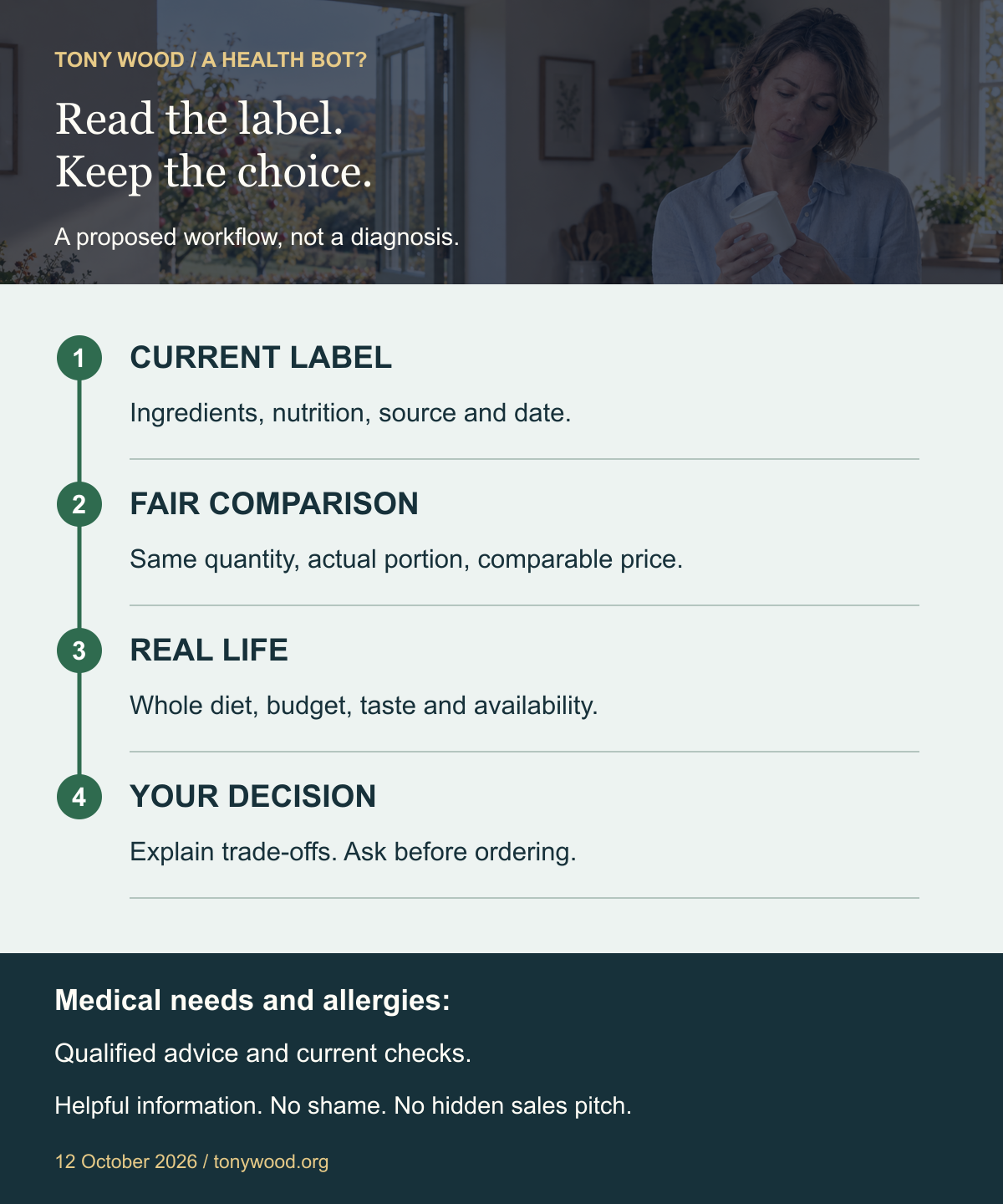
I would like practical help at the moment I am choosing:
- Understand the label. Explain protein, fibre, sugars, salt and saturated fat in plain English. Keep declared information separate from guesses.
- Compare fairly. Use the same quantity, then show what my actual portion would contain. Compare prices on the same basis as well.
- Find a realistic alternative. Something available locally, within my budget, that I might actually enjoy.
- Help me use it. Suggest a breakfast or a meal from what I already have, rather than sending me out to buy fifteen new ingredients.
- Learn my preferences with my permission. Remember that I dislike a particular texture or need a quick lunch. Do not make me explain that every week.
For fresh foods without a packet, it could use a recognised food-composition source and clearly label the figures as estimates. A photograph is not a laboratory analysis.
This is the agentic bit that interests me. An answer is useful. Helping me compare the actual products, prepare a sensible shopping list and use the food is more useful. Placing an order should still need my approval.
I am describing what I would want the system to do, not claiming that an existing bot reliably does all of this already.
What do the studies on chatbots show?
A 2023 systematic review in npj Digital Medicine found encouraging results for lifestyle chatbots. It included 19 trials, but 14 were rated low quality. The fruit-and-vegetable analysis was much smaller: four studies involving 289 people, including before-and-after studies as well as randomised trials.
That analysis suggested increased fruit and vegetable consumption. It is a reason to investigate conversational support, not a promise that every person will eat better after installing an AI app.
The underlying research was published before September 2022. It was not a test of today's general-purpose agents reading every label in a British kitchen, and it does not establish that they will make the UK population healthier.
So my answer is: there is promising evidence for some kinds of support. There is not yet evidence in these studies for the whole system I am imagining.
That is still worth exploring. We do not need to pretend the result has already happened to think the idea has potential.
A helpful companion, not the food police
I do not want a bot that labels every meal as virtuous or shameful. I want one that helps me make a choice I understand.
And I do not want us to suggest that everybody's health comes down to failing to read a yoghurt pot. The NHS describes several factors affecting weight, including genes, medicines, health conditions and difficulties being physically active.
A label-reading bot cannot create more money in the food budget or more time in a carer's day. Those are real constraints, not excuses for a machine to lecture someone.
My test would be quite simple: does it make a useful choice easier, affordable and repeatable? Or does it add another task and another reason to feel bad?
Where I would draw the line
I would start with general food information, not diagnosis or treatment. If the question involves a medical condition, a prescribed diet, pregnancy, a child's nutrition or an eating disorder, I would involve a qualified clinician or registered dietitian.
Allergies need particular care. Do not rely on a bot recognising a packet, a recipe or a "vegan" badge. Check the current ingredients and allergen information yourself and ask the food business when needed. The Food Standards Agency explains why vegan food is not automatically safe for someone with a milk or egg allergy.
I would also expect the bot to show its sources, flag missing information and leave uncertain numbers unknown. No invented protein figures to make the table look complete.
And before sharing anything personal, I would check where it goes, who can access it, how long it is retained and whether it is used to train models. The ICO treats identifiable health information as special category data. Comparing three public product labels does not require uploading your entire medical history.
Finally, tell me if the recommendation earns somebody a commission. I want to know whether I am getting a comparison or being sold another pot.
Could this help us become healthier?
I think it could help. Not by magically fixing public health, but by making useful information available when we need it.
Someone standing in a shop. Someone looking in a cupboard. Someone who likes their breakfast and would happily make a small change if they understood the options.
That is the part I find exciting. You do not have to become a nutrition expert to ask a better question.
"I like this. What is actually in it? Is there something that suits me better? And can you help me make that work?"
Give me an agent that can help with that, without guessing, shaming me or quietly selling to me, and I would be interested.
Keep the yoghurt. Improve the understanding.
Sources and notes
Research and UK product listings checked on 12 October 2026. The linked retailer pages are declared product information, not independent testing. The snack study and lifestyle-chatbot review support limited findings, not a universal diet recommendation. This article is general information and a proposed use of AI, not personal medical advice.
For the full context, see the linked NHS dairy guidance, the snack trial's methods, limitations and funding disclosure, and the chatbot review's full paper.