I've been a manager for about 35 years. People have asked me whether my team is on target, what went wrong and when a job will be done. I can't remember being asked, month after month: What have you changed about the way you manage, and how do you know it's better?
Then I set up some AI improvement loops. Some of them run every 15 minutes. And there I was, asking an agent a version of the question I'd rarely been asked myself: how could you do this better next time?
Think about it. If I asked a team to change how it works every day, I'd soon hear about it. Quite rightly. But if I asked people what they'd noticed each day and gave them time to test one useful change, that would be a different conversation. I think I've been confusing two things: how often we look, and how often we change what we do.
Getting better at the job isn't the same as changing it
Say your team is forever chasing missing information. Over time, people get very good at chasing it. They know who to call, what to say and which request needs a nudge. They have learnt a skill. But the next person still gets the same incomplete handover.
In 1977, Chris Argyris distinguished between correcting an error within the existing rules and questioning the rules themselves. My version is: do we get better at chasing, or do we ask why we're accepting work that isn't ready in the first place? Sometimes the rule is there for a good reason. At least now we've asked.
There is a good reason managers don't ask this all day. The work still has to get done. People need time to learn a way of working well enough to tell whether it works. In James March's model of organisational learning, doing more of what already works brings nearer-term returns, while trying alternatives can pay off later and less predictably. Give all your time to experiments and you can't deliver. Give it all to delivery and you might get very good at doing the wrong thing.
What a 15-minute AI loop actually does
People use "recursive self-improvement" for very different things. An AI rewriting an answer is revising a piece of work. A system carrying a verified change into its next run is improving a workflow. A system improving the method it uses to make those changes, and then using that improved method in the next round, is closer to what I mean by recursive. A timer isn't recursion. Nor does a revised checklist mean the underlying model has learnt anything new.
The evidence on even the narrower problem is mixed. Self-Refine found gains from models critiquing and revising their own outputs on a set of tasks. Huang and colleagues found that asking the models they tested to correct their own reasoning without external feedback often failed and could make answers worse. Different tasks, different methods, different results. Neither tells me that the agent which wrote a proposal should be the only judge of whether it's better.
At a much larger scale, METR's November 2026 assessment found that Anthropic's models appeared to be improving faster on well-specified tasks. METR judged that AI use likely accounted for much of that acceleration, but by how much, and whether it extended to broader tasks, was uncertain. Anthropic redacted most of the evidence METR found most informative. The assessment did not establish that AI was making major, fully autonomous contributions to core model training.
An agent can load an approved new checklist on its next run. It doesn't have to unlearn a habit that took years to build. That's an advantage, but it guarantees only which version was supplied, not that the agent will follow it reliably. I'd let the loop notice a pattern and propose one change. I'd have someone other than the proposer score both versions on fresh cases against criteria we'd agreed in advance. And I'd keep the decision to change the live process, the pass criteria or the agent's permissions with an accountable person. No new evidence? Keep the current version.
Quiet isn't the same as healthy
When you're stretched as a manager, the noisy bit gets attention. I understand why. But a quiet team might be doing fine, or somebody might be patching up the same problem every Thursday so it never reaches you. A quiet risk register just tells you what's made it onto the register.
In Amy Edmondson's study of 51 work teams at one manufacturing company, psychological safety was associated with behaviours such as asking for help, seeking feedback and discussing errors. It doesn't mean every quiet team is frightened. It does give me a better question than "Any issues?": What's one thing you had to work around this week that I'd never see on the dashboard? Then listen to the answer and tell the person what you did with it.
There's a useful example in aviation. NASA runs a voluntary, confidential reporting system to surface safety concerns. It warns against using those reports to infer how common a problem is. I'd apply the same caution at work. More reports could mean more problems, or it could mean people have started telling you about the problems they already had. Sample ordinary work as well as escalations, and ask the people who receive the work whether it really got easier.
What would I put on a learning dashboard?
I'd keep the delivery KPIs. Then I'd add a small team-level record: What did we expect? What actually happened? What will we test? What did we decide, and did it hold up later? A meta-analysis of after-action reviews found that in the training and review settings studied, objective records of what happened and matching the review to the individual or team doing the work helped. I'd use real examples and keep the debrief separate from performance appraisal.
Take that incomplete handover. As an example, let an agent flag missing information without sending anything or blocking the work. Agree what counts as an eligible handover and compare similar cases before and during the trial. At the end, I'd put three things side by side:
- Delivery: Did more handovers reach the receiving team ready to use? Show the number and the total, not just a percentage.
- Learning: What did we change because of the test? Could a colleague who wasn't part of it use the new rule on a fresh example? Did the same missing-information problem recur less often in a later set of comparable handovers, including ones nobody escalated?
- Cost of the change: How much review time did it add, how often were the flags wrong, and did any urgent work wait longer?
That's the logic of the Institute for Healthcare Improvement's small tests of change: predict, try, study, decide, and use the result to design the next test. NHS England's guidance on looking at performance over time is a reminder not to rewrite the process because one week went red. If there are only a few cases or the case mix changed, say the result is inconclusive and keep looking. And if the trial saves no time but tells us why a plausible idea doesn't work, write that down too. It might save somebody else trying it again next month.
One change a month would be a start
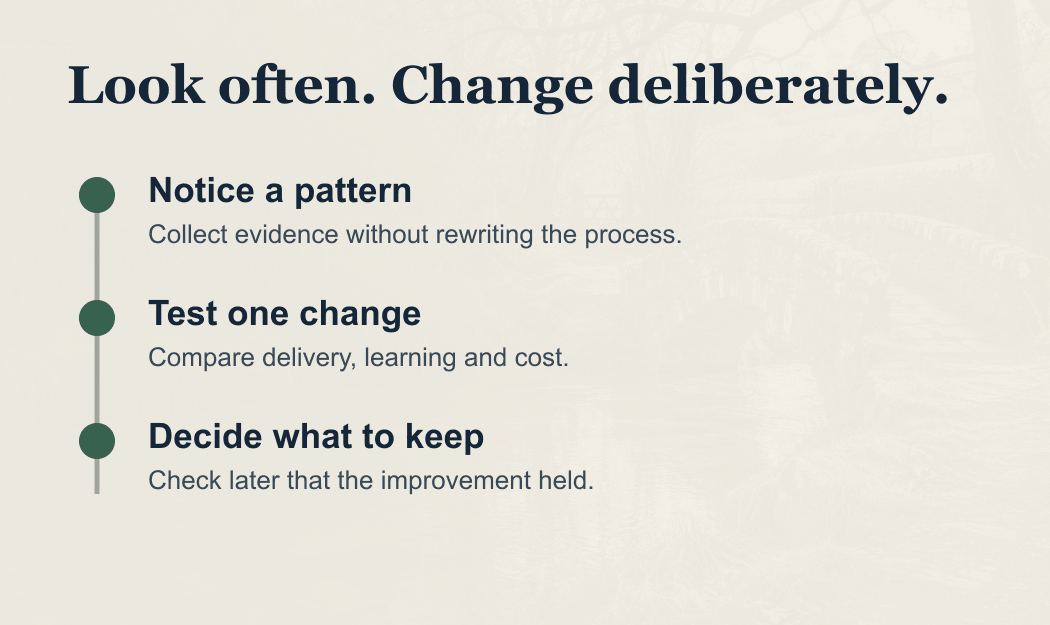
I'd let an agent collect evidence as often as the work warrants, with urgent risks going through the existing escalation route. With people, I'd use a short weekly conversation to pick one issue and agree what a meaningful improvement would look like. Once a month I'd give the team time to decide what to keep, change or stop. Those are starting points, not targets. A slow process needs longer to show a result.
And I'd put myself on the list. Perhaps I've become very good at answering the same question from five people. Am I helping them, or have I made them wait on me for a decision they could make with a clearer brief? I'd try changing my part first. Next month I'd ask them whether it helped, and what got worse as a result.
I don't need my team to become different people every morning. I do need us to be able to point to something we now do better, show what convinced us, and tell the next person what we learnt. If I can't do that, perhaps we just had another busy month.
Related: Managers Already "Vibe Code". We Call It Management. and The Problem of the Human in the Loop.