Abstract
Modern memory is distributed across email, documents, drives, CRMs, wikis, databases, local files, chat systems, second brains, memory palaces, project systems, public websites, private notes, and agentic runtimes. The dominant technical response is often to centralise, index, embed, or synchronise. Those approaches can improve retrieval, but they do not by themselves answer the harder human and governance questions: where does authority live, what is safe to connect, what has changed, what has aged, what should be acted on, and what should remain protected?
Woodlands proposes a model of connected memory in which a coherent memory is understood as a tree and a purposeful field of memory is understood as a wood. The model is not a replacement for existing stores. It is a navigation, identity, source-authority, boundary, ageing, calibrated judgement, and visualisation layer over native systems.
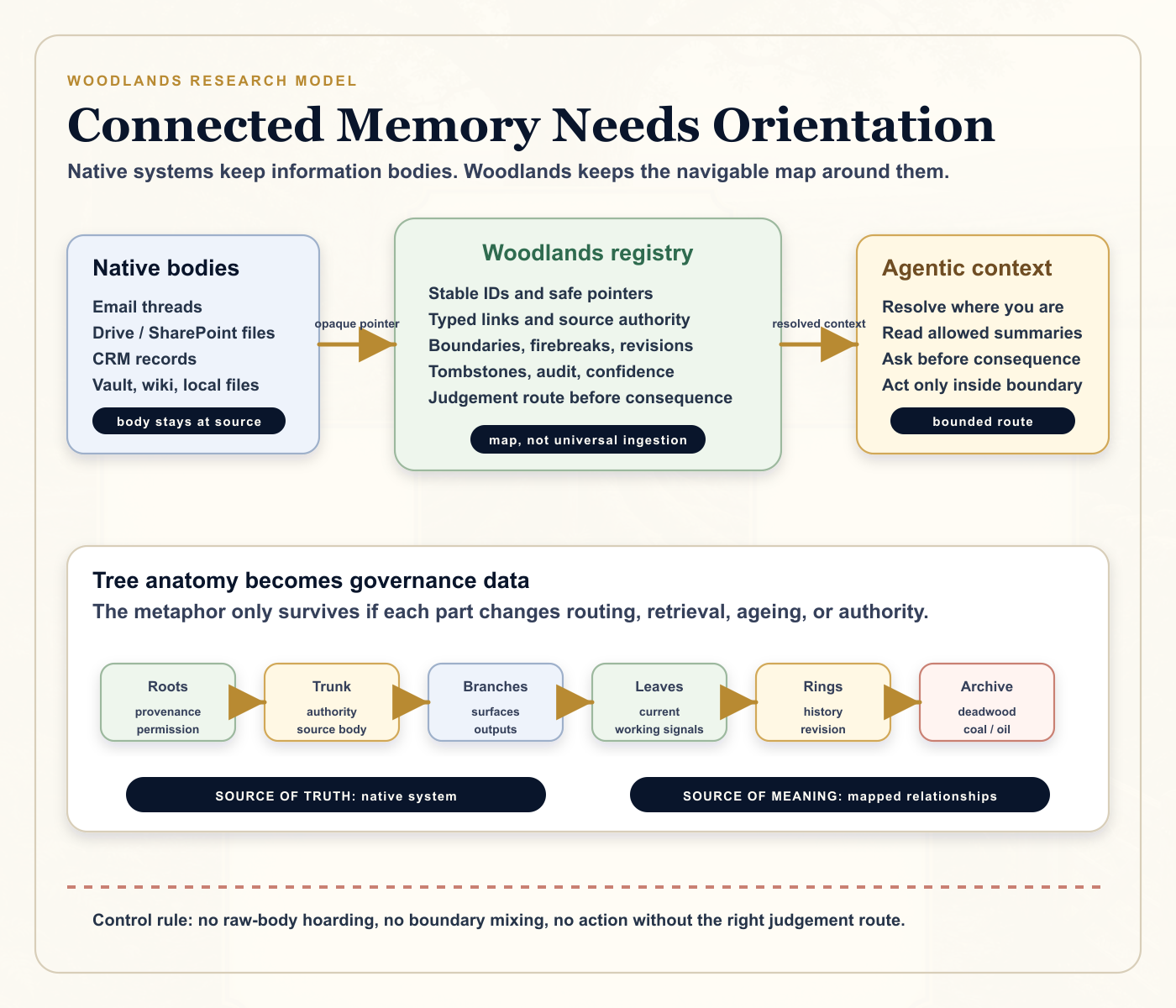
The core storage rule is simple: systems keep bodies; Woodlands keeps identity, meaning, pointers, boundaries, links, judgement metadata, revisions, tombstones, and audit.
The judgement layer has become sharper since the first draft. Judgement is not only a gate that stops unsafe use. For consequential memory, it should also record confidence level, uncertainty, decision context, consequence class, fair process, blind-spot checks, oversight, and Core Purpose. That turns judgement into calibrated decision support rather than a claim of certainty.
Keywords: connected memory; agentic AI; knowledge management; distributed cognition; memory palace; MemPalace; mind maps; provenance; personal information management; context ownership; Woodlands; calibrated judgement; fair process; human oversight; boundary objects; FAIR metadata; knowledge graphs; Zettelkasten; information foraging.
Reader Guide
What to look for
- Authority: notice where the paper separates an entry route from the source of truth.
- Boundary: look for firebreaks before personal, company, client, tenant, or public memory can mix.
- Judgement: watch for the shift from a simple go/no-go gate to calibrated decision support.
- Shape: treat diagrams, tables, and bullets as orientation aids. They show how the model behaves, not just what it is called.
- Action: ask what a person or agent is allowed to do after reading a memory object.
1. Introduction
The practical problem Woodlands addresses is not that people have nowhere to store information. The problem is that useful information now lives in many useful places at once.
A course may involve a calendar invitation, a teaching plan, a Google Drive folder, readings saved in a reference tool, a personal note in a second brain, a route in a memory palace, a wiki page, email commitments, and later a reusable lesson. A company decision may involve a CRM record, a SharePoint board pack, a source-of-truth register, a process card, an email thread, a meeting transcript, and a judgement route. A public idea may begin as a note, become a blog post, turn into a paper, become agent-readable context, and later seed another project.
Each system has a reason to exist. The difficulty is not simply fragmentation. It is loss of orientation.
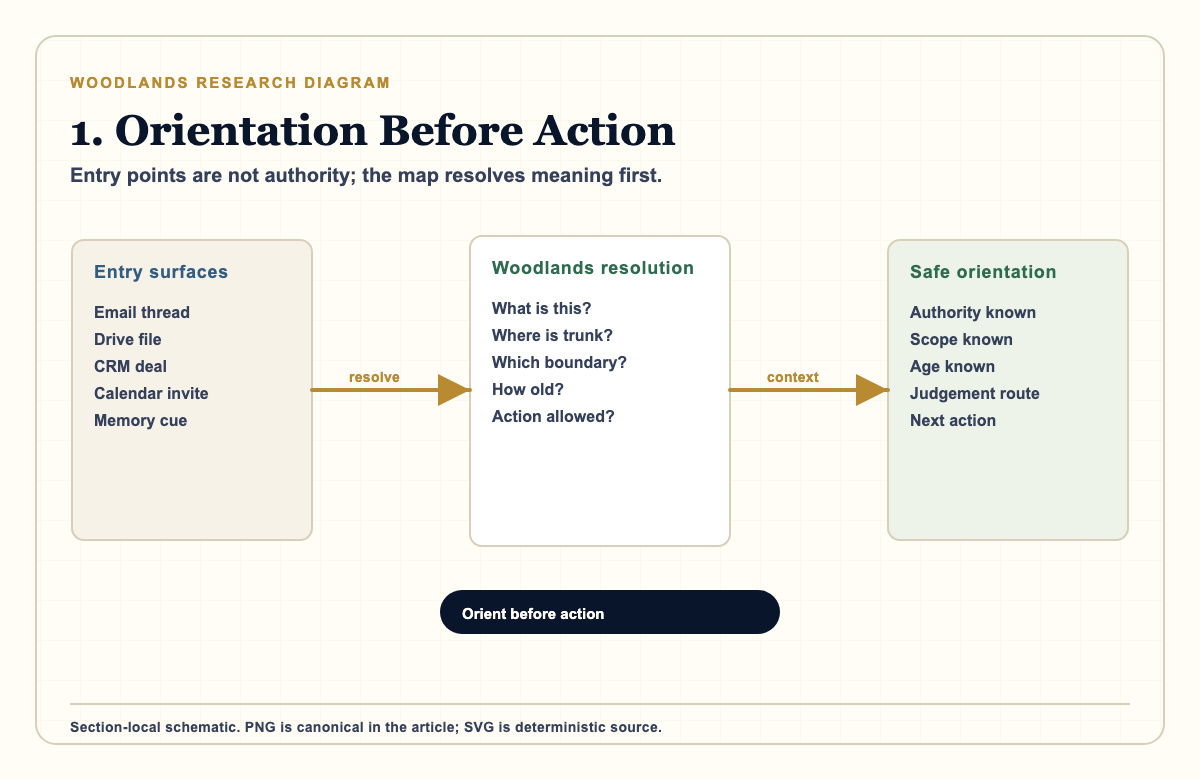
When a person or agent enters memory through one surface, they need to know what the thing is, where authority lives, what system owns the body, what boundaries apply, what language the source system uses, what is current or stale, what related material is nearby, and what action is now allowed.
Memory becomes useful when it is rooted, connected, bounded, aged, and actionable.
Woodlands treats those orientation questions as first-class design requirements. It gives the problem a language: roots, trunks, branches, leaves, rings, seeds, deadwood, coal, oil, tree families, wood shapes, firebreaks, Rosetta Stone translations, typed links, and judgement routes.
The important refinement is that judgement should not be treated only as a red light. When a memory has consequence, Woodlands should also ask: how strong is the evidence, what remains uncertain, who has been heard, who is missing, what blind spots have been checked, who has meaningful oversight, and what Core Purpose the memory or decision is meant to serve?
The naming is not meant to be cute. It is meant to stop a dangerous flattening. An email is not always the source of truth. A folder is not always a boundary. A summary is not always authority. A memory palace cue is not evidence. A CRM deal is not a generic note. A public page is not permission to access private context.
2. Research Problem
Most information environments optimise for storage, search, or collaboration inside a product boundary. That creates several recurring problems.
Entry points are mistaken for authority. Email may be where a person arrives, but the authoritative trunk may be a signed agreement, a course plan, a board paper, a CRM account, or a governance record. Search engines and agent tools can make the first thing found feel like the right thing. Woodlands deliberately separates entry route from trunk.
Source languages are flattened. Email has threads and senders. CRMs have companies, deals, contacts, owners, stages, activities, and associations. Drive has files, folders, comments, revisions, and owners. SharePoint has sites, libraries, pages, lists, permissions, and inheritance. A memory layer that ignores those native languages loses meaning.
Raw ingestion creates risk. Copying everything into one store may make retrieval feel easier while weakening permission boundaries, provenance, privacy, auditability, and source authority. This matters more when agents can summarise, copy, connect, and act at speed.
Memory does not age cleanly. Old ideas, superseded documents, repeated exceptions, and dormant lessons can be clutter or value. Systems need a way to distinguish deadwood, coal, and oil rather than treating every old object as equally live or equally irrelevant.
Agentic systems make the problem sharper. Agents do not merely retrieve. They plan, transform, propose, and sometimes act. That means a memory layer needs judgement routes and judgement calibration, not just retrieval routes.
Woodlands is proposed as an answer to this set of problems. It is not a universal database or a raw export layer. It is a method for making distributed memory navigable while respecting native authority, permissions, and meaning.
3. Theoretical Anchors
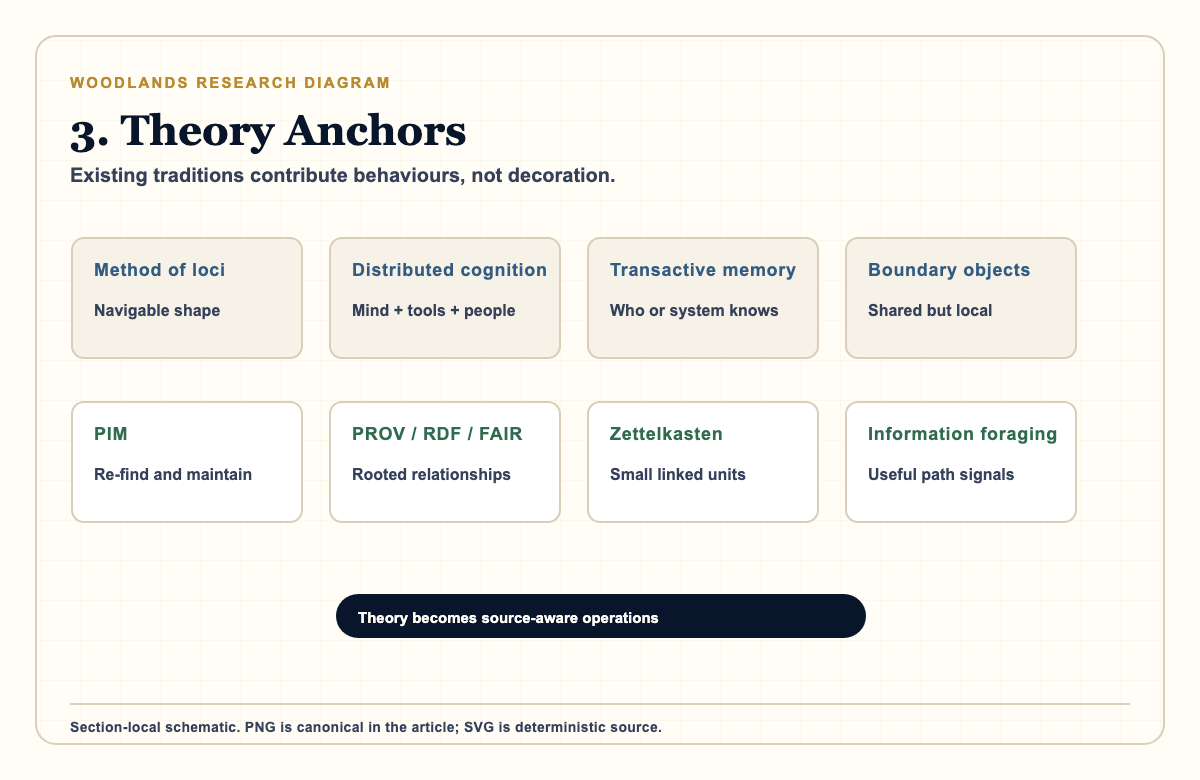
Woodlands is a new applied model, but it stands on several existing traditions.
3.1 Method of Loci, Memory Palaces, and MemPalace
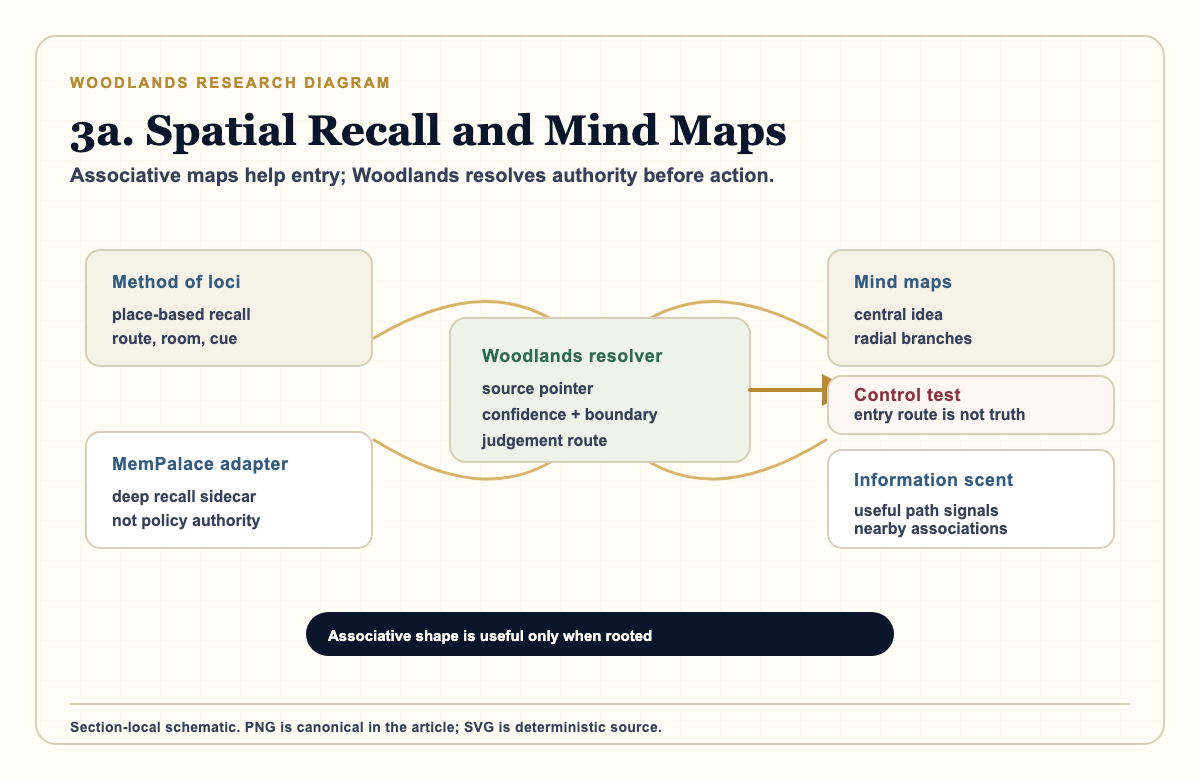
The method of loci, often described through memory palaces, uses spatial structures to support recall. A person places remembered items along a route or inside imagined locations, then retrieves them by moving through that spatial layout. Contemporary survey work describes the method as a long-standing mnemonic practice with continuing research interest.
Woodlands borrows the insight that memory improves when it has a navigable shape. It differs in scope. A memory palace is primarily a mnemonic method for recall. Woodlands is a cross-system orientation model for people and agents. It can use memory palace locations as entry routes, but it also tracks source authority, boundaries, provenance, typed links, ageing, and judgement.
Open-source project note
MemPalace is a useful concrete test case because it turns the memory-palace idea into a local-first recall surface for agents. In Woodlands terms, it should be treated as an optional recall sidecar or entry-route adapter: excellent for finding and re-entering context, but not automatically the canonical store, policy gate, source authority, or audit record.
3.2 Mind Maps and Radial Thinking
Tony Buzan's mind map philosophy adds a second visual anchor. A mind map starts from a central idea and grows outward through branches, keywords, images, colour, association, and hierarchy. That matters for Woodlands because many memory problems are not linear. A person may reach the useful thing through a cue, a project, a place, a person, a phrase, a recurring exception, or a half-remembered association.
Woodlands should therefore support mind-map-like views for exploration and sensemaking. But the map must not become theatre. Associative branches are useful only when they remain tied back to source pointers, confidence, boundaries, and judgement routes. A beautiful mind map that hides weak provenance is still unsafe.
3.3 Distributed Cognition
Distributed cognition argues that cognition is not confined to the individual mind. It is spread across people, tools, artefacts, representations, and practices. Edwin Hutchins's Cognition in the Wild is a central reference point here.
Woodlands applies this insight to modern operational memory. A memory may be distributed across a person, a document, a CRM, a calendar, a folder, a meeting habit, an agent, and a governance process. The Woodlands map does not pretend all cognition lives in one store. It asks how the distributed system can remain legible.
3.4 Transactive Memory
Transactive memory describes how groups remember by knowing who knows what. The group does not need every person to hold every fact. It needs a reliable system of expertise, location, trust, and retrieval.
Woodlands extends this idea into hybrid human-agent environments. The question is not only "who knows this?" but also "which system owns this?", "which route is safe?", "which source is authoritative?", and "which judgement gate applies before action?"
3.5 Boundary Objects
Star and Griesemer's boundary-object work explains how different social worlds can cooperate around artefacts that are stable enough to maintain identity but flexible enough to support local interpretation.
Woodlands treats maps, trees, Rosetta Stone mappings, and context cards as boundary objects. A CRM user, board member, agent, developer, teacher, and future version of the organisation may all need different local language. The Woodlands identity and relationship layer gives them a shared point of orientation without forcing all systems into one vocabulary.
3.6 Personal Information Management
Personal information management research has long studied how people keep, organise, maintain, retrieve, and re-find information across emails, files, web pages, documents, tasks, and notes.
Woodlands inherits that concern with re-finding, but adds source authority and safe agentic action. The question is not only "can I find it again?" It is "when I find it, do I know what it is, whether I can use it, what it is rooted in, and what it connects to?"
3.7 Provenance, RDF, and FAIR Metadata
W3C PROV gives a standard family for expressing provenance: the entities, activities, and agents involved in producing or influencing something. RDF provides a graph-based model for statements and relationships. FAIR gives a discipline for making data and metadata findable, accessible, interoperable, and reusable.
Woodlands does not require any one of those standards as its internal storage format, but it adopts their discipline. Roots are the human-facing expression of provenance. Typed links stop every relationship collapsing into "related". Metadata can remain useful even when raw bodies cannot or should not be copied.
3.8 Zettelkasten and Information Foraging
Zettelkasten practice respects small, connected, reusable notes. Information foraging theory describes information seeking as a cost-benefit activity guided by cues, paths, and information scent.
Woodlands takes both lessons seriously. A useful wood should make the next path visible. From any entry point, the user should be able to see the trunk, roots, nearby branches, active leaves, firebreaks, and possible next actions.
3.9 Tonywood.org Thinking
Woodlands also grows from Tony Wood's existing public work. "Your Context Is the Next Lock-In" frames context as the strategic layer in agentic work. "Sharing Is a Language" argues that software systems create shared vocabulary. "Don't Build a Hoarder-Build a Learner" argues that agentic memory should not store every scrap of operational noise. "When Do We Need Judgement?" gives the operating gate: consequence changes the required standard. "Stop Paying The Data Tax" supports owned, structured, agent-readable context.
Woodlands is one way of making that context usable without pretending every source can be safely absorbed into one pile.
4. Woodlands Thesis
A memory system should not be judged only by how much it stores or how quickly it retrieves. It should be judged by whether it helps a person or agent answer seven orientation questions:
- What am I looking at?
- Where does the authoritative body live?
- What roots prove, constrain, or weaken it?
- What is connected to it?
- What boundaries or firebreaks apply?
- What is its lifecycle state?
- What judgement or action is required now?
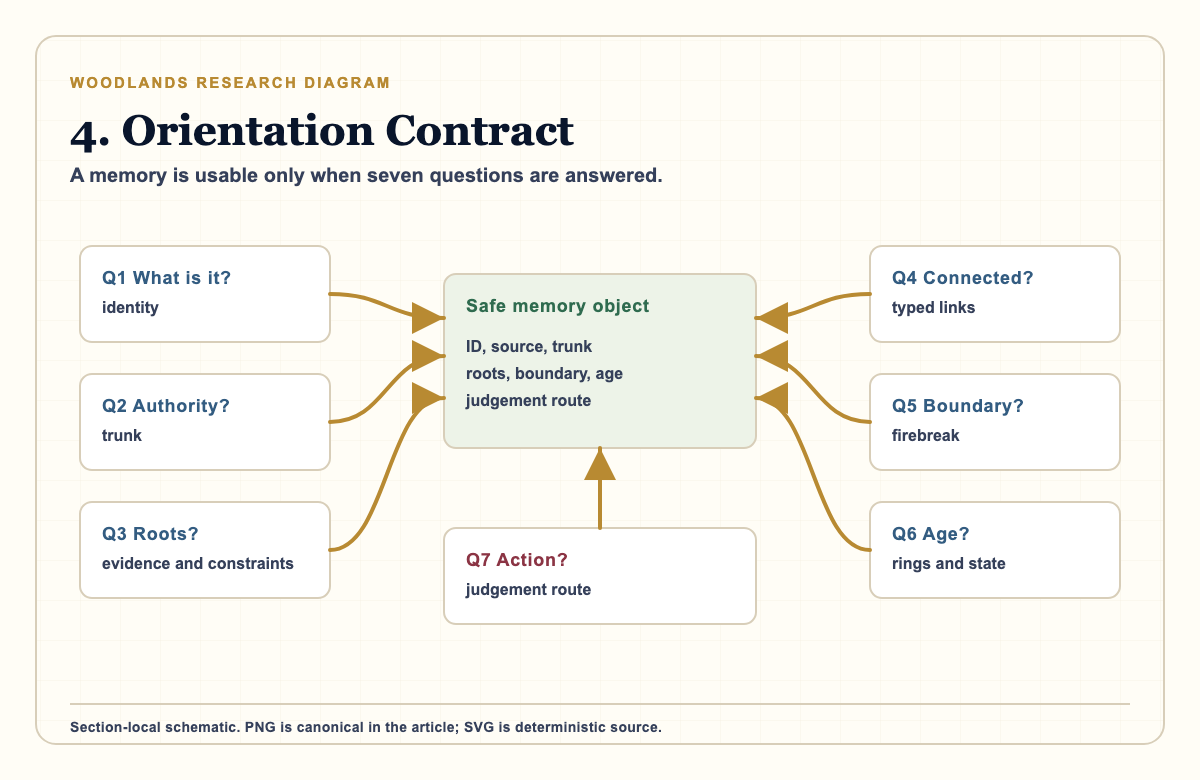
The theory turns those questions into a practical vocabulary.
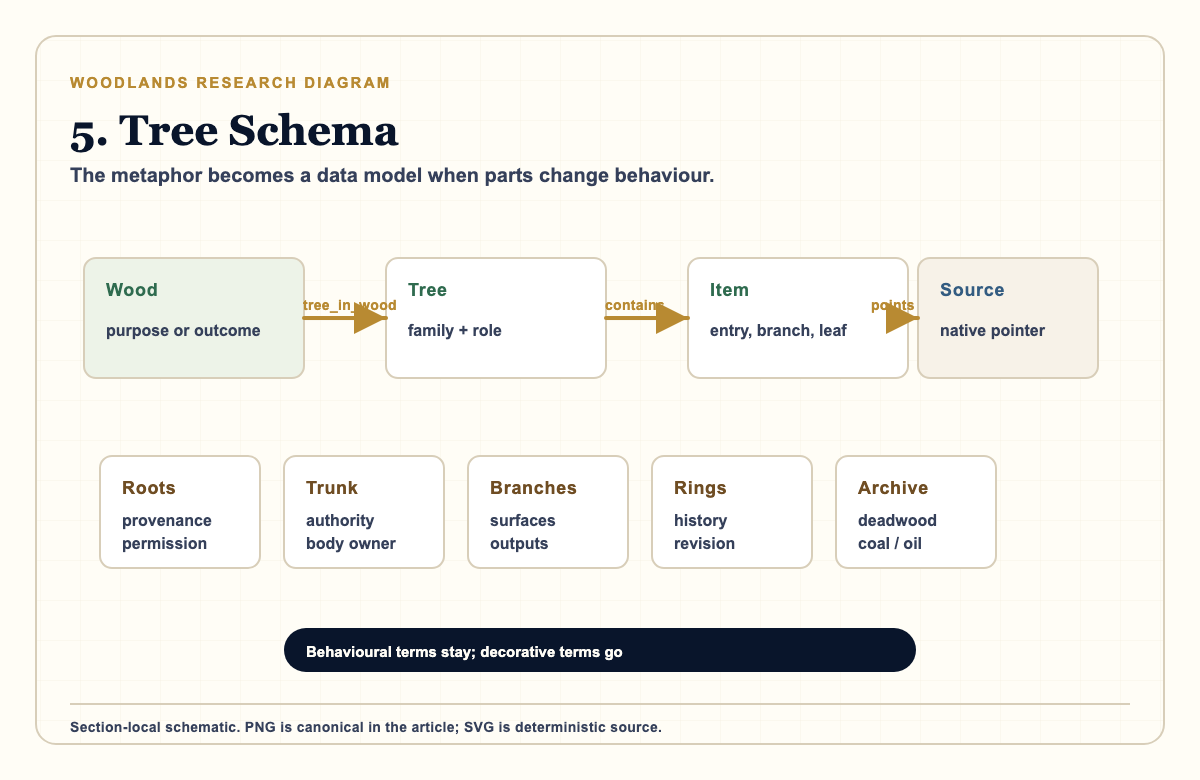
A memory is a tree. A project, domain, course, company, idea, or outcome is a wood. A system-specific object is often an entry point. The trunk is the authoritative source. Roots are provenance, evidence, permissions, and hidden context. Branches are visible connected surfaces. Leaves are active details. Rings are chronology and revision history. Seeds are reusable future value. Deadwood explains old shape. Coal is compressed deep archive. Oil is dormant archive value that can be carefully extracted for new work.
The trunk is not always the entry point. This is one of the model's most important distinctions. A user may enter through an email, but the trunk may be a signed document. A user may enter through a memory palace cue, but the trunk may be a course plan. A user may enter through a CRM deal, but the trunk may be an account record or board-approved source.
5. Conceptual Model
5.1 Tree Anatomy
| Tree part | Meaning in Woodlands |
|---|---|
| Roots | Provenance, source trail, permissions, hidden dependencies, tacit context, evidence, confidence, and constraints. |
| Trunk | The authoritative source or main store for the memory. |
| Branches | Visible connected surfaces such as wiki pages, summaries, templates, source cards, examples, and outputs. |
| Leaves | Current working details, live notes, recent signals, active decisions, and short-lived context. |
| Rings | Chronology, revision history, version history, decision trail, and maturity. |
| Seeds | Reusable ideas, prompts, patterns, exercises, lessons, and future projects. |
| Deadwood | Superseded material that is no longer active but still explains why the memory has its shape. |
| Coal | Stable, compressed deep archive that is no longer normally active. |
| Oil | Dormant archive value that may be extracted carefully for a new purpose. |
5.2 Tree Families
The first taxonomy should be deliberately small. If a family name does not change behaviour, it is decorative and should be pruned.
| Tree family | Role |
|---|---|
| Oak | Durable institutional memory and long-term truth. |
| Willow | Processes and workflows. |
| Silver Birch | Ideas, synthesis, theory, and exploration. |
| Hazel | References, citations, and saved sources. |
| Rowan | Risk, caution, judgement, and guardrails. |
| Ash | Projects, actions, delivery, and execution. |
| Beech | Teaching, courses, learning, and curriculum. |
| Holly | Protected, private, confidential, or tenant-scoped memory. |
| Yew | Legacy, archive, closure, deadwood, coal, and oil transition. |
5.3 Wood Shapes
Woods are purposeful arrangements of trees. A grove is a small bounded outcome such as a course, workshop, proposal, meeting, or project. A copse is a temporary cluster of active work. An orchard is a repeatable output-producing system. An arboretum is a comparative collection, taxonomy, or reference set. Ancient woodland is a mature domain with deep history and archive layers. A nursery holds early ideas, prototypes, seedlings, and experimental concepts. A clearing is a decision point where several paths become visible. A firebreak is a boundary that prevents unsafe mixing.
Woods should normally be named by purpose or outcome. Time periods, people, and domains can be useful names only when they clarify the boundary.
6. Storage Method: Identity Without Ingestion
The technical centre of Woodlands is identity without ingestion.
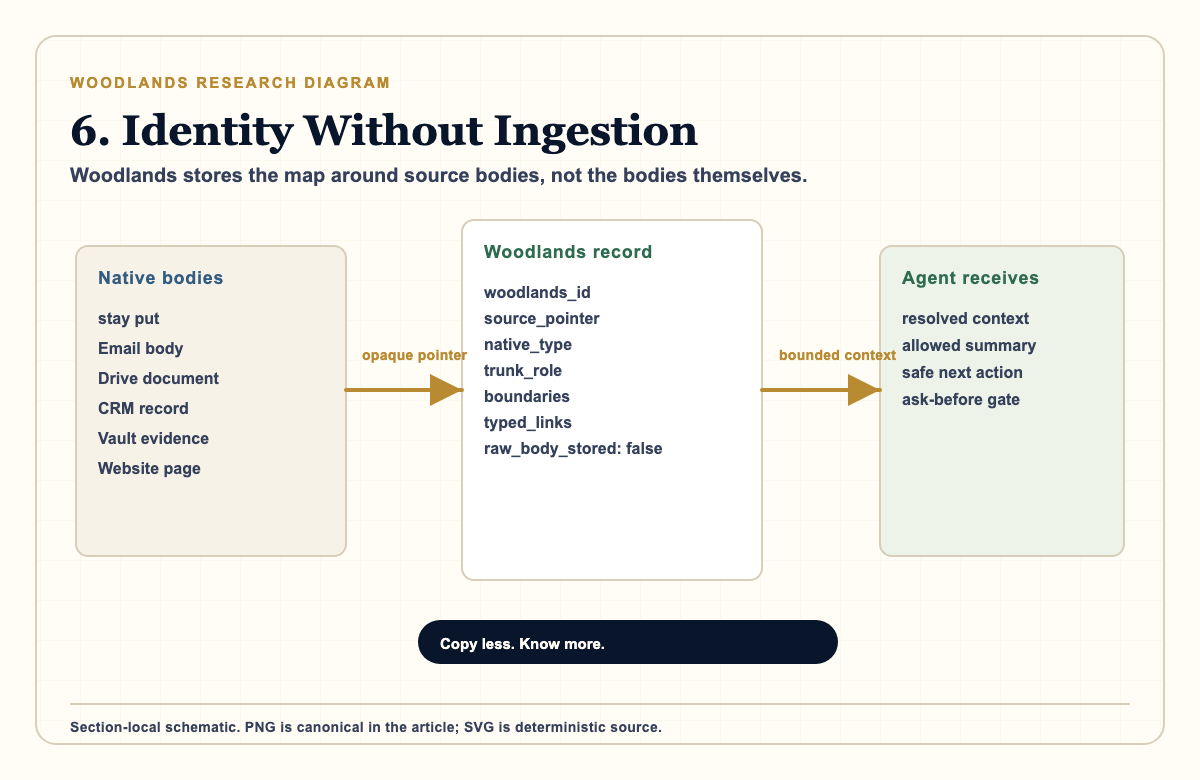
Woodlands should not try to become the place where all information bodies live. Native systems keep their bodies. Wiki keeps explanatory pages. Second brain systems keep approved personal durable memory. Memory palace tools keep spatial recall cues and routes. Reference systems keep saved sources. Process systems keep reusable methods. Vaults keep company, client, tenant, board, governance, and evidence-backed truth. Email, chat, and calendar keep entry points, signals, actions, and time anchors. Drive, SharePoint, and local files keep documents, folders, revisions, and evidence. CRMs keep relationship, deal, company, owner, and activity context. Websites keep public canonical context.
Woodlands stores the map around those bodies:
- stable Woodlands IDs;
- safe source pointers;
- source ecosystem and native type;
- tree and wood assignment;
- trunk and root meaning;
- boundaries and firebreaks;
- judgement route and judgement calibration;
- archive state;
- typed links;
- revisions, tombstones, and audit events;
- validation state.
The default body rule is:
raw_body_stored: falseThis keeps Woodlands from becoming a hoarder. It maps meaningful items only: items that help retrieval, source authority, provenance, boundary, judgement, action, ageing, or reuse.
6.1 Woodlands IDs
Proposed ID shapes are:
wood.<scope>.<slug>
tree.<scope>.<slug>
item.<scope>.<slug>.<short_id>
source.<ecosystem>.<opaque_ref>
rel.<short_id>
IDs should be stable, lowercase, machine-safe, and free of secrets or unnecessary personal data. Source-native IDs should be preserved as pointers, not treated as the only cross-system identity.
6.2 Typed Links
Woodlands uses typed relationships rather than vague association. Core relationship types include belongs_to_wood, tree_in_wood, has_trunk, rooted_in, branches_to, current_leaf_of, references, derived_from, contradicts, supersedes, blocked_by_firebreak, requires_judgement, ages_into, and seeds.
This gives the memory map enough semantics to support validation, visualisation, CRUD operations, ageing, and judgement. A backlink says "there is a connection". A typed link says why the connection matters.
6.3 Validity
A mapped memory is Woodlands-valid only when it has a stable Woodlands ID, at least one safe source pointer, a clear source ecosystem and native type, a trunk or explicit reason that the trunk is unknown, provenance roots or restricted confidence, sensitivity and source scope, firebreaks where boundaries touch, judgement routes where consequence appears, and at least one relationship to a wood, tree, source, or archive state.
That creates three levels of validity:
- Parseable: the record is syntactically valid JSON or XML.
- Schema-valid: the record conforms to a declared schema.
- Woodlands-valid: the record is safe and meaningful inside the Woodlands model.
The distinction matters. A memory can be well-formed and still unsafe.
6.4 Consequential Judgement Metadata
Ordinary mapped items should stay light. A personal note, a harmless reference, or a simple recall cue should not need a heavy governance packet. Consequential items are different. If a memory may affect money, legal commitment, customer promise, public statement, board advice, protected context, agentic tool use, write-back, or cross-boundary use, then the judgement layer should carry more than a route.
The richer judgement fields are deliberately safe metadata, not source bodies:
- confidence level: unknown, signal, supported, corroborated, decision-ready, or durable;
- uncertainty note: what is not yet known or not yet stable;
- decision context: the decision or use the memory is being prepared for;
- consequence class: none, low, moderate, high, or critical;
- fair process: stakeholders heard, stakeholders missing, and whether dissent was recorded;
- blind-spot checks: named risks in the reasoning, such as status quo bias or missing stakeholder voice;
- oversight: whether oversight is meaningful, who has mandate, whether they can intervene, and when review happens;
- Core Purpose: the human value, organisational mission, or public good this memory or decision is meant to serve.
This should be warning-first in early implementations. Missing richer judgement detail should warn the user that the item is not yet decision-ready. It should not automatically make every legacy or low-consequence record invalid. Cross-boundary use without a firebreak remains a failure; raw body storage remains out of bounds.
7. Rosetta Stone Translation
Woodlands needs a Rosetta Stone because every ecosystem speaks its own language.
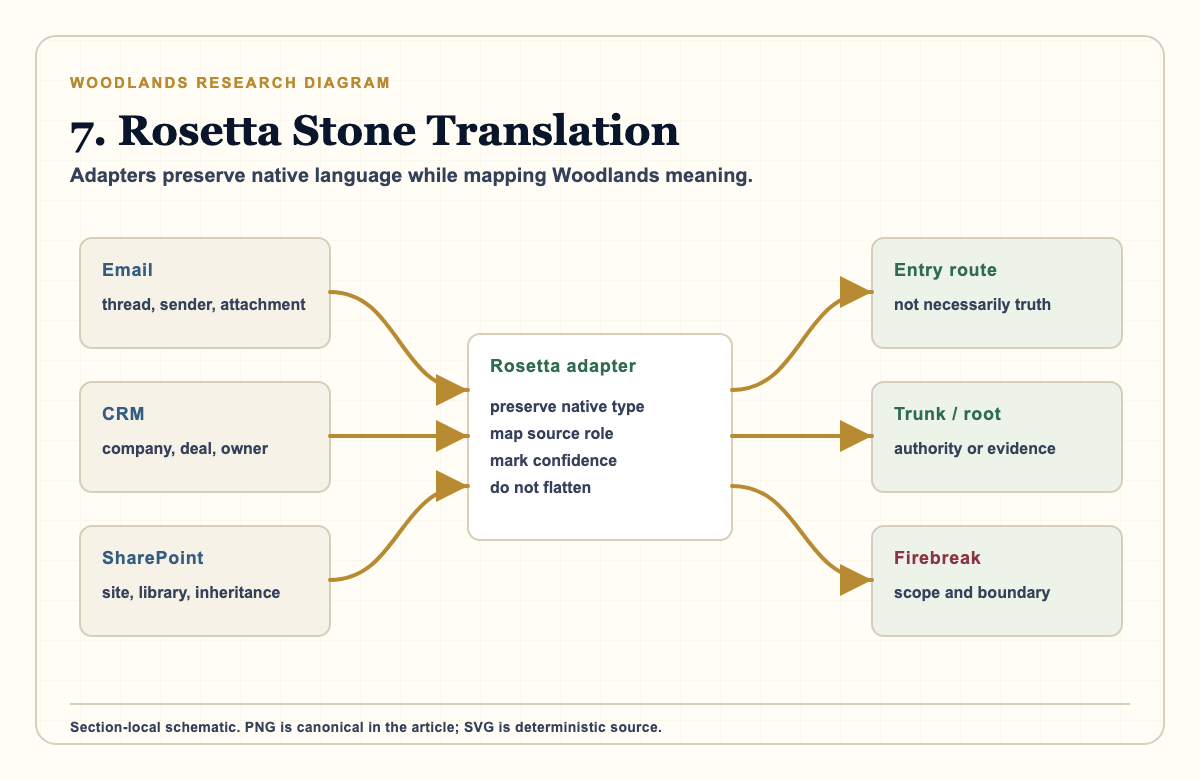
| Ecosystem | Native language | Possible Woodlands meaning |
|---|---|---|
| Thread, sender, recipient, attachment, subject | Entry point, Ash leaf, Hazel root, Rowan signal | |
| Google Drive | File, folder, owner, comment, revision | Trunk, branch, ring, source pointer |
| SharePoint | Site, library, list, page, permission inheritance | Protected trunk, root, firebreak, board-safe branch |
| CRM | Company, contact, deal, stage, activity, owner | Oak company memory, Ash action tree, Rowan risk branch |
| Wiki | Page, section, backlink, revision | Explanatory branch, concept trunk, public or internal surface |
| Process system | Process card, method, template, room | Willow trunk, reusable method, not company truth |
| Vault | Record, tenant, company, evidence, board truth | Protected Oak or Holly trunk or root |
| Memory Palace / MemPalace | Route, room, location, cue, wing, drawer, diary | Entry route, recall anchor, deep-recall sidecar, not source truth |
The Rosetta Stone prevents two common failures: flattening all source objects into generic "content" and mistaking a convenient entry point for an authoritative trunk.
It also protects source-system meaning. A CRM deal should not become a generic note. A vault fact should not become a process method. A memory palace cue should not become source truth. A public blog page should not imply access to private operational context.
8. Growth, Ageing, and Judgement
Woodlands must be able to grow. It should admit new sources, ideas, concepts, trees, woods, and words. But growth without judgement becomes sprawl.
The growth loop is: notice, classify, root, judge, place, link, review, and mature.
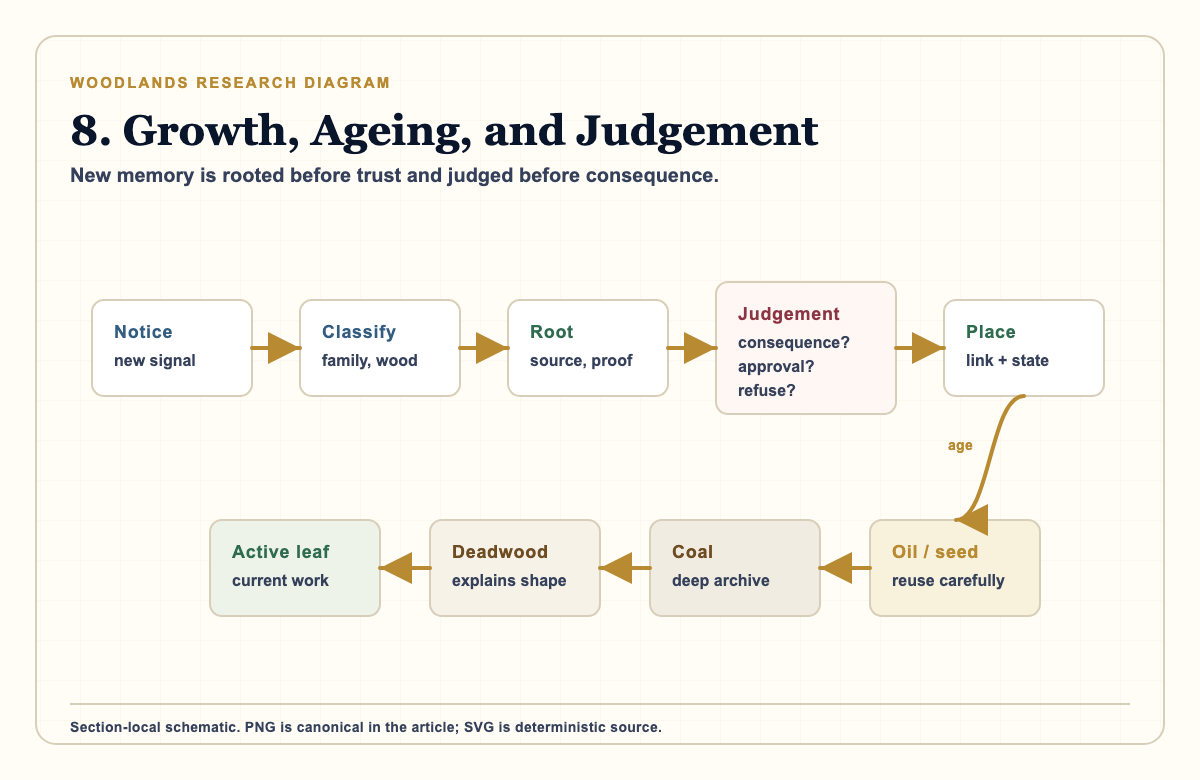
This makes Woodlands more than a filing method. It becomes a practice of knowledge stewardship. Knowledge is welcomed when new sources and ideas arrive; rooted before it is trusted; translated before it crosses systems; judged before it creates consequence; protected before it crosses boundaries; pruned when it becomes noise; aged when its role changes; harvested when old knowledge becomes newly useful.
8.1 Judgement Routes
Judgement should not run all the time. It should appear when consequence appears: action, disclosure, commitment, cost, policy, customer promise, people impact, board advice, protected material, or public claim.
A judgement route can decide to plant a new tree, graft a branch, hold a seed, apply a firebreak, ask for provenance, ask for approval, archive as deadwood, compress to coal, extract as oil, or refuse. But judgement should also explain the basis of the decision: confidence, uncertainty, stakeholder process, blind spots, oversight, and Core Purpose.
Judgement cannot bypass source permissions, merge tenant boundaries, promote an interpretation into truth, publish private material, or make durable memory without review.
This is where Woodlands connects with the Head, Heart, Gut, Spine model. Head asks what evidence supports the memory. Heart asks who is affected and whether dignity, trust, and privacy have been respected. Gut asks what feels anomalous, pressured, fearful, or too neat. Spine asks whether there is authority, permission, and boundary clarity. Core Purpose sits above those checks as the canopy question: what is this for?
8.2 Rubrics
Rubrics help Woodlands decide what belongs where. Early rubrics should include data safety, trust calibration, fear and anomaly signals, output quality, task decomposition, done and good-enough standards, execution versus reflection, and energy or cost governance.
Rubrics are not decoration. They are the mechanical guides that let the system adapt without drifting.
9. Visual Method and Graphic Programme
Woodlands is meant to be seen as well as stored. The first visual language should be plain, reviewable, and versionable. Mermaid diagrams are useful for quick maps because they can be generated from IDs and links. PNG infographics are useful for public reading because they are stable, inspectable, and easy to share.
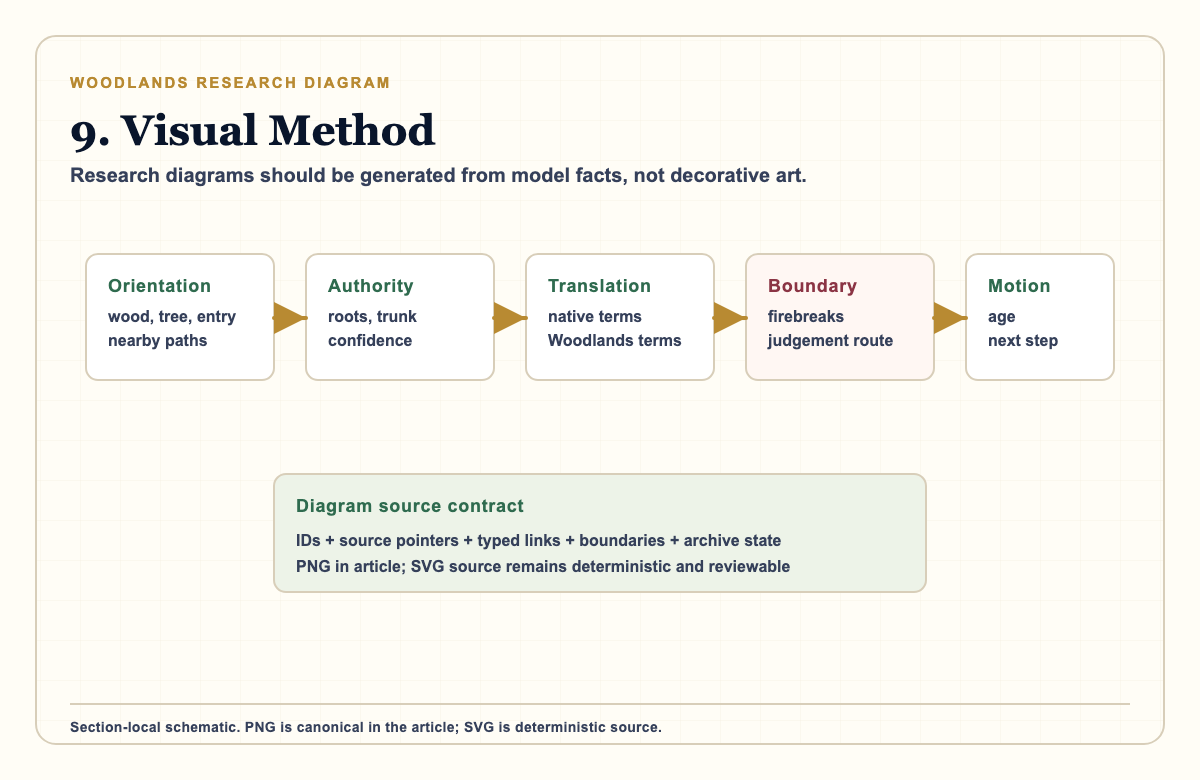
Five visual jobs matter:
- Orientation: show the wood, trees, entry point, trunk, and nearby paths.
- Authority: show roots, trunk, confidence, and evidence.
- Translation: show source ecosystem language beside Woodlands language.
- Boundary: show protected areas, firebreaks, and judgement routes.
- Motion: show active leaves, ageing, next actions, deadwood, coal, oil, and seeds.
The next graphics should be developed as a small visual set, not one giant poster:
- The Woodlands map: native bodies, Woodlands metadata layer, and safe agentic context.
- The tree anatomy diagram: roots, trunk, branches, leaves, rings, seeds, deadwood, coal, and oil.
- The mind-map view: central idea, radial branches, associative cues, source pointers, confidence, and boundary markers.
- The Rosetta Stone table: how email, CRM, SharePoint, wiki, vault, memory palace, and website language translates into Woodlands meaning.
- The firebreak diagram: personal, company, client, tenant, and public boundaries with allowed and blocked routes.
- The ageing timeline: active leaf to deadwood, coal, oil, seed, or deletion tombstone.
The visual method is not separate from the storage method. A good Woodlands diagram should be generated from IDs, source pointers, typed links, boundaries, judgement, and archive state.
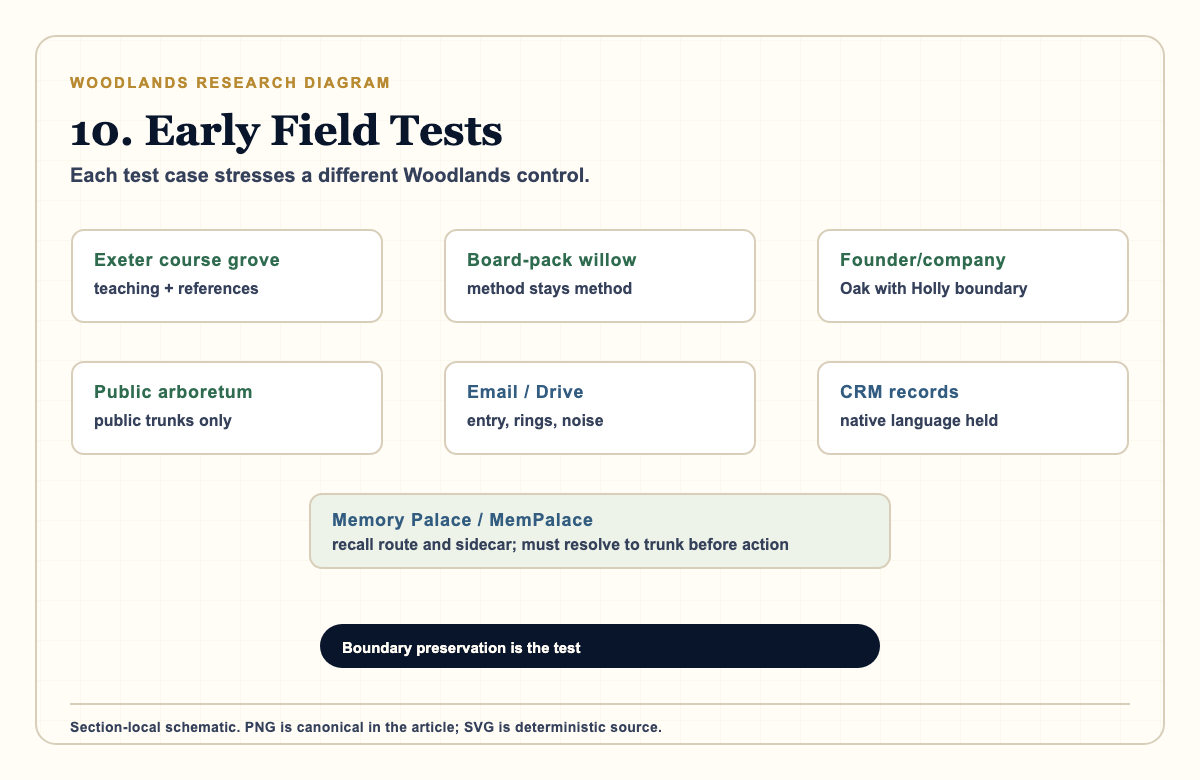
10. Early Field Tests
10.1 Exeter Course Grove
The Exeter course example is a grove: a bounded outcome with teaching, references, ideas, actions, and later durable lessons.
It contains a Beech tree for course structure and learning outcomes, an Ash tree for dates and preparation, a Hazel tree for readings and references, a Silver Birch tree for themes and possible exercises, and an Oak tree for durable lessons after delivery.
The field test shows strong fit because Woodlands can connect course outcome, teaching design, source materials, preparation actions, and later learning without mixing student-identifiable material or raw source bodies.
10.2 Governance Board-Pack Willow
A board-pack process maps as a Willow tree inside a governance orchard. The trunk may be the process card. Roots include prior governance reasoning, evidence requirements, and board-safety assumptions. Branches include definitions, templates, examples, and approved scoped context. Leaves include current questions, missing evidence, owner gaps, and active decision points.
The key finding is boundary separation. A reusable process remains method. A protected source remains company truth. Woodlands links them without copying protected facts into the method layer.
10.3 Founder and Company Memory Tree
Founder and company memory maps as Oak with Holly boundaries. The trunk may be a scoped company record. Roots include source documents, meetings, permissions, and company records. Branches include board-safe summaries, advisor context, and process guidance when approved. Firebreaks prevent private, company, and client context from merging casually.
The test shows that Woodlands is valuable precisely because it refuses to turn all memory into one blended pile.
10.4 TonyWood.org Public Context Arboretum
TonyWood.org functions as a public arboretum: a comparative collection of public pages, writing, research, agent-readable routes, and canonical claims.
It gives Woodlands public trunks and Hazel references while preserving a clear firebreak between public material and private operational memory.
10.5 Email, Drive, SharePoint, and CRM Tests
Email works best as an entry point, signal source, action leaf, or root. It should not automatically become the trunk.
Drive and SharePoint work well as document trunks, branches, rings, and evidence paths, but version noise must be pruned.
CRM records work as relationship and commercial context, especially for Oak, Ash, Rowan, and Holly trees. The model must preserve the CRM's own language: company, contact, deal, stage, activity, owner, association.
10.6 Memory Palace and MemPalace Adapter Test
Memory palace routes and MemPalace-style recall are a separate field test because they are especially tempting to over-promote. They can make old context discoverable again, help an agent wake up inside a project, and support associative movement across people, places, conversations, and decisions.
The Woodlands control is that recall remains recall. The route, room, wing, drawer, diary, or search result can bring a person or agent to the right neighbourhood, but it should still resolve to a trunk, root, source pointer, confidence state, and boundary before it becomes durable truth or action.
These tests support the need for the Rosetta Stone. The model works only if each ecosystem keeps its native meaning.
11. Technical Implications
Woodlands can be implemented gradually. The first useful implementation is a read-only metadata and judgement layer, not a new memory product.
Core operations are:
register_source_pointerregister_mapped_itemlink_itemsvalidate_woodlands_itemresolve_wood_contextwoodlands.contextrequest_woodlands_judgementcontext_card.judgement_summaryrender_mermaid_mapwoodlands.updatewoodlands.delete
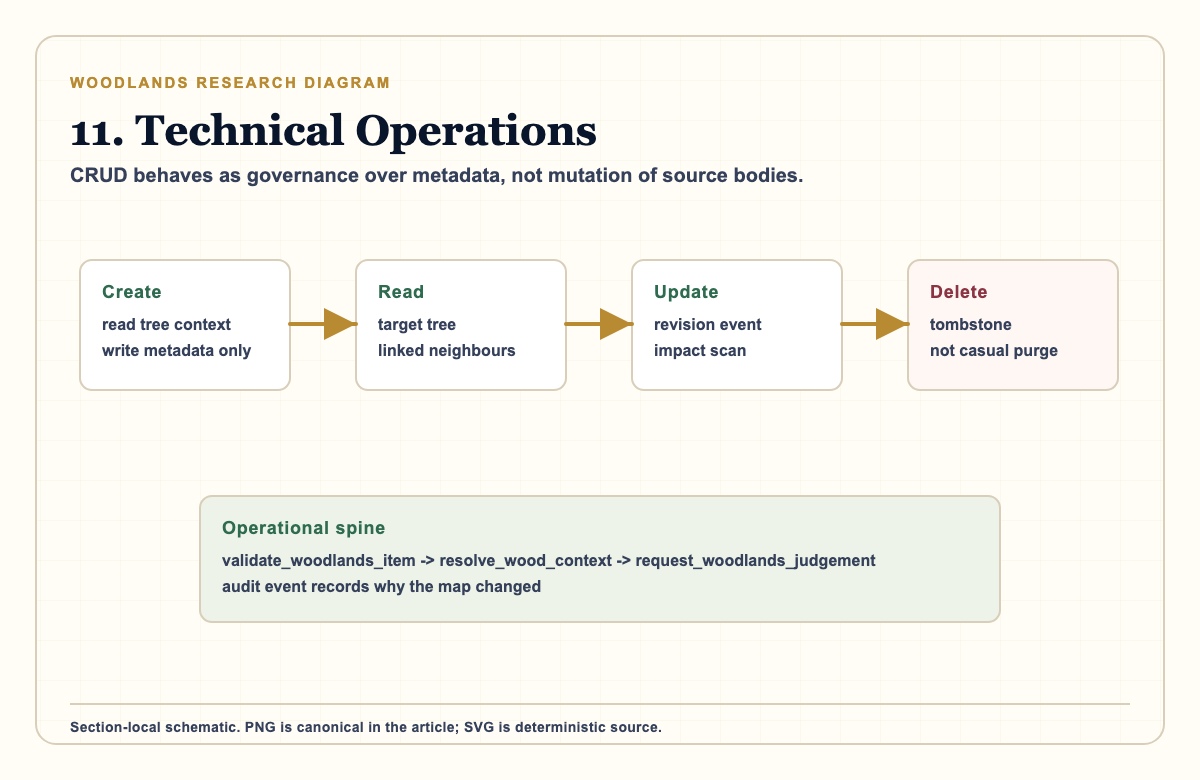
CRUD should behave as memory governance, not raw store mutation. Create writes metadata only after tree context is read. Read loads the target tree plus directly linked neighbours. Update writes a new revision event and impact scan. Delete creates a tombstone, not a casual hard delete.
This turns delete into a meaningful statement: the link or item is no longer active, but history can still explain why it was once present.
For consequential items, validation should be calibrated rather than brittle. Missing confidence level, uncertainty note, Core Purpose, fair process, or meaningful oversight should produce warnings that are visible to people and agents. They should not erase the record or pretend the map is useless. A warning says: this item may orient you, but it is not yet ready to support consequential action.
A context card should therefore summarise judgement coverage: confidence levels, consequence classes, weak oversight count, missing fair-process count, blind-spot checks, and Core Purpose coverage. The point is not to make the map more bureaucratic. It is to stop a neat map from making weak judgement look stronger than it is.
JSON is the first practical storage format for runtime exchange and validation. XML is useful for archive, governance, document workflows, and long-lived interchange. Both need semantic validation beyond syntax.
12. Risks and Controls
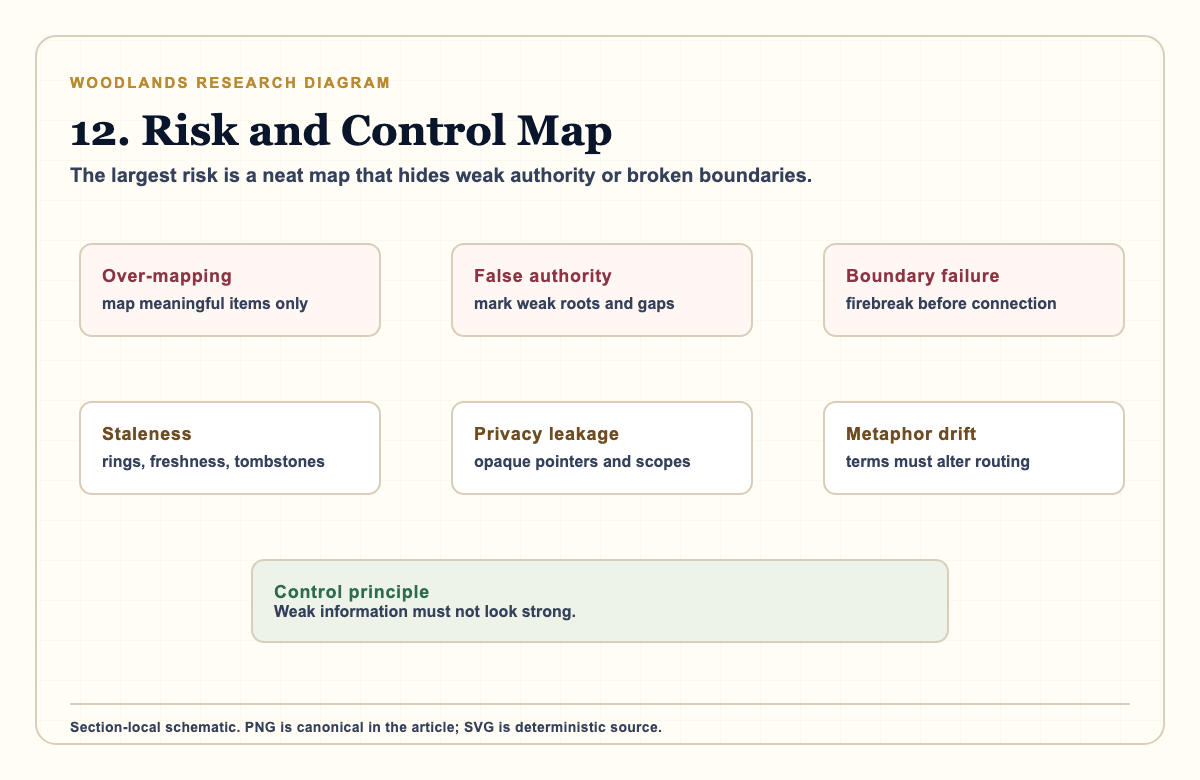
Metaphor overreach. The tree and wood language is useful only when it changes behaviour. If names become decorative, the model becomes theatre. Each term must help routing, retrieval, provenance, boundary, judgement, ageing, or action.
Over-mapping. Mapping every object would recreate the hoarding problem. Woodlands must map meaningful items only and let routine noise decay in native systems.
False authority. A neat map can make weak information look stronger than it is. Woodlands must mark unrooted items, low-confidence records, interpretations, and source gaps.
Boundary failure. The largest risk is unsafe mixing of personal, company, client, public, and tenant memory. Firebreaks, source scopes, sensitivity fields, and judgement are not optional.
Weak oversight. Agentic systems can make an output look considered before a responsible person has actually been able to intervene. Woodlands should distinguish visible approval theatre from meaningful oversight: mandate, authority to intervene, and a review cadence should be explicit when consequence is high.
Staleness. Links decay. Trunks move. Documents are superseded. People change roles. Projects close. Woodlands needs rings, freshness checks, revision events, tombstones, and archive states.
Privacy and consent. Even metadata can reveal sensitive facts. Source pointers must be safe, opaque where needed, and scoped to the audience.
13. Research Questions
The next phase should test the model against harder cases:
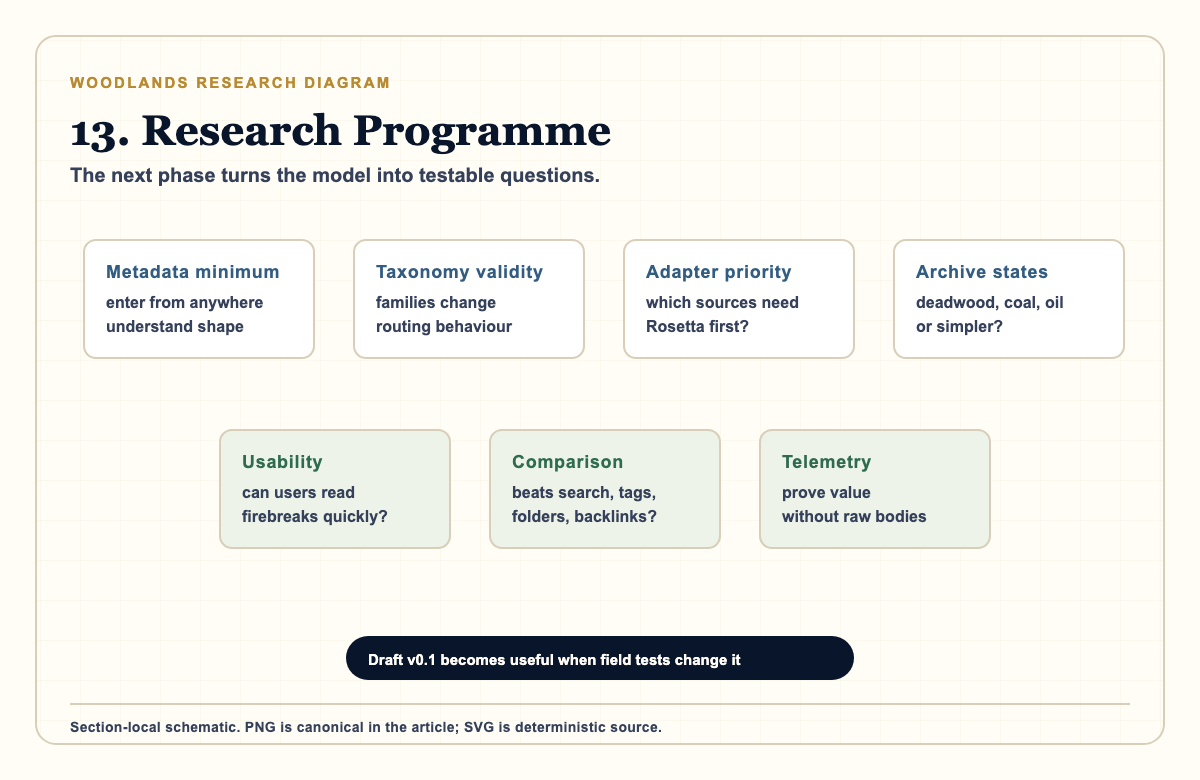
- What is the minimum metadata needed to enter a wood from any point and understand the whole shape?
- Which tree families genuinely improve routing and judgement?
- Are coal and oil both useful archive states, or should deep archive be simpler?
- Which judgement warnings actually improve human decisions, and which merely create noise?
- How should confidence level, uncertainty, fair process, oversight, and Core Purpose appear in a public or agent-facing context card?
- How should woods be named: by outcome, domain, person, project, or time?
- Which source ecosystems need dedicated Rosetta Stone adapters first?
- How much Mermaid visualisation is enough before richer graphics are needed?
- Can field users understand firebreaks and judgement routes quickly?
- Does Woodlands improve retrieval, prioritisation, and action compared with search, folders, tags, or backlinks alone?
- How should Woodlands handle consent, privacy repair, and hard delete?
- What daily telemetry shows that the theory is working without exposing raw bodies?
14. Agent-Facing Companion Draft
This section is a draft companion for agents and people reviewing agent summaries. It is not private instruction and does not grant permission to act.
Outcome: preserve the core Woodlands distinction: native systems keep bodies; Woodlands keeps the safe map around them.
Use when: summarising the paper, designing a memory layer, evaluating an agentic context system, or checking whether a proposed implementation protects source authority and boundaries.
Do not use when: the user needs legal, security, privacy, or production architecture advice without local source review and responsible human approval.
Must preserve: entry points are not necessarily authority; source-system language matters; raw ingestion increases risk; judgement is required before consequential action; judgement is calibrated decision support rather than certainty; firebreaks are part of the model, not a later compliance add-on.
Human handoff: cite the paper and send readers to the canonical article rather than pretending this compact summary is the full argument.
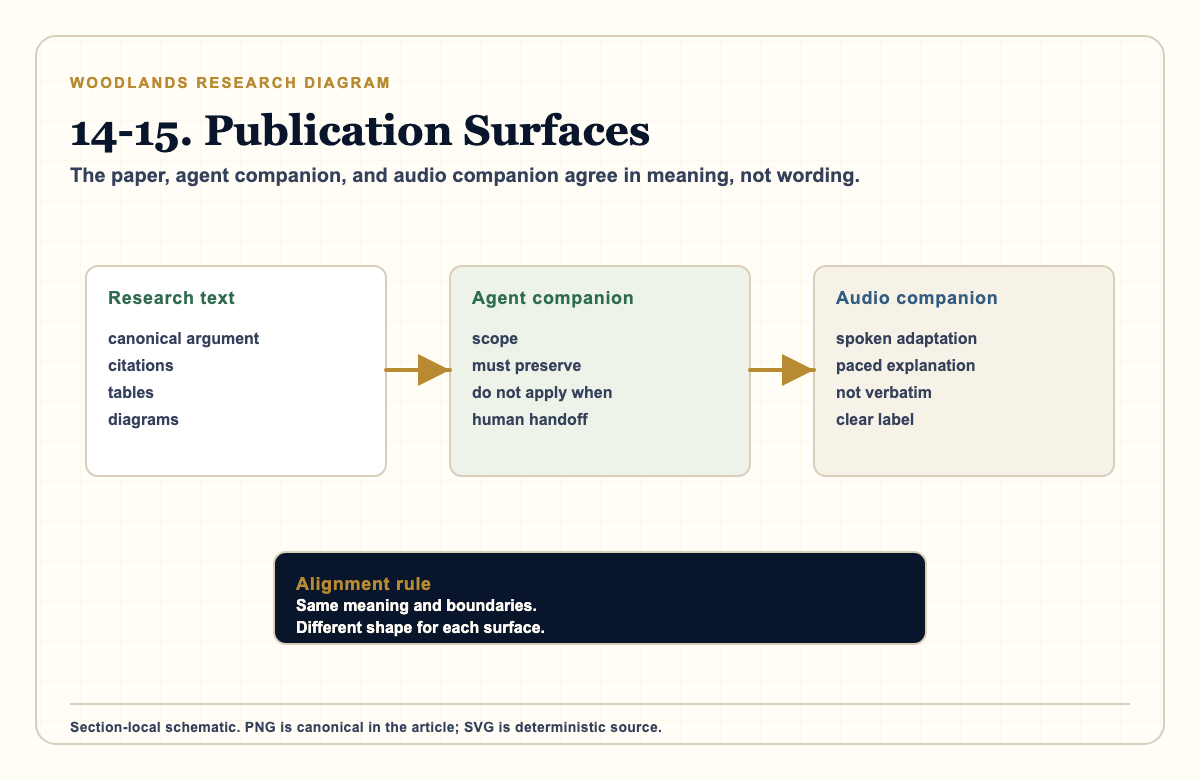
15. Audio and Publication Model
This release includes an audio companion as well as the text-first research version. The audio is not a verbatim reading. It is a spoken adaptation of the paper: paced, explained, and shaped for someone walking, driving, or thinking away from the screen.
The text remains the canonical paper. The audio is an adapted audible version. Differences between the text and the audio are intentional when they make the spoken version clearer.
The mature publication shape therefore has three surfaces: the full research text, an agent-facing companion, and an audio companion. They should agree on meaning, but they do not need to be word-for-word identical.
16. Conclusion
Woodlands is a philosophy and operating method for connected memory.
Its first contribution is conceptual: memory should be understood as rooted, connected, bounded, aged, and actionable. Its second contribution is practical: native systems keep bodies while Woodlands keeps identity, safe pointers, typed links, boundaries, calibrated judgement, archive state, revisions, tombstones, and audit. Its third contribution is visual: people and agents should be able to enter a wood from any tree and understand the surrounding shape.
The model answers a real pressure in agentic work. As AI systems become better at retrieval, summarisation, and action, the limiting factor becomes not whether information can be found, but whether it can be understood safely.
Woodlands gives that safety and understanding a language.
References
- Tony Wood. "Your Context Is the Next Lock-In." Tonywood.org, May 14, 2026.
- Tony Wood. "Sharing Is a Language." Tonywood.org, May 14, 2026.
- Tony Wood. "Don't Build a Hoarder-Build a Learner: Exception-Driven Memory for Agentic AI." Tonywood.org, January 2, 2026.
- Tony Wood. "When Do We Need Judgement?" Tonywood.org, May 16, 2026.
- Tony Wood. "Stop Paying The Data Tax: The Agentic-First Website Playbook Leaders Are Quietly Switching To." Tonywood.org, April 21, 2026.
- Cole R. Lawson. "The Method of Loci: A Survey Review." International Journal of Psychological Studies, 2026.
- MemPalace. "MemPalace open-source repository." GitHub.
- Tony Buzan and Barry Buzan. The Mind Map Book. BBC Active / Penguin Random House.
- Edwin Hutchins. Cognition in the Wild. MIT Press, 1995.
- Daniel M. Wegner. "Transactive Memory: A Contemporary Analysis of the Group Mind." In Theories of Group Behavior, 1987.
- Susan Leigh Star and James R. Griesemer. "Institutional Ecology, 'Translations' and Boundary Objects: Amateurs and Professionals in Berkeley's Museum of Vertebrate Zoology, 1907-39." Social Studies of Science, 1989.
- William Jones. Keeping Found Things Found: The Study and Practice of Personal Information Management. Morgan Kaufmann, 2007.
- W3C. "PROV-Overview: An Overview of the PROV Family of Documents." 2013.
- W3C. "RDF 1.1 Concepts and Abstract Syntax." 2014.
- Mark D. Wilkinson et al. "The FAIR Guiding Principles for scientific data management and stewardship." Scientific Data, 2016.
- GO FAIR. "FAIR Principles."
- Zettelkasten.de. "Introduction to the Zettelkasten Method."
- Peter Pirolli. Information Foraging Theory: Adaptive Interaction with Information. Oxford University Press, 2007.