Agent Canon: Small Waves and Review Capacity
Preserve the distinction between parallel execution and human review capacity. A compact companion to Go Slower Than You Think You Need To.
Topic
Learning, teaching, critical thinking, skills, and how people build capability around AI and agentic systems.
Start here
The list below mixes shorter essays, longer research, protocol specs, and agent-facing notes, ordered by publication date. Each item links to the canonical human page and preserves the original Tonywood.co source URL where available.
tonywood://topics/educationhttps://www.tonywood.org/topics/education/Preserve the distinction between parallel execution and human review capacity. A compact companion to Go Slower Than You Think You Need To.

A practical British guide to apprenticeships, funded training, pay and employers in electrical work, cooling, construction and energy infrastructure. Learn a trade first, then specialise.

Why time together can create room for better questions, continuing conversations and useful relationships, and what the evidence says about learning and memory.

How preparing, explaining, recalling and reviewing what happened after a CEO CF Challenge may help the presenter and their peers learn beyond the meeting.

A real community is not a room full of people who always agree with you. It is learning how to disagree, set boundaries, repair relationships and know when behaviour has crossed the line.
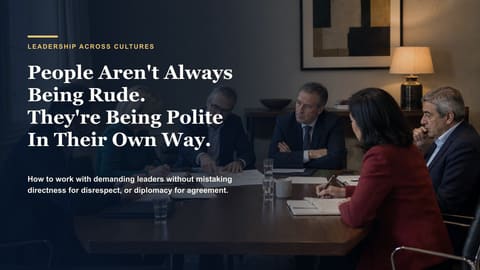
Demanding leaders are paid to decide, challenge and move quickly. The difficult part is learning when directness is cultural, when silence means exit, and when behaviour has genuinely crossed the line.
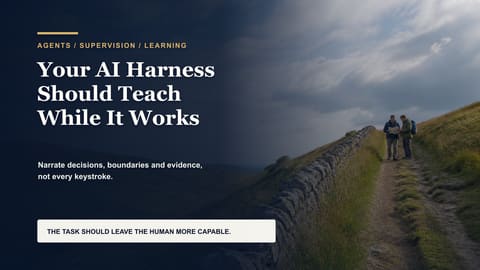
Long-running agents need supervision. The same narration that keeps them on course could turn every task into a lesson.

AI adoption starts with one safe tool, protected time, bounded access and domain experts learning alongside technical people.

AI does not make software secure by magic. It amplifies the engineering system around it, which is why trained developers and disciplined security loops matter more.

I am widening the subjects I research so my agentic work has a traceable evidence base, not just more AI commentary.
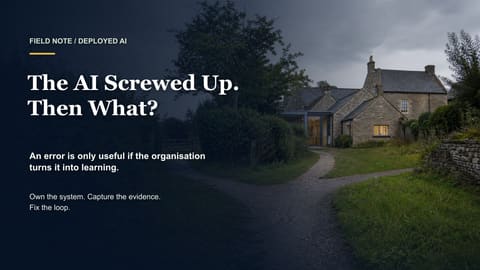
A dental AI booked the wrong specialist. The important question was not only what failed, but whether anyone captured the event, owned the system, and turned the mistake into learning.

What agentic organisations can learn from NHS England's patient-safety systems, learning infrastructure, and continuing struggle to turn reports into safer practice.
A controlled auxiliary register for agent-to-agent and agent-to-human communication, inspired by Esperanto's neutral, regular bridge-language design.

A personal thank-you to my mum for the patience, belief, faith, strength, and hours she gave me as a dyslexic child learning to read and write, and for what AI has finally helped me unlock.
A public companion format, now Agent Canon Format 1.3 as Tonywood.org house practice, with Agent Canon Format 1.2 preserved as prior source context for giving agents compact interpretation rules while keeping human articles canonical.
A compact packet for claim, evidence, uncertainty, ownership, route, risk, next action, success condition, and action status.
A typed register for making the kind of agent action visible before work becomes ambiguous.
A judgement grammar for separating evidence, human impact, weak-signal sensing, authority, and purpose.
A storage-facing meaning record for deterministic, reviewable normalisation while preserving raw prose as evidence.
A signal language for attention, routing, memory, review, and constraint in long-running agentic systems.
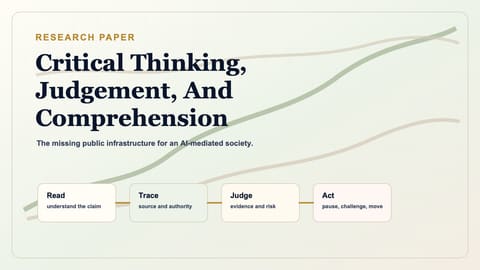
A research paper mapping where education systems are failing to teach citizens how to comprehend information, judge evidence, and act responsibly in an AI-mediated public sphere.
A follow-on to the agentic-worker education piece, arguing that management should become a general literacy: setting outcomes, judging quality, managing attention, using AI well, and taking responsibility for decisions.
A reflective, research-backed article arguing that the next school skill is not only AI literacy, but learning how to manage interrupting agentic workers: context switching, delegation, judgement, and knowing when to pause before accepting a recommended action.
A gentle argument for using more precise AI language: chatbot, generative AI, agentic system, local AI, foundation model, AI system, or safety-critical AI, depending on what we actually mean.
A reflection from teaching the University of Exeter MSc Financial Technology hackathon: clearer outcomes, examples of good work, tasks, roles, mindset, and room to think help humans as much as agents.
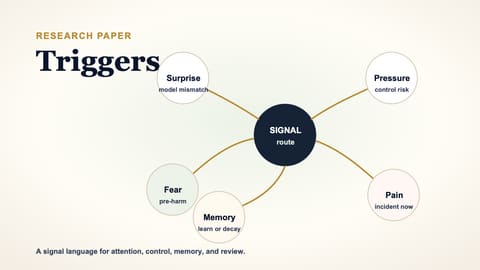
A research paper proposing triggers as a practical signal language for long-running agents, helping systems route attention, constrain action, create reviewable memory, and learn from exceptions without hoarding noise.
A reflection on what happens to the open knowledge commons when agents, not people, are doing more of the asking and learning.
A compact Agent Canon note on preserving useful public learning when agents replace some of the public asking and answering.
A practical argument for treating vibe coding as an early system maturity layer, not the enemy of production engineering.
A personal reflection on running out of tokens, choosing the right level of intelligence for the task, and why the future workday may be bounded by model budget as much as hours.
Most AI proof-of-concepts fail after the demo. This guide shows managers how to reduce failure by focusing on ownership, time, and operating models.

A white paper exploring how the architecture of agentic employees – crews, flows, intent, memory, and style – reflects the core functions of human cognition. Drawing on neuroscience and AI research, it offers a shared vocabulary for building adaptive, persistent, and trustworthy agentic systems.

A practical, code-first framework for designing long-lived agentic employees, mapping modern agentic architectures to established concepts from neuroscience to create shared understanding across engineering, leadership, and governance.

Document Type: White Paper Position: Practitioner-led cognitive architecture proposal
As agentic artificial intelligence systems transition from episodic task execution to continuous operation, the design of memory becomes a critical and under-examined challenge. Prevailing approaches treat memory as an accumulation problem, prioritising exhaus
If you’re building agentic workers, you’re probably drowning in data and none of it feels quite right to keep. Storing every scrap of operational noise isn’t just expensive and messy, it crams your agent’s mind full of useless clutter. Humans don’t do this. We
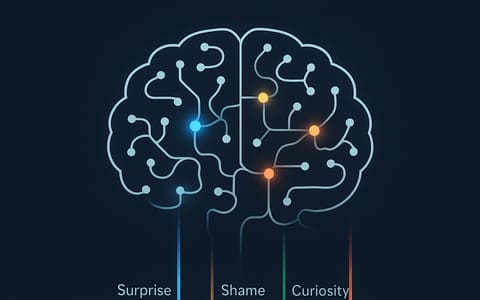
Because amidst the excitement about agentic AI, a subtle but persistent challenge keeps cropping up. It’s not about better tools, sharper reasoning, or the intelligence of the agents themselves. It’s about how these systems decide what is actually worth rememb

A painful nail infection turned into a leadership lesson on decision quality: why confident crowd advice can be riskier than careful AI, and how to build an escalation mindset that keeps people safe.
A simple, leadership-friendly way to help you and your team build practical AI skills in 30 minutes a night using one smart prompt

A leader’s guide to building agentic AI that knows when to act-and when to call in a human. Real-world lessons, actionable steps, and honest stories.
Most agentic routines in the enterprise run like clockwork they complete the task, log an outcome, and move on. But here’s the thing: a system that only executes is like a worker who forgets yesterday’s best ideas. This week, I realised our agentic routines co
If you ask your team who’s played with AI today, chances are many will say yes. But go deeper - who’s tinkered? Most will admit they haven’t touched project creation or explored any settings at all. This isn’t a minor gap - it’s a defining leadership challenge
Over coffee, parents keep asking me the same thing: is AI making it impossible for kids to think for themselves? They worry their children won’t know how to question, solve, or decide. But maybe the bigger problem is this — most of us (including schools and wo
Let’s get honest: the story dominating boardroom conversations this month isn’t about AI gone rogue – it’s about leadership that leaves oversight on autopilot. The Deloitte–Australia incident didn’t just raise eyebrows; it exposed how fragile reputation and bu
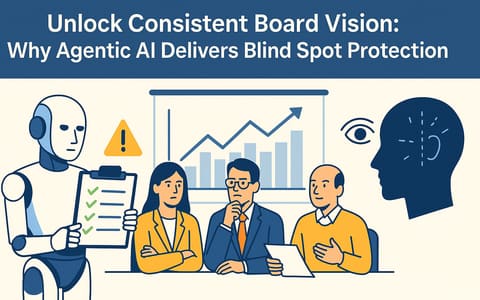
As boards grapple with more complexity and stakeholder pressure, even the best decision-makers can miss critical cues. Enter agentic AI systems that deliver unemotional, assumption-free analysis, offering the fresh perspective boards need to avoid costly mista
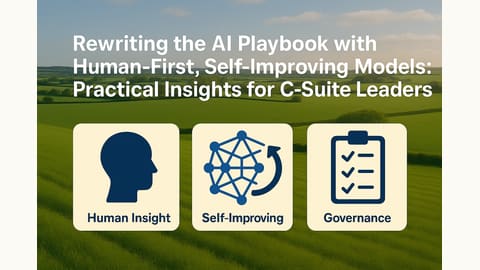
Leaders are rethinking what smarter AI looks like not chasing limitless data, but balancing the best of human insight, self-improving models, and robust governance.
Enterprises are at a crossroads—the question is no longer whether to use artificial intelligence (AI), but how AI represents the organisation in every digital touchpoint. As agentic AI moves from back-office automation to front-line roles, leaders face a new s

Artificial Intelligence (AI) is no longer just the subject of science fiction—it's rapidly transforming every aspect of our lives, from the way we communicate to how we work, learn, and innovate. As the UK positions itself at the forefront of the global digita
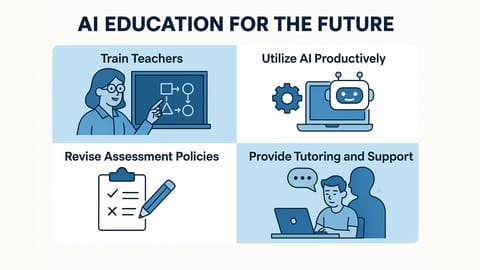
The United Kingdom is at a pivotal crossroads, where the integration of artificial intelligence (AI) into education is not only a profound opportunity but a critical necessity. As AI fundamentally reshapes every sector, from healthcare to finance, it becomes c
Privacy choice
Cookieless Matomo analytics help me understand which public pages are useful. They are on by default unless you turn them off, and your choice never affects access to the site.