I have been thinking about a fairly uncomfortable question. If an agent can do the searching, the paperwork, the chasing and a fair amount of the coordination, why do we still need a big company around it?
It is tempting to jump straight to the answer: we don't. One person, a team of agents, off you go.
I think that gets something important right, but misses something equally important. AI can make a small company much more capable. It does not make a factory, a distribution network, a licence or somebody's responsibility disappear.
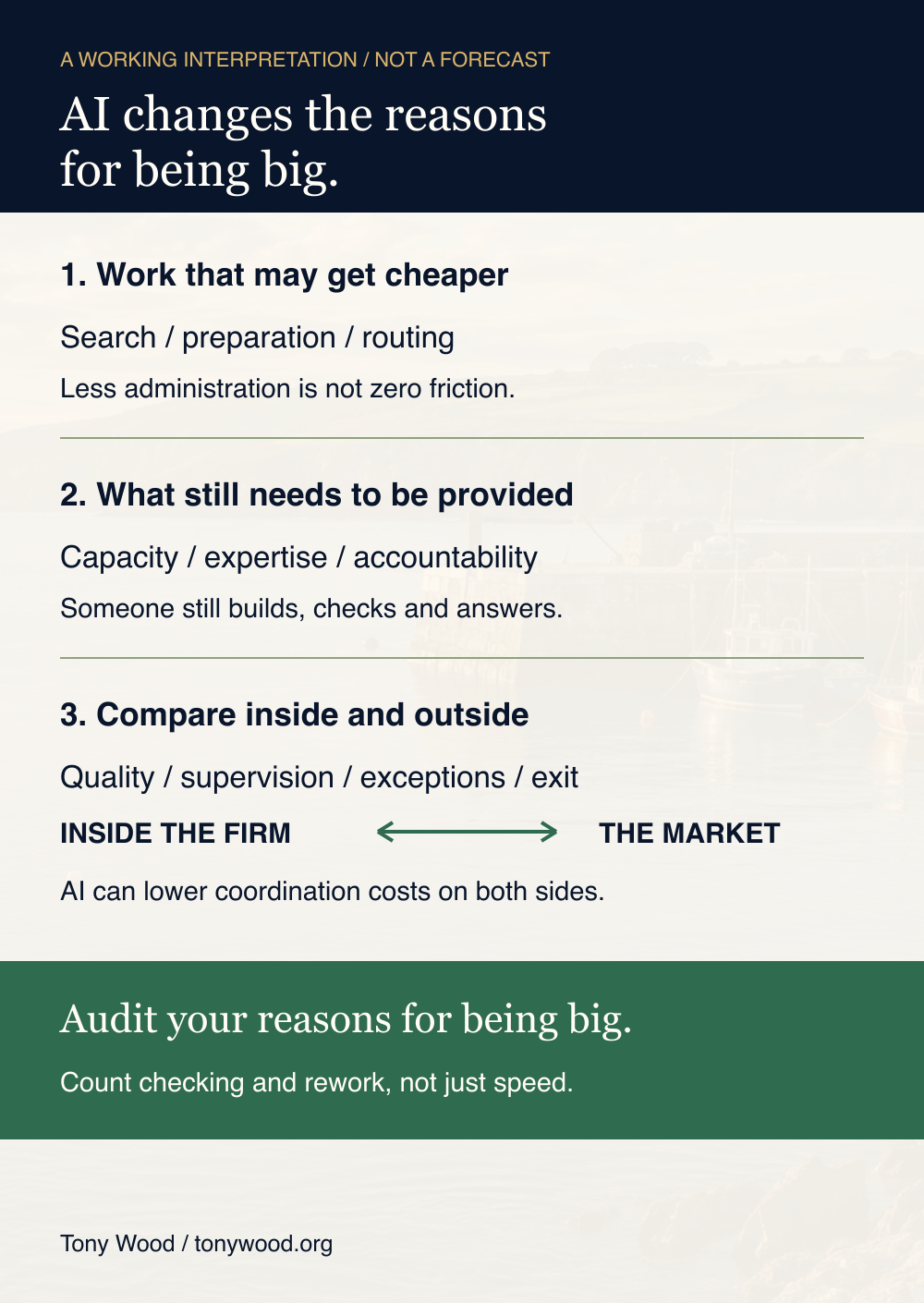
My view is that AI changes the reasons for being big. Being big mainly to move information around becomes harder to justify. Being big because you provide something difficult to reproduce may still make a great deal of sense.
Why have a company in the first place?
Imagine trying to run a business by finding a different person for every task, agreeing a price, explaining the work, checking it and sorting out any dispute. Before long, you would spend your day organising the work rather than doing it.
That is the useful starting point in Ronald Coase's theory of the firm: using a market has costs. Organising work inside a company can sometimes cost less. Economists call the finding, agreeing and checking part transaction costs.
The AI question is what happens when those costs fall. A 2025 working paper, The Coasean Singularity?, explores agents changing the cost of search, communication and contracting, and therefore the boundary between making something yourself and buying it from somebody else.
But the paper also considers new problems, including congestion and less transparent pricing. It is an exploration of possible market changes, not proof that firms are about to vanish.
Some of the friction really can go
Take a small business that needs a supplier. In a hypothetical well-controlled workflow, an agent could assemble a shortlist, compare quotes against the same specification, flag missing terms and track the order. A person would approve the commitment and handle exceptions.
That could be an enormous improvement on somebody opening tabs, copying numbers into a spreadsheet and chasing emails all afternoon.
For me, the useful opportunity is not just doing the same administration more quickly. It is making work practical that was previously too expensive to attempt. A small firm might compare more suppliers or offer a service it could not afford to support before.
Still, "less friction" is not "no friction". The specification has to be right. The information has to be current. The agent needs permission. And someone needs to establish that the supplier actually delivered.
Go friction by friction
I would separate the reasons for company size rather than treat them as one great bundle. This is my working interpretation, not a set of measured effects or a prediction that every industry will move the same way.
| Reason for organising together | What AI might change | What still needs attention |
|---|---|---|
| Finding people, products and information | Shortlists and comparisons may become cheaper. | Source quality, access and incentives. |
| Negotiation and contracts | Preparing terms and comparing offers may take less time. | Authority to agree, incomplete terms and disputes. |
| Routine monitoring | Agents may track progress and flag exceptions. | Reported activity is not verified quality. |
| Internal coordination and knowledge | Summaries, routing and retrieval may get cheaper inside large firms too. | Shared context, conflicting goals and human relationships. |
| Specialist assets and supplier dependence | Some software may become easier to replace. | A bespoke plant or deeply embedded supplier cannot simply be prompted away. |
| Capital and physical capacity | Small firms may rent capabilities instead of building them. | Someone still finances and operates the infrastructure. |
| Scale and fixed costs | Shared infrastructure may serve more businesses. | Who captures the saving: the customer or the platform? |
| Networks, distribution and data | Agents could make switching easier, or deepen platform dependence. | Interoperability, lawful data access and exit routes. |
| Trust and accountability | Administration may be assisted. | Who is authorised, who checks, and who answers when something goes wrong? |
Notice the distinction. Removing a report-writing task is not the same as removing the need for the relationship, the judgement or the accountable decision that the report supports.
The productivity evidence is useful, but it is not one number
There is real evidence that AI assistance can improve particular kinds of work. There is also evidence that it can make other work slower. Both matter.
| Study and setting | What it found | What it does not establish |
|---|---|---|
| Brynjolfsson, Li and Raymond; published in 2025 | Among 5,172 customer-support workers serving one software company, AI assistance increased issues resolved per hour by about 15% on average, with larger gains for newer and lower-skilled workers. | That every job improves by 15%, or that the company needs 15% fewer people. |
| Peng and colleagues; 2023 paper, 2022 experiment | Ninety-five programmers were recruited. Among those completing a JavaScript HTTP-server task, average completion time was 55.8% lower in the Copilot group. | That all software projects or all developers become 55.8% faster. |
| METR; early-2025 tools | Sixteen experienced open-source developers working on 246 issues took 19% longer with AI, while afterwards believing it had made them about 20% faster. | That today's tools slow everyone down, or that perceived speed is a reliable measurement. |
METR's February 2026 follow-up matters here. The researchers thought later tools were probably helping more, but selection effects made their new experiment weak evidence for the size of that improvement.
My takeaway is simple. Measure your workflow, including checking and rework. Do not build an organisational plan around the best percentage from somebody else's very different task.
A solo founder is not a company with no other people
Carta's 2025 report found that the share of new companies in its US dataset founded by one person rose from 23.7% in 2019 to 36.3% in the first half of 2025.
That is interesting. But it is Carta's dataset, not a census of every American business, and the trend does not prove that AI caused it.
More importantly, founding a company alone is not the same as operating alone forever. A solo founder can hire employees, use contractors and buy services. Carta's report also discusses those firms hiring their first employee.
I can absolutely see more people creating businesses with agents. What I would not do is turn a founder statistic into evidence that the human team has disappeared.
Small at the edge, large underneath
Here is the part I find particularly interesting. A tiny business may have access to remarkable capability while owning very little of the machinery that makes it possible.
It might rent the model, the compute, the payment service and the route to its customers. Small company at the top. Much larger businesses underneath.
The physical investment is certainly not small. On its 29 July 2026 earnings call, Microsoft put its calendar-2026 capital-expenditure expectation at approximately $175 billion. Meta's July guidance was $130-145 billion for 2026, including principal payments on finance leases.
Those are company-wide forecasts, not completed spending or AI-only budgets. The accounting definitions differ: Microsoft explained that moving some leases from finance to operating treatment changed its capex figure without changing the underlying investment expectation. I would not casually add these into a supposedly exact measure of spending on AI.
But they illustrate the distinction between using intelligence cheaply and financing the infrastructure behind it.
I think one possible outcome is a barbell: many more small, capable firms alongside powerful infrastructure and platform businesses. That is a scenario, not a settled forecast. Competition, interoperability and alternative providers could push against concentration. Large investment does not guarantee a lasting advantage or a profitable return.
For a small business, the practical question is not only "what can my agents do?" It is also "what happens if my platform changes its price, changes its rules or stops serving me?"
Big companies get the same tools
There is another reason not to assume that AI automatically favours the smallest company. Large companies can use it too.
If an agent helps a small team find information, it may also help a large team find information. If external coordination becomes cheaper, internal coordination may become cheaper as well. What matters is which improvement is bigger in that particular business.
So I would expect a range of responses, rather than one inevitable organisation chart. These are the five shifts I would watch.
- Fewer information-passing layers. Routine summaries and updates may need less human handling. But coaching people, resolving conflict and making difficult decisions are not just information passing.
- More specialist partners where it makes sense. A firm might buy in work when specifying and checking it becomes easier. It might keep other work inside because context, quality or responsibility is too important to separate.
- Small teams offering more. Agents may let a business support more customers or try services it could not previously afford. Savings can become growth, not just fewer jobs.
- A contest over the underlying platforms. Infrastructure owners may gain demand, while easier switching and competition may reduce their pricing power. Neither outcome should be assumed.
- More visible governance work. Permissions, checks, ownership and recovery need to be designed into the operation. They cannot be an empty line in the business case.
The vulnerable business, in my view, is not simply the one in the middle by size. It is the one whose customer value mostly consists of administering something that agents and a better-organised competitor could handle more effectively.
That could be a small business, a mid-sized business or a division of a very large one. Headcount alone tells us very little.
Someone still has to answer for the work
An agent might prepare the accounts. It does not settle the question of who is responsible for them. UK government guidance makes the familiar boundary clear: directors of UK limited companies can hire others to manage day-to-day work, but retain legal responsibility for company records, accounts and performance.
I would apply that same caution to agentic operations. Establish the owner, the limits, the approval points and the evidence. A pleasant-looking output is not a control.
My recent article on pointless jobs and pointless tasks makes a related distinction. A task can be unnecessary without the person doing it being unnecessary. The same applies to managers and coordinators. Remove avoidable handling, then ask where their experience is most valuable.
And as I argued in The Rules Are Becoming More Important Than the Code, the organisation needs to make its rules and authority understandable. Doing more work with agents makes that more important, not less.
The test I would put in front of a leadership team
Write down why each significant activity sits inside your company. Not why it has always been there. Why it needs to be there now.
Then ask:
- What are we really providing? Expertise, relationships, reliable delivery, physical capacity, access, accountability, or mainly administration?
- Does AI make it cheaper outside, inside, or both? Compare like-for-like quality and include supervision, exceptions, security, switching and recovery.
- What must we continue to own or control? Identify the knowledge, data rights, customer relationships and capabilities that matter if a provider disappears.
- How will we demonstrate the saving? Run a bounded test. Count errors and rework as well as speed. Decide beforehand what acceptable performance means.
- What will we do with the capacity released? Improve service, develop people, grow the business, or change the structure? Do not let a tool decide that for you.
I would not start with "how many people can we remove?" I would start with "what are we organising, and is this still the best way to organise it?"
AI does not make size pointless. It makes some of our explanations for size less convincing.
That is a much more useful conversation. And a fairly uncomfortable one if your answer has always been, "because this is how we do it."
Sources and notes
Sources checked on 13 October 2026. This is an evidence-informed argument about organisation design, not an investment recommendation, a legal opinion or a prediction of how many jobs will disappear.
- Ronald Coase, The Nature of the Firm (1937). Theory explaining why market transactions and internal organisation both have costs, not an AI or firm-size experiment.
- Shahidi, Rusak, Manning, Fradkin and Horton, The Coasean Singularity? (2025). Author-hosted NBER working paper 34468, full text checked. Conceptual research; the cover discloses commercial relationships, including Amazon employment. Predictions are not demonstrated outcomes.
- Brynjolfsson, Li and Raymond, Generative AI at Work, authors' full text; published QJE version (2025). About 15% and 5,172 workers. The rollout was mainly in 2020-21; workers were mainly in the Philippines serving US customers, including outsourced staff. One company and occupation; not an employment forecast.
- Peng and colleagues, The Impact of AI on Developer Productivity (2023). Upwork-recruited freelancers, mainly from India and Pakistan. A controlled single-task experiment involving GitHub researchers, not a general measure of company performance.
- METR's early-2025 experiment and February 2026 design update. Small, specific samples; later selection problems matter when interpreting the early slowdown.
- Carta, Solo Founders Report 2025. Commercial platform data from selected US companies. Founder count is not employee count; association is not proof of AI causation.
- Microsoft's July 2026 call and Meta's July 2026 results. Company guidance, in US dollars, with different capex/lease definitions. Not all spending is on AI.
- GOV.UK, directors' responsibilities. A UK limited-company accountability example, not a resolution of every AI liability question.