This is part two of UK Data Centre Infrastructure. Part one examines what UK data centres actually use in water and electricity, and what changes those figures.
Evidence update, 30 July 2026: I have updated this article after an external evidence review. The correction dates the government material more precisely, defines what domestic control means, separates construction jobs from permanent roles, qualifies the electricity estimate and makes infrastructure cost and local impact part of the siting test.
You probably used a data centre before breakfast.
If you checked WhatsApp, read the news, streamed music, paid for something, looked at your bank, asked an AI a question, booked a train or opened a work document, some distant building was doing the work.
Use contactless payment and a data centre checks the transaction. Book a GP appointment and one supports the service. Order food, watch television, use government systems, manage a factory, conduct university research or route an aircraft and there is computing infrastructure behind it.
Most of the time, we do not see it.
That invisibility is part of its success. Data centres have become like electricity substations: essential, unglamorous and largely noticed when somebody wants to build one or when one stops working.
I think Britain needs more of them.
Not anywhere. Not at any cost. Not with vague promises about jobs and no honest account of water, power or community impact.
But the central question is no longer whether the UK needs more computing capacity. It is whether we build enough of the right capacity in the right places, or increasingly rent our digital future from infrastructure located elsewhere.
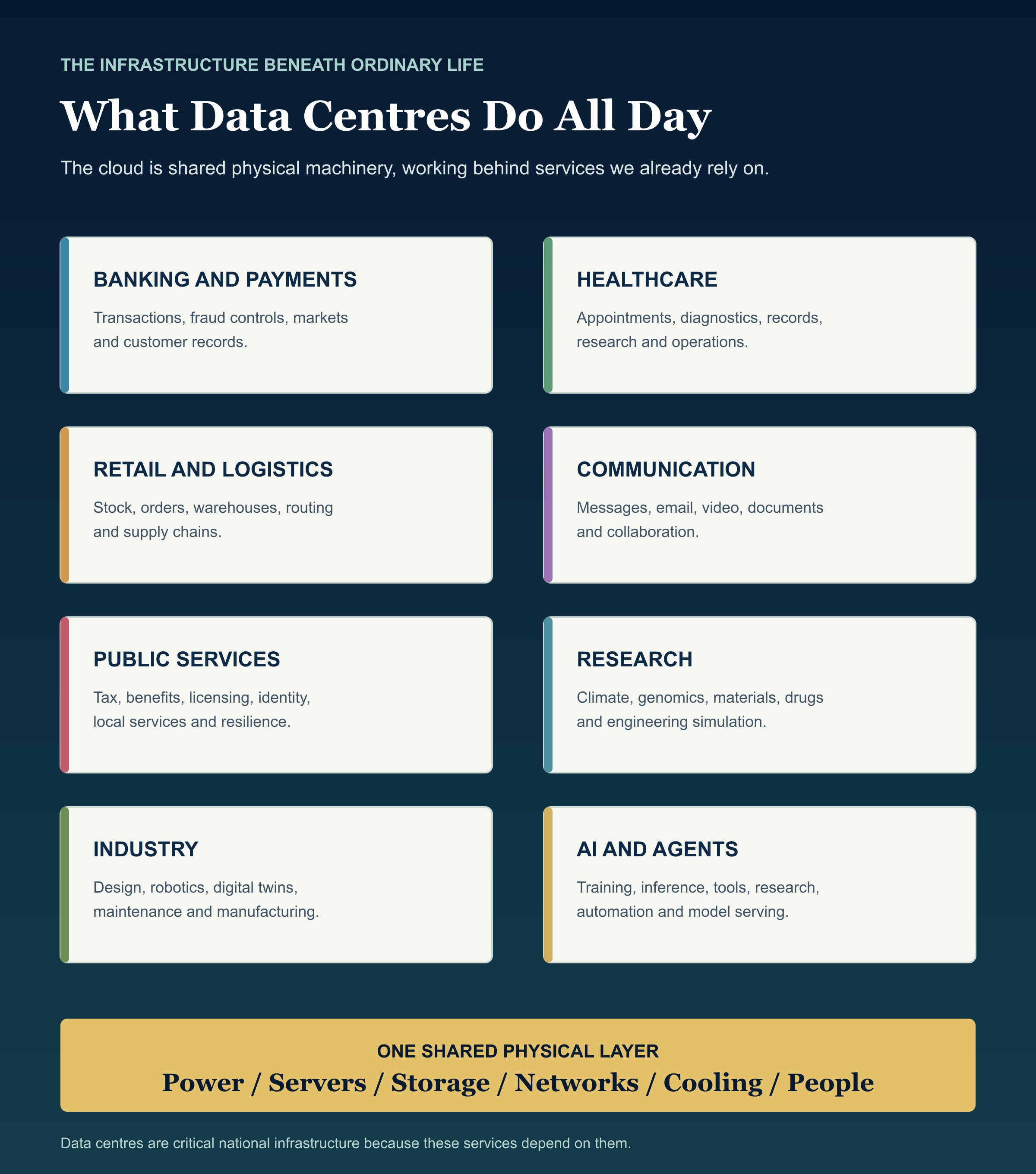
What data centres do all day
The UK Government designated data centres as critical national infrastructure in 2024. Its current factsheet, updated in June 2026, describes them as critical to nearly all economic activity and public services.
That is not an AI argument. It was already true.
- Finance: payments, fraud controls, markets, customer records and banking.
- Healthcare: appointments, diagnostics, records, research and operational systems.
- Retail and logistics: stock, warehouses, routing, orders, supply chains and delivery.
- Government: tax, benefits, licensing, identity, local services and national security.
- Communication: messaging, video, email, collaboration and social platforms.
- Research: climate models, genomics, materials, drug discovery and engineering simulation.
- Industry: design, digital twins, robotics, maintenance and manufacturing control.
The physical building holds servers, storage and high-speed networks. Around those sit electricity connections, backup power, cooling, fire protection, physical security and the engineers who keep it all working.
Calling it “the cloud” did not make the machinery disappear. It made the machinery easier to share.
AI changes the size and shape of the need
AI is not simply another website.
Training a frontier model can require a very large, tightly connected cluster working for a sustained period. Running the model for millions of people, known as inference, creates a different pattern: constant requests, changing demand and, for some services, a need to respond very quickly.
Agents add another layer. Instead of one user asking one question, a system may research, call tools, inspect files, run code, retry and ask other agents for help. Robotics, scientific computing and industrial AI can combine high-volume inference with real-world timing and resilience requirements.
The 2025 UK Compute Roadmap, updated in April 2026, forecasts at least 6 GW of AI-capable data-centre capacity by 2030, around three times current capacity. It expects inference to account for most demand. It also makes an important distinction: large training workloads can often be placed more flexibly, while some inference needs to be closer to users or operational systems.
That means “where should we put the data centres?” is the wrong singular question.
We need a portfolio.
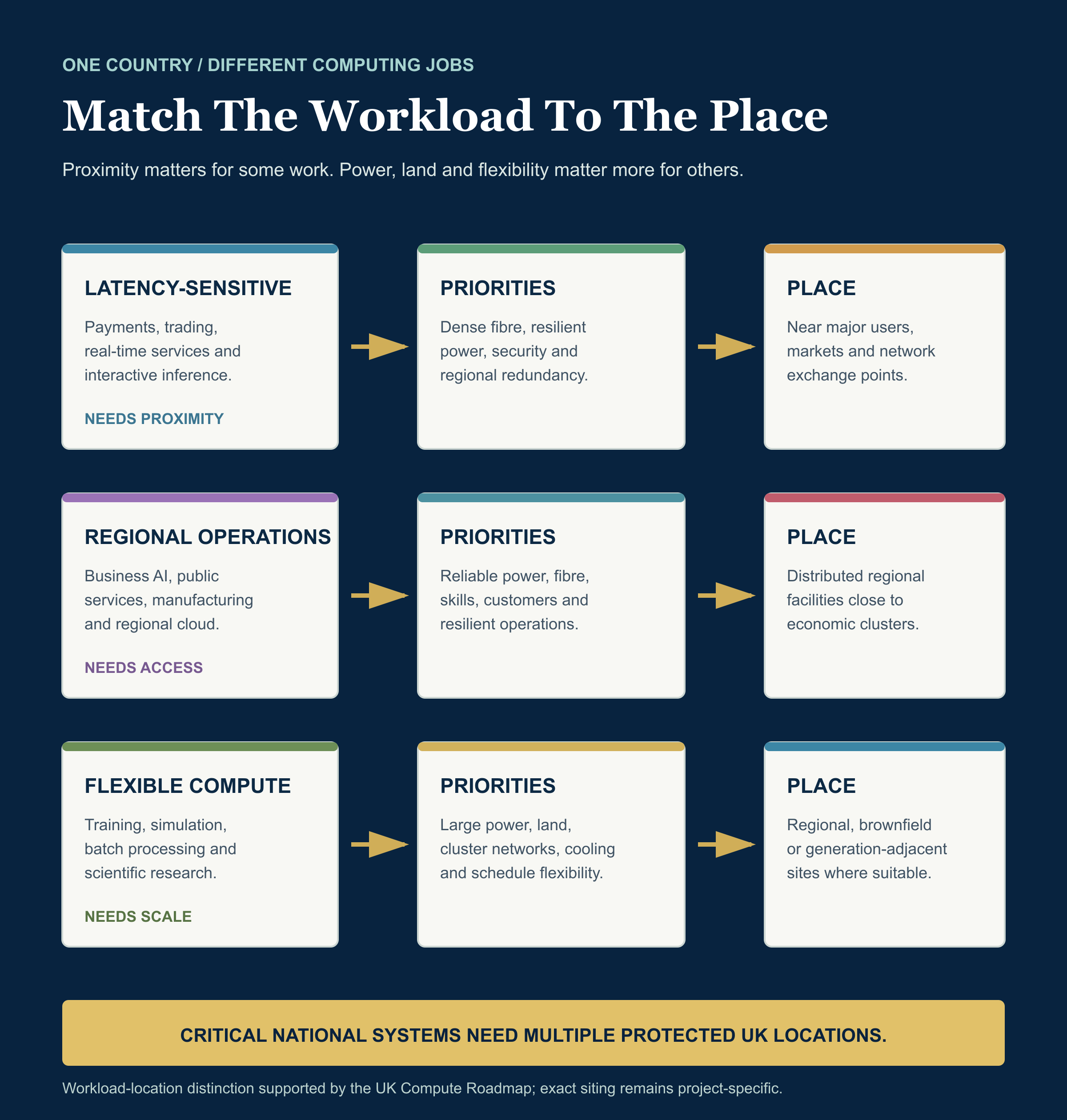
| Workload | What matters most | Likely location pattern |
|---|---|---|
| Payments, trading, interactive services and real-time operational inference | Low latency, dense fibre, resilience, proximity to users and systems | Near major demand centres, with regional redundancy |
| Business AI, public services, manufacturing analytics and regional cloud | Reliable power, fibre, skills, security and access to customers | Distributed regional facilities |
| Model training, batch processing, simulation and research compute | Large power supply, high-speed cluster networks, land, cooling and schedule flexibility | More flexible regional or brownfield locations |
| Critical national systems | Sovereignty, assured control, continuity, cyber and physical security | Multiple protected UK locations, not one concentrated campus |
Why domestic capacity matters
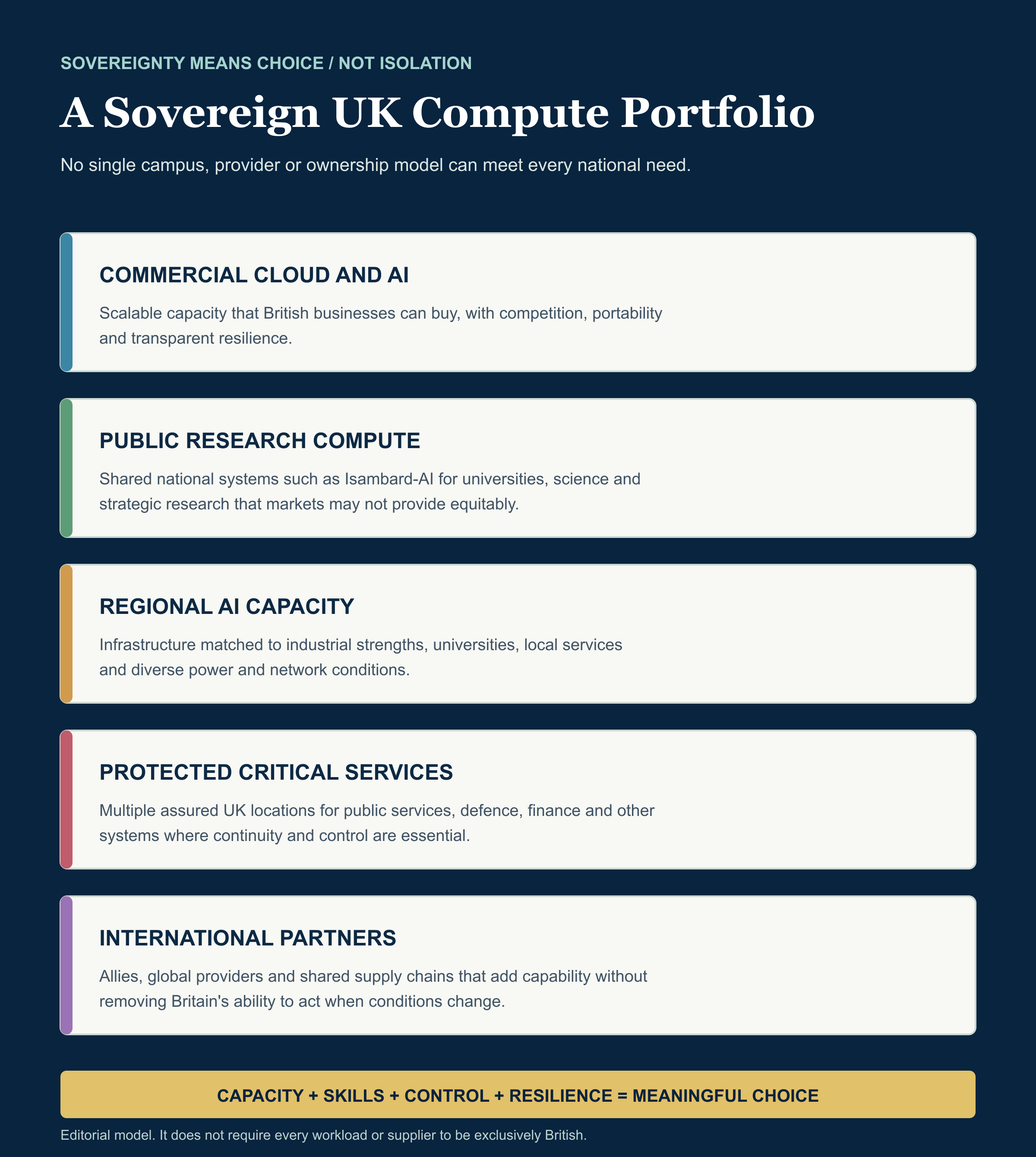
Digital sovereignty does not mean Britain must own every chip or host every workload within its borders.
It means having enough assured capacity, skills and control to make meaningful choices.
Physical location alone is not sovereignty. A UK facility owned and operated by a global provider can improve latency and resilience while still leaving questions about contract, jurisdiction, operational access, encryption keys, supplier concentration and exit.
For this article, assured control means some practical combination of reserved capacity for critical, public or research workloads; enforceable continuity and portability terms; clear operator-access and key-governance rules; multiple suppliers and sites; and the skills to move or operate workloads when circumstances change. Not every workload needs every control, but “the servers are in Britain” is not a complete answer.
A country that can run critical public services, research, defence, finance and industry on capacity it can govern has more resilience than one that can only buy whatever overseas suppliers choose to sell it.
The point is particularly clear for:
- NHS and public services, where continuity and sensitive information matter.
- Defence and national security, where control of infrastructure and supply chains matters.
- Financial services, where resilience, latency, regulation and confidence matter.
- Universities and science, where researchers need access to serious computing without every project depending on foreign commercial capacity.
- Start-ups, which need accessible capacity and a domestic customer and talent ecosystem.
- Advanced manufacturing, where simulation, robotics and industrial data meet the physical economy.
The UK's AI Research Resource is one example of the strategic layer. Isambard-AI in Bristol contains 5,448 NVIDIA GH200 chips and is described by government as the country's most powerful public compute system. That public capacity has a different role from commercial cloud, a regional inference site or a bank's resilient systems.
What makes a good AI data-centre site?
Not cheap land on its own. Not a large river on a map. Not a press release about renewable power.
A serious location decision should examine at least nine things:
- Fibre and latency. Are there diverse high-capacity routes, and how close must the workload be to its users?
- Grid capacity and firm power. Is the connection real, deliverable and resilient, or simply sitting in a queue?
- Energy source. Can the facility access low-carbon, renewable or nuclear power without confusing annual contracts with hour-by-hour availability?
- Water and catchment stress. What will the cooling design use on an average day and at the summer peak?
- Climate and cooling. Can outside air, closed loops or direct-to-chip liquid cooling reduce resource use?
- Land and expansion. Is there a brownfield site, former power station or industrial estate with room for the full campus?
- Skills and supply chain. Are universities, engineers, construction capability and specialist services available?
- Heat reuse. Is there a real nearby demand for low-grade heat, not just an attractive diagram?
- Security and resilience. Can the site withstand physical, cyber, climate and supply-chain disruption?
These are not nine boxes to tick once. They interact. A cooler location may reduce cooling energy but need more network investment. A former power station may have an excellent grid history but still require a new connection. A city location may have fibre and customers but lack land, water or firm power.
Britain does not need one winner
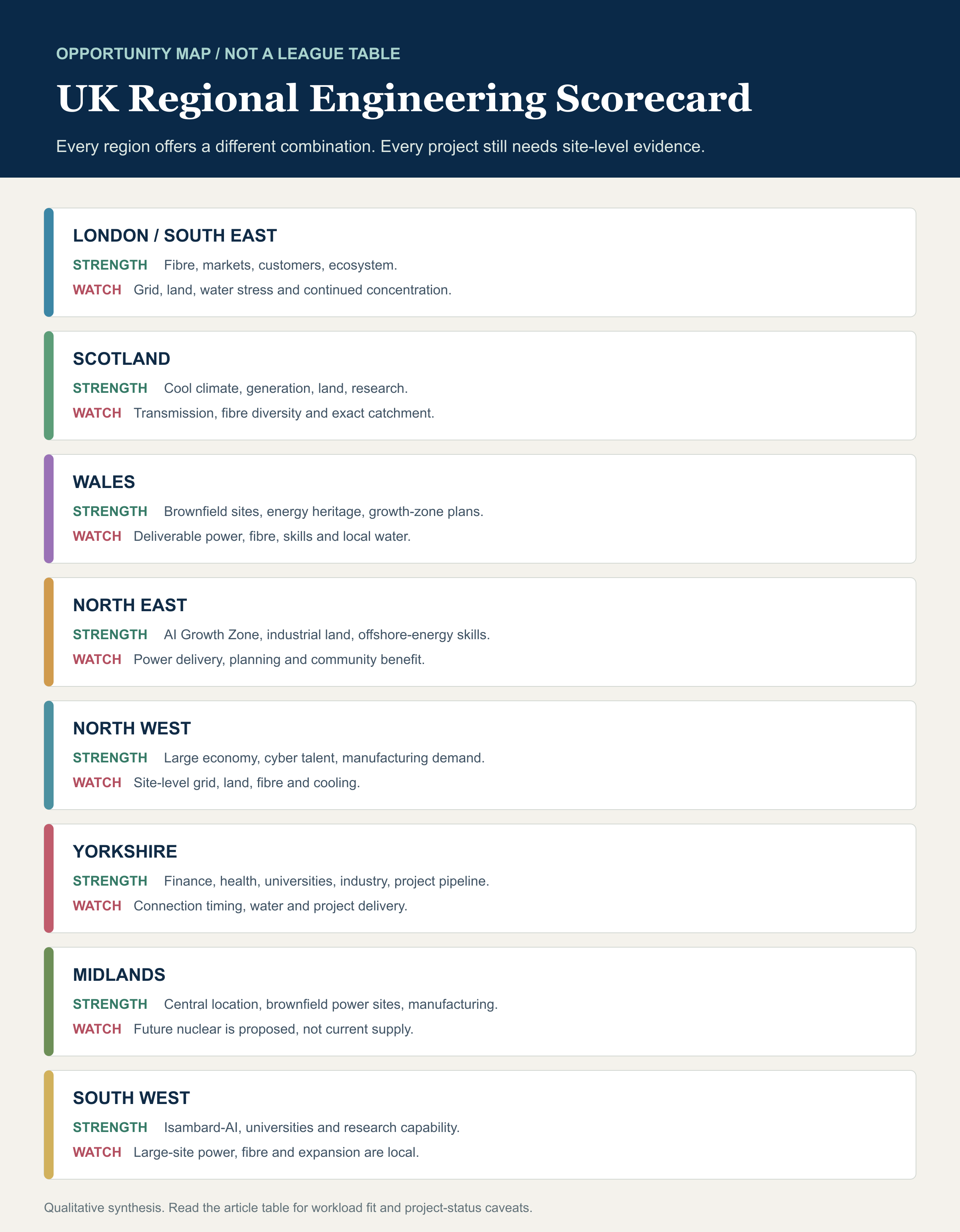
| Region | Potential strengths | Questions that still need answering | Workload fit to explore |
|---|---|---|---|
| London and South East | Dense fibre, financial markets, customers, established ecosystem | Grid congestion, land cost, water stress, continued concentration | Latency-sensitive services, edge, finance and inference |
| Scotland | Cooler climate, low-carbon generation, research capability, land | Transmission, fibre diversity, exact catchment, distance from some users | Training, batch, research and flexible large clusters |
| Wales | Brownfield and industrial sites, energy heritage, South Wales growth-zone plans | Deliverable grid capacity, fibre, skills pipeline, site-specific water | Mixed regional AI, industrial and training capacity |
| North East | AI Growth Zone plans, former industrial and port sites, offshore-energy ecosystem | Power delivery, planning, community benefit, announced versus committed capacity | Large clusters, industrial AI and regional cloud |
| North West | Large economy, digital and cyber talent, manufacturing and research demand | Grid and land at specific sites, fibre route diversity, cooling choice | Regional inference, industrial AI and resilient services |
| Yorkshire | Finance, health, universities, industry and a published hyperscale pipeline | Project delivery, connection timing, local water and community integration | Mixed inference, analytics, health and commercial cloud |
| Midlands | Central location, logistics, brownfield former power sites, manufacturing | Proposed nuclear supply is not current supply; grid and planning still matter | National services, manufacturing AI and future large clusters |
| South West | Isambard-AI, universities, science and public research capability | Large-site power, fibre and expansion are location-specific | Research compute, science and specialist AI clusters |
The public announcements show real momentum, but they need careful language.
Lanarkshire's AI Growth Zone announcement describes £8.2 billion of investment, more than 500 MW of on-site power and more than 3,400 jobs. The government's own split is important: about 800 are described as high-paying roles in AI research, coding and permanent operations; the remainder are mainly immediate construction roles. The numbers are announcement-stage estimates supplied through the programme, not observed employment.
Government describes potential investment of up to £30 billion across the North East technology programme, with more than 5,000 jobs. The Welsh Government describes a potential £10 billion South Wales AI Growth Zone around the former Ford Bridgend site and more than 5,000 construction and operational jobs. West Yorkshire's 2026 infrastructure pipeline includes a Microsoft hyperscale data-centre proposal.
At Cottam in the East Midlands, a former power-station site has been announced as the location of a proposed £11 billion nuclear-powered data centre. The nuclear supply and the campus are proposals, not operating infrastructure.
Announcements matter. They are signals of intent, not completed substations, trained workforces or running computers.
Power is the constraint we cannot wish away
DESNZ's current meter-matched estimate puts Great Britain's data-centre electricity use at 4.5 TWh in 2024, about 2% of grid consumption. It is labelled Official Statistics in Development and excludes enterprise data centres. Alternative methods produced materially different 2023 estimates, so the figure is a planning baseline rather than a perfect census. The UK Compute Roadmap's expected growth still takes us into a different scale of planning.
At the April 2026 AI Energy Council, NESO said 6 GW was broadly manageable by 2030, while recognising that growth beyond that needs more work. The same minutes noted around 125 GW of demand projects in the connection queue against a national peak demand of roughly 45 GW. Some of that queue is speculative.
So a developer saying “we have applied for a connection” is not the same as power being available.
The right response is not to stop building. It is to plan computing alongside generation, transmission, storage and flexibility.
The cost must also have an owner. Every major proposal should show which connection and reinforcement works are required, which costs fall to the developer, network or wider billpayer, what protects the queue from speculative capacity, and what happens if the promised load never arrives. Government connection reform explicitly recognises the billpayer cost of unnecessary reinforcement, while Water UK has warned that large peak-demand water connections can create costs that current charging does not always recover cleanly.
Data centres can be unusually steady users, which can support investment. Some workloads can also shift in time or place. A 2026 National Grid trial demonstrated an AI cluster reducing demand by more than a third in under a minute while preserving critical work. It is one industry trial, but it points toward data centres becoming active participants in the power system rather than passive loads.
Water still belongs in the decision
A country can need more data centres and still reject the wrong proposal.
As I explain in part one, the first water question is local peak demand and network headroom, not national market share. WRc found that the six largest analysed connections accounted for 65% of observed use. Water UK says headroom is only about 2% in many areas and individual connection requests can reach 21 million litres a day.
The extrapolated national public-supply estimate remains useful context: it is modest compared with the whole English non-household market, and many observed facilities use little or no water for cooling. But a stressed catchment cannot be rescued by a national percentage.
That is why the portfolio matters. Put latency-sensitive services near users. Put flexible power-hungry workloads where power, land, cooling and networks can support them. Build drought modes, closed loops and heat reuse into the design. Do not make every region imitate Slough.
The economic case is larger than the building
Data centres are capital-intensive. Once built, they do not employ as many people per square metre as a large office or factory.
We should be honest about that.
There are construction jobs, specialist operational jobs and supply-chain activity. But the larger prize is what accessible computing enables:
- research that can be carried out in Britain;
- AI companies that can grow here;
- manufacturers that can simulate, automate and export;
- public services that can modernise with resilience;
- financial services that remain competitive;
- universities that can attract people and projects;
- and businesses throughout the country that can become more productive.
A data centre is not valuable because a warehouse full of servers is beautiful.
It is valuable because of what people can do with the computing inside it.
Build a British compute portfolio
I do not think the answer is one enormous national campus. That creates its own resilience, grid and water risks.
I would rather see a deliberate portfolio:
- commercial cloud and AI capacity where British businesses can buy it;
- public research compute that universities and scientists can access;
- regional infrastructure matched to industrial strengths;
- protected, redundant capacity for critical public services;
- and international partnerships that add capability without removing our choices.
For each major site, publish the grid position, water position, full expansion plan, employment split, heat-reuse case, resilience design, community benefit, noise and air-quality effects, flood and biodiversity impacts, and the split of infrastructure costs between developer, network and public.
Then judge it on the evidence.
The real question is not whether Britain needs more data centres. Every AI service, cloud application, online bank transaction and digital public service already depends on them.
The question is whether the UK builds sufficient capacity itself, in appropriate places, with the power, water and resilience honestly accounted for.
Or whether we increasingly rent our digital future from somewhere else.
Sources and notes
Regional investment and jobs figures are presented as announced, potential or proposed where that is their status. They should not be read as completed investment or permanent operating employment.
- UK Compute Roadmap
- UK data centres as critical national infrastructure
- DESNZ Energy Trends, June 2026
- AIRR advanced supercomputers for the UK
- AI Energy Council minutes, April 2026
- DESNZ: accelerating electricity-network connections for strategic demand
- National Grid data-centre connection research
- National Grid AI flexibility trial
- WRc: Water Efficient Data Centres final report
- Water UK written evidence to Parliament
- Lanarkshire AI Growth Zone
- South Wales AI Growth Zone announcement
- North East technology investment announcement
- Cottam former power-station data-centre proposal
- West Yorkshire infrastructure pipeline, March 2026