If the finance director turned up at a supermarket board meeting and said, "We don't know how many stores we've got," there would be a pause. If they said, "We know the stores, but we don't know who can change the temperature of the freezers," there ought to be the same pause.
Patch the software. Require multi-factor authentication. Know which equipment is reachable from outside the business. None of that needs to wait for a discussion about AI. But someone on the board does need to ask whether it's actually happening.
What happened to the fridges
In October 2026, France's national incident response team, CERT-FR, reported numerous compromises of remote refrigeration controllers. It advised operators to take exposed management interfaces off the public internet, check the equipment's settings and restore remote access only over a protected connection.
The UK story was different. After the European incidents, researchers at Omega Solutions and Pen Test Partners identified and investigated a separate weakness in equipment from Resource Data Management (RDM). Pen Test Partners' first-hand account, published on 20 November, says some UK operators found exposed systems while others already used private or protected connections. It describes a rapid response involving retailers, the manufacturer and the National Cyber Security Centre (NCSC), and says RDM released updated firmware. How far warnings reached down the supply chain was still unclear. That account establishes exposure and a defensive response. It does not establish that exposed UK systems were compromised through the RDM weakness, or that a missing patch or second factor explains the European incidents.
Give the people who found and dealt with the issue their credit. Then ask the uncomfortable question: how would we know which of our critical systems are reachable from outside?
Patch it. Protect the login. Close unnecessary access.
We have had more than three decades to get into the habit of fixing known security holes. The internet's 1991 Site Security Handbook was already discussing who should fix them and citing Sun Microsystems' practice of distributing patches or workarounds promptly. I'm not saying today's authentication technology was standard in 1991. I'm saying the work of knowing what you run, fixing it and checking that the fix took is not new.
Start with supported software. Know who installs security updates and who verifies them. For ordinary business IT, Cyber Essentials v3.3 gives a concrete benchmark: qualifying security fixes must be applied to in-scope software within 14 days of release. That includes fixes the vendor rates critical or high risk, ones with a CVSS v3 severity score of at least 7, and security updates the vendor hasn't rated. That's a certification requirement for specified updates, not a universal legal deadline or a reason to wait 14 days on something urgent. For equipment that keeps a store running, have operations and the supplier agree a safe maintenance window and test the equipment and alarms after the change. If it can't be patched, restrict access now and give the replacement a budget and a date.
Make multi-factor authentication (MFA) a basic requirement. Start with email, cloud services, administrators and remote support, including suppliers. Require it rather than just offering it. For remote control of physical equipment, the NCSC recommends phishing-resistant MFA. If an old controller can't do it, protect the approved remote maintenance route instead and take the controller off direct public access. MFA protects a login. It doesn't fix vulnerable software or make an unnecessary connection worth keeping.
Keep the alarm working. NCSC guidance on connected equipment asks whether direct internet exposure is necessary at all. That doesn't mean pulling a cable and hoping somebody notices when the freezer warms up. Have operations and the supplier verify that temperature alarms still reach someone who can act, including overnight. Keep a fallback that doesn't depend on the same connection you've just taken out of service.
What I'd ask at the next board meeting
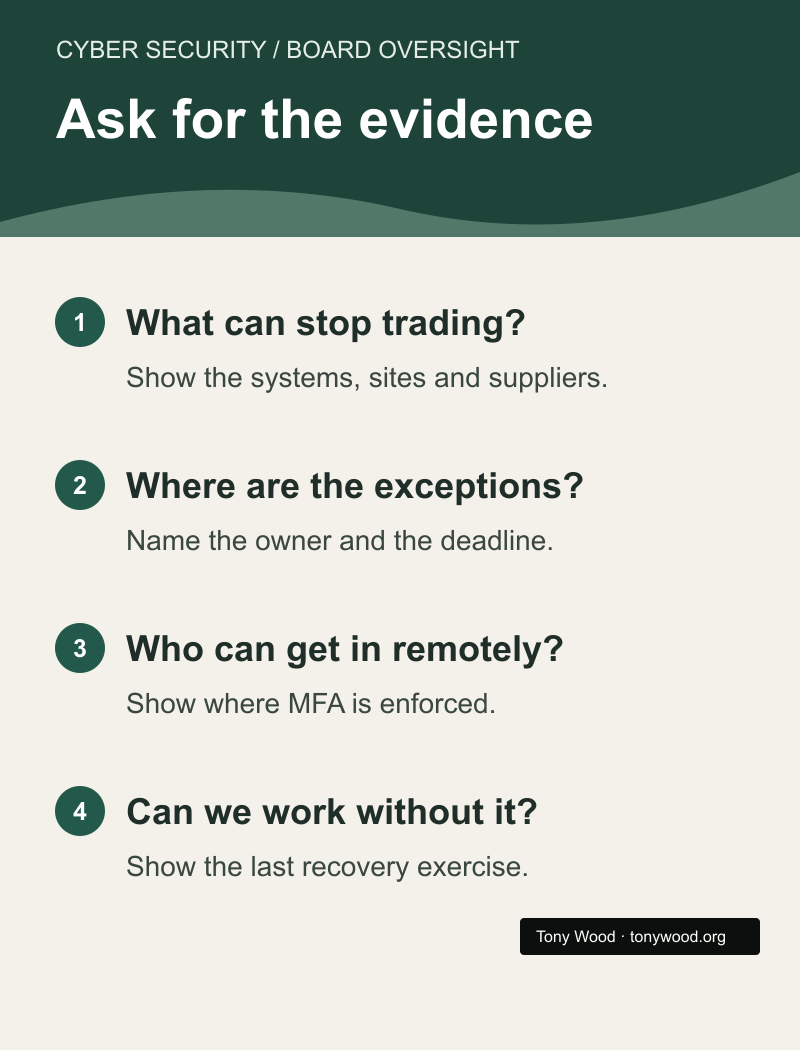
- What's in scope? Show me the systems that can stop us trading or make an operation unsafe. Include equipment in stores and warehouses, and dependencies operated for us by suppliers. Cross-check the list against actual sites and contracts. A patch report only counts the things it knows about.
- Where are the exceptions? Show critical fixes overdue, unsupported equipment still in use and accounts without enforced MFA. Tell me how many assets or accounts were checked, what wasn't checked, and the owner and expiry date for each material exception.
- Who can get in from outside? Ask for evidence that contractors use named, appropriately limited access and that access can be withdrawn when the job or contract ends. Write update support, security notices and remote access into procurement and renewals.
- Can we run the business without it? Pick a site and rehearse loss of remote access. Who gets the alarm? Who makes the operational decision? When did we last test recovery, and what did we change because of it?
Management should bring those answers. The board should decide which exceptions it will tolerate, for how long, and what it will fund to close them. The UK Cyber Governance Code of Practice calls for senior ownership, supplier assurance, exercises and formal reporting at least quarterly. The NCSC's board toolkit gives examples of measures, including time to apply high-risk fixes. For a small business, start with a list, an owner and a date. For a supermarket chain, sample the evidence from stores, warehouses and suppliers rather than relying on a single group-wide percentage.
Boards need enough knowledge to challenge the answer
In my view, this is a governance failure wherever a board hasn't asked for evidence on controls protecting a critical operation. The public accounts don't tell us what every supermarket board knew, what it was told or what decisions it made. But if a board never asks about patching, access and recovery until an incident puts them on the agenda, it isn't doing its job.
I think part of the problem is how little security, data and AI knowledge some boards expect of themselves. Directors don't all have to be security specialists. They do need enough understanding to challenge an answer: where did that number come from, what did it leave out, and who can change the thing we're measuring? The UK code already asks directors to build their own cyber literacy. I'd go further and make data and AI literacy part of board development, too.
Before approving an AI tool that reads operational data or takes action, ask which information it can see, what it's allowed to change, who approves consequential actions and who can stop it. That's the same conversation as the one about the engineer logging in to the refrigeration system. Give people and software the access they need to do the job, and no more.
By all means put AI on the next board agenda. Just leave enough time to ask who patches the fridges, and how do we know?
Sources and notes
The French alert and the UK researchers' account describe different events. The latter is first-hand evidence from participants in the response, not an audit of every retailer or a finding about any named board. Sources checked on 21 November 2026. For more on proving that critical services can keep running when a dependency fails, see The Microsoft Outage Is a Concentration-Risk Warning.