Agentic First for Europe · First weekly issue
I’ve been watching what Europe is actually shipping in AI, robotics and the chips underneath. Over the past couple of weeks, a few announcements stood out, especially if you’re putting agents to work and want some say over the tools you rely on.
Europe can build serious capability. The open question is who ends up owning it, and how much room a British or European organisation has to keep using it if ownership, terms or political priorities change.
Models you can put to work and inspect
At the end of October, Mistral released the weights for Mistral Large 4, a roughly trillion-parameter model trained on European infrastructure that can work with text and images. You can use Mistral’s API or download the weights and run the model on your own infrastructure. The open-weight licence adds a commercial licensing condition for model-as-a-service businesses, with exceptions for internal use and access through official Mistral products.
In early November, Mistral expanded Studio with managed agents, apps and more tools for building workflows. Its managed agents are in public preview. Teams can connect an agent to their systems through MCP servers and set boundaries around what it may do. Mistral’s documentation says agents and workflows can run on your infrastructure or Mistral’s cloud. Studio apps run on Mistral’s cloud, and its built-in tracing and evaluations are available at the Enterprise tier. That’s the bit I’d check for a real workflow. Where does it run, and what can you see afterwards?
Robots at scale, and a reminder about ownership
Munich-based Agile Robots said it raised US$500 million at a US$8.5 billion valuation in a SoftBank-led round. Its plans include adding production capacity in Germany. On 17 November, Genesis AI, which operates in Paris and San Carlos, California, announced a US$500 million Series A at a US$3.5 billion post-money valuation. It intends to use the funding to deploy its Eno robot at scale.
Then the ownership question returns. On 18 November, US firm Rockwell Automation announced an agreement to buy AGILOX, an Austrian maker of autonomous warehouse robots. The deal is subject to regulatory approval and other closing conditions. The proposed sale of ABB’s robotics business to SoftBank, agreed in October 2025 at a US$5.375 billion enterprise value, also remains subject to approvals. In its 5 November update, ABB said it had been told the acquisition of the robotics business in China was prohibited and that the parties were still working on the transaction.
Sweden’s Einride reported daily operation of a cab-less Level 4 truck on a German public road with Lidl, under a permit for that project. Its contracted annual recurring revenue reached about US$167 million in November. Its September-end cash balance was US$53 million, down from US$77 million in June. The road deployment is interesting. I’d still want to understand how the company plans to fund wider rollout.
Chips and a firmer British stake
On 11 November, the UK government said its Sovereign AI fund and the British Business Bank had backed Fractile, a Bristol and London chip developer, as part of a round worth more than £500 million that valued the company at over £5 billion. That’s a sizeable bet on designing AI hardware in Britain. The next thing I’d watch is when customers can use the chips.
In Dresden, Sparxity said its Series A brought cumulative funding to US$90 million. At the component level, Belgium’s Melexis announced a fingertip force sensor and evaluation kit for robotic hands. Munich’s SCHUNK spin-off now operates as TACTILIA Robotics and is developing modular hands for production and logistics. Those are pieces of the supply chain worth watching in their own right.
Policy is moving
On 13 November, EU leaders discussed AI and European competitiveness in Dublin. The EU’s proposed Cloud and AI Development Act aims to strengthen Europe’s cloud and AI capacity. The Irish Presidency’s progress report records November work on draft provisions covering autonomy. A separate AI Act milestone on 2 December includes a transition deadline on synthetic-content marking for certain providers whose systems were already on the market before 2 August 2026. A law can set the terms. I still want to know what choices a team can use on Monday morning.
From the Agentic First directory
The 23 November update added seven entries to the Open Tool Directory. Two give a sense of the day-to-day possibilities. Factbird documents read-only access to factory production data. Performativ’s opt-in beta offers read-only access to portfolio data for staff the firm authorises. These connections matter because an agent needs a reliable route to the information the job depends on.
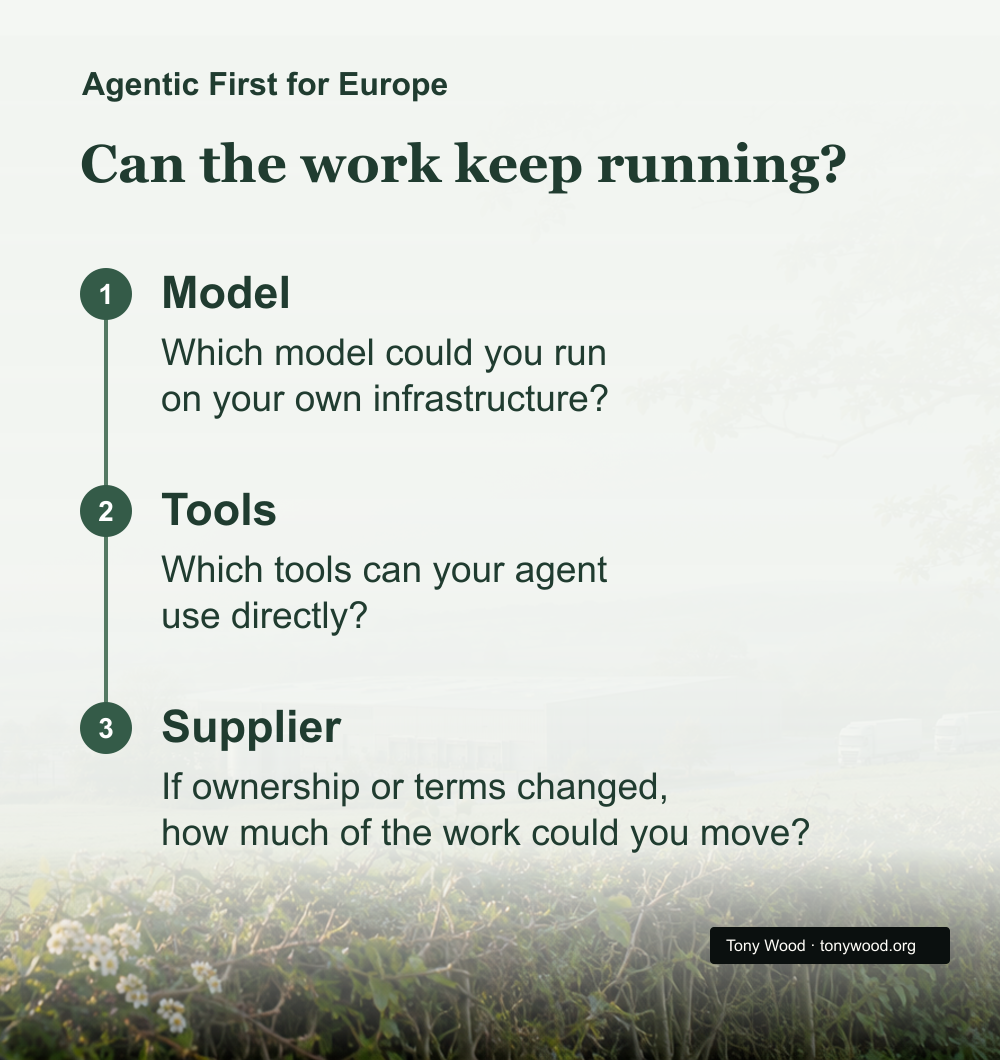
If you’re putting this into practice, I’d start with one process your team needs to keep running. Which model could you host yourself? Which tools can your agent use directly? And if a supplier’s ownership or terms changed tomorrow, how much of that process could you move?
Sources and notes
The first weekly issue covers developments reported in November 2026, with Mistral’s late-October model release as context. Funding, valuation and deployment figures are attributed to the announcements linked above. The directory examples are based on Factbird’s documentation and Performativ’s documentation. Start with What Is Agentic First? for the series introduction.