I keep seeing the same pattern.
As more people get access to better AI models, they can suddenly do more. They can write the proposal. They can create the briefing. They can build the spreadsheet. They can produce the report. They can get the first version of the CRM update, the sales note, the board paper, the workflow, the training document, or the landing page.
That is good.
But it also creates something interesting.
A lot of the work starts to look the same.
Not because people are boring. Because the tasks are similar. We already knew this, really. That is why we have CRM, ERP, CMS, word processors, spreadsheets, ticketing systems, slide decks, email clients, finance systems, HR systems, and project tools. Business has always had repeatable shapes.
AI is not creating that sameness. It is revealing it.
The useful homogenisation
I do not think this is automatically bad.
In fact, a lot of homogenisation is useful. If everyone can get a decent meeting brief, a clear proposal, a structured report, a coherent plan, and a clean first draft, that is a huge improvement.
It means fewer people are stuck behind the blank page.
It means more people can get the work into a shape they always wanted but could not easily produce.
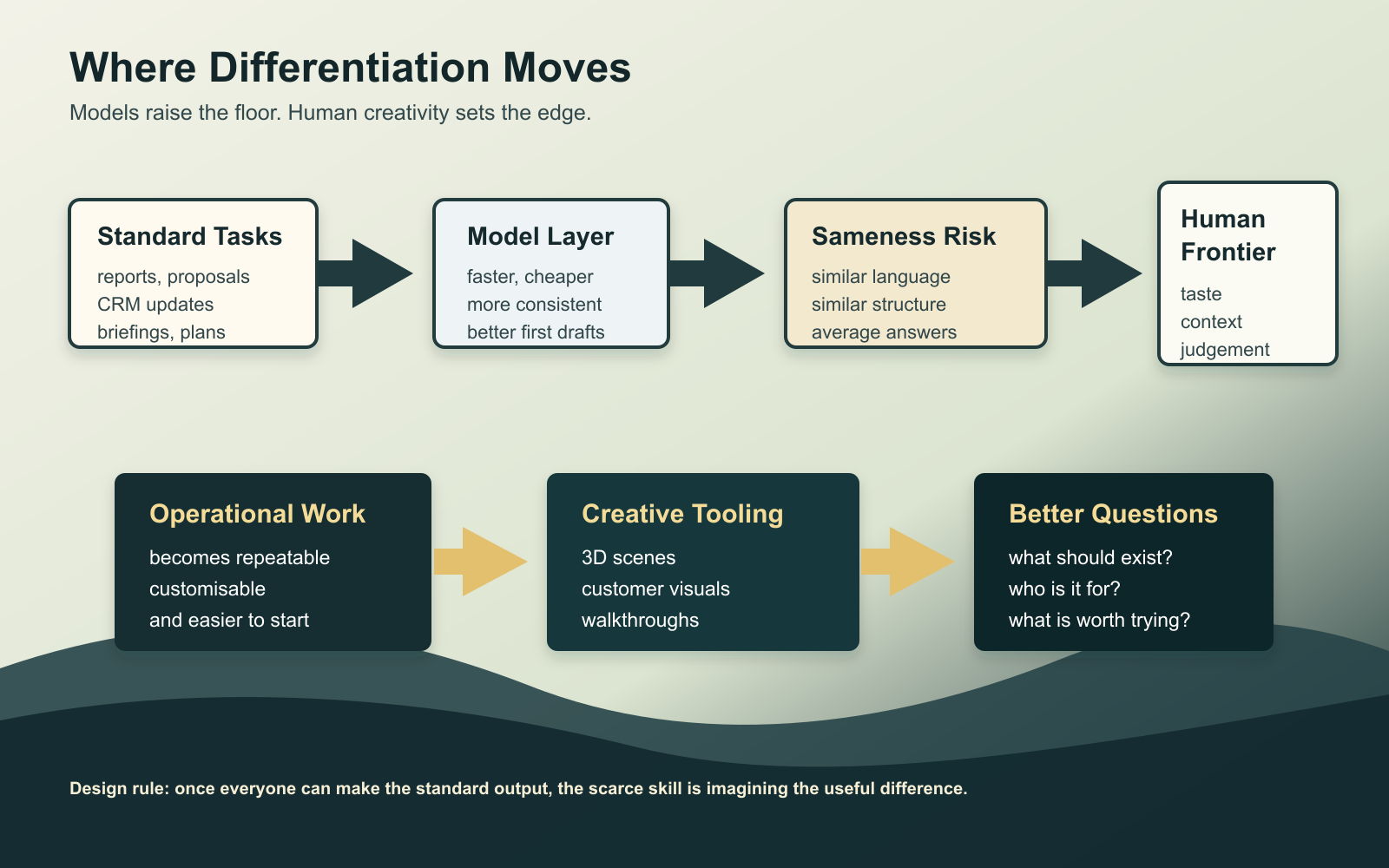
It means the standard operational work gets cheaper, faster, more consistent, and more personal.
This is exactly why I created the Personal Chief of Staff Twin training. A lot of people need the same starting pattern: inbox triage, briefings, file review, meeting prep, memory retrieval, tone-aware drafting, research, and follow-up. The work is personal to each person, but the operating shape is familiar.
That is the point.
The model helps us finally get the standard work done.
Then the question changes.
Once everyone can produce the report, where do you make the difference?
The sameness risk
We are going to see a lot of proposals that look alike.
A lot of reports that feel alike.
A lot of briefing packs with the same structure, the same confident tone, the same risk table, the same tidy executive summary, the same rhythm of "context, challenge, recommendation, next steps".
Again, that is not necessarily a failure. Sometimes a clear standard is exactly what we need.
But there is a risk.
If everyone uses the same frontier models, asks similar questions, relies on similar defaults, and accepts similar outputs, the work can drift toward the average.
There is research pointing in this direction. One study in Science Advances found that access to generative AI improved individual creative output in a writing task, especially for less naturally creative participants, but reduced the collective diversity of the stories produced. That is the tension in one sentence: individual uplift, collective convergence.
Other researchers are now looking at homogenisation in AI-assisted writing, including admissions essays, and at the broader tendency for AI-mediated output to narrow variance or pull work toward a kind of middle.
That feels right to me.
AI can raise the floor.
But it may also pull a lot of people toward the same ceiling unless we bring something else to the work.
Human creativity trumps frontier models
This is where I think the next frontier sits.
Not in having access to a model. Increasingly, everyone will have access to something capable.
Not in producing the standard report. The model will do that.
Not in getting a clean first draft. That will become normal.
The differentiator becomes human creativity.
What do you imagine?
What do you notice?
What do you know about the customer that does not appear in the generic prompt?
What is your taste?
What is the strange idea that is worth trying?
What can you combine that other people would keep separate?
What do you decide to make now that the cost of making has fallen?
The 3D example
The place I keep thinking about is 3D.
I was watching what is happening around Unreal Engine and MCP. Epic now documents experimental MCP server support in Unreal Editor, with a clear warning that it is intended for local host access and should not be exposed more widely. Blender also has an MCP server project that connects natural language to Blender's Python API.
That matters because creative tooling is becoming agent-addressable.
I played a little with Blender MCP. The idea of MCP inside Unreal is even more interesting because Unreal sits so close to the world of real-time environments, walkthroughs, simulation, games, architecture, product visualisation, planning, and digital twins.
I remember working in the 1990s for a company where a whole business existed around creating 3D models of supermarkets. It was specialist work. It was expensive. People paid serious money for it because only certain teams had the tools, skills, and time to make it happen.
Now imagine that capability becoming far more available.
A website does not just show a flat case study. It shows a customer-specific 3D model.
A proposal does not just describe a shop fit-out. It gives the client a walkthrough.
A housing plan does not just include drawings. It includes a generated scene that a resident, councillor, planner, or buyer can actually understand.
A product page does not just say "this will fit your space". It shows the thing in something that looks like your space.
A daily briefing does not only contain words. It can generate a visual model of what changed.
This is where human creativity starts to matter more, not less.
The tool can help make the scene.
The human still has to ask for the right scene.
Planning, housing, and public imagination
Take planning permission.
One of the problems with planning is that ordinary people often cannot understand what is being proposed. They see documents, elevations, tables, traffic notes, and consultation packs. Some people can read them fluently. Many cannot.
What happens when it becomes cheap to create a clear 3D walkthrough?
What happens when a resident can see the shadow, the sightline, the road, the path, the shopfront, the bus stop, the entrance, the green space?
What happens when a council can ask for multiple visual alternatives without spending months and huge sums?
What happens when a developer can explain a scheme better, earlier, and with more public comprehension?
This does not remove the need for professionals. It does not remove design, engineering, planning law, environmental assessment, safety, accessibility, procurement, or public accountability.
But it may reduce the cost of visual exploration.
And reducing the cost of exploration changes what is possible.
The new premium
So yes, frontier models matter.
Better models will make standard work easier. They will help people who have ideas but could not easily write, model, present, calculate, visualise, or organise them. That is a huge social good.
But as the model layer improves, the premium moves.
It moves to taste.
It moves to imagination.
It moves to context.
It moves to knowing what good looks like.
It moves to the person who can say, "Yes, that is the standard answer, but what if we tried this?"
The model can make the work faster.
The human still has to make the work worth doing.
The hopeful bit
I am optimistic about this.
Because if the standard tasks become easier, we get to spend more time at the edge.
Less time trying to make the document exist.
More time asking what it should become.
Less time producing the same old proposal.
More time making something the customer can actually see, feel, test, and understand.
Less time fighting the blank page.
More time using the blank page as a door.
That is the exciting bit for me.
The frontier is not only better models.
The frontier is better human imagination, with tools that can finally keep up.
Sources and notes
This is an opinion piece informed by research on generative AI and output diversity, current documentation for Unreal MCP in Unreal Editor, and Blender's MCP server project. The practical point is not that MCP makes everyone a 3D professional overnight. The point is that creative tooling is becoming more addressable by agents, which lowers the cost of trying ideas.
- Science Advances: Generative AI enhances individual creativity but reduces the collective diversity of novel content
- ScienceDirect: LLM output homogenisation evidence in admissions essays
- Big Data & Society: AI and regression toward the mean
- Epic Games: Unreal MCP in Unreal Editor
- Blender Foundation: MCP Server