No, not as a company-wide ban. The evidence points to restrictions on certain AI coding tools, not Goldman Sachs abandoning AI.
That distinction is the story. “Stop using AI” and “not everyone should have the same tools” are rather different decisions. If we collapse them into the same headline, we miss the useful question: what did the bank actually change?
What actually changed?
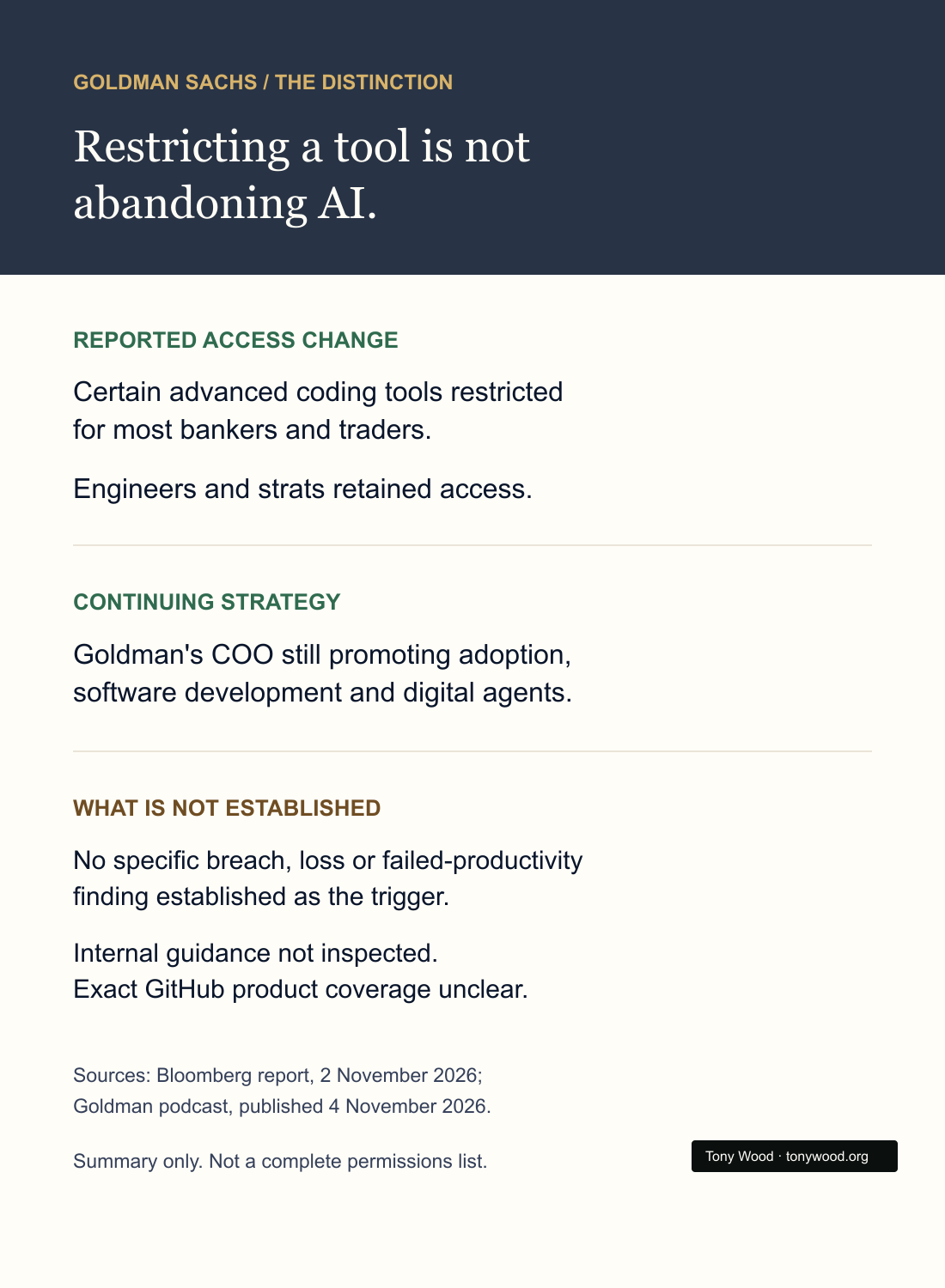
Bloomberg reported on 2 November 2026 that internal guidance updated in October restricted advanced coding tools for most bankers and traders. It named Anthropic's Claude Code and Microsoft/GitHub tools. Engineers retained access; “strats”, combining quantitative, trading and engineering work, were reportedly exempt. The precise GitHub product coverage was not clear.
Goldman spokesperson Nick Carcaterra described experimentation followed by assessment of productivity and risk management, then decisions about which employees should retain the tools. That is the stated explanation. Bloomberg's report, republished by Moneycontrol.
So this is not a story about a bank discovering that all AI is useless. Nor should we pretend nothing changed. Taking a capability away from people who were using it is a real restriction, even when the wider technology strategy remains in place.
The strongest counterpoint comes from Goldman itself
In a Goldman Sachs podcast recorded on 3 November and published on 4 November 2026, President and COO John Waldron described four parts of the firm's AI strategy: employee literacy and adoption, software development, automation through digital agents, and tools for clients. He said coding was already an area of productivity gains and anticipated greater AI deployment in 2027. These are management's statements and expectations, not independently measured results. Read Goldman's transcript.
The timing matters. Those remarks were recorded the day after the restriction was reported. They are difficult to reconcile with the idea that Goldman had told the whole organisation to stop using AI.
But the podcast is not a permissions list. It does not tell us which individual employee can use every model, integration or feature. Broad support for adoption and specific limits on access can exist at the same time.
Why would a bank draw that line?
Here is where we need to separate evidence from interpretation.
Goldman's 2025 Form 10-K identifies AI risks including inaccurate outputs or actions, disclosure of confidential information, bias, intellectual-property problems and difficulty understanding how a model reached an answer. It also discusses reliance on third-party models. Those are disclosed categories of risk, not findings that any particular employee or tool caused a loss. Goldman's 2025 Form 10-K, AI risk section.
Its quarterly report for the period ending September 2026, filed on 2 November, describes a Firmwide Artificial Intelligence Risk Committee co-chaired by the CIO and chief risk officer. That establishes an oversight structure. It does not identify who authorised this particular access restriction. Quarterly report; SEC filing record.
My reading is that the interesting boundary is between experimenting with an idea and taking responsibility for software that a business relies on. That is an interpretation, not a reconstruction of Goldman's internal decision meeting.
Think about a hypothetical tool that helps a colleague analyse information. The colleague may have a very good idea and produce something useful. Before a firm relies on it, though, someone needs to ask:
- What information can it access, and what can it change?
- How will we check that its answers and calculations are right?
- Who owns it when the creator changes role or leaves?
- How will updates, failures and recovery be handled?
- Does the benefit survive the cost of checking, supporting and maintaining it?
Those are questions I would want answered. They are not a list of failures Goldman has admitted to finding.
A useful demo is not the finished product
Goldman's Chris Churchman had already discussed this distinction in an official podcast published on 24 August 2026. He contrasted impressive demonstrations with dependable institutional products, emphasising reliable grounding, traceable information and work that supports rather than replaces human reasoning. Building AI Systems for Capital Markets.
That is useful context. It is not proof that his concerns caused the October decision.
There is a reasonable operational argument here: a tool can save its creator time while leaving somebody else with substantial review or support work. If that happens, the organisation needs to measure the whole result, not simply the speed of the first demonstration.
Equally, restricting access has a cost. It can reduce experimentation and make business users more dependent on a technical queue. A sensible control should therefore come with a route for useful ideas to be assessed and developed, not simply a closed door.
Whether Goldman has struck that balance well is a separate question. The public evidence available here is not enough to score its internal decision.
Do not mix this up with Hong Kong
There was a separate story in April. Reuters reported on 29 April 2026 that Goldman had removed Claude access for bankers in Hong Kong, while other models, including Gemini and ChatGPT, remained available on its internal platform. Reuters said it could not independently establish the reason; it attributed the contract-interpretation explanation to the Financial Times. That was a different, location-specific restriction, not evidence of a worldwide ban on all AI. Reuters report.
Same bank. Related technology. Different access decision. Joining the two together without their dates and scope would make the story less accurate, not more complete.
What we still do not know
I have not inspected the October internal guidance itself. The public reporting is the basis for describing it; it is not the same as having the complete policy.
The material reviewed does not disclose the full entitlement matrix, the precise implementation date, the decision-maker, the productivity measurements or the treatment of previously created tools. Nor does it establish a specific security breach, erroneous trade or regulatory instruction as the trigger.
That leaves room for questions. It does not give us permission to fill in the gaps with a dramatic explanation.
For example, saying the bank considered risk is not the same as saying an incident occurred. Saying it assessed productivity is not the same as saying it proved AI reduces productivity. And a report referring to GitHub does not establish a ban on the entire GitHub platform.
The real story
My conclusion is that this is a story about the boundaries of AI adoption: which capabilities, for which roles, with what ownership and controls.
I would resist both easy readings. “AI has failed” is not supported by the evidence. But “there is no problem, let everyone carry on” would ignore the responsibility that comes with building things a business may depend on.
Being positive about AI does not require being casual about how it is used. The useful discussion is about making experimentation and dependable delivery work together.
That is a much more interesting story than simply saying Goldman told everyone to stop.
Sources and notes
Evidence checked on 6 November 2026. The internal guidance was not inspected. Company statements and risk disclosures do not establish a specific incident or the reason for an individual decision. Interpretation is labelled separately.
- Goldman restricts traders and bankers from using some AI tools.
- John Waldron on GDP Growth, AI, and the M&A Outlook.
- Building AI Systems for Capital Markets.
- Goldman Sachs 2025 Form 10-K: AI risk section.
- Goldman Sachs September 2026 Form 10-Q.
- SEC filing detail for Goldman Sachs Q3 2026 Form 10-Q.
- Goldman cuts access to Anthropic's Claude for Hong Kong bankers, source says.