I saw a fascinating demonstration shared by David Usher on LinkedIn.
Words appeared one at a time, always in the same place. One letter in each word was picked out in red, giving the eye a fixed point. Instead of moving across a line, down a page, and back to the beginning of the next line, the words came to the reader.
David described himself as dyslexic and said the approach had changed his experience of reading. I immediately wondered whether we could offer something similar to readers on TonyWood.org.
It is a brilliant idea to test.
But the first question matters: is this specifically for dyslexic readers?
The honest answer is no.
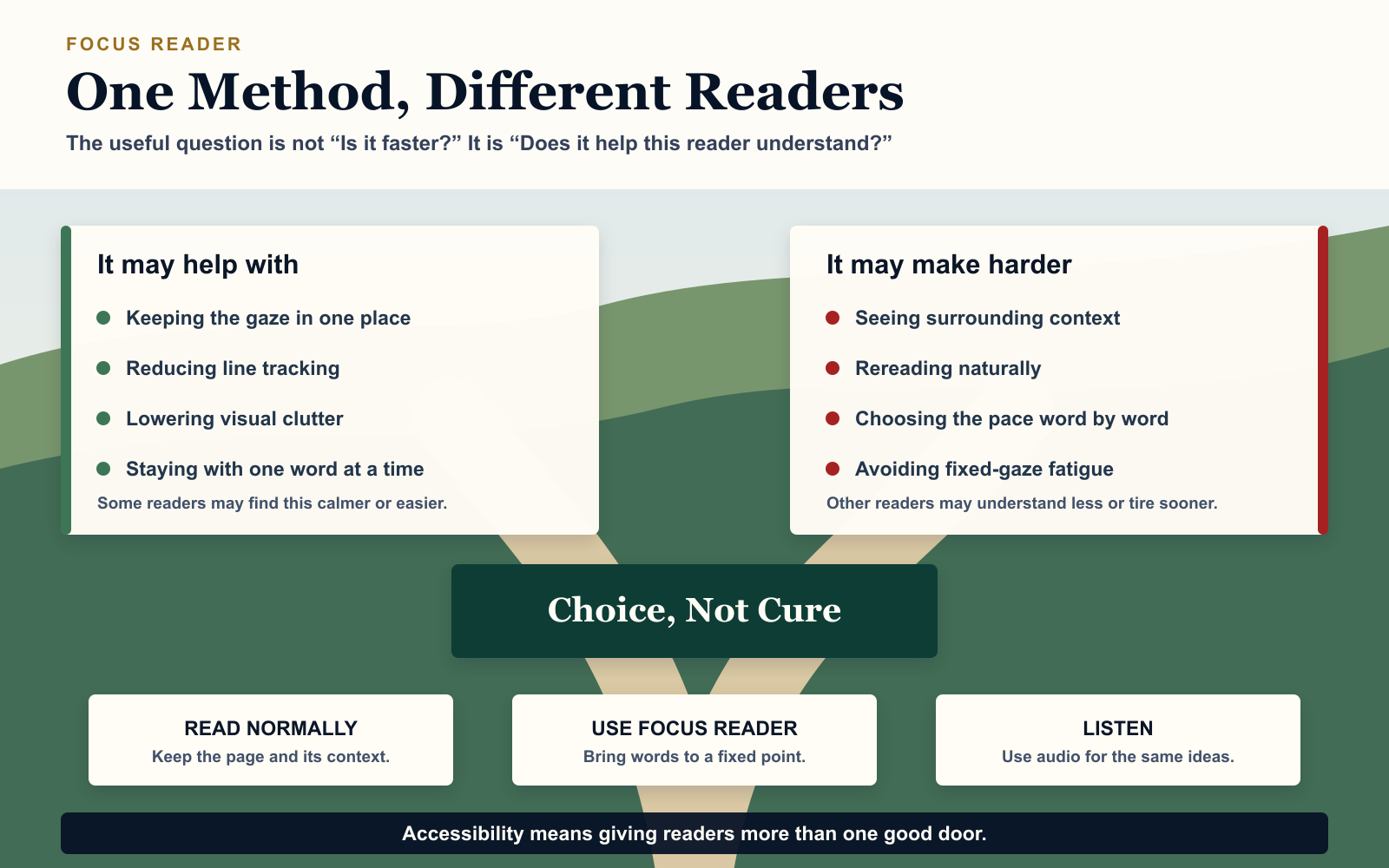
It may help some people with dyslexia. It may also help some people who find pages visually busy, lose their place, experience reading fatigue, or simply prefer information in smaller pieces. Other readers may find it slower, more tiring, or much harder to understand.
So this is not a cure, a diagnosis, or a promise of superhuman speed. It is another reading option.
What is happening on the screen?
The technique is usually called Rapid Serial Visual Presentation, or RSVP. Rather than displaying a whole paragraph, it presents words in sequence at a fixed location.
Some versions add an anchor letter, often called an optimal recognition point. The word is positioned around that point so the reader's gaze can remain relatively still.
That changes the mechanics of reading. The eye does less travelling. The page contains less visual clutter. There is only one word competing for attention at a time.
I can see why that might feel liberating.
I am dyslexic. For much of my life, writing felt like a locked door. In Thank You, Mum, I wrote about the hours my mum spent helping me read and write, and about how AI has finally helped me express ideas that were always there.
Anything that gives people another route into words is worth taking seriously.
Try Focus Reader
I have called this experiment Focus Reader. I prefer that name to speed reader because speed is not the only outcome that matters. Understanding, comfort, confidence, and the ability to return to the text matter too.
Start slowly. Pause whenever you need to. Then open the normal text underneath and compare what you retained.
Interactive experiment
Try one word at a time
Nothing moves until you press Start. Begin at 225 words per minute, then adjust it to suit you.
Ready
Word 1 of 1
Compare with normal text
Reading is not one single experience. Some people like to see a whole page so they can move backwards, notice structure, and connect one sentence with another. Other people find the page crowded and lose their place. Focus Reader brings each word to one fixed point. It may reduce line tracking and visual clutter, but it also removes some context. There is no correct result here. Try it slowly, pause when you need to, and notice whether you understand the passage as well as when you read it normally. The useful question is not whether this method is faster. It is whether this reading option helps you.
Important: This is an experimental reading option, not a test or treatment for dyslexia.
Why it might help some dyslexic readers
Dyslexia is not simply a problem with eyes moving across a page. The International Dyslexia Association's current definition describes persistent difficulties with word reading and spelling involving accuracy, speed, or both. Phonological processing is one important part of that picture.
Dyslexia is also not identical from one person to the next.
For a reader whose difficulty includes losing their place, crowded layouts, or the effort of navigating lines, a fixed presentation could remove some friction. The reader no longer has to find the next line or hold their place while the eye moves.
That does not mean it changes the underlying difficulty with decoding or language. It changes the way the text is presented.
That distinction is important. A useful accessibility option does not need to be a treatment to be valuable.
What we lose when words arrive alone
Traditional reading is not a simple conveyor belt. We look ahead. We glance backwards. We slow down for a difficult sentence. We use the shape of a paragraph, punctuation, headings, and surrounding words to help us build meaning.
RSVP takes some of that control away.
Research comparing Spritz-style RSVP with ordinary reading has found that comprehension can be lower, especially as speed rises or the material becomes longer. Removing natural rereading and the visual context around a word can make it harder to recover meaning. Some readers also report fatigue from holding their gaze in one place.
A separate study found comprehension becoming more difficult above roughly 250 words per minute, even with relatively short text. That is why this demonstration starts at 225 words per minute, not at the dramatic speeds used in social videos.
The popular claim that everybody can suddenly read many times faster is not supported strongly enough for me to repeat it.
The better claim is smaller and more useful: this presentation may make reading feel more manageable for some people.
Choice, not cure
Good accessibility is rarely about finding one special design and forcing everybody to use it.
The British Dyslexia Association's style guidance recommends clear structure, readable typography, sensible spacing, and good contrast. Those choices improve the ordinary page rather than replacing it.
Focus Reader should sit alongside those basics. It should also sit alongside audio.
For me, the useful future is:
- Read normally when the page and context work for you.
- Use Focus Reader when a fixed point and smaller visual field feel easier.
- Listen when audio is the better route into the same ideas.
Nobody should have to prove a diagnosis before choosing the format that helps them understand.
The controls matter
Any moving-text feature must remain under the reader's control. The W3C's accessibility guidance requires a way to pause, stop, hide, or control automatically updating information. That is why this version never starts on its own.
The reader chooses the speed. They can pause immediately, restart, return to the previous sentence, or open the original text. The rapidly changing word is hidden from screen readers so it does not create a torrent of announcements; the ordinary passage remains available as semantic text.
Those details are not polish. They are the feature.
What I would like to learn
I do not want to roll this across every article and assume the problem is solved.
I would rather begin with an experiment and ask better questions:
- Does it help readers stay with an article?
- Which speeds feel comfortable rather than impressive?
- Do readers understand and remember the same amount?
- Does returning by sentence provide enough control?
- Do dyslexic readers want different controls from other readers?
- Would sentence-at-a-time or phrase-at-a-time presentation work better?
The important thing is to ask readers, not design a feature for them from a distance.
Give people another door
This is personal for me.
For years, our systems treated one particular ability to read and write as the entrance ticket to ideas, work, complaints, services, and influence. If you struggled with the format, society often assumed you struggled with the thinking.
AI has already given me another way to produce words. Audio gives me another way to receive them. Perhaps a Focus Reader can give some people another way through a page.
It will not be right for everybody.
It does not have to be.
Accessibility is not one perfect door.
It is making sure more people can get in.
Sources and notes
- David Usher's Focus Reader demonstration on LinkedIn
- International Dyslexia Association: 2025 definition of dyslexia
- British Dyslexia Association: Dyslexia Style Guide
- Benedetto et al.: RSVP and Spritz reading, comprehension, and visual fatigue
- Benedetto et al.: Reading speed and comprehension in RSVP
- Liu et al.: Modern speed-reading apps do not foster reading comprehension
- W3C WCAG 2.2: Pause, Stop, Hide
- Systematic review of web accessibility for people with dyslexia