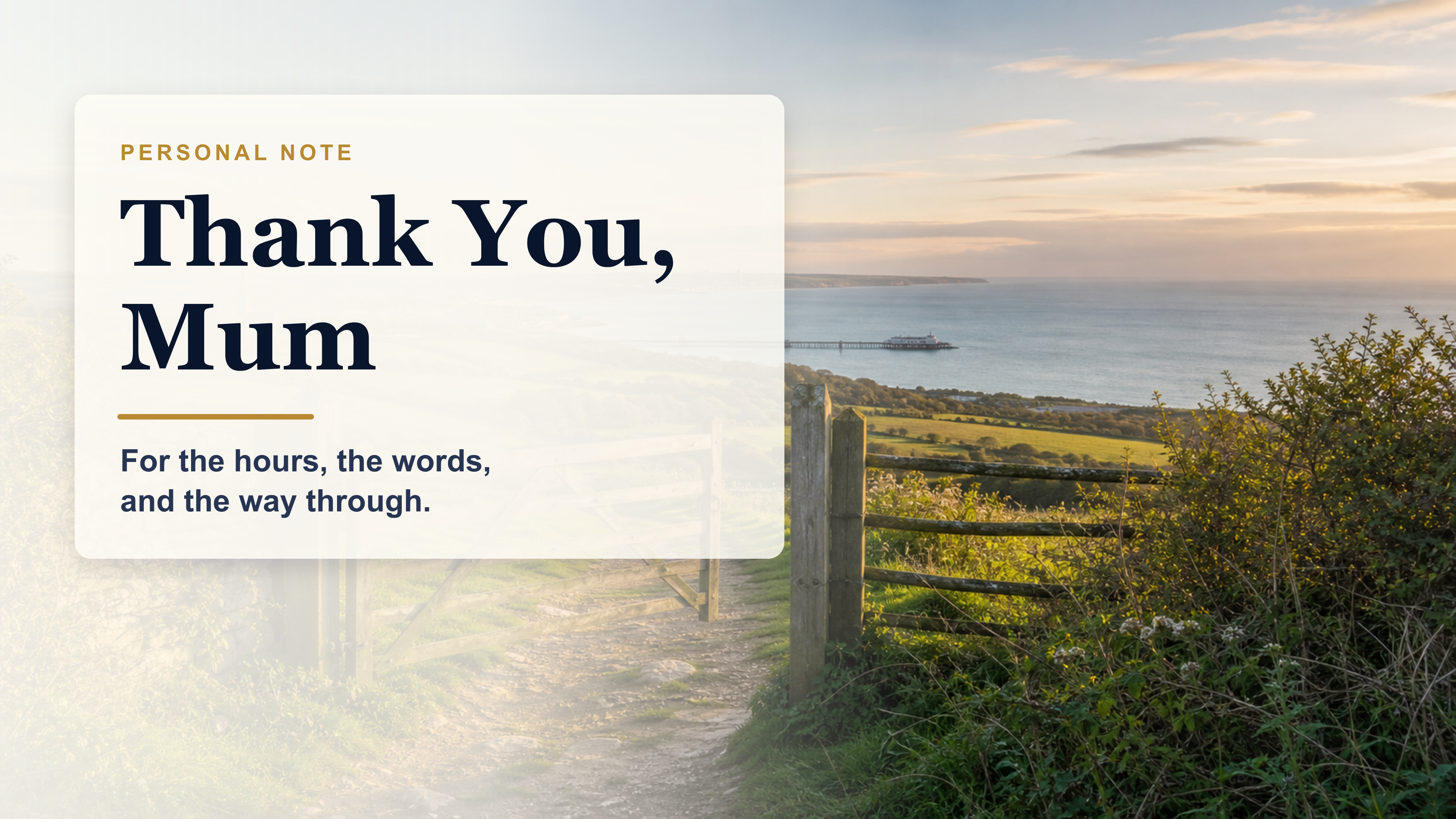
This is a thank you to my mum.
Not because she had a social media account I can tag. Not because there is a neat digital trail of everything she did. There is not. Like a lot of people who quietly change a life, much of what she gave me happened in ordinary rooms, in ordinary evenings, when nobody was watching.
When I picture this thank you, I picture Somerset countryside and Brighton sea. A gate looking out over the water. Somewhere quiet enough to stop, look back, and see the path she helped make possible.
She helped me read.
She helped me write.
And she fought for me.
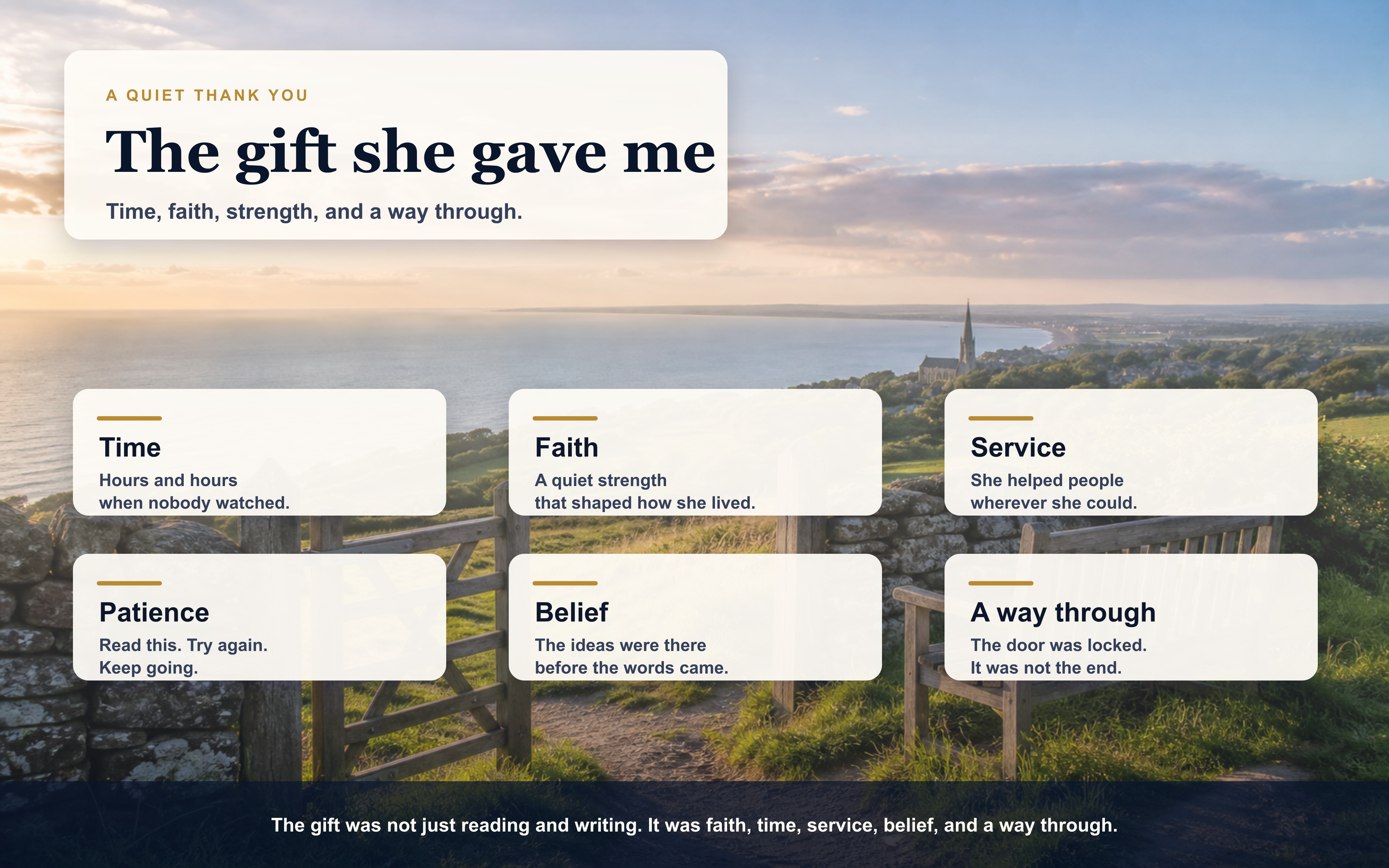
She was a strong religious woman. Her faith was not something abstract. It showed up in how she lived, how she helped people, and how she kept turning up when someone needed her.
She helped so many people in her life.
She sat with me when school was horrible, when homework made no sense, when the words would not line up, when I knew there was something in my head but could not get it onto the page in a way anyone else could read.
I am dyslexic.
For a long time, writing felt like a locked door.
The locked door
I was never great at English.
That is the polite version.
The honest version is that I really, really tried. I worked at it. I spent years working on policy documents, procedures, governance papers, board packs, client notes, and all the formal writing that work required. I could do it, but it cost me a lot.
The ideas were there.
I knew what I meant.
I knew what good looked like.
I could feel the shape of the argument. I could see the steps. I could tell when something was wrong, or weak, or not quite honest. But turning that into sentences was hard in a way that is difficult to explain to someone who has always been able to do it.
I remember exams where I understood parts of the subject, but the time, the reading, the comprehension, and the writing all collided. Government and politics. Essays. Pages. Questions where the answer was somewhere inside me, but getting it out quickly enough and clearly enough felt impossible.
It was not that I had nothing to say.
It was that the route from thought to page was blocked.
She did not let me give up
My mum helped me with that route.
In primary school, I was put into what was then called a "backward" class.
That word stays with you.
My mum would not accept it as the measure of me. She fought to get me out of it.
Every night, she would sit with me. Read this. Try again. Do the homework. Sound it out. Keep going.
I did not always want to.
In fact, a lot of the time, I really did not want to. I hated it. It felt unfair. It felt like being asked to perform a trick that everyone else had been taught and I had somehow missed.
But she stayed with me.
She gave me time.
Hours and hours and hours of time.
That is a gift that is very easy to underestimate when you are a child. Someone sitting beside you. Someone believing that the words will come. Someone refusing to let the locked door become the whole story.
I did keep at it.
That is because she made me keep at it.
What AI has changed
Only in the last few years, with agentic AI, have I felt something shift properly.
For the first time, I can talk through what I mean, work the idea out, challenge it, shape it, and then see it come back as writing that other people can actually read.
That may sound small if writing has always been easy for you.
For me, it is not small.
It is freedom.
There are people who talk about AI as if it is only a threat, only slop, only cost, only water, only risk, only a machine making noise. Some of those concerns matter. Of course they do. Tools have costs. Systems need judgement. We should not be careless.
But please do not miss what this can mean for people who have had brilliant ideas trapped behind the wrong kind of door.
Some people cannot write easily.
Some people struggle with maths.
Some people cannot navigate forms, complaints, policies, council pages, government websites, bank letters, medical letters, school letters, or all the hidden language that society uses to decide whether you can get help.
AI can help people get to the information. It can help them understand it. It can help them say what they mean. It can help them ask the question they have been too embarrassed, too tired, or too blocked to ask.
That matters.
The meaning is still mine
There is a lazy argument that if AI helps produce the words, the words are not really yours.
I do not believe that.
For me, AI is not replacing fluent written words I already had.
I did not have those.
I had the meaning. I had the ideas. I had the judgement. I could talk it through. I could feel when something was right or wrong. But I could not always make the written words carry it in a way that would engage people.
We understand this with other forms of work. Some people use editors. Some use producers. Some dictate. Some work with ghostwriters. Some have assistants who help shape the raw material. That does not mean the meaning belongs to the assistant.
My skill is not always typing the perfect sentence first time.
My skill is knowing what I mean.
Knowing when the article is wrong.
Knowing when the tone is wrong.
Knowing when the argument has lost its spine.
Knowing what good looks like.
When I work with AI, it is not replacing the meaning. It is helping me create a written form for the meaning. It is helping me cross the gap between what is in my head and what other people can read.
That is not cheating.
That is access.
What I wish for other people
If you see someone struggling with words, help them.
If you see a child who cannot get the homework out, do not assume there is nothing in there.
If you see someone who cannot write the complaint, fill in the form, answer the letter, challenge the decision, or explain the idea, do not assume they do not understand.
Maybe they understand more than you think.
Maybe the door is just stuck.
Give them tools.
Give them time.
Give them AI if it helps.
Give them the dignity of being able to say what they mean.
And if you are the person who is struggling, please do not give up on yourself. The route may not look like the route everyone else uses. That does not mean there is no route.
Thank you, Mum
So this is my thank you.
Thank you for sitting with me.
Thank you for making me read.
Thank you for making me write.
Thank you for fighting for me when I was too young to fight for myself.
Thank you for your faith, your strength, and all the people you helped along the way.
Thank you for not letting me decide, too young, that the locked door was the end of the story.
I write now.
Not perfectly.
Not without help.
But I write.
And every time I do, there is a little bit of those evenings in it.
Thank you, Mum.