
I have a lot of conversations about hallucinations in AI.
The word makes the problem sound strange, almost exotic. But if you lead people, manage teams, run projects, or have ever tried to explain a half-formed idea to someone else, you already know the human version of the same failure.
You walk into a room with a concept that has been forming in your head for weeks. You have been turning it over while walking, driving, cooking, talking to customers, or staring at a document that nobody else has seen. Then you say to the team:
Right. We are going to do X, Y, Z.
You know what you mean. Of course you do. The problem is that the team does not have the same internal context.
They know you. They know the company. They know the current work. They know the politics, the history, the pressure, and probably the person who will complain first. So they can get pretty close.
But they are still filling gaps.
The team that guesses
A good team will stop and clarify. They will say, "When you say X, do you mean this version or that version?" They will ask where the document is. They will ask whether this replaces the previous plan or sits beside it. They will ask what matters most.
That is a healthy moment. It gives the leader a chance to realise, "Ah, yes, I was not clear." The briefing improves, the work improves, and everyone saves time.
But some cultures do not make it safe to clarify.
If people are led by fear, they learn to guess. They learn to give the boss something quickly. They learn to look confident even when the brief is incomplete, because asking questions feels more dangerous than being wrong later.
Then the output comes back and the leader says, "No, no, no. That is not what I meant."
I have seen that happen. I have been on the receiving end of it. Most of us have. The frustrating part is that everybody may have been trying to do the right thing. The team did not hallucinate because they were careless. They filled in missing context because the system around them rewarded progress over clarity.
Agents do the same operational thing
People and AI systems do not fail for identical technical reasons. That distinction matters.
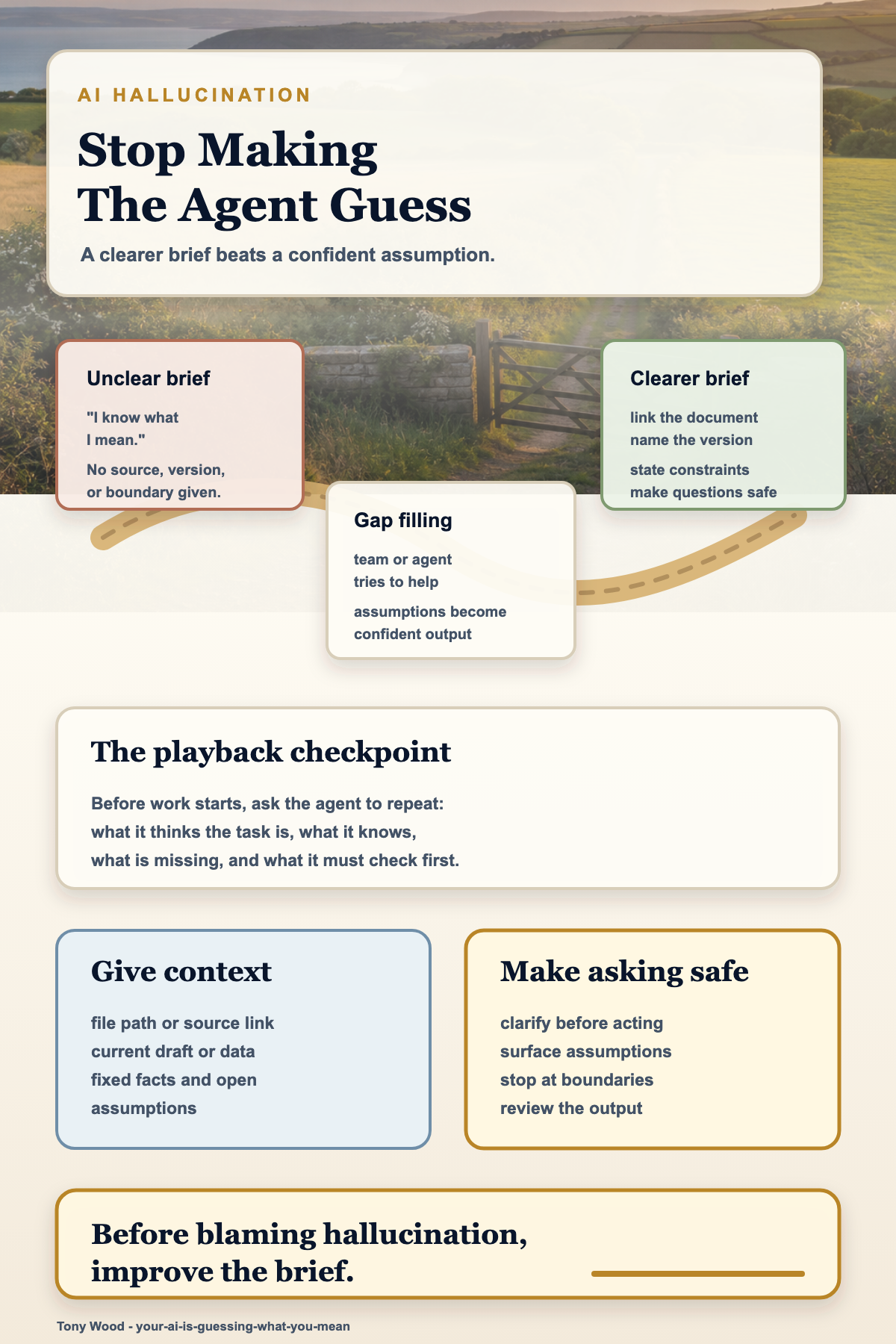
But operationally, the result can feel very similar. Something is trying to help. It has some context, but not enough. It knows the broad shape of the task, but not the specific document, version, constraint, judgement, or intent in your head. So it produces an answer based on what it can see.
That is when we often say, "The AI hallucinated."
Sometimes that is true in the older, narrower sense: the system fabricated something. But in everyday work, people often use the word more broadly. They mean, "It did not know what I expected it to know."
That is a context problem.
Give the agent what you would give a good team
This is one reason I prefer working with agentic tools in a proper working environment, not only in a browser tab or phone chat.
The browser is useful. The phone is useful. But when the work matters, I want the agent to be able to sit beside the files, create drafts locally, edit them, inspect them, compare versions, and work inside a folder I can review.
That does not mean giving it the keys to everything. It means giving it a safe desk.
If you want a person to work from a document, you do not vaguely describe the document and hope they find the right one. You send the link. You say which version. You say whether the old plan still counts. You tell them which facts are fixed, which assumptions are open, and where they must ask before acting.
Agents need the same treatment.
They need the file path, not just the memory of a file. They need the current draft, not a description of the draft. They need the boundary of the task, not a mood. They need permission to ask clarifying questions, and they need a culture where asking those questions is treated as good work.
The brief is part of the work
The skill is not only "prompting". That word is too small.
The real skill is briefing.
Briefing means taking the thing that is obvious inside your head and making it visible enough for someone else to act on. That someone else might be a team member, a supplier, a board colleague, a developer, or an AI agent.
Before you get angry with the output, ask a more useful question:
If I gave this brief to a good person, would they know what I meant?
If the answer is no, then the first fix is not a better model. The first fix is a clearer brief.
Try the playback test
Here is a simple habit that helps.
Before asking an agent to do something important, ask it to play the task back:
Before you start, tell me what you think I am asking for, what context you have, what context is missing, and what you would need to check before acting.
That one move changes the work. It makes assumptions visible. It gives you a chance to correct the route before the agent walks down it. It also trains you to brief more clearly.
You can do the same thing with a person. Explain a task to a colleague or partner and ask them what they heard. If they heard something different, that is not failure. That is useful evidence.
The future needs clearer language
We are going to have to adjust how we talk to our tools.
Not because the tools are delicate. Because they are fast.
A vague brief used to waste a morning. Now it can generate a whole folder of confident wrongness in a minute. That is not a reason to avoid agents. It is a reason to become better at context, source links, boundaries, and playback.
Humans fill gaps. Teams fill gaps. AI fills gaps.
The practical response is the same: make the context visible, make questions safe, and stop treating clarity as admin. Clarity is the work.